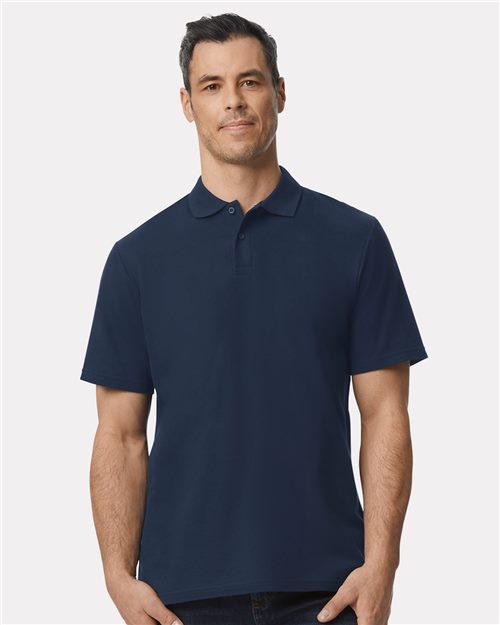
The Gildan 64800 is a strong wholesale polo for uniforms when you want a cotton-forward, breathable pique shirt with a modern classic fit, a polished placket, sizes currently listed from S through 4XL, and a surface that can support compact embroidery or carefully tested DTF. This Gildan 64800 wholesale guide explains where the Softstyle Pique Polo fits, how its 5.2 oz. double-pique construction affects decoration, and how to build a repeatable corporate, staff, hospitality, school, team, or event-apparel program around it.
The main attraction is balance. The 64800 looks more structured than a standard jersey T-shirt, but its 100% ring-spun cotton base fabric is designed to feel softer and more breathable than a stiff traditional uniform polo. The clean finished placket, dyed-to-match buttons, rolled-forward shoulders, side seams, and tear-away label support a refined finished product without forcing every buyer into a heavy performance or workwear fabric.
Gildan 64800 quick facts
- Fabric: 5.2 oz./yd², 100% ring-spun cotton, 31 singles; Sport Grey is listed as 90/10 cotton/polyester.
- Knit: Softstyle double pique for a textured, breathable polo face.
- Fit: Modern classic fit with rolled-forward shoulders and side seams.
- Details: Clean finished placket, dyed-to-match buttons, and tear-away label.
- Current Beytees range: S through 4XL and 13 listed colors; live size-color inventory can change.
- Best decoration starting point: Compact left-chest embroidery or a controlled DTF design with documented sampling and wash testing.
- Best use: Corporate uniforms, hospitality teams, front-of-house staff, schools, events, clubs, sales teams, branded merchandise, and organized replacement programs.
Is the Gildan 64800 a Good Wholesale Uniform Polo?
Yes. The Gildan 64800 Unisex Softstyle Pique Polo is especially useful when the customer wants the recognizable texture of pique, prefers cotton-forward comfort, and needs a blank that can move between embroidered uniforms and printed promotional apparel. It is not automatically the best polo for every environment. A moisture-management program, an industrial uniform, or a very heavy-duty wash cycle may require a different fabric. For offices, retail teams, hospitality, education, events, sales organizations, clubs, and branded merchandise, however, the 64800 is a practical sample candidate.
| Decision factor | How the Gildan 64800 performs | What the buyer should verify |
|---|---|---|
| Professional appearance | Textured double pique, clean placket, matching buttons, side seams | Actual color, collar behavior, and appearance after laundering |
| Comfort | Ring-spun cotton base fabric and a moderate 5.2 oz. weight | Finished decorated sample in the real work environment |
| Embroidery | Traditional pique presentation works well with compact logos | Digitizing, backing, topping, hooping, stitch density, and wash performance |
| DTF | Cotton-rich face can support heat-applied graphics | Texture, pressure marks, hand, edge adhesion, color response, and laundering |
| Uniform sizing | Current catalog range runs S through 4XL | Live stock, employee try-on samples, finished measurements, and tolerance |
| Branding | Tear-away label can help secondary-branding workflows | All applicable fiber, origin, care, tracking, trademark, and consumer-label rules |
| Reorders | Core uniform colors and a broad adult size run support organized programs | Size-color continuity, lot differences, supplier inventory, and replacement stock |
The fastest way to make a poor polo choice is to compare blank price alone. A uniform is worn repeatedly, seen by customers, washed often, and reordered when employees join or garments are damaged. The right decision must include comfort, appearance, decoration quality, size coverage, stock continuity, replacement cost, and the amount of operational work required to keep the program consistent.
Gildan 64800 Specifications and Construction
The current Beytees product record lists the 64800 at 5.2 oz./yd² in the United States and 8.7 oz./linear yard in Canada. The primary fabric is 100% ring-spun cotton at 31 singles. Sport Grey is the stated exception at 90% cotton and 10% polyester. That color-specific blend matters for heat decoration, so a recipe tested on Black, Navy, or White should not be assumed to approve Sport Grey.
The fabric is described as Softstyle double pique. Pique is a textured knit rather than the flatter surface found on a typical jersey tee. The texture gives a polo its familiar business-casual appearance, creates visual depth around embroidery, and helps the shirt read as a uniform even before a logo is added. At the same time, the ring-spun cotton and moderate weight help the 64800 avoid the hard, bulky hand that some buyers associate with older uniform polos.
Construction details that matter in production
- Modern classic fit: Intended to provide a current but broadly wearable silhouette. It still requires actual fit approval.
- Clean finished placket: Helps the front opening present neatly in staff, sales, event, and hospitality environments.
- Dyed-to-match buttons: Keeps the blank visually coordinated and allows a logo to remain the primary brand element.
- Rolled-forward shoulders: Changes how the shirt sits on body and should be considered when approving upper-chest or shoulder-adjacent placement.
- Side seams: Support the intended shape and provide a useful reference during inspection, folding, and placement control.
- Tear-away label: Can simplify relabeling or secondary neck branding when the finished product remains legally compliant.
The current product record also identifies the item as made in a facility with OEKO-TEX and Fair Labor Association certifications and states that it contains U.S.-grown BCI cotton. Those statements can be useful for procurement documentation. They should be repeated accurately and narrowly. They do not, by themselves, establish that the garment is organic, recycled, carbon neutral, impact free, or suitable for an environmental claim that is not supported by current documentation.
Fabric weight is only one part of the buying decision. A 5.2 oz. pique polo does not behave like a 5.2 oz. jersey tee because knit construction, yarn, fit, finishing, collar, placket, and seams change the finished garment. The blank apparel weight guide for print methods explains why weight should be evaluated together with surface and decoration.
Gildan 64800 Fit, Measurements, and Sizing
The Beytees catalog currently lists the Gildan 64800 from S through 4XL. That range can cover many adult uniform programs, but the letters alone are not a fit system. Use current finished-garment measurements, distribute try-on samples when possible, and record the approved size for each wearer. A customer who wears a large in another Gildan product, a jersey polo, a dress shirt, or a fashion-fit polo may not choose the same size in the 64800.
| Size | Body length | Chest width, laid flat |
|---|---|---|
| S | 28 in. | 20 in. |
| M | 29 1/2 in. | 21 1/2 in. |
| L | 30 1/2 in. | 22 1/2 in. |
| XL | 31 1/2 in. | 23 3/4 in. |
| 2XL | 32 1/2 in. | 25 in. |
| 3XL | 33 1/2 in. | 26 1/2 in. |
| 4XL | 34 1/2 in. | 28 in. |
The current catalog measurement record specifies a plus-or-minus one-inch tolerance for body length and chest width. Treat that as part of the product specification, not as a promise that every shirt will be identical. Decoration placement also needs a reasonable tolerance because garment dimensions, seams, placket alignment, loading, hooping, and production handling can vary.
For a company-wide rollout, do not order from an employee spreadsheet that contains only usual retail sizes. Set up a fit session with undecorated samples, record selections, and make the size chart available for remote employees. When the program includes different body types or fit preferences, provide a documented alternative rather than forcing everyone into one silhouette. A uniform looks professional when the wearer can move comfortably and the decoration sits correctly on the body.
Gildan 64800 Colors and Inventory Planning
At the time this guide was prepared, the live Beytees catalog exposed 13 color names for the Gildan 64800: Black, Charcoal, Cherry Red, Daisy, Forest Green, Light Blue, Navy, Red, Royal, Sand, Sapphire, Sport Grey, and White. This is an assortment count, not a stock promise. A catalog color can exist while a specific size is unavailable, split across warehouses, or temporarily delayed.
Core uniform programs usually benefit from restraint. Black, Navy, Charcoal, Sport Grey, and White can simplify logo approval and replacement ordering. School, club, and event buyers may prefer Royal, Red, Forest Green, Daisy, Sapphire, or another identity color. Before promising a perfect corporate-color match, compare a physical sample under the lighting in which the team will actually work. A monitor swatch, website image, and printed color name cannot establish an exact textile match.
How to protect a repeat uniform program
- Choose one primary garment color. Every added color creates another logo-contrast decision, inventory lane, photo, approval, and reorder risk.
- Map the real size curve. Use employee selections or historical sales instead of buying equal quantities of every size.
- Check live size-color inventory before quoting. Recheck before collecting a deadline commitment and immediately before placing the order.
- Hold controlled replacement stock. Keep only the sizes justified by hiring, turnover, damage, and issue frequency.
- Retain an approved reference. Store one finished sample with the garment color, lot information when available, art file, thread or transfer details, placement, and approval date.
- Reapprove meaningful changes. A different blank color, supplier source, fabric lot, transfer lot, thread, digitized file, press, or embroidery setup can justify another test.
For multi-style school and team programs, use the wholesale blank apparel guide for schools and teams to coordinate size curves, deadlines, art, and replenishment across the wider order.
Gildan 64800 Embroidery Guide
The Gildan 64800 is a natural embroidery candidate because pique texture and a compact stitched logo share the visual language of corporate, hospitality, education, club, and team uniforms. Good results still depend on the complete system. The blank cannot correct an over-dense file, poor underlay, unstable hooping, unsuitable backing, wrong needle choice, excessive tension, or a logo that was designed for a billboard instead of a flexible knit shirt.
Start with embroidery-friendly artwork
Left-chest logos should be readable at actual size. Simplify very thin lines, tiny counters, small registered marks, narrow gaps, gradients, and long lines of text. If the brand standard contains details that cannot be stitched cleanly at polo scale, create an approved embroidery version rather than allowing the production operator to improvise.
A compact mark often looks more premium than a large dense badge. Excessive stitch count can pull the pique surface inward, create a stiff patch, distort the side seam or placket, and make the backing noticeable against the wearer. The best test is not a digital stitch simulation. It is the actual logo sewn on the actual size and color, viewed on body and after laundering.
Digitizing and stabilization
Digitize for textured knit fabric. Appropriate underlay can create a stable foundation and keep top stitches from disappearing into the pique. A water-soluble topping may help fine elements remain visible on the textured face. A suitable cutaway backing is a common starting point for knit polos because it can support the design after the garment leaves the hoop and goes through repeated washes. The exact topping, backing weight, layers, needle, thread, tension, density, pull compensation, and underlay must be selected by testing the real design.
Do not copy a recipe from a cap, woven dress shirt, sweatshirt, or heavy work polo. Those garments stabilize and feed differently. Even another pique polo may use a different weight, blend, knit, or finishing process. Record the approved production setup so reorders are not rebuilt from memory.
Placement and hooping
The placket, collar, shoulder seam, sleeve seam, and side seam affect how the polo can be hooped and how the logo appears on body. Establish placement from a defined reference point, but visually inspect the finished shirt as well. A measurement can be technically consistent and still look wrong if the placket is loaded off-center or the design is too close to a seam.
Hoop securely without stretching the fabric out of shape. If the operator pulls the knit to make it look flat, the shirt can relax after unhooping and leave the logo puckered. Confirm that backing coverage is adequate, the garment is not trapped under the hoop, and the needle path will not strike a button, seam, or placket layer.
Embroidering different sizes
A single compact logo may work across S through 4XL, but placement should be reviewed at both ends of the range. The same distance from the shoulder or placket can appear different as chest width and body proportions change. For large uniform orders, approve at least one smaller and one larger representative size. If a design is scaled, keep separate named files and document which sizes use each version.
For a broader comparison of polo fabrics and decoration, read the pique vs jersey polo guide. For additional blank options, the wholesale blank polo guide for corporate embroidery places the 64800 in a wider uniform assortment.
DTF Printing on the Gildan 64800
DTF can turn the Gildan 64800 into a more graphic uniform, event polo, sponsor shirt, branded merchandise item, or short-run promotional product. It is useful for multicolor art, names, event marks, and designs that would be expensive to embroider. The tradeoff is that DTF adds a smooth film to a textured, breathable knit. The art and production settings should preserve as much of the polo’s comfort and character as possible.
Do not use one universal heat recipe
Follow the current instructions from the manufacturer of the exact transfer. Then test the received garment style, color, size, production lot, artwork coverage, platen, press, protective sheet, time, temperature, pressure, peel, and optional finishing press together. The correct setting is the lowest controlled process that produces the required adhesion and wash performance without damaging the shirt or transfer.
Sport Grey contains 10% polyester according to the current product record. Keep its test separate from the solid 100% cotton colors. Check for heat response, gloss, pressure marks, color change, migration, carrier outline, edge lift, and surface flattening. A result that works on White is evidence for White, not automatic approval for every color.
Design for a pique surface
DTF can bridge the high and low points of pique, but very fine details and narrow isolated elements need inspection. Large solid rectangles can feel heavy and reduce breathability. Use intentional negative space, avoid unnecessary background film, and size the artwork for the garment instead of filling every available inch. A small chest or sleeve design may fit a uniform program better than a large front panel.
The placket creates a natural visual center but also a pressure obstacle. Keep transfers safely away from buttons and thick seams, or use an appropriate platen, pad, or loading method that allows the intended print area to receive even pressure. Never force a button or seam into the active press area. For sleeve decoration, confirm that the sleeve seam is outside the pressure zone and that the art remains straight when the shirt is worn.
Inspect after cooling and laundering
Do not approve DTF while the garment is still hot. Let it cool as required, then inspect edge adhesion, fine elements, gloss, texture, color, pressure marks, scorching, stiffness, and placement. Wash the finished sample through multiple intended care cycles. Look for cracking, lifting, migration, fading, shrinkage, seam distortion, collar change, and a hand that becomes uncomfortable.
If the DTF result looks too plastic for the program, the answer may be artwork reduction, a smaller location, a different transfer construction, embroidery, screen printing, or a smoother polo. Decoration is part of product design; it should not be treated as a sticker added after the blank decision.
Screen Printing, HTV, and Other Decoration Methods
Screen printing
Screen printing can be economical for larger runs with controlled colors and locations. The pique texture requires attention to screen setup, ink deposit, off-contact, squeegee behavior, flash, and cure. Too little deposit can leave an uneven image; too much can fill the texture and create a heavy patch. Test the complete ink system and verify cure without overheating the garment.
A compact one- or two-color logo can work well for staff, sponsors, and events. Highly detailed halftones or delicate lines should be tested at production size. The printer should approve the surface, not assume that settings from a smooth jersey tee will transfer directly to double pique.
Heat-transfer vinyl and names
HTV can be useful for individual names, departments, roles, or small-quantity personalization. Select a film compatible with the garment and intended wash environment, and follow its current instructions. Inspect thick seams, placket interference, shine, pressure boxes, edge adhesion, and stiffness. Standardize capitalization, name order, location, maximum width, and handling of long names before production begins.
Combination decoration
A uniform can use embroidery on the front and a printed sponsor, event, or department mark elsewhere. Combination decoration increases setup, handling, alignment, and spoilage risk. Build the full sample in the same sequence planned for production, because a second heat or hooping operation can affect the first decoration. Price the extra touches as production operations, not as free additions.
How to Build a Gildan 64800 Uniform Program
A successful uniform program is a controlled replenishment system, not a one-time shirt order. Decide who qualifies for garments, how many each person receives, who owns them, when replacements are issued, what happens when a size changes, and how new employees are added. The product choice matters, but the operating rules determine whether the program stays consistent.
Corporate and sales teams
Use a restrained color and a compact left-chest logo. Confirm that the shirt looks professional both tucked and untucked if both are allowed. If a name, title, or department is added, define typography and maximum width. Keep a digital issue record so replacements do not depend on memory.
Hospitality, retail, and front-of-house teams
Comfort, stain visibility, laundering frequency, movement, heat, and guest-facing appearance all matter. Test the shirt during a real shift before buying volume. A cotton-forward polo can be comfortable, but environments that involve outdoor heat, kitchen exposure, chemicals, industrial soil, or specialized laundering may justify a performance or workwear alternative.
Schools, clubs, and event staff
The 13-color assortment can support school and team identities, while DTF or screen printing can handle event-specific marks. Control dates carefully. Blank inventory, receiving, decoration, sorting, issue, and replacement all need time. The wholesale blank apparel shipping guide can help build a schedule that does not confuse supplier transit with a finished-product promise.
Merchandise and uniforms in one style
Some organizations use the same polo for staff issue and customer merchandise. This can simplify purchasing, but the economics are different. Staff garments are an operating cost; retail garments need a selling price, margin, size curve, photography, returns policy, and reorder logic. Keep the two inventory pools visible even if they use the same style and color.
Gildan 64800 Wholesale Pricing and Cost Control
Wholesale blank pricing changes by size, color, inventory, supplier conditions, and account context. Use the live Beytees product page for a current quote instead of copying a number from an old article. More important, calculate the complete finished cost:
- Blank polos by exact size and color
- Inbound or supplier shipping
- Embroidery digitizing, setup, thread, backing, topping, and stitch production
- DTF transfers, press labor, setup, and finishing
- Names, departments, sleeve marks, or additional locations
- Inspection, folding, bagging, sorting, labeling, and employee distribution
- Spoilage, defects, misprints, wrong-size exchanges, and replacements
- Payment processing, platform fees, customer service, and outbound fulfillment
- Required profit, contingency, and reorder buffer
Do not quote every size at the lowest displayed blank price. Extended sizes may carry a higher cost, and different colors or sources can affect the order. A simple uniform price can still be offered to the customer, but the internal model should use the actual expected size curve so the business understands its blended cost.
Embroidery cost should reflect real stitch count and production time, not only logo dimensions. DTF cost should reflect transfer area, film usage, art coverage, press labor, and added handling. A large dense chest design can cost more and wear worse than a smaller, better-designed mark. Value engineering should improve the product rather than simply remove margin.
Fourteen-Step Sampling and Production Checklist
- Define the environment. Record who will wear the polo, where it will be worn, laundering expectations, quantity, issue policy, budget, and required delivery date.
- Choose the exact color. Review a physical sample under relevant lighting and approve logo contrast.
- Check live inventory. Confirm every required size-color combination before quoting a time-sensitive order.
- Run a fit session. Use current undecorated samples and the actual measurement chart; record each wearer’s selection.
- Prepare decoration-specific art. Simplify embroidery details or reduce unnecessary DTF film coverage instead of forcing one master file into every process.
- Approve placement by size. Check at least one smaller and one larger garment, especially for chest and sleeve locations.
- Build the complete sample. Use the exact style, color, art, thread or transfer, equipment, backing, platen, and production sequence.
- Inspect the blank first. Record shade, measurements, collar, placket, buttons, seams, marks, and visible variation before decoration.
- Document the recipe. Save the digitized file, needle, thread, backing, topping, density, placement, press settings, peel, finishing steps, and operator notes that apply.
- Inspect after decoration. Check alignment, puckering, distortion, coverage, pressure marks, shine, scorching, migration, edge lift, and finished hand.
- Wear and wash test. Evaluate comfort and appearance during intended use, then complete multiple care cycles and remeasure.
- Obtain finished-sample approval. The approver should see the real decorated polo, not only a mockup.
- Freeze the bill of materials. Record style, color, sizes, source, art version, decoration recipe, packaging, issue rules, and approval date.
- Recheck every reorder. Verify live inventory and retest when a material, lot, source, file, transfer, thread, machine, or process changes.
The checklist may look slower than placing a blank order immediately. It is faster than remaking a company-wide uniform run because the logo puckered, the transfer left a pressure box, the size curve was guessed, or a key size was promised without live inventory.
When Should You Choose a Different Polo?
The Gildan 64800 is a cotton-forward double-pique polo. Choose an alternative when the program’s main requirement points elsewhere.
- Choose a jersey polo when a smoother surface, softer T-shirt-like drape, or detailed printed graphic matters more than traditional pique texture.
- Choose a cotton-poly blend when the buyer prefers a more blended fabric strategy and has tested it for the work environment and decoration.
- Choose performance apparel when verified moisture management, athletic use, outdoor exposure, or specialized uniform requirements control the decision.
- Choose workwear when industrial durability, snag resistance, high-visibility requirements, chemical exposure, or commercial laundering calls for a purpose-built garment.
- Choose a heavier pique when the customer specifically wants a more substantial traditional polo hand.
The Gildan 8800 DryBlend Jersey Polo is a useful smoother comparison. The Tultex 400 Sport Pique Polo offers a heavier 50/50 pique direction. Compare actual samples and complete costs rather than assuming that one fabric name is automatically better.
Frequently Asked Questions About the Gildan 64800
What is the Gildan 64800?
The Gildan 64800 is a unisex Softstyle double-pique polo with a 5.2 oz./yd² ring-spun cotton base fabric, modern classic fit, clean finished placket, dyed-to-match buttons, rolled-forward shoulders, side seams, and a tear-away label. Sport Grey is listed as a 90/10 cotton-polyester blend.
Is the Gildan 64800 good for uniforms?
Yes. It is a strong sample candidate for corporate, sales, retail, hospitality, school, club, team, event, and front-of-house uniforms. Buyers should still test fit, comfort, decoration, laundering, live inventory, and the actual work environment before committing to volume.
Is the Gildan 64800 good for embroidery?
Yes. Its pique texture and professional polo construction can pair well with compact left-chest embroidery. The design must be digitized for textured knit fabric and tested with the actual backing, topping, needle, thread, density, underlay, hooping, and placement.
What backing should be used on the Gildan 64800?
A suitable cutaway backing is a common starting point for knit polos because it can continue supporting the design after washing. The correct type and weight depend on the logo, stitch count, size, thread, machine, and fabric behavior. Prove the combination on the actual shirt rather than treating one backing as universal.
Can you DTF print the Gildan 64800?
Yes. DTF can work for logos, multicolor graphics, names, events, and short runs. Test the exact style, color, transfer, art coverage, time, temperature, pressure, peel, platen, and wash process. Inspect texture, edge adhesion, pressure marks, color response, and finished hand.
What DTF temperature should be used on the Gildan 64800?
Use the current instructions from the manufacturer of the exact DTF transfer and validate them on the exact garment color. There is no responsible universal temperature for every transfer, press, platen, artwork, and polo lot. Record the approved process after wash testing.
What sizes does the Gildan 64800 come in?
The live Beytees catalog currently lists S, M, L, XL, 2XL, 3XL, and 4XL. Availability can vary by color, size, warehouse, and date, so confirm the live matrix before quoting or ordering.
How does the Gildan 64800 fit?
Gildan describes it as a modern classic fit. Current laid-flat chest widths run from 20 inches in S to 28 inches in 4XL, and body lengths run from 28 to 34 1/2 inches. The catalog lists a plus-or-minus one-inch tolerance. Use try-on samples for uniform assignments.
How many colors are available in the Gildan 64800?
The Beytees catalog exposed 13 color names when this guide was prepared. That count describes the catalog assortment, not guaranteed inventory in every size. Check the live product page for current size-color stock.
Is the Gildan 64800 100% cotton?
The primary specification is 100% ring-spun cotton. Sport Grey is the listed exception at 90% cotton and 10% polyester. Keep fabric composition attached to the exact color in quoting, decoration testing, care guidance, and customer communication.
Does the Gildan 64800 have a tear-away label?
Yes, the current product record lists a tear-away label. That can help secondary-branding workflows, but removing or replacing a label does not remove legal obligations. Confirm all applicable fiber, country-of-origin, care, tracking, trademark, and consumer-product requirements.
Is pique or jersey better for DTF?
Jersey provides a smoother print surface, while pique provides a more traditional textured polo appearance. DTF can work on both. Choose based on the finished product and test fine detail, film coverage, texture, adhesion, hand, and laundering on the exact blank.
Is pique or jersey better for embroidery?
Pique is the traditional starting point for embroidered polos because its texture and structure fit the visual style of stitched corporate logos. Jersey can also be embroidered, but it may require different stabilization and extra care with density. The actual design and sample decide the result.
Can one embroidery file be used for every Gildan 64800 size?
A compact logo may work across the full range, but placement should be approved on representative small and large garments. If the design is scaled, save separately named files and document which size range uses each one.
How should Gildan 64800 wholesale orders be quoted?
Quote from live size-color pricing and include shipping, decoration setup, stitch or transfer production, extra locations, names, inspection, sorting, packaging, spoilage, replacements, payment costs, fulfillment, and required profit. Use the expected size curve rather than assuming every unit costs the lowest displayed price.
Final Recommendation
The Gildan 64800 earns its place in a wholesale uniform shortlist by combining a professional double-pique face with ring-spun cotton comfort, a moderate 5.2 oz. weight, practical polo details, seven currently listed adult sizes, and a focused 13-color assortment. It is particularly compelling for buyers who want a cotton-forward embroidered polo without moving to a heavy traditional blank.
Choose it when the customer values breathable cotton, recognizable pique texture, compact embroidery, controlled DTF options, and a clean business-casual presentation. Choose a jersey, performance, workwear, or heavier blended polo when the use case requires a smoother print face, verified moisture management, industrial durability, or a different fabric strategy.
Most importantly, approve the finished product. Order the exact color and sizes, build the real decoration, document the recipe, wear it, wash it, and verify live inventory before the deadline is promised. That process turns the Gildan 64800 from a promising blank into a reliable uniform system.
Leave a Reply