Author: admin

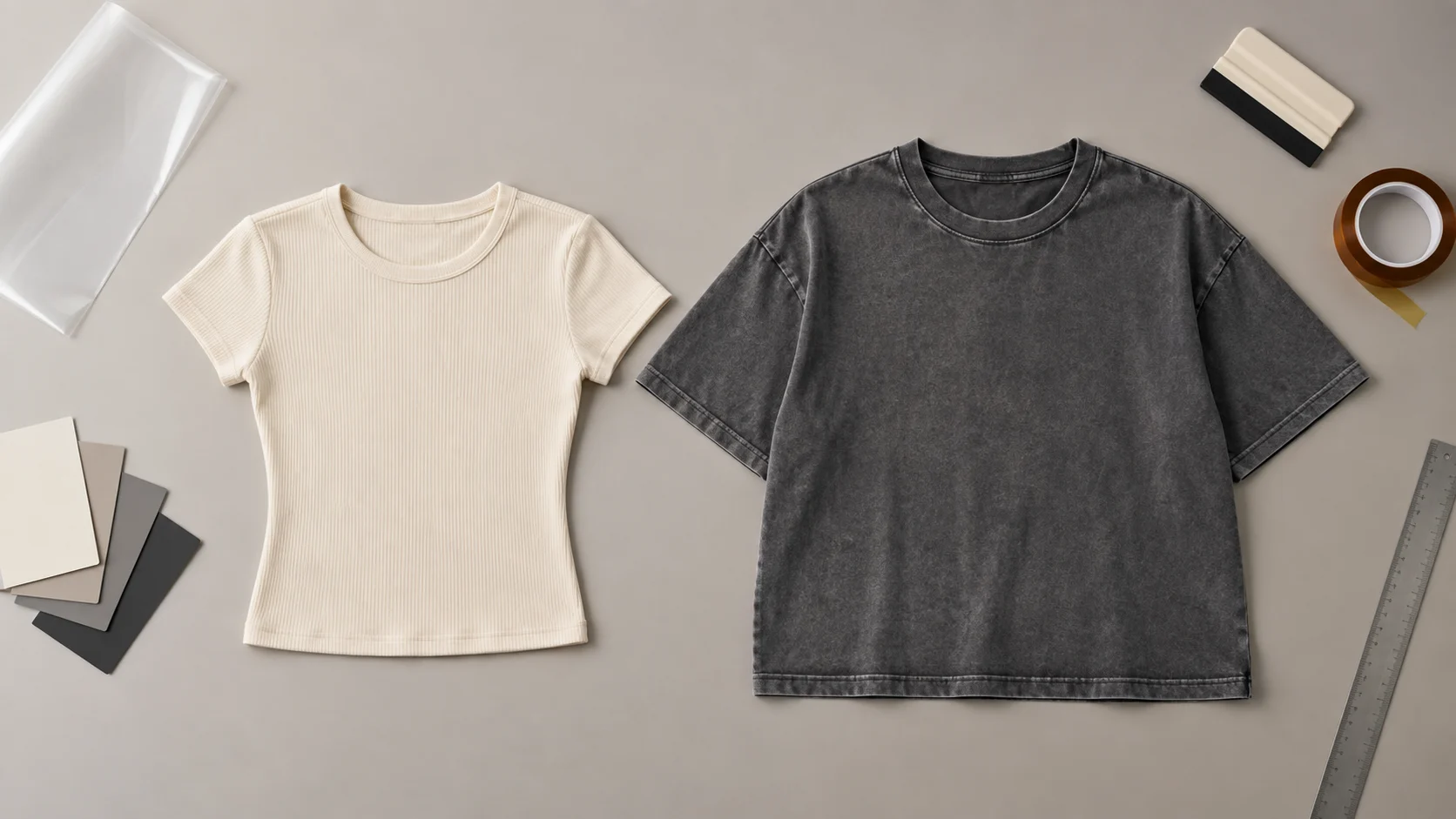
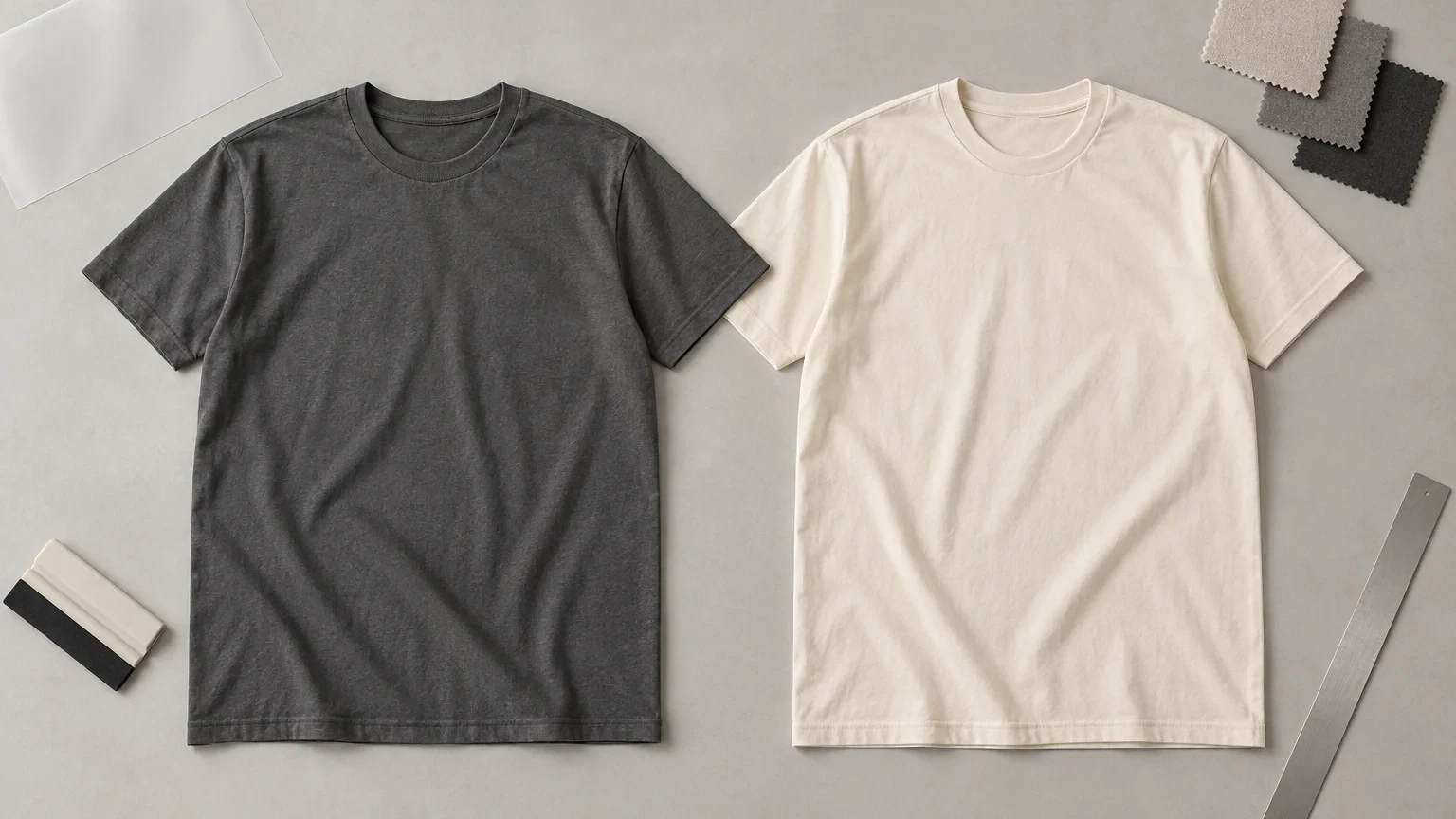
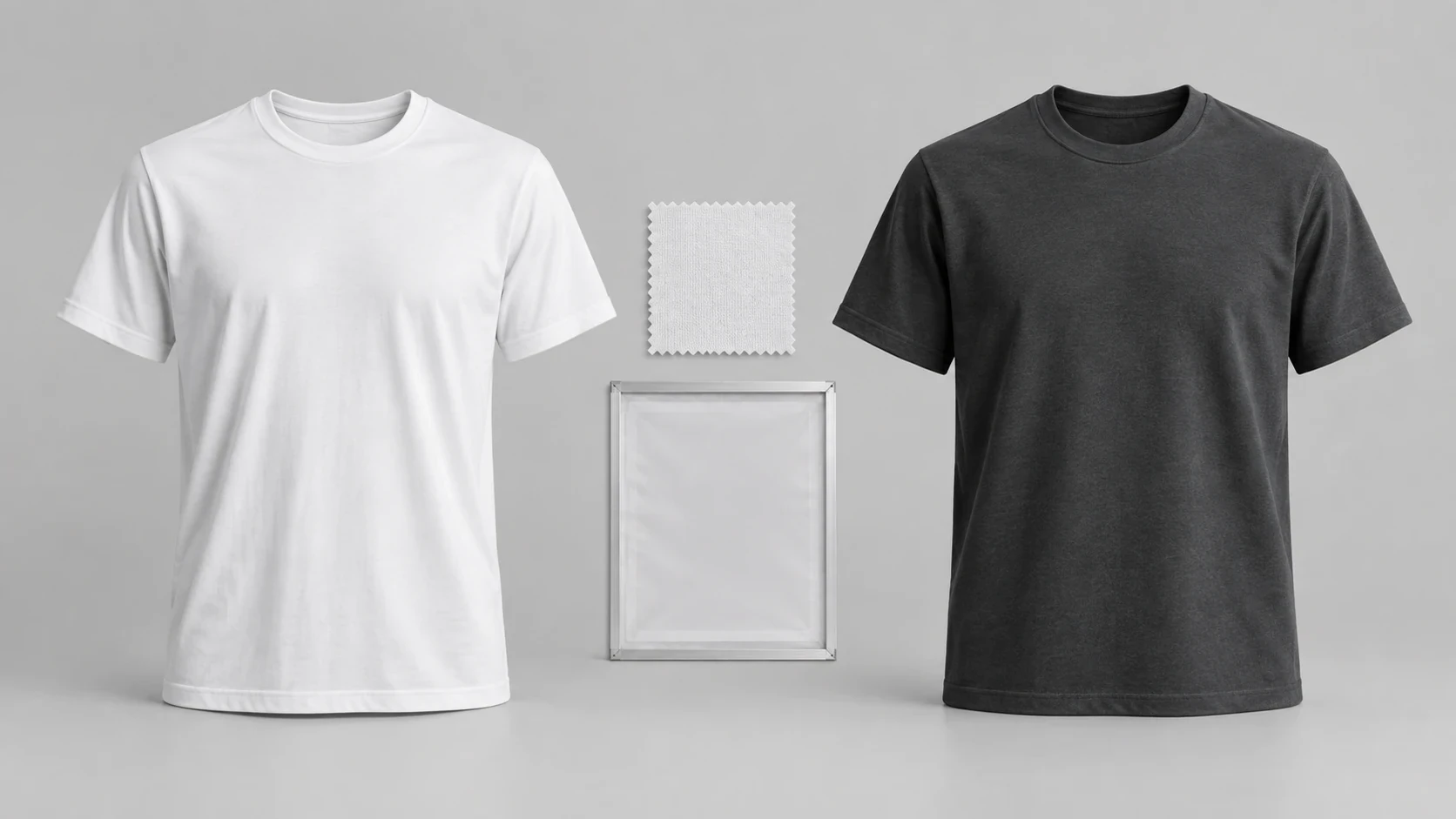
  • Gildan 3000 vs Gildan 5000: Light Cotton vs Heavy Cotton T-Shirts for DTF and Screen Printing

    Gildan 3000 vs Gildan 5000: Light Cotton vs Heavy Cotton T-Shirts for DTF and Screen Printing

    Quick Answer: Which Gildan Tee Should You Sample First?

    Choose from the written brief, then prove the choice with samples. Sample the Gildan 3000 first when the program calls for the lighter listed 4.45 oz./yd² US weight, a modern classic fit, a narrow-width rib collar, and a 30-singles platform. Sample the Gildan 5000 first when the brief calls for the heavier listed 5.3 oz./yd² US weight, a classic fit, a rib collar, and a 20-singles platform.

    That is a sourcing direction, not a universal winner. Listed weight and yarn count do not by themselves prove softness, opacity, drape, durability, print detail, comfort, or wash performance. Fit labels also do not replace finished measurements or wearer approval. Both product records include color-specific fiber exceptions, so the exact ordered color must be verified rather than treated as identical to the base cotton specification.

    Test both styles when the decision depends on wearer preference, artwork scale, transfer behavior, screen-print setup, color migration, underbase, cure, wash response, current availability, substitution, or landed economics. Approve production-equivalent decorated samples before a bulk order, then retain the exact style, color, size, artwork revision, settings, and quality standard for reorders.

    Verified Gildan 3000 vs Gildan 5000 Specification Comparison

    Begin with the exact Gildan 3000 Beytees product record and Gildan 5000 Beytees product record. The Gildan brand page confirms the broader brand and decorator-apparel scope, but it does not expose exact 3000 or 5000 specifications. The style-level facts below therefore come from the two live Beytees records; the brand page is not presented as independent model-level corroboration.

    Decision factor Gildan 3000 Gildan 5000 Buyer treatment
    Listed base weight 4.45 oz./yd² US 5.3 oz./yd² US Use as a construction signal, not proof of wear or print performance
    Base fiber statement 100% U.S. cotton 100% cotton Verify the exact color because both records list blend exceptions
    Yarn count 30 singles 20 singles Do not convert count alone into a softness or detail promise
    Fit Modern classic fit Classic fit Approve finished measurements and wearer samples
    Collar Narrow-width rib collar Rib collar Inspect neckline presentation on the exact sample
    Label Recycled tearaway label Tear-away label Plan relabeling and compliance as separate work
    Decoration decision Lighter candidate for testing More substantial candidate for testing Approve exact color, artwork, process, and wash result

    The table narrows the first sample; it does not authorize a production run. Product selectors and availability can change. Confirm the exact style number, color, size, fiber label, measurements, and received goods before decoration.

    Gildan 3000: Lighter Modern-Classic Starting Point

    The current Gildan 3000 record lists a 4.45 oz./yd² US base weight, 100% U.S. cotton in the base specification, 30 singles, a modern classic fit, a narrow-width rib collar, and a recycled tearaway label. Those are useful procurement facts when a collection brief specifically asks for a lighter listed construction and the 3000 silhouette.

    They do not establish that every color has the same fiber content or that the shirt will feel, hang, cover, print, wash, or wear in one predictable way. Color-specific blends need exact-color review. A 30-singles statement is one construction input; it does not independently prove a smoother surface or finer finished detail. The narrow collar and modern-classic positioning should be inspected on the intended sizes rather than summarized as universally preferred.

    Keep this exact comparison separate from the Gildan 3000 vs Gildan 64000 decision. That article answers a different pair query. For item 132, the 3000 should be judged only against the 5000 through the buyer’s actual use case, sample, and production controls.

    Gildan 5000: Heavier Classic Starting Point

    The current Gildan 5000 record lists a 5.3 oz./yd² US base weight, 100% cotton in the base specification, 20 singles, a classic fit, a rib collar, and a tear-away label. It is the logical first sample when the written requirement prioritizes the heavier listed weight and classic blank-tee positioning.

    Heavier listed weight is not proof of greater opacity, durability, warmth, quality, print yield, or wearer approval. The 20-singles statement also cannot establish a universal hand or decoration result. Exact color matters because the product record includes fiber-blend exceptions. Confirm the current color and size, inspect received labels and measurements, and decorate the actual candidate before making claims to a customer.

    The Gildan 5000 vs Gildan 64000 comparison covers another decision, while the Hanes Beefy-T 5180 vs Gildan 5000 comparison covers a different heavyweight-brand choice. Use those only when the purchasing question actually includes those alternatives.

    Fabric, Weight, Yarn Count, Fit, Collar, and Size Decisions

    Read the numbers together rather than ranking one specification in isolation. The 3000 is listed at 4.45 oz./yd² US and 30 singles; the 5000 is listed at 5.3 oz./yd² US and 20 singles. That establishes a lighter-versus-heavier listed construction and different yarn-count platforms. It does not establish the finished experience of a specific color, size, print, or wearer.

    Fiber content must be controlled at the variant level. The base 3000 specification states 100% U.S. cotton, and the base 5000 specification states 100% cotton, but both records identify color-specific cotton/polyester exceptions. A buyer should capture the exact selected color’s fiber statement on the order record and repeat that check when approving a substitute or reorder.

    Fit labels are starting language. Modern classic and classic do not mean the same dimensions, and neither guarantees preference across a team or customer base. Compare the current finished-measurement information, then fit-test representative sizes. Record which exact style, color, and size each approver evaluated. Do not infer one style’s size from the other or rely only on a familiar size name.

    Collar presentation can matter for uniforms and merch collections. The 3000 record specifically identifies a narrow-width rib collar; the 5000 record identifies a rib collar. Inspect neckline width, artwork balance, and the completed decorated sample. Tear-away labels may support workflow planning, but removal does not by itself satisfy relabeling, fiber, origin, care, or other applicable requirements.

    DTF and Heat-Applied Decoration Qualification

    Neither style is a universal DTF winner. Use the broader wholesale DTF blank T-shirt guide for category discovery, then qualify the exact 3000 or 5000 color with the intended artwork, transfer system, equipment, operator, and care process. Follow the current blank and transfer supplier instructions rather than an evergreen recipe.

    Control What to verify Approval evidence
    Blank identity Exact style, color, size, fiber label, and received condition Purchase and receiving record
    Artwork Physical size, placement, detail, color, and underbase strategy Approved production file and sample
    Application Current heat, pressure, time, peel, and repress instructions Recorded system settings
    Immediate result Adhesion, edges, glossing, scorching, shade change, distortion, and migration where relevant Front and close-up inspection
    Care test Approved wash and dry protocol, adhesion, cracking, lifting, and garment response Documented test result
    Repeatability Result across representative sizes and production conditions QC standard and retained sample

    Record failures as well as approvals. If the exact color, fiber blend, transfer, artwork, or equipment changes, decide whether a new test is required. Do not turn one successful sample into a claim about every variant or production system.

    Screen Printing and Embroidery Test Controls

    For screen printing, compare the production brief rather than assuming lighter or heavier automatically means better. Test the exact color and artwork with the intended ink system, mesh, screen tension, squeegee, pressure, off-contact, underbase, flash, cure method, and dryer conditions. Inspect registration, coverage, hand, detail, fibrillation, scorching, dye behavior where relevant, and wash response. The wholesale screen-printing blank guide can help with method-level planning, but it does not replace style-level approval.

    Do not claim that 30 singles automatically produces finer detail than 20 singles. Yarn count is one variable among fabric, color, garment condition, screen preparation, ink, artwork, press control, cure, and operator execution. Likewise, listed weight alone does not prove opacity or print coverage. Approve the completed sample under the lighting and quality standard that the order will use.

    Both tees can also enter an embroidery sample when the artwork is appropriately scaled for a T-shirt. Test digitizing, backing or stabilizer, hooping, needle, thread, density, speed, tension, distortion, puckering, interior comfort, and laundering. A successful result depends on the entire embroidery system; it should not be inferred from the style name or fabric weight alone.

    Business Use-Case Decision Matrix

    Use-case recommendations identify the first sample only. They do not promise wearer preference, decoration performance, durability, availability, or margin.

    Written brief First sample Why it enters first What remains to prove
    Lighter listed tee for a merch program Gildan 3000 4.45 oz./yd² US, modern classic fit, narrow collar Exact color, fit, decoration, wash result, and cost
    More substantial classic promotional blank Gildan 5000 5.3 oz./yd² US and classic-fit positioning Exact variant, wearer approval, output, and economics
    Uniform or team program Test both when fit is unresolved Fit labels and weights alone cannot choose for wearers Size set, movement, decoration, QC, and reorder plan
    Detailed DTF or screen-print artwork Test both Specifications do not prove finished detail Production-equivalent print and care approval
    Private-label merch Test the style matching the silhouette brief Both records identify tear-away labels Relabeling, disclosures, fit, decoration, and compliance
    Buyer has no approved preference Test both The styles differ in weight, yarn count, fit, and collar Documented side-by-side approval and landed cost

    Sample-to-Bulk Buyer Checklist and Reorder Record

    1. Freeze the brief: audience, use case, quantity, color direction, size range, decoration method, quality standard, and required date.
    2. Confirm the candidate: exact 3000 or 5000 style, current product title, color, size, fiber statement, measurements, collar, and label.
    3. Inspect received blanks: identity, shade, dimensions, stitching, collar, labels, damage, and consistency.
    4. Fit-test representative wearers: retain size and style results without converting them into a universal fit statement.
    5. Approve artwork: physical dimensions, placement, color, underbase or digitizing revision, and intended production file.
    6. Decorate production-equivalent samples: record equipment, materials, settings, operator, environmental conditions when relevant, and exact blank variant.
    7. Test care: use the approved wash and dry protocol and document the garment and decoration result.
    8. Define QC: measurements, placement tolerance, registration, coverage, adhesion or stitches, distortion, defects, and rejection handling.
    9. Set substitution rules: require review before changing style, color, size, fiber blend, artwork, transfer, ink, or decoration process.
    10. Calculate landed cost: use current blank, decoration, setup, freight, labor, spoilage, rework, and packaging evidence instead of static article claims.
    11. Archive approval: keep the exact blank record, sample, photos, artwork version, settings, test result, approver, and date.
    12. Revalidate reorders: confirm current identity, availability, received goods, and any change that could affect fit or output.

    This record turns the article into a controlled buying workflow. The comparison selects candidates; the approved sample and retained evidence control production.

    Frequently Asked Questions

    What is the main difference between the Gildan 3000 and Gildan 5000?

    The 3000 is listed at 4.45 oz./yd² US with 30 singles, a modern classic fit, and a narrow-width rib collar. The 5000 is listed at 5.3 oz./yd² US with 20 singles, a classic fit, and a rib collar. Neither is a universal winner.

    Is the Gildan 3000 lighter than the Gildan 5000?

    Yes. The 3000 is listed at 4.45 oz./yd² US and the 5000 at 5.3 oz./yd² US. Listed weight is a construction signal; it does not by itself prove comfort, opacity, durability, drape, or decoration performance.

    What fabrics do the Gildan 3000 and 5000 use?

    The 3000 base specification states 100% U.S. cotton, while the 5000 base specification states 100% cotton. Both product records list color-specific cotton/polyester exceptions, so verify the exact ordered color.

    Do the Gildan 3000 and 5000 fit the same?

    No identical fit is established. The 3000 is positioned as modern classic and the 5000 as classic. Compare current finished measurements and approve exact-style, exact-size samples with representative wearers.

    Which shirt is better for DTF printing?

    There is no universal winner. Test the exact color, artwork, transfer system, heat, pressure, time, peel, adhesion, migration where relevant, and wash result on production-equivalent samples.

    Which shirt is better for screen printing?

    There is no universal winner. Compare the production brief, then approve the exact ink, mesh, underbase, flash, cure, hand, coverage, detail, and wash result on the intended blank.

    Does the 30-singles Gildan 3000 automatically print finer detail than the 20-singles Gildan 5000?

    No. Singles count is one construction input, not proof of finished print quality. Fabric, color, artwork, screen or transfer preparation, ink or film, equipment, cure, and operator control also affect the result.

    Can the Gildan 3000 and 5000 be embroidered?

    Both can enter an embroidery sample for appropriately scaled artwork. Verify stabilizer, hooping, density, speed, tension, distortion, puckering, interior comfort, and wash behavior on the exact style and color.

    Which style fits uniforms, promotions, teams, or retail merch?

    Sample the 3000 first for a lighter modern-classic brief and the 5000 first for a heavier classic brief. Test both when wearer fit, decoration, reorder needs, or complete landed cost decides the program.

    What should buyers verify before a bulk order?

    Verify exact style, color, size, fiber label, measurements, live availability, artwork, decoration sample, wash result, QC standard, substitution rule, and landed cost. Archive the approved evidence for reorders.
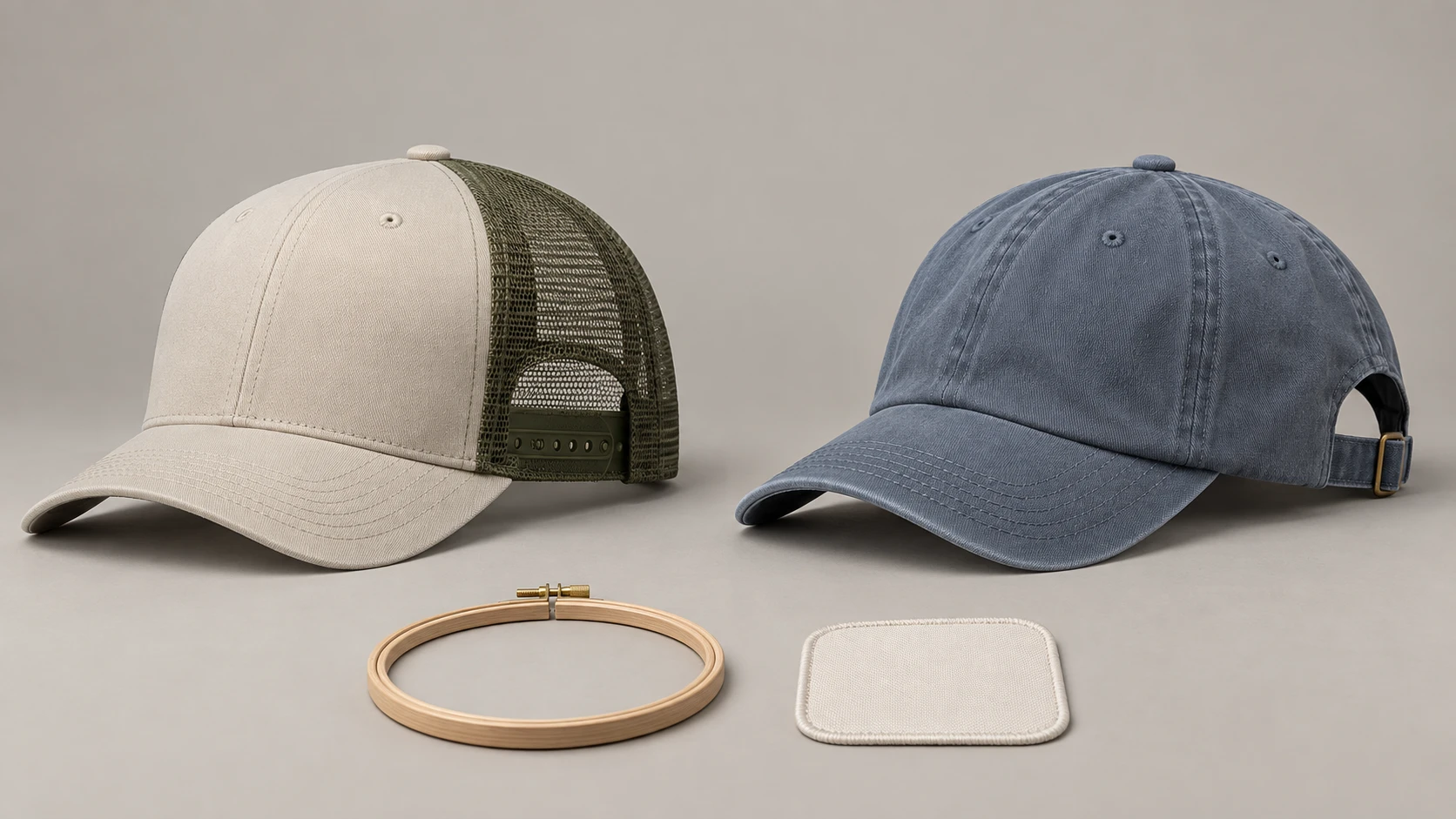
  • Richardson 112 vs Valucap VC300A: Structured Trucker vs Bio-Washed Dad Hat for Embroidery

    Richardson 112 vs Valucap VC300A: Structured Trucker vs Bio-Washed Dad Hat for Embroidery

    Quick Answer: Which Cap Should You Sample First?

    Choose by silhouette before decoration method. Sample the Richardson 112 first when the written brief calls for a structured, six-panel Mid Pro trucker with a twill front, polyester mesh back, pre-curved bill, and plastic snapback. Sample the Valucap VC300A first when the brief calls for an unstructured, six-panel, low-profile dad hat made from bio-washed cotton chino twill with a fabric strap and antique-brass buckle.

    The Richardson 112 vs Valucap VC300A decision is not a contest between a universally better and worse cap. These styles create visibly different merchandise. Structure, crown profile, rear construction, closure, fabric, artwork proportions, wearer fit, and the completed decoration system should decide the order. A logo that looks balanced on one cap may need a different size or placement on the other.

    Test both when the buyer has not approved the silhouette, when fit depends on representative wearers, or when embroidery, patches, transfers, care, exact-variant availability, substitution rules, and landed cost remain unresolved. A production-equivalent sample is more reliable than applying one model’s results to the other.

    Richardson 112 vs Valucap VC300A at a Glance

    Start with the exact Richardson 112 Beytees product record and Valucap VC300A Beytees product record. Cross-check the Richardson 112 manufacturer page and the Sportsman VC300 family page. The Sportsman page uses VC300 rather than VC300A, so it supports the family construction without independently proving the A suffix. Beytees remains the exact source for the buyer-facing VC300A identity.

    Decision factor Richardson 112 Valucap VC300A Buyer action
    Silhouette Structured mesh-back trucker Unstructured all-fabric dad hat Approve the merchandise direction before comparing decoration
    Crown Six-panel, Mid Pro profile Six-panel, low-profile Fit representative wearers and approve artwork proportions on-cap
    Main material 60/40 cotton-polyester front with 100% polyester mesh back 100% cotton bio-washed chino twill Verify the exact received style, color, labels, and sample
    Bill or visor Pre-curved bill Pre-curved visor Do not assume identical curve, depth, or decoration field
    Closure Adjustable plastic snapback Self-fabric tri-glide buckle with antique-brass finish Inspect the rear presentation and test wearer adjustment
    Rear construction Polyester mesh Cotton chino twill panels Choose the visible back treatment required by the brief
    Label evidence No tear-away claim established in reviewed exact sources Tear-away label Review relabeling requirements separately from decoration

    This table is a sourcing screen, not a substitute for receiving inspection. Product selectors, colors, and size terms can change. Before committing to a bulk run, confirm the exact style number, color, size, closure, label, material, and current availability on the received blank. Record the approved sample so a later reorder is compared with the right reference.

    Richardson 112: Structured Mid Pro Trucker Profile

    The Richardson 112 is a structured, six-panel Mid Pro trucker. Its front is a 60/40 cotton-polyester blend, while the rear is 100% polyester mesh. The style uses a pre-curved bill and an adjustable plastic snapback. Together, those details create the familiar trucker-cap presentation: a supported front, visible mesh at the back, and a closure that reads as casual and utility-oriented.

    That construction can suit teams, crews, outdoor programs, events, promotional merchandise, and retail concepts that intentionally want a trucker silhouette. It does not prove universal fit, comfort, airflow in use, durability, or decoration quality. The supported front can be a useful first sample for some embroidery briefs, but the center seam, crown curve, lower-front clearance, frame setup, backing, density, speed, and artwork still require an exact production test.

    Use the existing Richardson 112 buying guide for broader style navigation, then keep this comparison focused on the choice against VC300A. If the buyer is deciding among structured trucker proportions, the Richardson 115 vs 112 comparison provides additional profile context. Neither supporting article replaces the exact blank, artwork, and sample approval for the present order.

    Valucap VC300A: Unstructured Bio-Washed Dad-Hat Profile

    The Beytees VC300A record describes a 100% cotton bio-washed chino-twill cap with an unstructured, six-panel, low-profile crown, pre-curved visor, self-fabric tri-glide buckle, antique-brass finish, and tear-away label. It is an all-fabric dad-hat direction rather than a mesh-back trucker direction. That distinction should lead the buying decision before anyone compares thread colors or patch types.

    An unstructured crown can support understated retail, hospitality, campus, nonprofit, lifestyle, or service-business merchandise when the approved brief calls for a relaxed low-profile shape and fabric strap. It does not automatically mean softer, more comfortable, easier to embroider, more sustainable, or better for every wearer. Bio-washed describes the product treatment in the source; it should not be expanded into an environmental claim.

    The first-party Sportsman page uses the model name VC300. Its construction aligns with the family details, but it does not independently establish that VC300 and VC300A are interchangeable identifiers. Keep VC300A in buyer-facing copy because that is the exact Beytees product identity. Confirm the received label and do not use family sizing, case-pack, youth, or fit claims as if they were exact VC300A inventory facts.

    The tear-away label may help a buyer evaluate a relabeling workflow, but it does not complete one. Brand removal, replacement labels, fiber-content and origin disclosures, care instructions, legal requirements, and customer approvals remain separate tasks. The broad washed-cap sourcing guide can help with category context without replacing this exact structured-versus-unstructured decision.

    Structure, Profile, Fit, and Closure Decide the Merchandise Direction

    Structure changes how a cap presents before decoration. The Richardson 112’s supported Mid Pro front holds a defined trucker shape. The VC300A’s unstructured low-profile crown is intended to present more softly. Those are visual and construction differences, not quality rankings. A program that needs a matching uniform silhouette should approve the exact profile before bulk ordering.

    Closure also changes the back view and adjustment experience. The 112 uses a plastic snapback. The VC300A uses a fabric strap with a tri-glide buckle and antique-brass finish. Photograph both front and back during sample approval when rear presentation matters. Test adjustment with representative wearers rather than describing either option as universally fitting.

    Do not freeze mutable product-selector terms into a long-term promise. Confirm the current size terms, color, and exact variant at order time. If a program needs multiple fit ranges, record which style and size each wearer group approved. A later restock should be checked against that record, not against a generic statement that a cap is adjustable.

    Finally, compare actual artwork proportions. The same logo width can feel different on a Mid Pro structured crown and a low-profile unstructured crown. Approve the design at production size on each intended cap. Keep center seams, lower-front clearance, visor proximity, crown curvature, and the visible field in the approval record.

    Embroidery and Patch Qualification for Each Cap

    Neither cap is a universal embroidery winner. Begin with artwork cleanup and digitizing for the exact cap, then test the complete system: hoop or frame, backing, topping when appropriate, underlay, stitch direction, density, needle, thread, tension, speed, center-seam pathing, lower-front clearance, trimming, inside finish, and laundering. Approve the result from the exact production-equivalent blank.

    Control Richardson 112 test focus VC300A test focus Approval evidence
    Crown support Structured front and center seam Soft crown support and distortion control Front, side, and inside sample photos
    Artwork field Approve size around seam and lower-front clearance Approve size against low-profile curvature Production-size sew-out on exact cap
    Stitch system Digitizing, underlay, backing, density, speed, tension Digitizing, support, backing, density, speed, tension Recorded approved settings and artwork revision
    Patch Conformity to structured crown and mesh proximity Conformity without excessive stiffness on soft crown Material, edge, attachment, comfort, and care review
    QC Registration, puckering, skipped stitches, trimming Distortion, puckering, support, trimming Written acceptance standard and inspected sample

    Patches require their own sample. Verify material identity, size, shape, edge treatment, attachment method, crown conformity, hardware and closure clearance, interior comfort, and care. Do not label leather-look material as genuine leather without documentation. For another structured-cap patch example, use the Richardson 258 embroidery and patch guide only as planning context.

    DTF, HTV, Transfers, and Specialized Printing Considerations

    Both caps can be evaluated for heat-applied decoration only with cap-specific equipment, the current blank and transfer-system instructions, and a production-equivalent test. Curvature, seams, platen contact, pressure distribution, hardware, and crown support make a finished cap different from a flat apparel panel. A time, temperature, pressure, peel, or repress recipe that works on another cap is not evidence for either exact style.

    Inspect adhesion, edge lift, glossing, scorching, shade change, migration where relevant, crown distortion, mesh proximity, and care behavior. Record the exact blank, color, transfer, artwork size, equipment, settings, and result. If the decoration field crosses a seam or approaches the visor, use the test to establish whether the design must be resized or repositioned.

    Screen printing on a finished cap is specialized. Do not imply that an apparel screen-print setup transfers automatically to curved headwear. Sublimation is also not a default recommendation for the cotton or cotton-blend front decoration zones. Polyester mesh at the rear of the 112 does not make the front panel a sublimation surface.

    When comparing methods, keep the decision practical: Which process can the chosen shop control consistently on the exact style, color, artwork, and quantity? Which sample has been approved? What defects trigger rejection? What care statement is supported? Those questions protect the order better than declaring one cap universally best for DTF, HTV, embroidery, patches, or print.

    Use-Case Decision Matrix

    Use cases are starting points, not guarantees. A structured trucker can be a logical first sample for a crew or outdoor program, while a dad hat can be a logical first sample for relaxed retail or hospitality merchandise. The final choice still depends on brand direction, representative fit testing, artwork, decoration, current exact-variant availability, and approved economics.

    Written brief First sample Why it enters first What remains to prove
    Classic team or crew trucker presentation Richardson 112 Structured Mid Pro front, mesh back, snapback Fit, artwork field, decoration, availability, landed cost
    Outdoor or event trucker merchandise Richardson 112 Brief explicitly requests a mesh-back trucker silhouette Wearer approval, exact variant, sample performance
    Relaxed retail or campus dad hat Valucap VC300A Unstructured low-profile all-cotton construction Fit, artwork support, exact color, decoration, care
    Hospitality or service-business merchandise VC300A when a fabric buckle dad hat is specified Back presentation and low-profile direction match the brief Uniform consistency, fit, decoration, replenishment
    Patch-led program Test both Crown structure changes patch conformity and feel Material, attachment, stiffness, comfort, care
    Buyer has not approved silhouette Test both The products represent different merchandise directions Front, side, back, fit, decoration, and cost approval

    Avoid using static price, discount, minimum, stock, warehouse, freight, shipping-speed, lead-time, color-depth, bestseller, or margin claims in the selection brief. Those facts can change. Capture current official evidence during quoting and define what happens if the approved exact style, color, or size is unavailable.

    Sample-to-Bulk Buyer Checklist

    Use a written sample-to-bulk record so the purchase, decoration, and reorder are tied to the same approved evidence.

    1. Freeze the brief: customer, use case, silhouette, profile, rear construction, closure, color direction, quantity, in-hand date, and decoration method.
    2. Confirm the exact blanks: style number, product title, color, size, material, closure, label, and current official availability.
    3. Inspect received units: shade, shape, stitching, bill or visor, mesh or fabric panels, closure, labels, damage, and consistency.
    4. Fit-test representative wearers: record who tested which exact style and size without turning the result into a universal fit claim.
    5. Prepare artwork separately for each cap: approve physical dimensions, placement, center-seam treatment, lower-front clearance, and color.
    6. Produce exact samples: use the intended decoration system and record machine, material, settings, artwork revision, and operator notes.
    7. Define QC: registration, puckering, distortion, adhesion, edge lift, stitch defects, trimming, shade variance, interior finish, and care checks.
    8. Approve front, side, back, and inside: include closure and hardware presentation, not only a close-up of the logo.
    9. Set substitution rules: no style, color, size, material, or closure substitution without documented review.
    10. Calculate landed economics: use current blank, decoration, setup, freight, labor, spoilage, and rework evidence rather than evergreen article pricing.
    11. Archive the decision: retain the approved blank identity, sample photos, artwork and digitizing revision, settings, QC standard, approver, and date.
    12. Revalidate reorders: inspect current product identity, availability, received units, and any output-changing change before production.

    This process keeps the comparison useful even when catalog details change. The article helps identify the first sample; the retained approval record controls the order.

    Frequently Asked Questions

    What is the main difference between the Richardson 112 and Valucap VC300A?

    The Richardson 112 is a structured Mid Pro mesh-back trucker with a plastic snapback. The VC300A is an unstructured low-profile all-cotton chino-twill dad hat with a fabric strap and tri-glide buckle. Approve the silhouette before comparing decoration.

    Which cap is structured and which is unstructured?

    The Richardson 112 is structured; the Valucap VC300A is unstructured. Structure describes crown construction and presentation. It does not prove that one is more comfortable, durable, or easier to decorate.

    What fabrics do the Richardson 112 and VC300A use?

    The 112 has a 60/40 cotton-polyester front and 100% polyester mesh back. The VC300A is 100% cotton bio-washed chino twill. Verify the exact received style and color before production.

    What closures do the two caps use?

    The Richardson 112 uses an adjustable plastic snapback. The VC300A uses a self-fabric tri-glide buckle with an antique-brass finish. Test adjustment with representative wearers and approve the back presentation.

    Which cap is better for embroidery?

    There is no universal winner. The 112 is a logical first sample for a structured-front brief, while the VC300A requires a soft-crown support plan. Approve digitizing and a production-equivalent sew-out on the exact cap.

    Can both caps use patches?

    Both can enter a patch test. Verify patch material, size, shape, edge, attachment, crown conformity, stiffness, closure clearance, interior comfort, and care on the exact style.

    Can Richardson 112 and VC300A use DTF or HTV?

    They can be evaluated with cap-specific equipment and current blank and transfer-system instructions. Test curvature, seams, contact, adhesion, edge lift, scorching, shade change, distortion, and care. Do not reuse an unverified universal recipe.

    Can both caps be screen printed or sublimated?

    Screen printing on finished caps is specialized and requires an exact process test. Neither cotton or cotton-blend front is a default sublimation surface; the 112’s polyester rear mesh does not change its front-panel composition.

    Which cap fits teams, outdoor merch, retail, or hospitality programs?

    The 112 is a logical first sample for a specified team, crew, event, or outdoor trucker look. The VC300A is a logical first sample for a specified relaxed retail, campus, nonprofit, service, or hospitality dad-hat look. Fit and production approval remain required.

    What should buyers verify before a bulk cap order?

    Verify exact style, color, size, received labels, current availability, representative fit, artwork size and placement, decoration sample, QC standard, care, substitution rule, and landed cost. Archive the approved evidence for reorders.
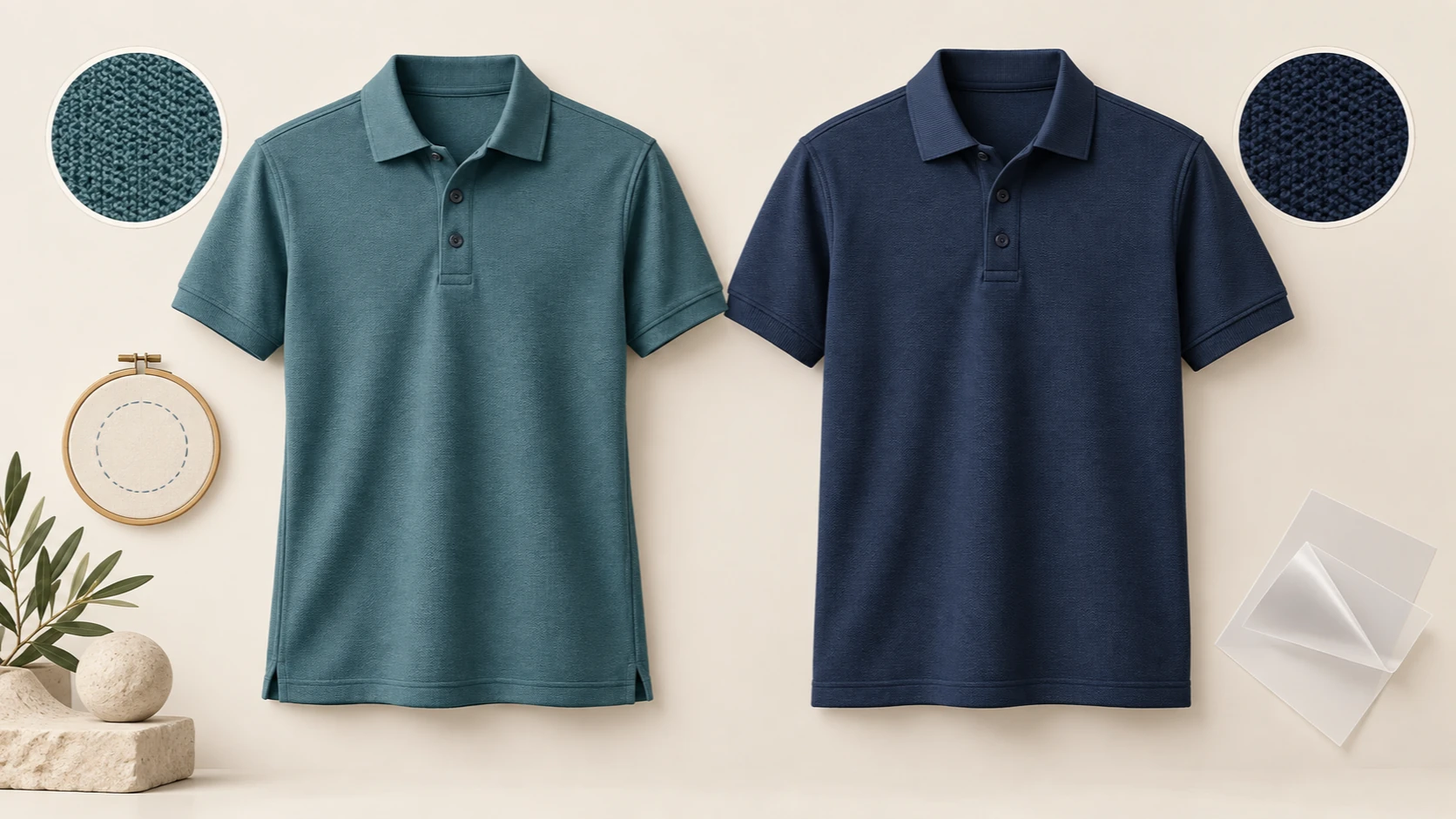
  • Gildan 64800 vs Tultex 400: Softstyle vs Sport Pique Polo for Embroidery and Uniforms

    Gildan 64800 vs Tultex 400: Softstyle vs Sport Pique Polo for Embroidery and Uniforms

    Quick answer: the Gildan 64800 vs Tultex 400 decision is a 5.2 oz/yd² cotton-forward Softstyle double-pique polo versus a 6.7 oz/yd² 50/50 cotton-polyester sport-pique polo. Sample the Gildan 64800 first when the brief favors its lower published area weight, modern classic fit, side-seamed body, or mostly cotton fiber program. Sample the Tultex 400 first when the brief favors its higher published area weight, consistent 50/50 blend, tubular construction, or contoured welt collar and cuffs.

    Procurement verdict: neither model is a universal embroidery, printing, uniform, or team winner. The 64800 and 400 differ enough in fiber, weight, construction, collar-and-cuff treatment, and catalog positioning that the correct choice should come from a production-equivalent sample, representative wearer approval, decoration testing, laundering, and live order-time terms.

    Gildan 64800 vs Tultex 400 at a Glance

    Start with the current Gildan 64800 Beytees product page and Tultex 400 Beytees product page. Cross-check the official Gildan brand page and official Tultex 400 product page. The Gildan corporate page confirms manufacturer identity but not the exact 64800 specifications; those specifications come from the live Beytees product page. The exact received garment, sewn label, color, lot, and production-equivalent sample remain the controlling evidence.

    Buying factor Gildan 64800 Tultex 400 Procurement action
    Published area weight 5.2 oz/yd² 6.7 oz/yd² Use the 1.5 oz/yd² difference to select samples; do not infer finished weight, comfort, heat performance, durability, or decoration quality
    Primary fiber statement 100% ring-spun cotton; Sport Grey is 90/10 cotton/polyester 50/50 cotton/polyester Verify the exact color and sewn label; qualify materially different fiber groups separately
    Knit Softstyle double pique Pique textured knit Approve logo detail, surface coverage, and finished hand on the actual face
    Fit or product wording Unisex; modern classic fit Men’s 400 Classic Polo; no equivalent fit measurement claim is established here Run wearer fittings instead of translating size letters between models
    Body construction Side seams and rolled-forward shoulders Tubular construction Build model-specific placement and loading references
    Front and trim Clean-finished placket and dyed-to-match buttons Three-button placket, contoured welt collar and cuffs, banded sleeves Inspect placket, collar, cuff, and sleeve presentation on the decorated sample
    Label Tear-away label Tear-away or manufacturer-termed Tear Anywhere label Approve removal and any replacement-label workflow separately

    The published area-weight difference is useful for narrowing a shortlist, but it is not a wear test. A heavier number does not automatically mean better embroidery, greater durability, more warmth, or better opacity. A cotton-forward statement does not automatically mean softer, cooler, or easier to print. Use the specifications to choose what to sample, then let the complete finished product decide.

    This article owns only the two-model decision. For deeper single-style context, use the Gildan 64800 guide and Tultex 400 guide. The pique versus jersey polo guide answers the broader fabric-category question rather than this exact head-to-head.

    Gildan 64800 Model Profile

    The 64800 is listed at 5.2 oz/yd² in 100% ring-spun cotton at 31 singles, with Sport Grey identified as 90% cotton and 10% polyester. Its double-pique knit gives the expected textured polo face, while Gildan’s Softstyle wording and the current Beytees description position the fabric as breathable and suited to embroidery. Treat that as a manufacturer or seller positioning statement, not a guarantee for every logo, wearer, climate, or wash process.

    Construction includes a modern classic fit, clean-finished placket, dyed-to-match buttons, rolled-forward shoulders, side seams, and a tear-away label. These details make it a logical first sample for a cotton-forward business-casual program and for buyers who want side seams as visual and inspection references. Rolled-forward shoulders can change where an upper-chest mark looks balanced, so approve placement on body rather than from a flat mockup alone.

    Sport Grey belongs in a separate decoration lane because its fiber content differs from the 100% cotton statement. That does not predict migration, scorching, adhesion, or wash performance. It means the solid-color approval should not be copied to Sport Grey without testing the exact garment and process.

    Tultex 400 Model Profile

    The Tultex 400 is listed at 6.7 oz/yd² in a 50/50 cotton-polyester pique knit. Its current first-party page identifies tubular construction, a contoured welt collar and cuffs, three buttons, banded sleeves, a double-needle bottom hem, and a Tear Anywhere label. The current Beytees page uses compatible tear-away wording and specifies USA premium cotton in the blend.

    This is the more direct first sample when the written brief intentionally calls for a higher published area weight, a uniform 50/50 fiber program, tubular construction, or the traditional presentation created by welt collar-and-cuff treatment and banded sleeves. None of those features proves fit preference, climate suitability, durability, colorfastness, snag resistance, or laundering performance.

    The current official Tultex selector presents S through XXL and a focused set of colors, while current seller assortments can differ or render conflicting labels. Treat every selector as mutable catalog data, not stock or delivery evidence. Before standardizing the 400, map the complete roster, confirm every required size and color at order time, and approve an alternative if the program needs a range the live catalog cannot cover.

    Embroidery: Choose the Complete System, Not Just the Polo

    Both polos are reasonable embroidery sample candidates because both use pique and traditional placket construction. The 64800 seller description expressly calls its double pique ideal for embroidery; the Tultex 400’s textured 6.7 oz face and classic trim create a conventional embroidered-polo direction. Neither statement approves a particular logo or production recipe.

    Embroidery control Why it matters Approval gate
    Artwork and digitizing Tiny text, narrow gaps, gradients, and dense fills can lose clarity or distort knit Approve the production-size stitch file on each finalist
    Backing and topping Pique needs support and may let fine stitches sink into the texture Test the actual backing, topping, needle, thread, underlay, and density together
    Hooping or framing Stretching the knit can create puckering after release Use a repeatable method that does not distort the body or placket
    Placement Side-seamed and tubular bodies provide different visual references Approve representative small and large sizes on body
    Interior comfort Backing and stitch count affect the wearer-facing surface Inspect the finished inside and test it during intended use
    Laundering Thread, backing, knit, collar, placket, and body can change together Wash the completed sample through a documented care protocol

    For a small left-chest logo, start with the approved final dimensions rather than scaling a cap or jacket file. Keep a retained control sample and production record. For broader polo selection logic, the corporate embroidery polo guide can help frame alternatives without replacing exact-style testing.

    DTF and Screen Printing: Test the Pique and Fiber Program

    DTF can be evaluated on both models, but a smooth transfer film is being applied to a textured knit. Fine isolated elements need complete contact; large solid fields can change hand and breathability. Keep buttons, plackets, collar layers, seams, and cuffs outside the active pressure zone unless the fixture and artwork have been engineered for them.

    Do not publish or inherit one universal time, temperature, pressure, peel, repress, or wash formula. Follow current transfer and equipment instructions on calibrated equipment. Qualify the 64800’s 100% cotton group separately from Sport Grey, and qualify every approved Tultex 400 color under the 50/50 program. Inspect cooled samples for contact, edge lift, gloss, texture flattening, pressure marks, scorching, dimensional change, shade response, migration where relevant, and finished hand; then launder before approval.

    Screen printing also needs model-and-color qualification. Pique can break fine detail across high and low points, while extra ink deposit can create a heavy patch. On polyester-containing garments, the ink system, underbase, flash, cure window, and color response deserve specific control. A successful White sample does not approve a dark color, another model, or another ink system.

    For both DTF and screen printing, document model, exact color, size, lot when available, artwork revision, dimensions, placement, equipment, platen, material batch, process settings, operator, inspection, and laundering result. Test-first language is not hedging; it is the shortest path to a repeatable reorder.

    Uniform and Team Scenarios

    Program scenario First sample direction What must decide the order
    Office, sales, or front desk wants cotton-forward Softstyle positioning and a modern classic fit Gildan 64800 Wearer fit, collar and placket presentation, embroidery, laundering, roster, and live terms
    Club, service, or traditional team brief specifies a 50/50 blend and higher published area weight Tultex 400 Climate wear test, fit, decoration, collar and cuff behavior, roster coverage, and live terms
    School or organization needs varied body types and recurring replacements Test both Complete size roster, fitting results, exact-color continuity, approved alternative, and reorder controls
    Mixed embroidery plus sleeve, back, or event print Test both Full decoration sequence, fixtures, heat exposure, stitch stability, finished hand, and spoilage allowance
    Outdoor, industrial, chemical, or specialized laundering environment Do not assume either wins Written performance requirements and an environment-specific wear-and-care trial

    A uniform program is also an operating system. Define issue quantities, fitting, personalization, replacements, new-hire ordering, returns, substitutions, and retained controls before purchasing. The school and team bulk-ordering guide provides a wider roster and deadline framework.

    Decision Tree: Which Polo Should You Sample First?

    1. Does the written brief require a mostly cotton, lower published area-weight polo? Start with the Gildan 64800; keep Sport Grey in its own 90/10 test lane.
    2. Does it require a consistent 50/50 blend or the higher 6.7 oz/yd² published area weight? Start with the Tultex 400.
    3. Does body construction matter to placement or presentation? Choose the 64800 for its listed side seams or the 400 for its listed tubular construction, then verify the sample.
    4. Does the complete roster fit only one current size-and-color path? Sample that viable path first, but confirm exact variants and an approved alternative at order time.
    5. Are fit, hand, decoration, climate, laundering, replenishment, or landed economics still unresolved? Test both under one written scorecard and choose the model that passes the complete program.

    Use case wins, not marketing adjectives. “Softstyle,” “Classic Polo,” “sport,” “premium,” and “ideal for embroidery” help describe positioning; they do not replace measurements, fitting, production, wash testing, or commercial verification.

    Buyer Checklist Before a Bulk Polo Order

    • Confirm the exact style, color, size, fiber statement, lot when available, and sewn labels.
    • Map the complete roster and fit representative wearers; do not translate size letters between models.
    • Approve garment measurements and logo placement on representative small and large sizes.
    • Build production-size embroidery, DTF, or screen-print samples with the real artwork and equipment.
    • Inspect collar, placket, buttons, cuffs, sleeves, seams, hem, body shape, and inside comfort.
    • Complete documented cooling, laundering, remeasurement, and post-wash appearance checks.
    • Freeze the decoration file, materials, settings, fixture, sequence, placement, and inspection standard.
    • Verify exact-variant availability, price, freight, lead time, and substitution rules only when ordering.
    • Include decoration labor, spoilage, relabeling, personalization, packaging, exchanges, and replacement stock in landed cost.
    • Retain the approved sample and reopen testing after a material garment, lot, art, equipment, or process change.

    Frequently Asked Questions

    What is the main difference between the Gildan 64800 and Tultex 400?

    The Gildan 64800 is a 5.2 oz/yd² cotton-forward double-pique polo with a modern classic fit, rolled-forward shoulders, and side seams. The Tultex 400 is a 6.7 oz/yd² 50/50 cotton-polyester pique polo with tubular construction, welt collar and cuffs, and banded sleeves.

    Which polo has the lower published fabric weight?

    The Gildan 64800 has the lower published area weight at 5.2 oz/yd², compared with 6.7 oz/yd² for the Tultex 400. The 1.5 oz/yd² difference does not prove finished weight, comfort, warmth, durability, or decoration quality.

    Which polo uses a 50/50 cotton-polyester blend?

    The Tultex 400 uses a published 50/50 cotton-polyester blend. The Gildan 64800 is 100% ring-spun cotton in its primary statement, with Sport Grey listed as 90% cotton and 10% polyester.

    Which polo is side-seamed and which is tubular?

    The Gildan 64800 lists side seams, while the official Tultex 400 page lists tubular construction. Use model-specific placement references and verify the actual received garment before freezing production templates.

    Which polo is better for embroidery?

    Neither is a universal embroidery winner. The Gildan 64800 is expressly positioned as embroidery-friendly, while the Tultex 400 offers a substantial textured pique direction. Test the exact logo, digitizing, backing, topping, hooping, placement, wearer comfort, and laundering on each finalist.

    Can the Gildan 64800 and Tultex 400 use DTF transfers?

    Both can be evaluated for DTF, but pique texture and polyester-containing colors or blends require exact-style and exact-color testing. Follow current supplier instructions and inspect cooled and laundered samples for contact, edge lift, surface change, shade response, migration where relevant, and finished hand.

    Can both polos be screen printed?

    Both can be sampled for screen printing. Approve the ink system, underbase, detail, deposit, flash, cure, texture, color response, hand, and laundering on the actual model and color rather than copying settings from a smooth jersey shirt.

    Do the Gildan 64800 and Tultex 400 fit the same?

    No equivalent fit is established by shared size letters. The 64800 is described as a unisex modern classic fit, while the 400 is sold as a men’s Classic Polo. Compare current measurements and conduct wearer fittings with production-representative samples.

    Are both polos suitable for uniforms and teams?

    Both are reasonable uniform and team candidates when they satisfy the written brief and pass fit, decoration, wear, laundering, roster, replenishment, and landed-cost gates. Specialized outdoor, industrial, or care environments may require a different polo.

    What should buyers test before a bulk polo order?

    Test identity, exact color and fiber, measurements, wearer fit, decoration, placement, collar, placket, buttons, cuffs, seams, inside comfort, cooling, laundering, dimensional response, live variant availability, landed cost, substitutions, and reorder controls.

    Compare, Sample, and Approve

    Review the live Gildan 64800 ordering page and Tultex 400 ordering page, then build a small production-equivalent sample set before committing to uniforms or team volume. Quote from exact variants and current terms, not old catalog counts or a blank-only price.

    Choose the Gildan 64800 when its cotton-forward 5.2 oz double-pique program, modern classic fit, and side-seamed construction best match the written brief. Choose the Tultex 400 when its 6.7 oz 50/50 pique, tubular body, and traditional welt trim best match the brief. Test both when the remaining decision depends on people, decoration, laundering, availability, or economics.

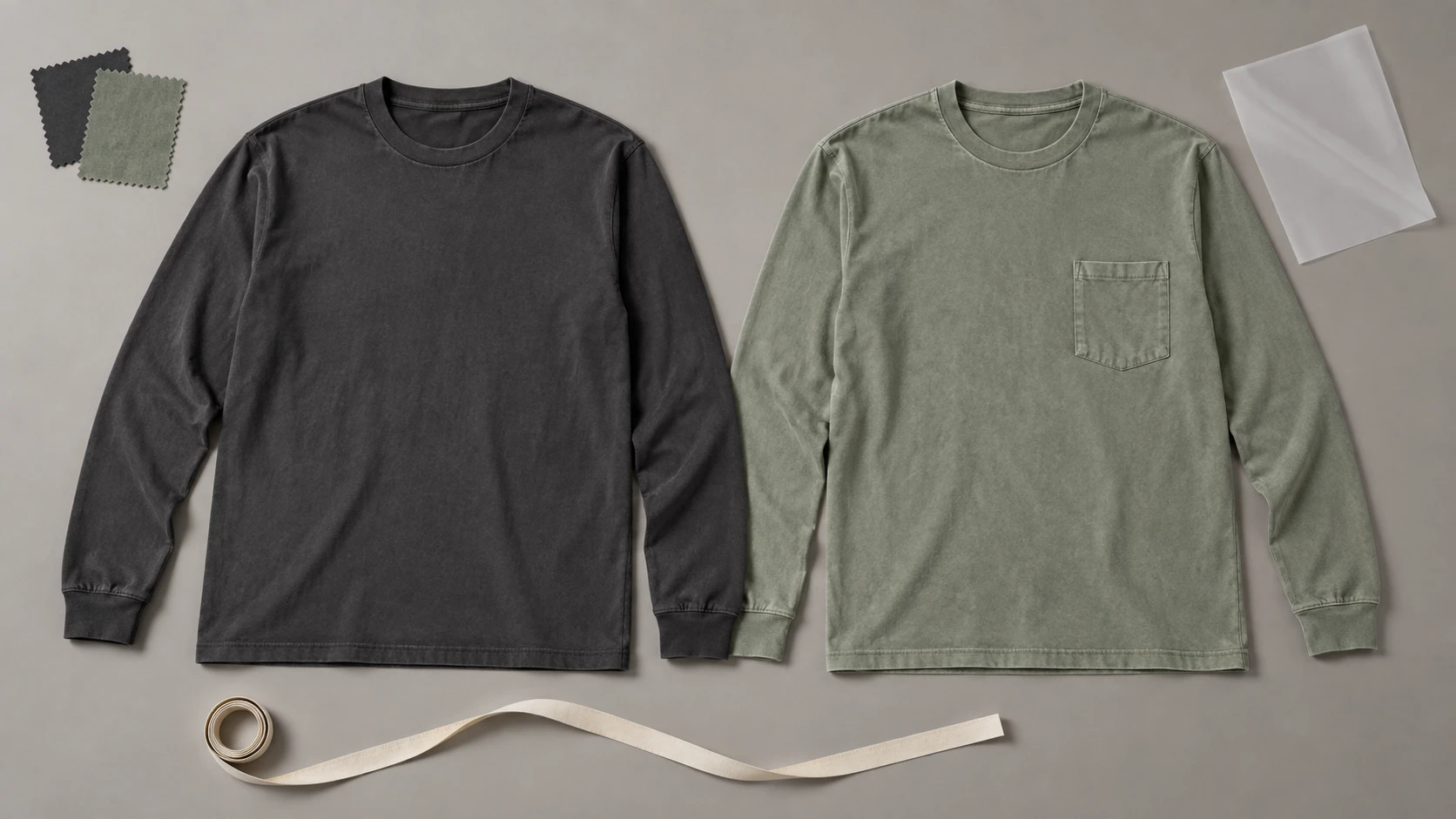
  • Gildan 5400 vs Comfort Colors 4410: No-Pocket vs Pocket Long Sleeve Tees for Printing

    Gildan 5400 vs Comfort Colors 4410: No-Pocket vs Pocket Long Sleeve Tees for Printing

    Quick answer: the Gildan 5400 vs Comfort Colors 4410 decision is a no-pocket, 5.3 oz/yd² classic-fit long sleeve versus a pocketed, 6.1 oz/yd² garment-dyed relaxed-fit long sleeve. Sample the Gildan 5400 first when the artwork needs an uninterrupted chest field, the brief calls for the lighter published fabric weight, or a tear-away label is important. Sample the Comfort Colors 4410 first when a functional left-chest pocket, garment-dyed character, a seamless body, or a signature twill label is part of the product concept.

    Verdict: for an artwork-led full-front program, the Gildan 5400 is the more direct first sample because its reviewed construction has no listed chest pocket. For a pocket-led merchandise concept, the Comfort Colors 4410 is the purposeful first sample. Test both if fit, shade, print-zone geometry, decoration behavior, labeling, or current commercial terms could change the decision.

    Gildan 5400 vs Comfort Colors 4410: Source-Aware Comparison

    Start with the current Gildan 5400 Beytees product page and Comfort Colors 4410 Beytees product page. Compare those seller records with the official Gildan G5400 page and official Comfort Colors 4410 page. The received garment, sewn labels, exact color, and production-equivalent sample remain the controlling evidence.

    Buying factor Gildan 5400 Comfort Colors 4410 Buyer action
    Chest construction No chest pocket is listed in the reviewed manufacturer or Beytees feature sets Left-chest pocket Choose by intended product and artwork field; confirm the received sample
    Published area weight 5.3 oz/yd² 6.1 oz/yd² Use the 0.8 oz/yd² difference for sample planning, not to infer finished weight, comfort, warmth, durability, or print quality
    Primary fiber statement Solids: 100% U.S. cotton; color-specific blends apply 100% ring-spun U.S. cotton with cotton threads Verify the exact color and received label before production
    Dye or finish No garment-dyed claim on the reviewed official page Garment-dyed; current official colors include pigment and direct/reactive groups Do not call every 4410 color pigment-dyed
    Fit wording Classic fit for loose comfort Relaxed fit Do not equate size letters, drape, or wearer preference
    Body and cuffs Rib collar, taped neck and shoulders, rib cuffs Seamless body, topstitched rib collar, shoulder-to-shoulder twill tape, rib cuffs Create model-specific placement references
    Label Tear-away label Signature twill label Plan compliant replacement labeling before removing required information
    Current manufacturer size selector S–3XL S–3XL Treat selector entries as mutable assortment signals, not stock promises or equivalent fit

    This page owns only the 5400/4410 decision. The 5400 versus 6014 article and 4410 versus 6014 article answer different comparisons.

    Pocket vs No Pocket: Make the Construction Intentional

    The 5400 is the no-pocket option: neither reviewed feature list identifies a chest pocket. Its front is uninterrupted by pocket construction, subject to the collar, armholes, hem, garment size, and received sample. Start here when a centered illustration, broad front mark, or flexible chest placement drives the brief.

    The 4410 pocket adds function, an opening, extra fabric, seams, and corners. Artwork on or near it needs a measured field and loading method. Do not bridge the opening unless the construction and intended pocket use have been engineered and tested. If the pocket matters, start with the 4410; if it is unnecessary and front art leads, start with the 5400.

    5.3 oz Heavy Cotton vs 6.1 oz Garment-Dyed Ring-Spun Cotton

    The published area-weight difference is 0.8 oz/yd². Gildan lists the 5400 at 5.3 oz/yd², while Comfort Colors lists the 4410 at 6.1 oz/yd². Area weight does not prove exact finished-garment weight, softness, opacity, warmth, drape, durability, or decoration quality. The blank apparel weight guide provides broader context, but production samples should control this purchase.

    Gildan’s official page lists 5400 solids as 100% U.S. cotton, Sport Grey as 90% cotton and 10% polyester, and Safety Colors as 50% cotton and 50% polyester. The current Beytees record adds Ash at 99/1 and identifies Dark Heather and Graphite Heather with the 50/50 group. Treat these as exact-color distinctions and verify the sewn label; a solids process does not automatically approve a polyester-containing color.

    Comfort Colors lists the 4410 as 100% ring-spun U.S. cotton with cotton threads. It is garment-dyed, but its current official selector separates 21 pigment-dye colors from four direct/reactive colors. “Every 4410 is pigment-dyed” is therefore inaccurate. Record the selected color, dye group, lot, and received label before qualification.

    Comfort Colors’ official care guidance says garment-dyed products should be washed separately before wearing, pigment shades with like colors, and cold water used to reduce staining risk. It also says loose pigment may remain and shade variation is inherent. Its “almost no shrinkage at home” wording is a manufacturer statement, not a shrink-proof guarantee for a decorated finished garment.

    Classic vs Relaxed Fit, Current Sizing, and Label Systems

    The 5400 is described as classic fit for loose comfort. The 4410 is described as relaxed fit. Shared size letters from S through 3XL do not establish equal body width, length, sleeve geometry, ease, or wearer preference. The 4410 official page publishes style-specific measurements; the reviewed Gildan retail page exposes a generic men’s size-chart image rather than an equivalent exact-style table. Do not manufacture a numerical side-by-side chart from unlike evidence.

    Measure received samples with one method, including the smallest and largest planned sizes. Approve fit and artwork by size tier. Use the Gildan 5400 adult and youth guide only if the program later needs a youth branch.

    The 5400 has a manufacturer-listed tear-away label. The 4410 has a signature twill label and should not be called tear-away. The FTC’s textile labeling guidance addresses fiber content, country of origin, responsible-business identity, replacement labels, attachment, and records. Its Care Labeling Rule guidance requires a reasonable basis for complete instructions covering the finished garment. A removable label is not permission to sell an unlabeled or incompletely labeled shirt.

    Zone Gildan 5400 Comfort Colors 4410 Approval requirement
    Centered or broad front No listed pocket interrupts the chest field Left pocket may intersect the design or loading field Measure actual art against representative sizes and platen geometry
    Left chest Define placement from garment center and collar on the sample Choose on-pocket, above-pocket, or another intentional relationship Keep art clear of opening and seam allowances unless specifically tested
    Back Pocket does not control the back, but model, size, collar, shoulder, and hem still define the field Approve the actual back art on smallest and largest planned sizes
    Sleeve Both have rib cuffs; locate sleeve seams and taper on received garments Use the intended sleeve platen or fixture and a repeatable reference

    Front and body prints

    Build separate templates. Record art dimensions, size tier, collar distance, center reference, platen, and setup. On the 4410, identify any image area over the pocket layer or seam. Never assume a 2XL template fits small.

    Pocket-area decoration

    Preserve the opening and avoid unstable edges unless testing proves otherwise. Identify every layer under the image and qualify the fixture. For embroidery, test backing, stitch density, distortion, and pocket function.

    Back and sleeve decoration

    Back and sleeve positions keep the pocket clear but still need measured fields. Sleeve art requires size-specific length, rotation, seam and cuff clearance, equipment access, and a repeatable reference.

    Pre-Production Testing: Qualify the Exact Program

    Neither reviewed exact-style source provides a universal DTF recipe, wash-life guarantee, migration guarantee, screen-print result, embroidery result, or production-yield promise. Follow current instructions from the transfer, ink, thread, stabilizer, and equipment suppliers. Record model, exact color, fiber or dye group, size, lot, artwork, coverage, batch, equipment, platen or fixture, operator, placement, and date.

    DTF and other heat-applied decoration

    Do not publish or inherit one time, temperature, pressure, peel, cure, repress, or wash formula. Qualify 5400 cotton and blend groups separately. On the 4410, qualify the selected pigment or direct/reactive color and inspect surface-color response, loose pigment, staining or transfer, press boxes, shine, scorching, adhesion, edge lift, dimensional change, and laundering without predicting the result.

    Screen printing and DTG

    Gildan lists screen printing for the 5400, which supports testing rather than a guarantee. Qualify ink or pretreatment, underbase, cure, opacity, hand, registration, and laundering. The blank T-shirts for DTF guide is context, not approval.

    Embroidery and labels

    Test digitizing, backing, stitch density, hooping, distortion, and laundering. On the 4410, preserve pocket function. Complete replacement-label and finished-care plans before removing original information.

    Catalog, Stock, Price, Freight, and Lead-Time Caveats

    At the research snapshot, the public Beytees 5400 parent exposed 150 variation IDs, 25 color terms, and six size terms. The 4410 parent exposed 174 variation IDs, 29 color terms, and six size terms. Both parent records returned is_in_stock=false. The current Comfort Colors manufacturer selector exposed 25 colors, not the seller’s 29. These are mutable channel signals, not proof of stock, a universal assortment, or a contradiction that can be resolved without exact-variant evidence.

    Do not freeze a color count, size-color matrix, price, freight charge, warehouse source, replenishment date, lead time, delivery date, or margin into the order promise. At order time, verify the exact variant, quantity, current availability, landed cost, spoilage allowance, decoration labor, relabeling, packaging, exchanges, and reorder plan. The blank long-sleeve category guide can support discovery, but live checkout and order confirmation remain authoritative.

    Strict Two-Model Decision Framework

    Written program brief First sample Required gate before bulk
    Uninterrupted front field, 5.3 oz published weight, classic-fit wording, color-specific Heavy Cotton platform, or tear-away label Gildan 5400 Approve exact color/fiber label, fit set, print zones, decoration, replacement label, care basis, and live terms
    Functional left pocket, 6.1 oz ring-spun cotton, garment-dyed character, relaxed seamless body, or signature twill label Comfort Colors 4410 Approve exact dye group and lot, fit set, pocket function, print zones, decoration, labels, care basis, and live terms
    Fit, hand, shade, pocket value, artwork scale, decoration behavior, labeling, reorder matching, or landed economics remains unresolved Test both Score production-equivalent samples against one written brief and retain the approved control

    If the pocket is not useful and creates avoidable artwork constraints, the 5400 is the clearer first sample. If the pocket is a functional or visual requirement, the 4410 is the clearer first sample. This is a use-case verdict, not a claim that either shirt is categorically better for print quality, comfort, durability, wash life, or profit.

    Sample-to-Production Approval Checklist

    • Confirm exact model, color, size, lot, dye or fiber group, and received labels.
    • Measure representative smallest and largest sizes with one documented method.
    • Approve wearer fit without treating shared size letters as equivalent.
    • Map collar, armholes, hem, pocket where present, back field, sleeve seams, cuff, and actual art dimensions.
    • Qualify the intended decoration system on every materially different color, fiber, or dye group.
    • Inspect immediate appearance, cooled result, pocket function, dimensional response, and supported laundering evidence.
    • Complete replacement-label and finished-care controls before production.
    • Verify exact-variant availability, cost, freight, lead time, and reorder terms only when ordering.
    • Retain the approved garment and process record; reopen testing after a material change.

    Frequently Asked Questions

    What is the main difference between the Gildan 5400 and Comfort Colors 4410?

    The Gildan 5400 is a 5.3 oz/yd² classic-fit long sleeve with no chest pocket listed in the reviewed features and a tear-away label. The Comfort Colors 4410 is a 6.1 oz/yd² garment-dyed relaxed-fit long sleeve with a left-chest pocket, seamless body, and signature twill label.

    Which shirt is the no-pocket option?

    The Gildan 5400 is the no-pocket option in this comparison because the reviewed official and Beytees feature lists do not identify a chest pocket. Confirm the received sample before freezing artwork or production fixtures.

    Which shirt has a left-chest pocket?

    The Comfort Colors 4410 has the manufacturer-listed left-chest pocket. Treat the opening, extra fabric, seams, and corners as print-zone constraints, and approve pocket function after decoration.

    Which long sleeve has the higher published fabric weight?

    The Comfort Colors 4410 has the higher published area weight at 6.1 oz/yd², compared with 5.3 oz/yd² for the Gildan 5400. The 0.8 oz/yd² difference does not prove finished weight, comfort, warmth, durability, or print quality.

    How do the fiber and dye programs differ?

    The 5400 uses 100% U.S. cotton for solids with color-specific cotton/polyester blends. The 4410 is 100% ring-spun U.S. cotton and garment-dyed, with current pigment and direct/reactive color groups. Verify the exact color, dye or fiber group, lot, and sewn label.

    Do classic fit and relaxed fit use equivalent sizing?

    No. The 5400’s classic-fit and 4410’s relaxed-fit terms are not equivalent measurement systems. Both current manufacturer selectors show S–3XL, but matching size letters do not prove matching width, length, sleeve geometry, ease, or wearer preference.

    Which shirt has a tear-away label?

    The Gildan 5400 has the manufacturer-listed tear-away label. The Comfort Colors 4410 has a signature twill label. Any private-label workflow must preserve required textile and care information and applicable records.

    Which shirt is better for a full-front print?

    The Gildan 5400 is the more direct first sample for a broad full-front print because no chest pocket is listed in its reviewed construction. The 4410 pocket can interrupt the field. Actual art, garment size, platen, placement, and samples must still be approved.

    Which shirt is better for DTF or screen printing?

    Neither is a universal decoration winner from the reviewed evidence. Follow current transfer, ink, and equipment instructions, then test the exact model, color, fiber or dye group, size, lot, artwork, equipment, and placement before production.

    What should decorators test before a bulk long-sleeve order?

    Test identity, measurements, wearer fit, front, pocket, back and sleeve fields, exact colors and lots, decoration appearance, shade or migration response where relevant, adhesion or stitch quality, pocket function, laundering, labels, care basis, availability, cost, freight, and reorder controls.

    Final Recommendation

    Sample the Gildan 5400 first when the design needs an uninterrupted front, the brief calls for the 5.3 oz Heavy Cotton platform, or a tear-away label matters. Sample the Comfort Colors 4410 first when the pocket is part of the product, the brief calls for a 6.1 oz garment-dyed ring-spun cotton shirt, or the relaxed seamless construction and signature twill label are intentional.

    Test both whenever fit, shade, pocket value, artwork scale, labels, decoration behavior, reorder matching, or landed economics remains open. Choose the shirt that satisfies the documented program brief and passes the exact pre-production gates; do not name a universal winner from catalog language alone.

  • Gildan 18500 vs Comfort Colors 1567: Heavy Blend vs Garment-Dyed Hoodie for Custom Merch

    Gildan 18500 vs Comfort Colors 1567: Heavy Blend vs Garment-Dyed Hoodie for Custom Merch

    Quick answer: the Gildan 18500 vs Comfort Colors 1567 decision is an 8.0 oz/yd² classic-fit Heavy Blend hoodie versus a 9.5 oz/yd² garment-dyed, cotton-face, relaxed-fit hoodie. Sample the Gildan 18500 first when the program calls for a core midweight fleece platform, a double-lined hood, or a tear-away label. Sample the Comfort Colors 1567 first when the brief calls for a heavier published fabric weight, garment-dyed character, side seams, a jersey-lined hood, or a back-neck customization patch.

    Neither hoodie is a universal winner. Weight, fiber, dye, fit, construction, label treatment, artwork, and live commercial terms must be evaluated as one program. Test both when physical hand, wearer fit, shade character, decoration behavior, relabeling, or reorder consistency can change the decision.

    Gildan 18500 vs Comfort Colors 1567: Source-Aware Comparison

    Begin with the current Gildan 18500 Beytees product page and Comfort Colors 1567 Beytees product page. Then compare the seller records with the official Gildan G18500 page and official Comfort Colors 1567 page. The received garment, sewn label, exact color, and production-equivalent sample remain the controlling evidence.

    Buying factor Gildan 18500 Comfort Colors 1567 Buyer action
    Published fabric weight 8.0 oz/yd² 9.5 oz/yd² Use the 1.5 oz/yd² difference to plan samples, not to infer exact finished weight, warmth, comfort, or durability
    Primary fiber statement Solids: 50% U.S. cotton, 50% polyester; heather wording varies by channel 80% ring-spun U.S. cotton, 20% polyester with a 100% cotton face Verify the exact color and received label before decoration approval
    Dye or finish No garment-dyed claim on the reviewed official page Garment-dyed; current colors include pigment and direct/reactive groups Do not describe every 1567 shade as pigment-dyed
    Fit wording Classic fit for loose comfort Relaxed fit Do not equate size letters, drape, or wearer preference
    Hood Double-lined hood with color-matched drawcord Jersey-lined hood with color-matched flatcord Approve hood bulk, drawcord control, and upper-front placement on samples
    Body details Reviewed official page does not establish a tubular or side-seamed claim Side-seamed body and rolled-forward shoulder Build model-specific artwork and alignment references
    Label system Tear-away label Signature twill label, back-neck twill tape, and back-neck patch Plan compliant replacement labeling before removing information
    Current manufacturer selector S–5XL, with size availability varying by color S–3XL Treat menus as mutable assortment signals, not stock promises

    For deeper single-style context, use the Gildan 18500 wholesale buying guide. The Comfort Colors 1467 vs 1567 comparison provides related 1567 context, while the Gildan 18500 vs Independent Trading SS4500 comparison covers a different 18500 decision. This article stays limited to the 18500 and 1567.

    8.0 oz Heavy Blend vs 9.5 oz Cotton-Face Fleece

    The published area weights differ by 1.5 oz/yd²: 8.0 oz/yd² for the 18500 and 9.5 oz/yd² for the 1567. Area weight is useful for specifying a sample direction, but it does not prove exact finished-garment weight, warmth, softness, drape, durability, or decoration quality. Those outcomes require physical comparison.

    Gildan describes 18500 solids as 50% U.S. cotton and 50% polyester. Its official material summary describes heathers broadly as 40% U.S. cotton and 60% polyester, while the current Beytees copy names several heathers as 60% polyester and 40% cotton. Treat this as a channel-wording conflict: record the selected color, verify the received label, and do not move a solids process to a heather automatically.

    Comfort Colors lists the 1567 as 80% ring-spun U.S. cotton and 20% polyester, with a 100% soft ring-spun U.S. cotton face. A cotton face can be relevant to surface evaluation, but it does not make the whole hoodie 100% cotton or guarantee a specific print result. Compare the exact garments with the intended artwork and process.

    Garment Dye, Pigment Shades, Reorders, and Care

    The 1567 is garment-dyed, but its current official selector separates nine pigment-dye colors from two direct/reactive colors. “Every 1567 is pigment-dyed” is therefore inaccurate. Pigment and direct/reactive selections should be recorded and qualified as separate color groups, and every production lot should be checked against the approved sample.

    Comfort Colors’ official care guidance says garment-dyed products should be washed separately before wearing, that loose pigment may remain on pigment-dyed shades, and that pigment shades should be washed with like colors. It recommends cold water to reduce staining risk and describes shade variation as inherent in garment dyeing. The manufacturer also uses pre-shrunk and “almost no shrinkage at home” wording; that is not a shrink-proof guarantee for a decorated finished garment.

    Shade character and possible lot-to-lot variation belong in the purchasing plan. Keep an approved sample, document the selected dye group and lot, and decide in advance what visual range is acceptable for the merch program. Reorder matching should be checked with current physical evidence rather than promised from a product-page color swatch.

    Classic Fit vs Relaxed Fit: Do Not Equate Size Letters

    Gildan describes the 18500 as a classic fit for loose comfort. Comfort Colors describes the 1567 as a relaxed fit. Those catalog terms do not establish equal ease, body width, length, sleeve geometry, coverage, or wearer preference. A medium in one model is not evidence that a medium in the other will fit the same.

    The current official Gildan selector exposes S–5XL and warns that not every size is available in every color. Beytees currently exposes an additional XS catalog term, but channel menus and variation IDs are mutable. The official Comfort Colors selector exposes S–3XL and publishes width, length, and sleeve-center-back measurements from S through 3XL. Because the reviewed Gildan page does not provide an equivalent exact-style numerical table, avoid manufacturing a line-by-line numerical comparison.

    Measure production-equivalent samples with one documented internal method. Include the smallest and largest planned sizes, check front and back artwork fields, and approve fit with the intended wearer group. The decision should be based on the written merchandise brief, not shared words such as “unisex,” “loose,” or “relaxed.”

    Hoods, Seams, Pockets, Shoulders, and Label Systems

    The 18500 uses a double-lined hood with a color-matched drawcord, a pouch pocket, rib cuffs and bottom band with spandex, and double-needle stitching at listed stress areas. The reviewed official page does not establish whether its body is tubular or side-seamed, so this comparison makes no unsupported seam claim.

    The 1567 uses a jersey-lined hood with a color-matched flatcord, side seams, a rolled-forward shoulder, a pouch pocket, rib cuffs and waistband, back-neck twill tape, a signature twill label, and a back-neck customization patch. These details can affect artwork references, hooping, loading, and neck-branding plans, but they do not establish that one hoodie is easier or faster to decorate.

    Gildan lists a tear-away label for the 18500. Comfort Colors lists a signature twill label for the 1567, not a tear-away label. The FTC’s textile labeling guidance addresses fiber content, origin, responsible-business identity, replacement labels, secure attachment, and recordkeeping. Its Care Labeling Rule guidance calls for complete instructions supported by a reasonable basis for the finished garment. A removable label is not permission to sell an unlabeled or incompletely labeled hoodie.

    Qualify DTF, Screen Printing, and Embroidery on Exact Samples

    Neither reviewed exact-style source supplies a universal DTF recipe, wash-life guarantee, migration guarantee, embroidery result, or production-yield promise. Follow the current instructions from the transfer, ink, thread, stabilizer, and equipment suppliers. Record the hoodie model, color, fiber or dye group, size, lot, artwork, coverage, process batch, press or machine, platen or hoop, operator, placement, and date.

    DTF and other heat-transfer processes

    Do not publish or inherit one time, temperature, pressure, peel, cure, repress, or wash formula. For 18500 heathers, verify the exact fiber content and check heat and migration behavior by color. For 1567 pigment shades, inspect surface-color response, loose pigment, staining or transfer, press boxes, shine, scorching, adhesion, and edge lift. Test direct/reactive shades separately. Keep hood bulk, drawcords, pouch-pocket seams, and ribbing outside the pressure field when the equipment and design allow.

    Screen printing and DTG

    Gildan lists screen printing and DTG among manufacturer decoration techniques for the 18500, and Comfort Colors describes the 1567 cotton face as enhancing printability. These statements support testing, not a guaranteed result. Qualify ink or pretreatment, cure, opacity, hand, color response, registration, and laundering on the exact garment and artwork. The broader blank sweatshirts for DTF guide offers category context but does not replace exact-model qualification.

    Embroidery, patches, and neck customization

    For embroidery, test digitizing, backing, hooping, stitch density, distortion, interior comfort, hood and pocket interference, and laundering. For patches or neck branding, confirm usable space and construction before production. The blank hoodies for embroidery guide can frame the evaluation, while the approved stitched sample must control the order.

    Catalog, Stock, Price, Freight, and Lead-Time Caveats

    At the research snapshot, the Beytees 18500 parent exposed 423 variation IDs, 47 color terms, and nine size terms, while the 1567 parent exposed 66 variation IDs, 11 color terms, and six size terms. Both public parent records returned is_in_stock=false. A live page, purchasable flag, color term, size term, or variation ID does not prove current stock or delivery.

    Do not freeze color counts, size-color matrices, price, freight, replenishment, warehouse source, lead time, or delivery dates into an evergreen purchasing promise. At order time, verify the exact variant, required quantity, current availability, landed cost, spoilage allowance, relabeling labor, packaging, exchanges, and reorder plan. The blank-apparel shipping guide provides planning context, but live checkout and order confirmation remain authoritative.

    If the program needs broader garment-dyed discovery before committing to the 1567 direction, the blank garment-dyed hoodie guide can help define category criteria. It should not be used to override the exact two-model comparison or current order-time evidence.

    Strict Two-Model Decision Framework

    Written merch brief First sample Required approval gate
    8.0 oz core fleece platform, classic-fit manufacturer wording, double-lined hood, or tear-away label Gildan 18500 Approve exact color/fiber label, size set, artwork field, decoration, replacement label, care basis, and live terms
    9.5 oz 80/20 cotton-face fleece, garment-dyed character, relaxed side-seamed construction, jersey-lined hood, or back-neck patch Comfort Colors 1567 Approve exact dye group and lot, size set, shade range, artwork field, decoration, label plan, care basis, and live terms
    Hand, perceived weight, fit, shade, placement, relabeling, decoration behavior, reorder matching, or landed economics is unresolved Test both Score production-equivalent samples against one written brief and retain the approved control

    This framework does not add a third model or name an overall winner. If neither hoodie satisfies the brief, reopen product discovery rather than forcing a decision from catalog adjectives.

    Sample-to-Production Approval Checklist

    Gate Evidence to retain Stop condition
    Identity Exact model, color, size, lot, dye or fiber group, and received labels Unknown or conflicting garment identity
    Fit and measurements Documented method, representative smallest/largest sizes, wearer approval Approval based only on shared size letters
    Artwork and equipment Actual art dimensions, placement references, platen/hoop, operator, calibrated process Untested template or obstructed pressure/hoop field
    Decoration Immediate appearance, adhesion or stitch result, shade response, laundering evidence Unsupported settings or unreviewed color/fiber/dye group
    Labels and care Replacement disclosures, durable attachment plan, whole-garment care basis Missing required information or unsupported care instruction
    Commercial terms Exact-variant availability, quantity, cost, freight, spoilage, labor, lead time, and reorder plan Decision relies on stale catalog counts or assumed stock

    Frequently Asked Questions

    What is the main difference between the Gildan 18500 and Comfort Colors 1567?

    The Gildan 18500 is an 8.0 oz/yd² classic-fit Heavy Blend hoodie with a double-lined hood and tear-away label. The Comfort Colors 1567 is a 9.5 oz/yd² garment-dyed, cotton-face, relaxed-fit hoodie with side seams, a jersey-lined hood, and a back-neck patch. These facts direct sampling, not a universal winner.

    Which hoodie has the higher published fabric weight?

    The Comfort Colors 1567 has the higher published fabric weight at 9.5 oz/yd², compared with 8.0 oz/yd² for the Gildan 18500. The 1.5 oz/yd² difference does not prove exact finished weight, warmth, comfort, durability, or decoration quality.

    How do the Gildan 18500 and Comfort Colors 1567 fiber blends differ?

    Gildan lists 18500 solids as 50% U.S. cotton and 50% polyester, while heather wording varies by channel. Comfort Colors lists the 1567 as 80% ring-spun U.S. cotton and 20% polyester with a 100% cotton face. Verify the exact color and received label.

    Is every Comfort Colors 1567 color pigment-dyed?

    No. The current official selector separates nine pigment-dye colors from two direct/reactive colors. Record and qualify the selected shade and dye group instead of applying an all-pigment claim to the complete 1567 range.

    How do classic fit and relaxed fit compare?

    They are manufacturer fit descriptions, not equivalent measurement systems. The 18500 is described as classic fit for loose comfort, while the 1567 is described as relaxed fit. Compare production-equivalent samples and do not assume that matching size letters create matching fit.

    How do the hood and body construction differ?

    The 18500 has a double-lined hood with a color-matched drawcord. The 1567 has a jersey-lined hood with a color-matched flatcord, side seams, and rolled-forward shoulders. Both have pouch pockets. The reviewed Gildan source does not establish a tubular or side-seamed body claim.

    Which hoodie has a tear-away label?

    The Gildan 18500 has the manufacturer-listed tear-away label. The Comfort Colors 1567 has a signature twill label, back-neck twill tape, and a back-neck customization patch. Any private-label workflow must preserve required textile and care information.

    Which hoodie is better for DTF or screen printing?

    Neither is a universal decoration winner from the reviewed evidence. Follow current transfer, ink, and equipment instructions and test the exact model, color, fiber or dye group, size, lot, artwork, process, and placement before production.

    What garment-dyed care and shade-variation issues matter for the 1567?

    Comfort Colors says garment-dyed products should be washed separately before wearing, pigment shades with like colors, and cold water used to reduce staining risk. Loose pigment may remain, and shade variation is inherent. Attribute those instructions to the manufacturer and verify finished-garment care.

    What should decorators test before a bulk hoodie order?

    Test identity, measurements, wearer fit, artwork fields, hood and pocket interference, exact colors and lots, decoration appearance, shade or migration response where relevant, adhesion or stitch quality, laundering, replacement labels, care instructions, availability, cost, freight, and reorder controls.

    Final Recommendation

    Sample the Gildan 18500 first for a core 8.0 oz Heavy Blend direction with classic-fit wording, a double-lined hood, and a tear-away label. Sample the Comfort Colors 1567 first for a 9.5 oz garment-dyed cotton-face direction with relaxed side-seamed construction, a jersey-lined hood, and back-neck customization.

    Test both whenever fit, hand, shade, artwork scale, labeling, decoration behavior, reorder matching, or landed economics can change the decision. Approve the hoodie that satisfies the written B2B program brief, retain production evidence, and verify every live commercial term when ordering.

  • Comfort Colors 9360 vs BELLA + CANVAS 6008: Heavyweight Tank vs Women’s Racerback for Merch

    Comfort Colors 9360 vs BELLA + CANVAS 6008: Heavyweight Tank vs Women’s Racerback for Merch

    Quick answer: the Comfort Colors 9360 vs BELLA CANVAS 6008 decision starts with the intended tank silhouette and verified specifications, not a universal winner. Sample the Comfort Colors 9360 first when the brief calls for a 6.1 oz/yd² garment-dyed adult tank, seamless body, bound neck and armholes, or signature twill label. Sample the BELLA+CANVAS 6008 first when the brief calls for a 4.2 oz/yd² women’s racerback, side seams, color-dependent fiber choices, or a tear-away label. Test both when fit, coverage, artwork scale, color, labeling, or finished-merch positioning remains open.

    The two blanks differ in published fabric weight, dye and fiber programs, construction, size families, measurement headings, and labels. Those source-backed differences can direct sampling, but they do not prove comfort, opacity, durability, stock, price, decoration performance, or a one-setting DTF recipe. Production-equivalent samples and current order-time evidence should control approval.

    Comfort Colors 9360 vs BELLA+CANVAS 6008: Source-Aware Comparison

    Start with the live Comfort Colors 9360 product page and BELLA+CANVAS 6008 product page. Compare those seller records with the current official Comfort Colors 9360 page and official BELLA+CANVAS 6008 page. The received garment, label, and sample remain the final production evidence.

    Buying factor Comfort Colors 9360 BELLA+CANVAS 6008 Buyer action
    Current identity Official page: Heavyweight Adult Tank; Beytees: Unisex Garment-Dyed Heavyweight Tank Top Women’s Jersey Racerback Tank Preserve source attribution and exact model codes
    Published fabric weight 6.1 oz/yd² 4.2 oz/yd² Use the 1.9 oz/yd² difference as a sample-planning fact, not a performance conclusion
    Fiber program 100% ring-spun U.S. cotton 100% Airlume cotton solids; 52/48 cotton/polyester heathers; 90/10 Athletic Heather Verify the exact color family and received label
    Dye or finish Garment-dyed; current colors include pigment and direct/reactive groups The exact current manufacturer page makes no garment-dyed claim Identify the selected 9360 dye group; do not call the 6008 garment-dyed
    Fit wording Adult tank; relaxed fit; Beytees uses unisex wording Women’s racerback; relaxed fit Do not treat shared “relaxed” wording as equivalent cut or coverage
    Body and edges Seamless body; bound self-fabric neck and armholes Side-seamed racerback Approve art fields and placement on physical samples
    Label Signature twill label Tear-away label Plan compliant replacement labeling before removal
    Current manufacturer sizes XS–3XL S–2XL Do not equate size letters or interpret menus as stock

    This article owns the exact head-to-head decision. Use the standalone BELLA+CANVAS 6008 guide for deeper single-style context and the wholesale blank tank-top roundup for broader category discovery. Neither page replaces current specifications or sample approval.

    6.1 oz Garment-Dyed Cotton vs 4.2 oz Color-Specific Jersey

    The 9360’s published area weight is 6.1 oz/yd², while the 6008’s is 4.2 oz/yd², a difference of 1.9 oz/yd². That does not establish finished-garment weight, warmth, softness, opacity, drape, durability, or print quality. The blank apparel weight guide provides category context, but the exact samples should control the decision.

    Comfort Colors lists the 9360 as 100% ring-spun U.S. cotton and garment-dyed. Its current color program separates 30 pigment-dye colors from four direct/reactive colors. Therefore, “all 9360 colors are pigment-dyed” is not accurate. Record the chosen shade, stated dye group, received lot, and label before qualification.

    The 6008 uses color-dependent fibers: the current manufacturer sources list solid colors as 100% Airlume combed and ring-spun cotton, heather CVC colors at 52% cotton and 48% polyester, and Athletic Heather at 90% cotton and 10% polyester. The exact 6008 manufacturer page does not describe the style as garment-dyed. A solid-color approval does not automatically approve a polyester-containing version.

    Comfort Colors uses almost-no-shrink and pre-shrunk wording in its current materials, while Beytees calls the 6008 pre-shrunk. Neither statement makes a finished decorated tank shrink-proof. Decoration, laundering, exact color, and received stock can affect results, so record measurements before and after the approved qualification process.

    Adult/Unisex vs Women’s Racerback: Compare Measurements Carefully

    Comfort Colors calls the 9360 an adult tank and uses relaxed-fit wording; Beytees calls it unisex. BELLA+CANVAS calls the 6008 a women’s racerback and also uses relaxed-fit wording. These are catalog descriptions, not promises of universal fit, coverage, ease, or true-to-size behavior.

    Official chart Smallest listed Middle examples Largest listed Measurement caution
    9360 XS: width 16.5 in; length 25.25 in M: 19.5 × 28 in; XL: 23 × 30.75 in 3XL: 27 × 32.5 in Chart headings are “Width” and “Length”
    6008 S: body width 16 in; center-front length 19 in M: 16 3/4 × 19 3/8 in; XL: 18 3/4 × 20 3/8 in 2XL: 19 3/4 × 20 7/8 in Width is measured 1 inch below the armhole; length is center-front

    The official 6008 technical measurement PDF says its chart is subject to change. The 9360 and 6008 headings are not equivalent enough for a silent same-letter comparison. Measure received samples using each source’s stated method, then use one documented internal method for the wearer and artwork approval process.

    Seamless Tank vs Side-Seamed Racerback: Build Separate Art Templates

    The 9360 has a seamless body with bound self-fabric neck and armholes. The 6008 is a side-seamed racerback. These facts can influence center references, usable front and back fields, and how close an image sits to a neckline, armhole, seam, or curved edge. They do not prove that one tank is easier, faster, or more reliable to decorate.

    Approve artwork on representative smallest and largest production sizes. Measure the physical field between neckline, armholes, racerback geometry, side seams where present, and hem. Isolate layers and avoid creating uneven pressure over seams or curved edges. An adult tee or tank template should not be copied to both styles without testing.

    For back graphics, the racerback shape can constrain the upper field differently from the broader 9360 body. Use the actual artwork and production platen, define operator reference points, and retain the approved sample or precise placement record for repeat runs.

    Signature Twill vs Tear-Away Labels and Care Controls

    Comfort Colors identifies a signature twill label on the 9360; do not call it tear-away. BELLA+CANVAS identifies a tear-away label on the 6008. Removability alone does not authorize an unlabeled or incompletely labeled private-label garment.

    The FTC’s textile labeling guidance explains that most covered textiles need fiber content, country of origin, and a manufacturer or responsible-business identity. It also explains replacement-label conditions and three-year recordkeeping when a retailer substitutes a label. FTC guidance explains these duties; this article does not declare a garment compliant.

    The FTC’s separate Care Labeling Rule guidance calls for complete instructions supported by a reasonable basis for the whole finished garment. Comfort Colors’ current care guidance says garment-dyed products should be washed separately before wearing and distinguishes pigment-dyed shades from other colors. Attribute that guidance to the manufacturer and do not invent missing 6008 care details.

    A DTF Qualification Workflow, Not a Universal Recipe

    Neither exact product page supplies a style-specific DTF recipe or decorated-garment guarantee. BELLA+CANVAS’s printing recommendations say transfer requirements vary by system and direct users to the transfer manufacturer’s instructions. Follow that supplier’s current documented process on calibrated equipment rather than publishing one temperature, time, pressure, peel, post-press, cure, or wash formula.

    1. Identify variables: record model, exact color, dye or fiber group, size, received label, lot, transfer batch, artwork, coverage, press, platen, operator, placement, and date.
    2. Separate groups: qualify 9360 pigment and direct/reactive selections as exact colors and lots; qualify 6008 solids, 52/48 heathers, and Athletic Heather separately.
    3. Approve the field: measure front and back artwork areas on representative smallest and largest production sizes.
    4. Inspect without prediction: review shade response, staining or migration risk where relevant, press marks, shine, scorching, adhesion, edge lift, hand, dimensional response, and laundering.
    5. Retain controls: keep the approved sample and process record; reopen qualification after any garment, color, lot, artwork, equipment, or transfer change.

    Polyester-containing 6008 colors require migration and heat checks, but that is a test requirement—not a prediction that migration will occur or that one blocker or setting will solve it. The 9360’s dye groups likewise require exact-color testing rather than a universal garment-dyed formula.

    Treat Catalog Counts as a Snapshot, Not Availability

    At the September 24 research snapshot, the public Beytees 9360 parent exposed 34 color terms, seven size terms, and 238 variation IDs. The 6008 parent exposed 17 color terms, five size terms, and 85 variation IDs. Parent-level terms and variation counts do not prove that a color-size combination is in stock, purchasable at a particular price, replenishable, or deliverable by a deadline.

    The official 6008 page displayed “New Style Coming Soon” and “Product Not Available” while its specification text and PDF remained accessible. Use that page as a specification source, not manufacturer inventory evidence. Verify the exact requested variant, price, freight, lead time, spoilage allowance, relabeling labor, packaging, exchange plan, and replenishment when the order is ready.

    Browse the wider Comfort Colors category or BELLA+CANVAS category if neither sample fits. The blank-apparel shipping guide can help frame logistics, but live checkout and order confirmation remain authoritative.

    Buyer Decision Framework

    Merchandise brief Reasonable first sample Required gate before bulk
    6.1 oz garment-dyed adult tank, seamless body, bound edges, XS–3XL chart family, or signature twill label Comfort Colors 9360 Approve exact dye group, lot, measurements, placement, decoration, label plan, care evidence, and live variant
    4.2 oz women’s racerback, side seams, S–2XL chart family, exact solid/heather fiber choice, or tear-away label BELLA+CANVAS 6008 Approve exact fiber version, measurements, coverage, placement, decoration, replacement labels, care evidence, and live variant
    Wearer preference, coverage, weight, artwork field, color program, or label workflow is undecided Test both Score representative samples against one written brief; do not decide from shared fit adjectives
    Economics or timing controls the program Sample the closer specification, then compare current terms Include exact-variant cost, freight, spoilage, labor, packaging, exchanges, and replenishment

    Choose the sample that satisfies the documented program brief. If neither does, return to category discovery rather than forcing an overall winner from catalog copy.

    Production Approval Checklist

    • Confirm exact model code, color, size range, dye or fiber group, lot, and received labels.
    • Measure representative garments using the applicable manufacturer definition and a documented internal method.
    • Approve fit and coverage with intended wearers without true-to-size or universal-comfort assumptions.
    • Map neckline, armholes, side seams, racerback geometry, hem, artwork dimensions, and placement references.
    • Decorate exact production colors and sizes with the intended transfer system and calibrated equipment.
    • Record immediate appearance, later observation, laundering evidence, and supportable finished-garment care.
    • Complete the replacement-label plan before removing required original information.
    • Verify live price, stock, quantity, freight, lead time, and checkout terms only at order time.
    • Retain the approved sample and reopen qualification after any material variable changes.

    Frequently Asked Questions

    What is the main difference between the Comfort Colors 9360 and BELLA+CANVAS 6008?

    The 9360 is a 6.1 oz/yd² garment-dyed adult tank with a seamless body and signature twill label. The 6008 is a 4.2 oz/yd² women’s racerback with side seams, color-dependent fibers, and a tear-away label. Those differences direct sampling; they do not create a universal winner.

    Which tank has the higher published fabric weight?

    The Comfort Colors 9360 has the higher published fabric-area weight at 6.1 oz/yd², compared with 4.2 oz/yd² for the BELLA+CANVAS 6008. The 1.9 oz/yd² difference does not prove finished weight, comfort, opacity, warmth, durability, or print quality.

    Are both tank tops 100% cotton in every color?

    No. The 9360 is listed as 100% ring-spun U.S. cotton. The 6008 lists 100% Airlume cotton solids, 52/48 cotton/polyester heathers, and 90/10 cotton/polyester Athletic Heather. Verify the selected color and received label.

    Is every Comfort Colors 9360 shade pigment-dyed?

    No. The current official color program groups 30 shades as pigment-dyed and four as direct/reactive. Confirm the selected shade’s group and received lot rather than applying an all-pigment claim.

    How do the 9360 seamless body and 6008 side seams change artwork planning?

    They create different center references and usable fields around necklines, armholes, racerback geometry, seams, and hems. Build front and back placement templates on representative physical sizes instead of sharing one untested tank or tee template.

    How do the current size ranges and measurement methods differ?

    The 9360 manufacturer menu runs XS–3XL and labels measurements width and length. The 6008 chart runs S–2XL and uses body width one inch below the armhole plus center-front length. Same-letter sizes and unlike headings are not automatically equivalent.

    Which tank has a tear-away label for private-label programs?

    The 6008 has the manufacturer-listed tear-away label. The 9360 has a signature twill label and should not be called tear-away. Any relabeling program must preserve required textile and care information and applicable records.

    Which tank is better for DTF printing?

    Neither is a universal DTF winner from the reviewed evidence. The exact product pages provide no style-specific DTF recipe or decorated-garment guarantee. Follow the transfer supplier and test the actual garment, color, size, press, artwork, and placement.

    What should decorators test before a bulk tank-top run?

    Test exact production colors and sizes for measurements, artwork field, placement, shade or migration response where relevant, press marks, adhesion, edge lift, hand, dimensional response, laundering, labels, and supportable finished-garment care. Retain approved samples and records.

    What labeling and care issues matter when relabeling decorated tank tops?

    FTC guidance addresses fiber content, origin, responsible-business identity, replacement labels, attachment, records, and separate care-label duties. Preserve required information and support care instructions for the whole decorated garment. Obtain qualified advice when legal obligations are material.

    Final Recommendation

    Sample the 9360 first for an intentional heavyweight, garment-dyed adult-tank direction with a seamless body. Sample the 6008 first for an intentional women’s racerback direction with side seams and a color-specific fiber program. Test both when fit, coverage, artwork field, color, label workflow, or finished-merch positioning is unsettled.

    Do not name a universal winner or copy a universal DTF recipe. Compare production-equivalent samples against one written brief, verify live commercial terms at order time, and approve the tank whose documented result meets the program.

  • BELLA + CANVAS 3005 vs Gildan 64V00: Which Wholesale V-Neck Tee Is Best for DTF?

    BELLA + CANVAS 3005 vs Gildan 64V00: Which Wholesale V-Neck Tee Is Best for DTF?

    Quick answer: choose the first sample by verified specification, not by a blanket “best for DTF” claim. Start with the BELLA+CANVAS 3005 when the brief calls for a 4.2 oz/yd² Airlume cotton V-neck, retail fit, side seams, and shoulder taping. Start with the Gildan 64V00 when the brief calls for a 4.5 oz/yd² ring-spun cotton V-neck, modern classic fit, narrow rib collar, and taped neck and shoulders. Test both when neckline shape, fit, exact color fiber, artwork position, or finished-merch direction remains undecided.

    Both current Beytees selectors span XS–3XL and both seller listings identify tear-away labels. Their published weights differ by only 0.3 oz/yd², but their fit language, collar details, cotton terminology, and color-specific blends differ. Those specifications can direct sampling; they do not prove comfort, price, availability, shrinkage, durability, or DTF performance.

    BELLA+CANVAS 3005 vs Gildan 64V00: Source-Aware Comparison

    Begin with the live BELLA+CANVAS 3005 product page and Gildan 64V00 product page. The current official BELLA+CANVAS 3005 page supports the 3005 facts below. Gildan’s official 64V00 page returned HTTP 403 to the research client, so the 64V00 summary uses the current Beytees record and an HTTP-200 public distributor listing, with the construction conflict isolated rather than resolved by assumption.

    Buying factor BELLA+CANVAS 3005 Gildan 64V00 Buyer action
    Published fabric weight 4.2 oz/yd² 4.5 oz/yd² Use the 0.3 oz/yd² difference as a sampling input, not a performance conclusion
    Base fiber statement 100% Airlume combed and ring-spun cotton 100% ring-spun cotton Verify the exact color and received fiber label
    Published exceptions Ash: 99/1 cotton/polyester Sport Grey: 90/10 cotton/polyester; Dark Heather and heathers: 65/35 polyester/cotton Qualify every selected material group separately
    Fit wording Retail fit; unisex sizing Modern classic fit Do not translate catalog adjectives into true-to-size promises
    Verified neckline details Classic V-neck; current Beytees listing says coverstitched V-neck Narrow-width rib collar Approve neckline depth, art balance, and collar response on samples
    Shoulder/neck treatment Shoulder taping; Beytees says shoulder-to-shoulder taping Taped neck and shoulders Inspect the received garment when the exact treatment matters
    Current Beytees size selector XS–3XL XS–3XL Same labels do not establish equivalent fit or live stock
    Label Tear-away Tear-away Plan replacement labeling and finished-garment care before removal

    This page owns the direct two-model purchase decision. Use the wholesale V-neck T-shirt roundup for broader discovery and the 3005 vs 3005CVC comparison for a separate solid-jersey versus heather-CVC decision. Do not import 3005CVC fiber specifications into the 3005.

    4.2 oz Airlume Cotton vs 4.5 oz Ring-Spun Cotton

    The current 3005 manufacturer page lists solid colors at 4.2 oz/yd², 32 singles, and 100% Airlume combed and ring-spun cotton, with Ash at 99% cotton and 1% polyester. The 64V00 seller and distributor records list 4.5 oz/yd², 30 singles, and a 100% ring-spun cotton base. Sport Grey is listed at 90/10 cotton/polyester. Dark Heather and heather colors are listed at 65/35 polyester/cotton.

    Those exceptions matter more than a generic “cotton V-neck” label. A Black 64V00 does not validate a heather 64V00, and an Ash 3005 is not identical to a 100% cotton 3005 color. Record the style, exact color, received fiber label, supplier lot, and transfer batch before testing. If fiber composition changes, reopen the qualification rather than carrying forward the prior approval.

    The published 0.3 oz/yd² difference does not establish finished-shirt weight, opacity, drape, comfort, durability, or transfer quality. It simply tells the buyer that the 64V00 has the higher published fabric-area weight. The blank T-shirt weight guide offers wider category context, but an exact garment sample should control this decision.

    Fit, Sizes, and V-Neck Shape Require Samples

    BELLA+CANVAS calls the 3005 a retail fit with unisex sizing. The current 64V00 records use modern classic fit. These are brand-specific descriptions, not one shared measurement standard. Do not call either model fitted, relaxed, true to size, universally flattering, or interchangeable without evidence from the intended audience and received stock.

    Approval question 3005 source signal 64V00 source signal Required check
    Size range Current Beytees selector: XS–3XL Current Beytees selector: XS–3XL Measure representative samples; a selector is not inventory evidence
    Fit label Retail fit Modern classic fit Approve fit on the intended wearer profile without equating the terms
    Neckline Classic V-neck; Beytees lists coverstitching Narrow-width rib collar Check V depth, collar width, recovery, and visual balance after the planned process
    Artwork start point Set from the physical neckline and approved sample Set from the physical neckline and approved sample Do not copy a crewneck or other V-neck placement template

    V-neck geometry changes the available upper-chest field. A centered design that works on a crewneck can crowd the point of the V or sit too low when transferred without a sample. Approve the smallest and largest production sizes, define the reference point used by operators, and retain photos or a physical master for repeat runs.

    Treat the 64V00 Body Construction as Unresolved

    The 3005 is consistently presented as side-seamed in the current official and Beytees sources. The 64V00 is different: the current Beytees page and the public distributor page linked above say side seams, while another current distributor record reviewed for this build says seamless body. The official Gildan page could not resolve the conflict because it returned HTTP 403.

    Do not use “side-seamed versus seamless” as a 3005/64V00 selling point. For the 64V00, inspect the exact stock received and document body construction before building placement references, ordering a full run, or publishing a customer-facing specification. A changed supplier feed, production revision, mixed inventory, or stale listing can make a confident catalog claim wrong.

    Shoulder and collar statements are safer: the 3005 page lists shoulder taping, while the 64V00 listings state taped neck and shoulders and a narrow rib collar. Even then, inspect the garment if tape width, stitching, collar construction, or placement access affects production.

    Tear-Away Labels Still Require a Finished-Garment Plan

    Both current Beytees records list tear-away labels. That can simplify a private-label workflow, but removability is not permission to discard required product information. The FTC’s textile labeling guidance explains federal requirements involving fiber content, country of origin, responsible-business identity, replacement labels, attachment, and records.

    The FTC’s separate Care Labeling Rule guidance says care instructions need a reasonable basis and must account for the whole garment. A blank’s original instruction does not automatically substantiate care after a transfer, ink, pretreatment, trim, or replacement label is added.

    For production, photograph or record the received labels before removal, preserve the information needed for the finished item, and establish supported care instructions from actual evidence. This article does not make a legal or compliance determination; when obligations are material, use qualified advice for the product and sales channel.

    Conservative DTF Qualification for Both V-Necks

    No reviewed exact-style source provides a universal 3005 or 64V00 DTF time, temperature, pressure, peel, post-press, cure, or wash-life guarantee. Use the transfer supplier’s current instructions and qualify production-equivalent garments. The broader DTF blank T-shirt guide can frame the category, but it is not an exact-style recipe.

    1. Identify the sample: record model, color, size, fiber label, lot, transfer batch, artwork, coverage, press, platen, operator, and placement.
    2. Follow the transfer system: use its current documented process on calibrated equipment instead of copying an unsupported universal setting.
    3. Separate material groups: test 3005 Ash apart from its 100% cotton colors; test 64V00 Sport Grey and 65/35 heathers apart from 100% cotton colors.
    4. Approve the neckline relationship: confirm the design’s top edge, center, scale, and visual balance on representative sizes.
    5. Inspect conservatively: review adhesion, edge lift, press marks, shine, scorching, color response, collar distortion, hand, and dimensional change without predicting the result.
    6. Evaluate care evidence: test the complete decorated garment using the method needed to support finished-item instructions.
    7. Retain controls: keep an approved sample and process record, and reopen testing after a material, source, color, artwork, or equipment change.

    Verify Exact Variants at Order Time

    The September 23 public Beytees Store API snapshot showed both parent products as variable records with XS–3XL selector terms. The 3005 displayed 26 color terms and 182 parent variation IDs; the 64V00 displayed 10 color terms and 70 parent variation IDs. These are mutable parent-record observations, not promises that every color-size combination is available, priced correctly, or replenishable.

    Do not quote static price, stock, freight, delivery timing, or margin from this article. Open the exact product pages, choose the intended variations, and confirm current commercial terms at checkout or through the applicable sales process. Browse the wider BELLA+CANVAS category or Gildan category if neither sample meets the specification.

    The 3005 page also links to 3005CVC as another fabric. Keep the codes separate. A heather CVC product can have different fiber ratios, color appearance, and heat response; its specifications must not be assigned to the 3005 simply because the names share “3005.”

    Buyer Decision Framework

    Program brief Reasonable first sample Gate before bulk
    4.2 oz Airlume cotton specification, retail-fit language, side-seamed body, or shoulder-taped 3005 platform BELLA+CANVAS 3005 Approve exact color/fiber, measurements, V-neck placement, decoration, labels, and care evidence
    4.5 oz ring-spun cotton specification, modern-classic-fit language, narrow rib collar, or taped neck-and-shoulder construction Gildan 64V00 Inspect body construction on received stock; then approve exact color/fiber, fit, placement, decoration, labels, and care evidence
    Neckline, fit, artwork scale, or material response is undecided Test both Score physical samples against one written brief; do not decide from catalog adjectives
    Color requires Ash, Sport Grey, Dark Heather, or another heather Sample the exact requested color Verify the received fiber label and run a color-specific qualification

    The decisive rule is simple: award the order to the sample that meets the written merchandise and production brief. If neither meets it, do not force a winner. Return to the broader V-neck category and qualify another blank.

    Production Approval Checklist

    • Confirm exact model code, color, size range, supplier record, and received lot.
    • Keep the 3005 separate from 3005CVC in specifications, samples, and purchase records.
    • Read and record received fiber, origin, identity, and care information before altering labels.
    • Measure representative smallest and largest production sizes using one documented method.
    • Inspect the 64V00 body construction rather than relying on conflicting side-seam/seamless listings.
    • Approve V-neck depth, collar width, artwork dimensions, center reference, and top-edge placement.
    • Decorate exact production colors with the intended transfer system, press, platen, and artwork coverage.
    • Evaluate immediate appearance, laundering evidence, and supported finished-garment care.
    • Verify current variant and commercial terms only when the order is ready to be placed.
    • Retain the approved sample and reopen qualification after any material change.

    Frequently Asked Questions

    What is the main difference between the BELLA+CANVAS 3005 and Gildan 64V00?

    The 3005 is published at 4.2 oz/yd² with a 100% Airlume combed and ring-spun cotton base, retail fit, and side seams. The 64V00 is published at 4.5 oz/yd² with a 100% ring-spun cotton base, modern classic fit, and narrow rib collar. Color exceptions and samples still control.

    Which V-neck has the higher published fabric weight?

    The Gildan 64V00 has the higher published fabric-area weight at 4.5 oz/yd², compared with 4.2 oz/yd² for the BELLA+CANVAS 3005. That 0.3 oz/yd² difference does not prove comfort, opacity, durability, drape, or DTF performance.

    Are both styles 100% cotton in every color?

    No. The 3005 lists Ash at 99/1 cotton/polyester. The 64V00 lists Sport Grey at 90/10 cotton/polyester and Dark Heather and heather colors at 65/35 polyester/cotton. Verify the exact received fiber label.

    Do both current Beytees selectors run from XS through 3XL?

    Yes. The September 23 public Beytees selector snapshot showed XS, S, M, L, XL, 2XL, and 3XL for both models. A selector is not proof of exact-variant stock, and matching size labels do not establish equivalent fit.

    Is the 3005 retail fit and the 64V00 modern classic fit?

    Those are the current source terms: BELLA+CANVAS uses retail fit for the 3005, while the 64V00 listings use modern classic fit. Treat them as brand-specific descriptions and approve fit from physical samples.

    Is the Gildan 64V00 side-seamed or seamless?

    The reviewed sources conflict: Beytees and one public distributor page say side seams, while another current distributor record says seamless body. The official Gildan page returned HTTP 403. Inspect received stock and do not use this construction point as a comparison claim.

    Do both V-neck shirts have tear-away labels?

    Both current Beytees listings identify tear-away labels. Before removal, preserve needed fiber, origin, responsible-business, and care information, and establish a supported finished-garment labeling workflow.

    Which model is better for DTF printing?

    Neither is a universal DTF winner from the reviewed evidence. Follow the transfer-system supplier and test the actual model, color, fiber version, size, transfer batch, press, artwork, and neckline placement before bulk production.

    Can 3005CVC specifications be used for the 3005?

    No. The 3005 and 3005CVC are separate products with different color and fiber programs. Keep style codes, received labels, tests, product descriptions, and approvals separate even when their names or platform details look similar.

    What should a buyer approve before ordering either V-neck in bulk?

    Approve exact style and color, received fiber label, measurements, fit, neckline, artwork scale and placement, decoration result, laundering evidence, label workflow, finished-garment care basis, and current variant terms. Retain a production-equivalent approved sample.

    Final Recommendation

    Sample the 3005 first when its lighter published weight, Airlume cotton specification, retail-fit language, side seams, and shoulder taping match the brief. Sample the 64V00 first when its 4.5 oz ring-spun specification, modern classic fit, narrow rib collar, and taped neck and shoulders are closer. Inspect the 64V00 body construction on receipt because current sources conflict.

    Do not name a universal DTF winner. Put both finalists through the same exact-color, exact-size, production-equivalent qualification, then choose the garment that satisfies the documented fit, neckline, artwork, process, labeling, care, and purchasing gates.

  • BELLA + CANVAS 3001Y vs Comfort Colors 9018: Jersey vs Garment-Dyed Youth T-Shirts

    BELLA + CANVAS 3001Y vs Comfort Colors 9018: Jersey vs Garment-Dyed Youth T-Shirts

    Quick answer: the BELLA CANVAS 3001Y vs Comfort Colors 9018 choice is a specification and sampling decision, not a universal quality ranking. Sample the BELLA+CANVAS 3001Y first when the program calls for a current 4.2 oz youth jersey, side seams, or the seller-listed tear-away label. Sample the Comfort Colors 9018 first when the brief calls for a current 6.1 oz heavyweight, garment-dyed youth tee with a seamless body and signature twill label. Test both when fit, artwork scale, exact color, label workflow, or the finished merchandise position is still open.

    These youth blanks use different fabric weights, constructions, labels, size language, and measurement systems. This source-aware guide keeps those differences visible without promising comfort, durability, true-to-size fit, stock, price, shrinkage, compliance, or decoration performance. Physical production-equivalent samples and current supplier evidence should control the final approval.

    BELLA+CANVAS 3001Y vs Comfort Colors 9018: Source-Aware Comparison

    Start with the live BELLA+CANVAS 3001Y product page and Comfort Colors 9018 product page. Then compare the seller listings with the current official BELLA+CANVAS 3001Y page and official Comfort Colors 9018 page. Product pages help define a sample plan, but they do not replace inspection of the exact garments received.

    Buying factor BELLA+CANVAS 3001Y Comfort Colors 9018 Buyer action
    Current official identity Youth Jersey Short Sleeve Tee Heavyweight Youth T-Shirt Keep exact style codes on samples, approvals, and purchase records
    Published fabric weight 4.2 oz/yd² 6.1 oz/yd² Treat 9018 as the higher published fabric-area weight; infer nothing about comfort, opacity, durability, or print quality
    Main published fiber 100% Airlume combed and ring-spun cotton, with disclosed exceptions 100% ring-spun U.S. cotton Verify the exact color and received garment label
    Finish Youth jersey; the exact official page does not claim garment dyeing Garment-dyed, with pigment and direct/reactive color groups shown Do not assume every 9018 shade uses one dye process
    Official fit wording Classic fit and unisex sizing; Beytees uses retail-fit wording Classic fit; the official fit page describes room to grow Attribute source wording and approve fit on samples
    Body construction Side-seamed Seamless body Build placement references on representative physical sizes
    Label Beytees lists tear-away Signature twill label Plan replacement labeling before removing required information
    Current live manufacturer menu YS–YXL XS–XL Do not equate same-letter sizes or treat menus as stock promises

    This article owns the exact two-model buying decision. For broader discovery, use the wholesale youth blank T-shirt roundup. For more depth on each family, see the 3001Y vs 3001YCVC comparison and the Comfort Colors 9018 wholesale guide. Those pages support, rather than replace, the current source and sample checks below.

    4.2 oz Jersey vs 6.1 oz Garment-Dyed Heavyweight

    The current 3001Y manufacturer page lists a 4.2 oz/yd² Airlume combed and ring-spun cotton youth jersey at 32 singles, with an Ash 99/1 cotton/polyester exception. The official specification PDF also displays a 90/10 fabrication without assigning it to a color. Because that exception is not mapped, the received fiber label should decide what was actually supplied.

    The 9018 page lists 6.1 oz/yd² ring-spun U.S. cotton and calls the product heavyweight. Comfort Colors identifies the style as garment-dyed, while the current color presentation separates pigment colors from direct/reactive colors. “Garment-dyed” therefore should not become “every shade is pigment-dyed.” Confirm the selected shade and lot before approving a process.

    The 1.9 oz/yd² published weight difference is useful for directing the first sample. It is not finished-shirt weight and does not prove that one tee is softer, warmer, more opaque, longer-lasting, or better for a particular transfer. Buyer language should stay precise: one style has the higher published fabric-area weight; the finished-product result remains untested until samples are decorated and reviewed.

    Beytees calls the 3001Y pre-shrunk, while the exact current manufacturer product body reviewed for this comparison does not repeat that statement. Comfort Colors uses pre-shrunk and low-shrink language, but that is not a shrink-proof guarantee for every decorated color, lot, wash process, or production run. Record measurements before and after the qualification method you actually use.

    Youth Sizing: Do Not Match by Letter Alone

    The brands do not use identical youth size labels or measurement headings. BELLA+CANVAS publishes “Body Width – 1 inch Below A.H.” and “Body Length From HPS” for YS through YXL. Comfort Colors publishes width, length, and sleeve-center-back measurements, and its chart contains XXS even though the current live selector begins at XS. A chart row is not proof that a size is presently orderable.

    Official chart Smallest shown Next sizes Largest shown Use carefully
    3001Y body width × body length (in) YS 15.25 × 20.875 YM 16.25 × 22.125; YL 17.25 × 23.375 YXL 18.25 × 24.375 Manufacturer uses youth-prefixed labels and its own measurement headings
    9018 width × length (in) XXS 12.5 × 18 in chart; XS is first live selector size XS 13.5 × 18.75; S 14.5 × 20.5; M 16.5 × 21.5; L 17.5 × 22.75 XL 19.5 × 26 Do not promise XXS without current ordering evidence

    Do not equate YS with S, infer age ranges, double a width into a body circumference unless the source defines that calculation, or claim true-to-size performance. Measure representative garments using one documented internal method, compare those results with each manufacturer’s definitions, and have the buyer approve the sample that fits the program’s intended audience and ease.

    Side-Seamed vs Seamless: Build Separate Placement References

    The 3001Y is side-seamed. The 9018 is listed with a seamless body, a classic-width rib collar, topstitching, and shoulder-to-shoulder twill tape. These are useful construction facts, but they do not predict dimensional stability, comfort, decoration speed, or yield.

    Build artwork placement from physical youth garments, especially the smallest and largest approved production sizes. Check the neckline, side construction, body length, sleeve opening, center reference, artwork dimensions, and usable decoration field. A template created for an adult unisex tee should not be inherited by either youth style without testing. A seamless body and a side-seamed body should not automatically share one centerline or scale rule.

    Large solid transfers can change the hand of a youth garment, but no catalog source reviewed here predicts that effect for either style. Use the intended artwork, transfer system, press, platen, and production-equivalent garment rather than a generic mockup.

    Tear-Away Seller Statement vs Signature Twill Label

    Beytees currently lists a tear-away label for the 3001Y. The exact current manufacturer body and measurement PDF reviewed here do not state that feature, so keep it seller-attributed and inspect the received garment. Comfort Colors lists a signature twill label for the 9018; do not describe it as tear-away.

    The FTC’s textile labeling guidance explains requirements involving fiber content, country of origin, responsible-business identity, replacement labels, attachment, and records. The FTC’s separate Care Labeling Rule guidance addresses supportable instructions for the finished garment. A removable original label does not authorize selling an unlabeled or incompletely labeled product.

    The 9018 page also carries a manufacturer CPSIA tracking-label statement. That is a manufacturer claim for this style, not a legal conclusion about a decorated, relabeled, or resold garment. Preserve required information and obtain qualified advice when children’s-product, tracking, certificate, or care obligations are material.

    A DTF Qualification Workflow, Not a Universal Recipe

    Neither exact product page supplies a style-specific DTF time, temperature, pressure, peel, post-press, cure, or wash-life guarantee. Use current instructions from the transfer-system supplier and qualify the actual equipment, transfer batch, garment style, color, size, artwork coverage, and placement.

    1. Identify every variable: style, exact color, size, received fiber and care labels, lot, transfer batch, artwork, press, platen, operator, and placement.
    2. Follow the transfer supplier: use its current documented process and calibrated equipment instead of copying an unverified universal setting.
    3. Test production-equivalent sizes: include representative smallest and largest approved garments and every material or dye group that could change the result.
    4. Inspect the 3001Y: evaluate adhesion, edge lift, press marks, shine, scorching, color change, hand, dimensional response, and laundering without predicting an outcome.
    5. Inspect the 9018: evaluate the exact shade and lot for color or shade response, loose pigment or staining risk where relevant, press marks, adhesion, edge lift, hand, and laundering.
    6. Retain evidence: keep approved samples, measurements, placement references, process records, and supportable finished-garment care instructions. Reopen qualification when a material variable changes.

    For broader context—not an exact-style recipe—review the Comfort Colors DTF overview.

    Verify the Exact Variant at Order Time

    Catalog signals are mutable. In the September 22 public snapshot, the 3001Y parent showed a purchasable variable product with an aggregate out-of-stock flag, four Beytees size terms, 43 color terms, and 172 variation IDs. The 9018 parent showed the same purchasable/out-of-stock combination, five size terms, 30 color terms, and 150 variation IDs. Parent-level flags and variation counts do not prove exact color-size inventory, correct price, lead time, or replenishment.

    Color and size counts also conflict across sources. The 3001Y manufacturer prose, rendered menu, and Beytees selectors do not show the same totals. The 9018 official selector and Beytees selector differ by one color term, and the official chart includes an XXS row absent from current selectors. Do not freeze those totals into a quote or availability promise.

    Conversion step: open both exact product pages, choose the intended color and size range, then verify current variant price, stock, quantity, freight, lead time, and checkout terms. Browse the wider BELLA+CANVAS category or Comfort Colors category if neither sampled style meets the brief.

    Buyer Decision Framework

    Program brief Reasonable first sample Required gate before bulk
    4.2 oz youth jersey direction, side seams, YS–YXL manufacturer menu, or seller-listed tear-away label BELLA+CANVAS 3001Y Approve exact measurements, received labels, artwork placement, decoration result, care evidence, and live variant
    6.1 oz heavyweight positioning, garment-dyed presentation, seamless body, signature twill label, or XS–XL live menu Comfort Colors 9018 Approve exact dye group, shade and lot, measurements, placement, decoration result, care evidence, and live variant
    Fit preference, weight, color program, art scale, or label workflow is undecided Test both Use physical samples and a written scorecard; do not decide from catalog adjectives or same-letter sizing
    Margin or timing controls the program Sample the closer specification, then compare live economics Include exact-variant cost, freight, spoilage, relabeling, packaging, labor, exchanges, and replenishment

    Choose the sample that meets the documented youth-merch brief. Do not force an overall winner from two catalog pages. If both miss the intended fit, hand, finish, labeling workflow, or economics, return to the broader youth category and test a different blank.

    Production Approval Checklist

    • Confirm exact style code, color, size range, lot, and current supplier record.
    • Read the received fiber, origin, tracking, and care information before altering labels.
    • Measure representative garments with a documented method; preserve each manufacturer’s chart definitions.
    • Approve fit and ease with the intended audience without age or true-to-size assumptions.
    • Map neckline, seams, body length, artwork dimensions, and placement by approved style-size group.
    • Decorate exact production colors and sizes with the intended transfer system and equipment.
    • Record immediate appearance, later observations, laundering evidence, and supportable finished-garment care.
    • Complete any compliant replacement-label process before removing required original information.
    • Verify live price, stock, quantity, freight, timing, and checkout terms at order time.
    • Retain the approved sample and reopen testing after any material, supplier, process, or artwork change.

    Frequently Asked Questions

    What is the main difference between the BELLA+CANVAS 3001Y and Comfort Colors 9018?

    The current 3001Y is a 4.2 oz side-seamed youth jersey. The current 9018 is a 6.1 oz garment-dyed heavyweight youth T-shirt with a seamless body. Those published differences help choose a first sample; they do not create a universal winner.

    Which youth tee has the higher published fabric weight?

    The Comfort Colors 9018 has the higher published fabric-area weight at 6.1 oz/yd², compared with 4.2 oz/yd² for the BELLA+CANVAS 3001Y. Weight does not by itself prove comfort, opacity, durability, warmth, or print quality.

    Are both youth T-shirts 100% cotton in every color?

    No all-colors claim is safe. The 3001Y official page lists a 100% cotton base with an Ash 99/1 exception, and its specification PDF includes an unmapped 90/10 fabrication. The 9018 page lists 100% ring-spun U.S. cotton. Verify the exact received label.

    Is the 3001Y side-seamed and the 9018 seamless?

    Yes, according to the current official product pages: the 3001Y is side-seamed and the 9018 has a seamless body. Use physical samples to establish centers, usable decoration fields, and size-specific placement references.

    How do the current manufacturer size menus and measurement charts differ?

    The 3001Y live manufacturer menu runs YS–YXL and uses body-width/body-length headings. The 9018 live selector runs XS–XL while its chart also shows XXS and uses width, length, and sleeve-center-back headings. Do not equate same-letter sizes or promise chart-only availability.

    Is every Comfort Colors 9018 shade pigment-dyed?

    No. The current official presentation groups colors into pigment and direct/reactive categories. Confirm the exact selected shade and do not assume all dye groups behave identically during pressing, washing, or wear.

    Which youth tee has a tear-away label?

    Beytees currently lists the 3001Y with a tear-away label, while Comfort Colors identifies a signature twill label for the 9018. Inspect received garments, preserve required information, and plan any replacement-label workflow before removal.

    Which model is better for DTF printing?

    Neither is a universal DTF winner from the reviewed sources. The exact product pages provide no style-specific DTF recipe or decorated-garment guarantee. Follow the transfer supplier and test the actual garment, color, size, press, artwork, and placement.

    What should be tested before decorating either youth tee in bulk?

    Test production-equivalent samples for measurements, placement, adhesion, edge lift, press marks, color or shade response, hand, dimensional response, laundering, and supportable finished-garment care. Retain approved samples and records.

    What labeling, tracking-label, and care issues matter for private-label youth apparel?

    FTC guidance addresses fiber, origin, responsible-business identity, replacement labels, records, and separate care-label duties. Comfort Colors also publishes a tracking-label statement for the 9018. Preserve required information and obtain qualified advice for the actual finished product and sales channel.

    Final Recommendation

    Sample the 3001Y first for an intentional lightweight youth-jersey direction with side seams. Sample the 9018 first for an intentional heavyweight, garment-dyed direction with a seamless body. Test both when fit, artwork scale, color program, label plan, or finished-product position remains open.

    Ready to compare live options? Review the exact 3001Y listing and 9018 listing, verify the requested variants, and order only after the production-sample gates fit your youth merchandise brief.

  • BELLA + CANVAS 1010 vs Comfort Colors 3023CL: Baby Tee vs Boxy Tee for Women’s Merch

    BELLA + CANVAS 1010 vs Comfort Colors 3023CL: Baby Tee vs Boxy Tee for Women’s Merch

    Quick answer: the BELLA CANVAS 1010 vs Comfort Colors 3023CL decision starts with silhouette, not a universal quality ranking. Sample the BELLA+CANVAS 1010 first when the brief calls for the manufacturer’s body-hugging, stretch-fit micro-rib baby tee. Sample the Comfort Colors 3023CL first when the brief calls for the manufacturer’s boxy, mid-length, garment-dyed tee with a higher published fabric weight. Test both when customer ease, artwork scale, label workflow, or sizing is still uncertain.

    The two styles are not interchangeable women’s blanks. Current official sources list different fibers, fabric weights, body construction, labels, size menus, and measurement methods. This comparison keeps those distinctions visible without promising fit, comfort, stock, price, shrink performance, decoration results, or a one-setting DTF recipe.

    BELLA+CANVAS 1010 vs Comfort Colors 3023CL: Source-Aware Comparison

    Start with the live BELLA+CANVAS 1010 product page and Comfort Colors 3023CL product page. Then compare the seller listings with the current official BELLA+CANVAS 1010 page and official Comfort Colors 3023CL page. Product pages are useful decision inputs, but the received garment and production-equivalent sample should control final approval.

    Buying factor BELLA+CANVAS 1010 Comfort Colors 3023CL Buyer action
    Current official identity Women’s Micro Rib Baby Tee Heavyweight Women’s Boxy T-Shirt Use the exact style code on samples and purchase records
    Published fabric weight 5.4 oz/yd² 6.1 oz/yd² Treat the 3023CL as the higher published weight; infer nothing about opacity, comfort, durability, or print quality
    Main published fiber 52% Airlume combed and ring-spun cotton / 48% polyester micro rib, 32 singles 100% ring-spun U.S. cotton Verify the received label and qualify the exact color and garment
    Official silhouette wording Body-hugging silhouette; stretch fit; women’s sizing Boxy fit; mid-length Choose the intended shape before comparing secondary details
    Body construction Side-seamed Seamless body Build placement templates from representative physical sizes
    Label Tear-away label Signature twill label Plan any replacement-label workflow before removing an original label
    Current manufacturer size menu XS–2XL S–2XL Do not treat a menu as live Beytees stock or proof of equivalent sizing

    The comparison does not produce an overall winner. It narrows the first sample to the model whose verified published construction is closer to the merchandise brief. Buyers who need deeper single-style context can read the BELLA+CANVAS 1010 wholesale guide and Comfort Colors 3023CL printing guide. Those prior guides do not replace current source checks or physical testing.

    Baby-Tee vs Boxy, Mid-Length Silhouette

    BELLA+CANVAS describes the 1010 as body-hugging with a stretch fit. Comfort Colors describes the 3023CL as boxy and mid-length. These are manufacturer terms, not universal fit standards. Neither phrase establishes that a garment is true to size, runs small, suits every body, or will produce a particular appearance on a wearer.

    The current measurement charts also use different labels. BELLA+CANVAS publishes “body length from HPS at CF” and “chest” for the 1010. Comfort Colors publishes “width,” “length,” and “sleeve center back” for the 3023CL. Do not silently treat chest and width as the same measurement method or double either number into a circumference unless the source defines that conversion.

    Official chart XS S M L XL 2XL
    1010 body length from HPS at CF (in) 18.5 19 19.625 20.375 21.125 21.875
    1010 chest (in) 13.5 14.25 15 16 17 18
    3023CL length (in) Not listed 20 21 22 23 24
    3023CL width (in) Not listed 18.25 20.25 22 24 26
    3023CL sleeve center back (in) Not listed 15.625 16.5 17.375 18.375 19.25

    Use those numbers within each manufacturer’s stated system, then measure received samples consistently. A same-letter-size comparison is not enough because the silhouettes, starting sizes, chart labels, and grading are different. If neither direction is settled, the wholesale cropped T-shirt guide gives broader silhouette context without making the 1010 and 3023CL equivalent.

    Micro Rib vs Garment-Dyed Cotton

    The 1010’s current official body lists a 5.4 oz/yd² 52/48 cotton/polyester micro rib at 32 singles. The 3023CL page lists a 6.1 oz/yd² 100% ring-spun U.S.-cotton garment-dyed fabric and calls the style heavyweight. These facts identify different substrates and finishes. They do not prove softness, comfort, opacity, stretch recovery, durability, colorfastness, wash life, or decoration quality.

    A source caveat matters for the 1010: the current BELLA+CANVAS HTML document title contains stale generic wording that conflicts with the style-specific rendered body. This article follows the rendered 1010 product details and size chart, not the generic title metadata. Beytees currently describes the 1010 as pre-shrunk and lists an Athletic Heather fiber exception, but those statements were not present in the reviewed manufacturer body. Treat them as seller-page statements unless a current manufacturer document or received label confirms them.

    The Comfort Colors raw HTML is a generic JavaScript application shell. The 3023CL facts used here come from the publicly rendered model-specific page and its opened product tabs and size chart, not from the shell alone.

    Comfort Colors states that the 3023CL is garment-dyed and uses low-shrink wording. That is not a shrink-proof promise for a finished decorated garment. Test the exact received color and lot after decoration. Neither product’s finish should be converted into a performance or feel claim without evidence.

    Side-Seamed vs Seamless Body: Plan Artwork on Samples

    The 1010 is officially side-seamed; the 3023CL has a seamless body. This verified contrast can affect where a team establishes center lines, side references, and usable decoration fields. It does not establish dimensional stability or guarantee that one style is easier to print.

    Scale the design on representative physical sizes. Check the neckline, sleeve opening, body length, side construction, and intended visual balance. A placement template developed for a standard unisex tee should not be copied to either silhouette without review. Record artwork dimensions and placement references for each approved style-size group rather than relying on one generic mockup.

    When you want more Comfort Colors production context, see the Comfort Colors DTF overview. It is broader guidance, not a 3023CL-specific recipe or performance guarantee.

    Tear-Away vs Signature Twill Label

    BELLA+CANVAS confirms a tear-away label on the 1010. Comfort Colors identifies a signature twill label on the 3023CL and does not describe it as tear-away. That difference can influence workflow planning, but neither blank becomes legally ready for private-label sale merely because an original label can be removed.

    The FTC’s textile labeling guidance explains that most covered textile products need fiber content, country of origin, and the identity of the manufacturer or another responsible business. It also explains conditions for replacing another company’s label and recordkeeping when a retailer substitutes a label. Exact obligations depend on the product, seller role, origin, placement, and current law; this article is not legal advice or a compliance guarantee.

    Care labeling is separate. The FTC’s Care Labeling Rule guidance explains that instructions require a reasonable basis and must account for the whole finished garment. The blank, transfer, ink, pretreatment, replacement label, trim, and other components can affect supportable care instructions. Do not invent a wash temperature, dryer setting, ironing rule, bleach instruction, or dry-clean statement.

    DTF Qualification Without an Unsupported Recipe

    Neither exact manufacturer product page publishes a style-specific DTF time, temperature, pressure, peel, post-press, cure, or laundering formula. Follow the current instructions from the transfer-system supplier and qualify the actual press, transfer batch, garment, color, size, and placement. Published fiber content alone cannot award a DTF winner.

    1. Identify the sample: record style, color, size, received fiber label, lot, transfer batch, artwork, placement, press, platen, and operator.
    2. Follow the transfer supplier: use its current documented process with calibrated equipment instead of copying an unverified universal setting.
    3. Decorate production-equivalent garments: include every approved color or material variant and representative sizes.
    4. Inspect the 1010: evaluate adhesion, edge lift, stretch distortion, rib flattening, press marks, shine, scorching, color change, hand, and laundering without predicting an outcome.
    5. Inspect the 3023CL: evaluate the exact garment-dyed color and lot for shade response, press marks, color change, adhesion, edge lift, hand, and laundering.
    6. Retain evidence: keep an approved sample, test record, placement reference, and supported finished-garment care instructions; reopen qualification when a material variable changes.

    Verify the Exact Variant at Order Time

    At the September 22, 2026 research snapshot, the Beytees 1010 parent displayed 12 color labels, six size labels, and 72 parent variation IDs. The 3023CL parent displayed 14 color labels, five size labels, and 70 parent variation IDs. Both aggregate parent stock fields were false even though the records were purchasable. Those observations do not establish exact-variant inventory, price, orderability, replenishment, quantity, or delivery timing.

    The official Comfort Colors page showed 13 current color choices while Beytees displayed 14 selector labels. Do not silently reconcile that difference. Confirm the exact requested color and size on the live page and again at order time. Browse the wider BELLA+CANVAS category or Comfort Colors category if the sampled style does not meet the brief.

    Conversion step: open both exact product pages, choose the candidate color and size range, then verify live commercial terms before committing to a customer quote. Static article copy should never replace the current product and checkout evidence.

    Buyer Decision Framework

    Merch brief Reasonable first sample Required gate before bulk
    Body-hugging stretch-fit micro-rib direction, side seams, tear-away label, or an XS option BELLA+CANVAS 1010 Approve exact measurements, received label, decoration, placement, care evidence, and exact variant
    Boxy, mid-length, garment-dyed, 100% cotton direction with a higher published fabric weight and seamless body Comfort Colors 3023CL Approve exact color and lot, measurements, decoration, placement, care evidence, and exact variant
    Audience ease, body length, artwork scale, label workflow, or finish is undecided Test both Use representative samples and a written scorecard; do not decide from same-letter sizing
    Margin or timing controls the program Sample the closer silhouette, then compare live economics Include freight, spoilage, sample cost, relabeling, packaging, labor, returns, and current exact-variant terms

    Choose the model whose verified sample matches the intended silhouette and finished-product brief. A specification sheet can prioritize a test; it cannot substitute for one. If both samples miss the target, return to the live categories rather than forcing a winner.

    Production-Sample Checklist

    • Confirm exact style code, color, size range, received fiber label, lot, and current supplier record.
    • Measure representative garments using a documented method and preserve each manufacturer’s chart labels.
    • Approve silhouette and ease with the intended audience; avoid “true to size” assumptions.
    • Map seams, neckline, sleeve opening, body length, artwork dimensions, and placement references.
    • Decorate exact production colors and sizes with the intended transfer system and equipment.
    • Record immediate appearance, later observations, laundering evidence, and supported finished-garment care.
    • Complete any replacement labeling before removing required original information.
    • Verify live variant availability, commercial terms, freight, quantity, and timing at order time.
    • Retain the approved sample and reopen testing after any material, supplier, process, or artwork change.

    Frequently Asked Questions

    What is the main difference between the BELLA+CANVAS 1010 and Comfort Colors 3023CL?

    The 1010 is officially a body-hugging, stretch-fit 52/48 cotton-polyester micro-rib baby tee. The 3023CL is officially a boxy, mid-length, garment-dyed 100% cotton tee with a higher published fabric weight. Sample the silhouette that matches the brief.

    Is the 1010 a fitted baby tee and the 3023CL a boxy tee?

    BELLA+CANVAS uses body-hugging, stretch-fit, and baby-tee wording for the 1010. Comfort Colors uses boxy-fit and mid-length wording for the 3023CL. Those terms do not prove true-to-size behavior or a universal fit on every wearer.

    Which shirt has the higher published fabric weight?

    The 3023CL has the higher published weight at 6.1 oz/yd², compared with 5.4 oz/yd² for the 1010. Weight alone does not prove opacity, comfort, durability, print quality, or suitability for a specific customer.

    Are both shirts 100% cotton?

    No. The current 1010 manufacturer body lists 52% Airlume combed and ring-spun cotton and 48% polyester micro rib. The 3023CL page lists 100% ring-spun U.S. cotton. Verify the received label for the exact garment.

    How do the current manufacturer size menus differ?

    The 1010 menu currently runs from XS through 2XL, while the 3023CL menu runs from S through 2XL. A menu is not proof of stock, and same-letter sizes are not automatically equivalent across the two measurement systems.

    Is the 1010 side-seamed and the 3023CL seamless?

    Yes, according to the current official product pages: the 1010 is side-seamed and the 3023CL has a seamless body. Use physical samples to establish artwork centers, usable decoration fields, and size-specific placement references.

    Which label is tear-away?

    The 1010 has a manufacturer-confirmed tear-away label. Comfort Colors lists a signature twill label for the 3023CL, not a tear-away label. Label removability does not eliminate applicable replacement-label and care duties.

    Which tee is better for DTF printing?

    Neither is a universal DTF winner from the reviewed sources. The exact product pages provide no style-specific DTF recipe or decorated-garment guarantee. Follow the transfer supplier and test the actual garment, color, size, press, artwork, and placement.

    What must be tested before decorating either style in bulk?

    Test production-equivalent samples for measurements, placement, adhesion, edge lift, press marks, distortion, color or shade response, hand, laundering, and supportable finished-garment care. Retain an approved sample and reopen testing when a material variable changes.

    What labeling and care issues matter when selling either style under a private label?

    FTC guidance addresses fiber content, origin, responsible-business identity, replacement labels, records, and separate care-label duties. Preserve required information and use evidence for the whole decorated garment. Obtain qualified advice for the actual product and selling channel.

    Final Recommendation

    Sample the 1010 first for an intentional body-hugging stretch micro-rib baby-tee direction. Sample the 3023CL first for an intentional boxy, mid-length, garment-dyed cotton direction with the higher published weight. Test both if the audience, measurements, artwork scale, label plan, or exact color response remains open.

    Ready to compare live options? Review the exact 1010 listing and 3023CL listing, verify the requested variants, and order only after the production-sample gates fit your merchandise brief.

  • Gildan 64000 vs Tultex 202: Softstyle vs Fine Jersey T-Shirts for DTF and Private Label Merch

    Gildan 64000 vs Tultex 202: Softstyle vs Fine Jersey T-Shirts for DTF and Private Label Merch

    Quick answer: the Gildan 64000 and Tultex 202 are both ring-spun crewneck blanks worth sampling for everyday merch, but neither is a universal winner. Choose by the exact color’s fiber content, current garment measurements, seam construction in the sizes you will sell, and a production-equivalent decoration test. One important source conflict must stay visible: Beytees lists the Gildan 64000 at 4.5 oz/yd², while Gildan’s current official G64000 page lists 4.3 oz/yd². Confirm the current supplier document or received blank before making weight-sensitive decisions.

    This Gildan 64000 vs Tultex 202 guide separates manufacturer specifications, current Beytees catalog signals, and practical buyer controls. It does not promise stock, price, fit, softness, wash life, decoration performance, certification, or a universal press recipe.

    Gildan 64000 vs Tultex 202: Source-Aware Comparison

    Start with the current Gildan 64000 product page and Tultex 202 product page. Then reconcile those seller listings with the current official Gildan G64000 page and official Tultex 202 page. A selector or marketing phrase is a useful lead, not a substitute for the received garment.

    Buying factor Gildan 64000 / G64000 Tultex 202 Safe buyer action
    Published fabric weight Beytees: 4.5 oz/yd²; official Gildan: 4.3 oz/yd² Beytees and Tultex: 4.5 oz/yd² Do not call the styles equal-weight; verify current documentation or a received sample
    Solid-color fiber Official source says 100% ring-spun cotton Official source says 100% ring-spun cotton unless otherwise noted Confirm the exact color label because heather exceptions apply
    Published fit wording Modern classic fit Beytees lists unisex; the reviewed Tultex page does not publish a precise fit class Compare current measurements and physical samples rather than adjectives
    Neck and shoulder details Taped neck and shoulders; narrow-width rib collar on Beytees Ribbed crew neck and taped neck/shoulders; Beytees also states back-neck and shoulder-to-shoulder taping Inspect collar geometry and usable print clearance on each sample
    Body construction The reviewed exact sources do not verify tubular versus side-seamed construction Tultex says tubular; Beytees says 4XL and 5XL have side seams Check each ordered size before approving side or wrap placements
    Removable label Tear-away label Tear Anywhere label; Beytees describes it as tear-away Plan legally sufficient replacement labeling before removing the original
    Current manufacturer size menu Official page displayed XS–5XL Official page displayed XS–3XL Treat menus as current page observations, not measurements or Beytees inventory

    The 4.3-versus-4.5 oz Gildan conflict is not a reason to discard the style. It is a reason to stop treating one number as permanent truth. A distributor page, manufacturer retail page, warehouse specification, and received label can reflect different revisions or data paths. For a program where weight matters, capture the current supplier record and compare it with the actual lot.

    Fiber Content Changes With Color

    For applicable solids, both manufacturers describe ring-spun cotton. The important qualification is “applicable.” Polyester content changes how a garment can respond to heat, color migration, discharge processes, and care. Do not approve a solid and silently extend that approval to every heather.

    Style and color family Published fiber content Production implication
    Gildan solids 100% ring-spun cotton Qualify the exact color, transfer, press, and finished care system
    Gildan Sport Grey and Antique Heathers 90% cotton / 10% polyester Reopen heat and migration testing
    Gildan Heathers 65% polyester / 35% cotton Use a blend-specific qualification; do not inherit solid results
    Gildan Graphite Heather on Beytees 50% cotton / 50% polyester Verify the exact current variant record and garment label
    Tultex Heather Grey 90% cotton / 10% polyester Test separately from solid cotton colors
    Other Tultex Heathers 50% cotton / 50% polyester Include delayed color-shift and migration review

    Browse the wider Gildan catalog or Tultex catalog when the exact candidate does not meet the brief. For more context on the G64000’s role, use the Gildan 64000 buying guide, but verify live commercial terms rather than carrying forward an older price or availability statement.

    Fit, Size Labels, and Seam Uncertainty

    Gildan calls the 64000 a modern classic fit. Beytees calls the Tultex 202 unisex, while the reviewed Tultex product page does not provide a precise fit class or body-measurement table. Those labels are not interchangeable size charts, and neither proves “true to size,” relaxed, slim, or retail fit.

    At the September 21, 2026 catalog check, both Beytees selectors displayed XS through 5XL. That shared label range does not prove matching chest width, length, sleeve geometry, tolerance, grading, or stock. Measure received garments from representative sizes and run wear checks with the audience the program actually serves. If the brief is still open, the BELLA + CANVAS 3001 versus Gildan 64000 comparison provides another light jersey decision path.

    Seam evidence also differs. Tultex states tubular construction for the 202, while Beytees identifies a side-seam exception for 4XL and 5XL. The reviewed current Gildan and Beytees pages do not verify whether the G64000 body is tubular or side-seamed. Do not fill that gap with a third-party assumption. Inspect the exact size before placing art near a side, approving a wrap, or calculating a decoration field.

    For other Gildan positions, compare the Gildan 5000 versus 64000 guide and Gildan 3000 versus 64000 guide. For a Tultex-only decision, the Tultex 202 versus 216 comparison separates two different styles without pretending their fit is identical.

    A DTF Test Workflow, Not a Universal Recipe

    Neither reviewed manufacturer source publishes a universal DTF time, temperature, pressure, peel, or cure recipe for this exact head-to-head. Gildan lists several decoration categories but does not explicitly list DTF on the reviewed G64000 page. Tultex discusses heat transfer and other methods in its decoration guidance and repeatedly uses test-first language. Its approximate fabric-drying guidance is not a 202-specific DTF formula. The manufacturer’s FAQ guidance also supports sample-led evaluation rather than a result guarantee.

    1. Freeze the variables: record style, color, size, fiber label, lot, transfer system, artwork, placement, platen, press identity, and operator.
    2. Follow current supplier instructions: use the transfer-system maker’s instructions and a calibrated press; do not copy an internet setting without validation.
    3. Decorate the exact garment: include every approved fiber/color family and sizes that change seam or placement conditions.
    4. Inspect immediately: look for adhesion gaps, edge lift, press marks, scorching or color change, distortion, shine, collar interference, and seam pressure.
    5. Observe later: recheck polyester-containing colors for delayed dye migration or color shift on the schedule appropriate to the materials.
    6. Run supported care tests: evaluate the full finished garment under substantiated care instructions, not an invented wash routine.
    7. Approve and retain a standard: keep a production-equivalent sample and recorded process; reopen approval when a material variable changes.

    The broader wholesale blank T-shirts for DTF guide can help build a shortlist. The exact transfer, garment, color, press, and workflow still control the production decision. No style name guarantees adhesion, migration resistance, wash life, or a particular hand.

    Tear-Away Labels and Private-Label Duties

    A tear-away label makes removal easier; it does not make an unlabeled garment lawful or complete. The FTC’s textile labeling guidance explains that most covered textile products need fiber content, country of origin, and manufacturer or responsible-dealer identity. Businesses using an RN should confirm that the identifier and company relationship are correct for their program.

    Care is a separate duty. The FTC’s Care Labeling Rule guidance describes the need for a reasonable basis and warns that instructions must account for the whole finished garment. A transfer, ink, embroidery, replacement label, or attached component can change what care instructions are supportable.

    • Photograph and record the original garment labels before removal.
    • Preserve or replace required fiber, origin, responsible-business, and care information.
    • Base replacement care instructions on evidence for the blank plus decoration system.
    • Keep invoices, lot records, approved samples, test results, and label artwork with the job.
    • Use qualified legal or compliance support for the actual product and selling channel; this comparison is not legal advice.

    The tear-away-label blank T-shirt guide offers broader category context. Its older product claims should not override the current sources and safeguards in this exact comparison.

    Current Beytees Catalog Snapshot

    Snapshot: September 21, 2026, 10:37 CDT. These are mutable catalog observations, not inventory or pricing promises. The Gildan 64000 parent showed 72 color selector labels, nine size labels from XS through 5XL, and 648 indexed parent variation IDs. The Tultex 202 parent showed 71 color labels, the same nine size labels, and 639 indexed parent variation IDs.

    Both parent records were purchasable in the Store API while their aggregate is_in_stock fields were false. Five Tultex labels included “(disc),” but that text does not prove present stock, permanent discontinuation, or replenishment timing. Variation-level detail was unavailable through the tested public route. Confirm the exact color, size, live quote, quantity, and timing at order time; do not promise a customer from the parent selector alone.

    Which Blank Should You Sample First?

    Scenario Reasonable first move Gate before bulk
    Your specification calls for Gildan’s published modern classic fit or a particular G64000 color Sample the Gildan 64000 first Resolve the current weight record and verify fit, construction, decoration, and care on received units
    Your placement depends on Tultex’s published tubular construction in sizes below the stated 4XL/5XL exception Sample the Tultex 202 first Inspect every production size and do not generalize the tubular statement to 4XL or 5XL
    You need a polyester-containing heather Order the exact heather from both candidates if available Run separate heat, migration, appearance, and care qualification
    Fit and hand drive the customer decision Test both styles in representative sizes Use measurements and wear feedback; do not decide from “modern classic” or “unisex” alone
    Your margin is tight Compare live landed economics after sampling Include freight, spoilage, relabel labor, test cost, decoration yield, and current exact-variant pricing

    Production Checklist Before a Bulk Order

    • Confirm the exact style, color, size range, fiber label, lot, and current supplier specification.
    • Resolve the Gildan weight conflict if weight affects the brief or customer claim.
    • Measure representative garments and approve fit with the intended audience.
    • Inspect side-seam or tubular construction in every production size.
    • Map collar, shoulder tape, hems, seams, and usable artwork area.
    • Decorate the exact color/fiber families with production-equivalent materials and equipment.
    • Document immediate appearance, delayed migration, laundering, and finished-garment care evidence.
    • Finalize legally sufficient fiber, origin, business-identity, and care labeling before label removal.
    • Confirm live variant availability, landed cost, freight, quantity, and timing.
    • Retain an approved sample and reopen qualification after any material change.

    Frequently Asked Questions

    What is the main difference between the Gildan 64000 and Tultex 202?

    The sources differ most clearly in published fit wording, seam evidence, color-specific fibers, and the Gildan weight conflict. Gildan calls the 64000 modern classic; Tultex publishes tubular construction for the 202, while Beytees notes side seams in 4XL and 5XL.

    Are the Gildan 64000 and Tultex 202 the same fabric weight?

    Do not claim that they are verified equal-weight blanks. Beytees lists both at 4.5 oz/yd², but Gildan’s current official G64000 page lists 4.3 oz/yd². Confirm current supplier documentation or a received sample.

    Are both shirts always 100% cotton?

    No. Applicable solids are listed as ring-spun cotton, but polyester-containing heathers exist in both style families. Verify the exact color’s fiber label and reopen decoration and care testing when the blend changes.

    How does the Gildan modern-classic fit compare with the Tultex 202 unisex listing?

    The reviewed sources do not provide enough directly comparable measurement evidence to convert those labels into a fit verdict. Measure current samples and run representative wear checks instead of assuming equivalent sizing.

    Is the Gildan 64000 tubular or side-seamed?

    The reviewed current Gildan and Beytees exact-product pages do not verify that construction detail. Inspect the received garment and supplier documentation rather than relying on an unsourced third-party description.

    Which Tultex 202 sizes use side seams?

    Tultex describes the style as tubular, while Beytees specifically states that 4XL and 5XL have side seams. Verify the exact ordered size before approving side prints, wraps, or seam-sensitive placement.

    Which shirt is better for DTF transfers?

    Neither is universally better from published specifications alone. Test the exact transfer, color, fiber blend, size, press, and placement for adhesion, edge lift, marks, distortion, migration, hand, and supported care performance.

    Can both shirts be used for screen printing, DTG, or embroidery?

    Both can be evaluated for multiple decoration methods, but the method and artwork must be engineered for the exact garment. Follow supplier guidance and approve a production-equivalent sample; do not treat a listed method as a result guarantee.

    Do tear-away labels make either shirt ready for private labeling without replacement disclosures?

    No. Label removability does not remove fiber, country-of-origin, responsible-business, care, or other applicable duties. Preserve the original information and use substantiated replacement labeling for the finished garment.

    What should a buyer test before ordering Gildan 64000 or Tultex 202 blanks in bulk?

    Verify current specifications, exact fibers, measurements, seam construction, artwork field, decoration behavior, delayed migration, laundering, care support, replacement labels, variant availability, landed economics, and a retained production-equivalent sample.

    Final Recommendation

    Use specifications to decide what to sample, not to declare a universal winner. Start with the Gildan 64000 when its current color, published fit positioning, and supplier documentation align with the brief. Start with the Tultex 202 when its exact color and documented construction fit the placement plan. Test both when fit, hand, or heather behavior drives the customer decision.

    The defensible choice is the blank that passes your exact-size, exact-color, decoration, care, labeling, availability, and landed-cost gates. Keep the Gildan weight discrepancy visible, preserve uncertainty where the sources are silent, and approve the received garment rather than a product-page shortcut.

Chat with us