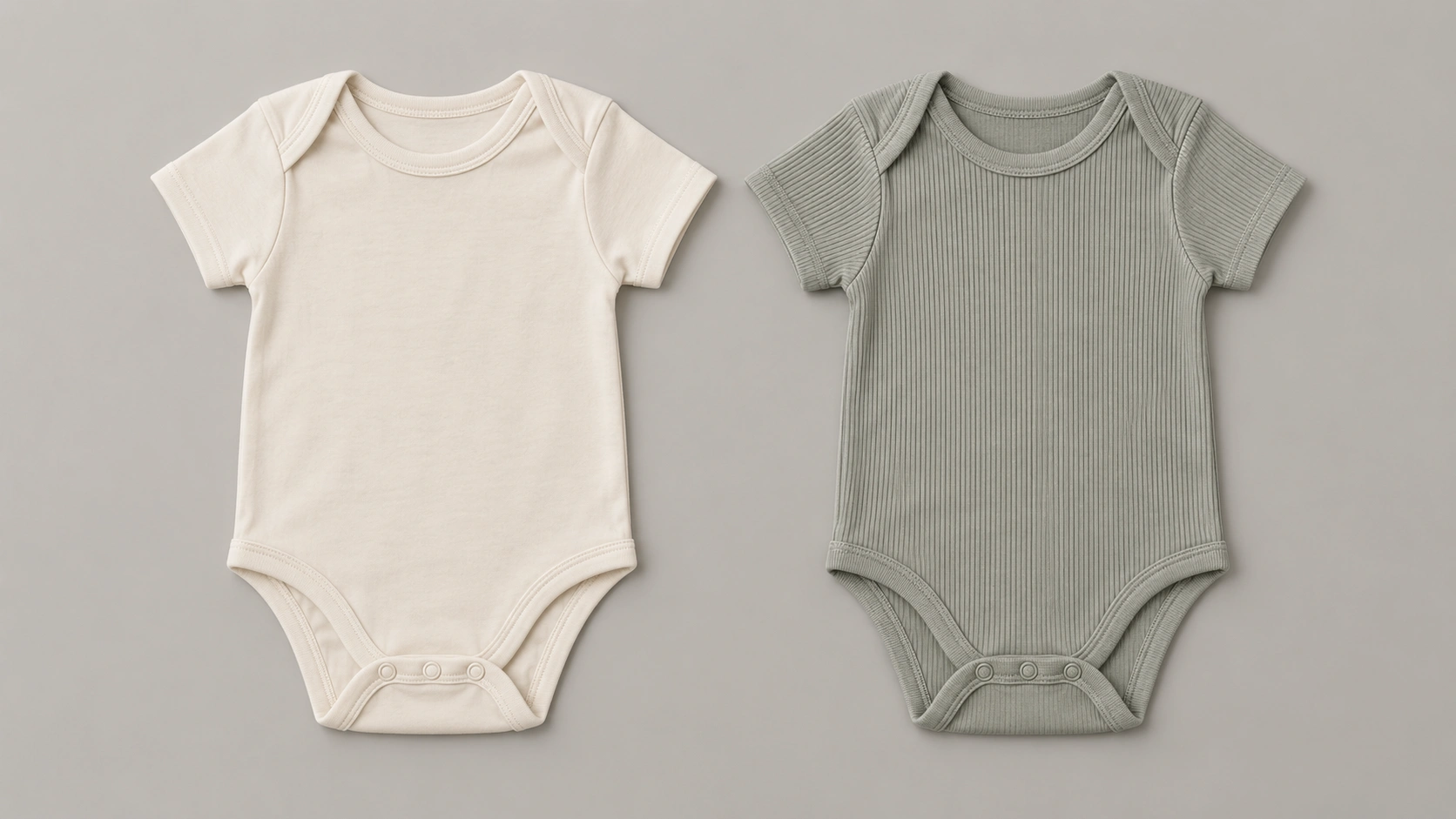
Quick Answer: Which Infant Bodysuit Should You Sample First?
Sample the BELLA + CANVAS 100B first when the approved brief calls for a lighter listed jersey platform, 32-singles construction, an envelope neck, and the BELLA + CANVAS product identity. Sample the Rabbit Skins 4400 first when the brief calls for a heavier listed 1×1 baby-rib platform, lap-shoulder construction, and the Rabbit Skins product identity. This is a sourcing direction, not a verdict about fit, comfort, safety, durability, or decoration quality.
The current records describe the 100B at 4.2 oz per square yard US in a base 100% Airlume combed and ring-spun cotton jersey specification. The 4400 is listed at 5.0 oz per square yard US in base 100% combed ringspun cotton 1×1 baby rib. Both have color-specific blend exceptions, expandable neckline or shoulder construction, side seams, snap leg closures, and tear-away label directions. The details matter, but physical samples and the exact ordered color control the decision.
Infant apparel requires careful product, decoration, labeling, packaging, and compliance review. A manufacturer or retailer product-page statement is not a substitute for a qualified compliance program. Preserve required tracking and care information, approve finished measurements, protect closures during decoration, and review the completed product for the intended market before sale or distribution.
Verified BELLA + CANVAS 100B vs Rabbit Skins 4400 Comparison
Start with the live BELLA + CANVAS 100B product page and Rabbit Skins 4400 product page. They establish the exact Beytees records and current construction claims. The matching official manufacturer pages provide additional style-level detail. None of these pages freezes current inventory, price, minimums, fulfillment, delivery, or a finished decoration result.
| Decision factor | BELLA + CANVAS 100B | Rabbit Skins 4400 | Buyer treatment |
|---|---|---|---|
| Base fabric direction | 4.2 oz 100% Airlume combed and ring-spun cotton jersey, 32 singles | 5.0 oz 100% combed ringspun cotton 1×1 baby rib | Verify the exact color because blend exceptions apply |
| Opening | Envelope neck | Lap shoulder with rib binding | Test dressing access and finished measurements; do not promise universal fit |
| Leg closure | Snap leg closure | Snap-tape or three-snap closure in current source wording | Protect hardware during decoration and inspect every finished piece |
| Construction | Side seams; tear-away label | Side seams; flatlock or coverstitch details; EasyTear label | Approve seam feel, appearance, placement, and label workflow on samples |
| Tracking statement | No equivalent claim found on the reviewed exact page | Product pages state CPSIA-compliant tracking label | Preserve required information and obtain qualified compliance review |
| First sample logic | Lighter listed jersey and 32-singles brief | Heavier listed baby-rib and lap-shoulder brief | Test both when fit, art, process, or completed cost decides |
Fabric weight and knit description are useful construction signals, not performance rankings. They do not prove softness, stretch, recovery, opacity, comfort, durability, shrinkage, print definition, wash life, safety, or buyer preference. Use the comparison to choose the first sample and then apply the same documented approval process to both candidates.
BELLA + CANVAS 100B: Jersey Construction Profile
The official BELLA + CANVAS 100B page describes solid colors as 4.2 oz 100% Airlume combed and ring-spun cotton at 32 singles, with heather blend exceptions. Current style features include side seams, an envelope neck, snap leg closure, and a tear-away label. The Beytees record also calls the base jersey pre-shrunk.
The jersey and 32-singles direction makes 100B a logical first sample for programs whose written specification already calls for a lighter listed blank and a smooth-looking jersey presentation. That may include personalized gift programs, small-brand collections, event merchandise, or coordinated family assortments. Those use cases are positioning ideas only; the sources do not establish a universal hand, fit, decoration result, or retail response.
The official page currently displays “New Style Coming Soon.” Do not translate that wording into a claim about Beytees inventory, manufacturer continuity, orderability, or a delivery date. Before quoting or approving production, verify the exact current product, size, color, fiber label, measurements, availability, and commercial terms through the live ordering channel.
Rabbit Skins 4400: Baby-Rib Construction Profile
The official Rabbit Skins 4400 page describes a 5.0 oz 100% combed ringspun cotton 1×1 baby-rib base, with color-specific blend exceptions. It lists lap shoulders, rib binding, short sleeves, flatlocked coverstitch at the armhole and side seam, snap-tape closure, side seams, an EasyTear label, and a CPSIA-compliant tracking-label claim.
The page currently shows sizes from newborn through 24 months and publishes finished measurements. Size names are not a promise that every infant of a stated age will fit the same way. Approve actual garment measurements, the intended size chart, dressing access, closure alignment, and a reasonable wearer-sample process before production. Never recommend sizing from age alone when measurements are available.
Sample 4400 first when the product brief specifically calls for baby-rib character, lap-shoulder styling, the listed seam and binding construction, or an established Rabbit Skins assortment. Do not claim that rib construction automatically delivers better comfort, flexibility, recovery, durability, or decoration performance. Those outcomes require direct evaluation of the exact lot and finished product.
Jersey vs Baby Rib: Fabric, Fit, and Color-Blends
Jersey and 1×1 baby rib differ in visible knit structure, but the product name does not settle real-world fit or feel. Fabric weight, yarn description, pattern dimensions, binding, seam construction, finishing, color blend, and laundering can all affect the received garment. Compare production-equivalent samples in every approved style, size, and representative color family.
For 100B, the base solid-color statement is cotton, while Heather CVC and Athletic Heather use listed cotton/polyester blends. For 4400, the official page lists blend exceptions for Ash, Heather, Granite Heather, CVC, and printed CVC colors. Confirm the exact fiber label and source record for the ordered color. This matters for artwork tests, care communication, receiving checks, and accurate customer-facing descriptions.
Build a finished-measurement worksheet rather than assuming both brands grade alike. Record body width, body length, sleeve, opening behavior, closure alignment, and decoration clearances using one consistent method. Document tolerances and the point at which a change triggers resampling. Keep any wearer review supervised, limited, and appropriate; it does not replace technical and compliance approval.
DTF, Heat Transfer, and Screen-Print Qualification
Neither exact product page establishes a universal DTF, heat-transfer, or screen-print recipe. Infant bodysuits add access and hardware considerations: the garment is small, the body has multiple layers and openings, and the snap area must be isolated from heat and pressure. Follow current equipment, ink, transfer, and blank instructions, then approve a production-equivalent sample.
| Control | What to test | Infant-product safeguard |
|---|---|---|
| Artwork | Physical size, line detail, placement, clearances, color, and contrast | Keep decoration clear of closures, required labels, seams, and sensitive openings |
| Press setup | Platen access, insert, layer isolation, pressure, time, temperature, and peel | Prevent direct pressure or heat damage to snaps and inspect hardware afterward |
| Substrate | Exact style, size, color, fiber blend, surface, stretch, and lot | Never assume a solid-color test approves heather or CVC variations |
| Finished result | Marks, distortion, adhesion, edge lift, opacity, hand, cracking, and migration | Reject rough, damaged, detached, distorted, or otherwise unsuitable results |
| Wash review | Use the approved care method and defined cycle count | Reinspect decoration, seams, binding, labels, and every closure after testing |
| Production control | Operator, equipment, consumables, settings, spoilage, and inspection rate | Retain an approved sample and stop on an unexplained material change |
For screen printing, record platen and garment support, ink, mesh, stencil, flash, cure verification, deposit, registration, hand, and wash result. For heat-applied decoration, record the exact transfer, support, protective materials, pressure, heat, time, peel, and inspection result. A successful test on one model, color, or size does not automatically approve the other.
Tracking Labels, Closures, Care, and Responsible Review
The 4400 pages state that the product includes a CPSIA-compliant tracking label. Treat that as a current source claim, not proof that a decorated, relabeled, packaged, or otherwise modified finished product satisfies every applicable requirement. The 100B reviewed pages do not present an equivalent statement. In either case, the seller remains responsible for accurate product records and qualified review.
Do not remove, cover, misstate, or make required tracking, fiber, country-of-origin, care, or other information unusable. If a tear-away label is removed for branding, confirm what information must remain, where it will appear, and how records connect the finished item to the source lot. Avoid decorative add-ons, loose components, packaging choices, or finishing methods that create preventable infant-use concerns.
Closures deserve a written inspection standard. Confirm snap presence, alignment, attachment, operation, surrounding fabric condition, and damage after pressing and washing. Quarantine any unexplained defect rather than repairing it casually. Route regulatory, labeling, testing, and market-specific questions to qualified professionals; this comparison is a sourcing guide, not legal or child-safety advice.
Personalized Gift, Brand, and Program Decision Matrix
Use the exact program brief to select the first sample. For broad category discovery, see the wholesale infant bodysuit guide. For the different baby-rib-versus-fine-jersey decision within Rabbit Skins, use the Rabbit Skins 4400 vs 4424 comparison. This page stays limited to 100B versus 4400.
| Written brief | First sample | Reason | Still to approve |
|---|---|---|---|
| Lighter listed jersey collection | 100B | 4.2 oz jersey and 32-singles direction | Exact color blend, measurements, decoration, labels, closures, and cost |
| Baby-rib and lap-shoulder assortment | 4400 | 5.0 oz 1×1 baby rib and lap-shoulder direction | Exact color blend, measurements, decoration, labels, closures, and cost |
| Gift set with brand-specific assortment | Match the required brand first | Product identity may be part of the approved range | Finished sample, packaging, labeling, current stock, and presentation |
| Multiple colors or heathers | Test both in representative blends | Both records list color-specific fiber exceptions | Contrast, marks, migration, wash result, shade, and description accuracy |
| Artwork near seams or leg opening | Test both | Construction and usable access differ | Physical clearance, platen setup, snap protection, and inspection |
| Long-term reorder program | Quote and sample both | Construction alone does not establish continuity or landed cost | Supplier record, substitution rule, lot control, availability, and reapproval |
Sample-to-Bulk Checklist for Infant Bodysuit Programs
Create one controlled specification for the blank, artwork, process, finished inspection, packaging, and reorder. Record the exact style, size, color, fiber label, current source, measurements, neckline or shoulder construction, binding, seams, closure, labels, and received condition. Photograph the undecorated sample and keep its lot or order record.
Approve the artwork at physical size. Document placement from stable reference points, the decoration method, equipment, platen or insert, consumables, settings, operator, and all closure-protection steps. Inspect the decorated sample before and after the approved care test. Define acceptable placement, appearance, feel, adhesion, distortion, seams, binding, labels, and snap condition.
Before bulk release, verify current availability, quantity, size allocation, color, commercial terms, freight, production allowance, spoilage, packaging, required date, and complete landed cost. Name who can approve a substitution. Any unapproved change in style, source, color blend, lot behavior, artwork, process, closure, label, packaging, or required compliance evidence should stop release and trigger documented review or resampling.
Frequently Asked Questions
What is the main difference between BELLA + CANVAS 100B and Rabbit Skins 4400?
The 100B is listed as a 4.2 oz jersey bodysuit with 32-singles construction and an envelope neck. The 4400 is listed as a 5.0 oz 1×1 baby-rib bodysuit with lap shoulders and additional rib-binding and coverstitch details. Those facts guide sampling; they do not establish a universal winner.
Is the BELLA + CANVAS 100B lighter than the Rabbit Skins 4400?
Yes, the current US product specifications list 100B at 4.2 oz per square yard and 4400 at 5.0 oz per square yard. Listed fabric weight alone does not prove softness, opacity, stretch, comfort, durability, shrinkage, or decoration quality.
What fabrics do the 100B and 4400 use?
Their base solid-color specifications are cotton: Airlume combed and ring-spun cotton jersey for 100B and combed ringspun cotton 1×1 baby rib for 4400. Both records list color-specific cotton/polyester exceptions, so verify the exact ordered color and fiber label.
Do the 100B and 4400 fit the same?
Do not assume they do. They use different knit, weight, pattern, opening, binding, and seam directions. Compare current finished measurements and production-equivalent samples for each intended size, then publish an approved size chart without promising that age labels fit every infant.
Which infant bodysuit is better for DTF or heat transfer?
There is no universal winner. Test the exact style, size, color, blend, artwork, transfer system, platen or insert, time, temperature, pressure, peel, marks, adhesion, edge lift, wash result, and snap protection before production.
Which style is better for screen printing?
Neither is automatically better. Qualify the exact garment with the intended artwork, platen support, ink, mesh, stencil, flash, cure verification, registration, deposit, hand, marks, wash result, and inspection standard. Approve 100B and 4400 separately.
Does baby-rib construction make the Rabbit Skins 4400 more comfortable?
No universal comfort conclusion follows from the knit name. Comfort depends on the complete garment, size, seams, binding, closure, decoration, care, wearer, and use. Treat baby rib as a construction distinction and evaluate finished samples responsibly.
What does the CPSIA tracking-label statement on the 4400 mean for a decorator?
The current product pages state that 4400 includes a CPSIA-compliant tracking label. Preserve required information and records, but do not treat the claim as proof that a decorated, relabeled, packaged, or modified finished product satisfies every applicable requirement. Obtain qualified compliance review.
Can the tear-away labels be replaced with a private label?
A tear-away feature does not by itself authorize incomplete relabeling. Before removal or replacement, determine which fiber, origin, care, tracking, identity, and other information must remain, where it must appear, and how the finished item links to source records.
What should buyers verify before a bulk infant bodysuit order?
Verify exact style, size, color, fiber label, measurements, opening, seams, binding, snaps, tracking and care information, artwork, placement, decoration test, wash result, finished inspection, packaging, current availability, commercial terms, substitution rule, compliance evidence, and complete landed cost.
Leave a Reply