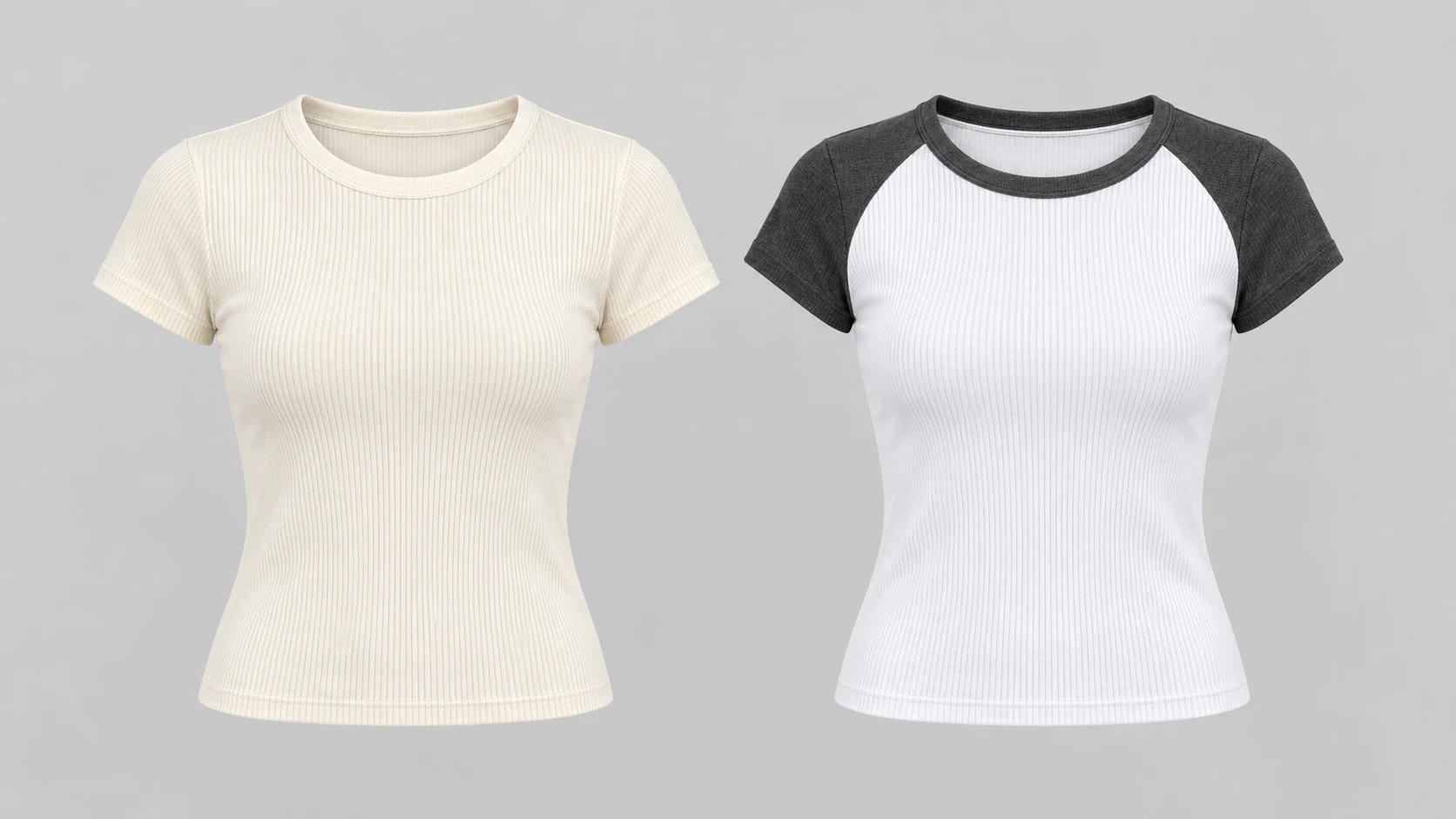
Quick Answer: Which Baby Tee Should You Sample First?
Sample the BELLA + CANVAS 1010 first when the approved brief calls for a straightforward fitted short-sleeve baby tee in 5.4 oz micro rib. Sample the BELLA + CANVAS 1201 first when the brief calls for an athletic-inspired contrast-sleeve baby tee marketed as a raglan style. Both currently share a listed 52/48 cotton/polyester micro-rib base, 32-singles construction, fitted direction, side seams, and tear-away label. The silhouette and color-blocking decision comes first; neither model is a universal quality, comfort, or decoration winner.
The official 1201 style name says “Raglan,” while its current feature text says “set-in cap sleeve” with contrast coloring. Do not silently resolve that wording difference. Inspect a current sample and technical record before promising seam geometry, artwork clearance, or production behavior. Likewise, the official pages currently display “New Style Coming Soon”; that wording does not establish Beytees stock, orderability, continuity, price, or delivery.
Use current product pages to identify the exact blanks, then approve production-equivalent samples. Verify the exact color blend, measurements, neckline, sleeves, decoration, care result, label workflow, packaging, commercial terms, and substitution policy. Shared specifications can narrow a sample plan, but they cannot replace physical qualification.
Verified BELLA + CANVAS 1010 vs 1201 Comparison
Begin with the live BELLA + CANVAS 1010 product page and BELLA + CANVAS 1201 product page. They identify the current Beytees records and core construction direction. The matching official pages add style-specific feature wording. None of the four pages freezes inventory, exact-variant availability, price, freight, lead time, delivery, margin, or decoration results.
| Decision factor | BELLA + CANVAS 1010 | BELLA + CANVAS 1201 | Buyer treatment |
|---|---|---|---|
| Base fabric | 5.4 oz, 52/48 Airlume cotton/polyester micro rib, 32 singles | 5.4 oz, 52/48 Airlume cotton/polyester micro rib, 32 singles | Verify the exact ordered color and received fiber label |
| Sleeve direction | Short sleeves | Contrast cap sleeves; marketed as raglan, with official feature text saying set-in | Inspect actual seam geometry before art approval |
| Silhouette wording | Body-hugging or fitted stretch direction | Fitted, mid-length, athletic-inspired direction | Compare measurements and samples; avoid universal sizing claims |
| Construction | Side-seamed; tear-away label | Side-seamed; crewneck binding; tear-away label | Approve neckline, seams, hem, and label workflow physically |
| Color structure | Single-garment color presentation | Contrast body, sleeve, and neckline combinations | Proof artwork against every ordered combination |
| First-sample logic | Simple short-sleeve baby-tee canvas | Contrast athletic-inspired baby-tee canvas | Test both when fit, art balance, or complete cost decides |
The shared fabric statement is useful because it focuses the comparison on silhouette, sleeve treatment, color blocking, artwork balance, and assortment role. It does not prove identical hand, stretch, recovery, opacity, shrinkage, fit, or production behavior. Current physical samples remain controlling.
BELLA + CANVAS 1010: Short-Sleeve Micro-Rib Profile
The official BELLA + CANVAS 1010 page currently describes a women’s micro-rib baby tee with a body-hugging silhouette, stretch-fit direction, short sleeves, side seams, women’s sizing, and a tear-away label. Its style-specific body lists 5.4 oz fabric, 32 singles, and a 52% Airlume combed and ring-spun cotton / 48% polyester micro-rib blend.
That straightforward short-sleeve presentation makes 1010 the logical first sample when the written brief calls for a simple baby-tee canvas where the garment body and artwork carry the visual story. Possible programs include fashion merch, creator capsules, dance or event collections, retail graphics, and coordinated assortments. These are positioning ideas, not promises about demand, comfort, fit, or sell-through.
The official document title still contains stale generic specifications that conflict with the current style-specific body. Use the style-specific body, not the page title metadata. Beytees additionally lists pre-shrunk construction and an Athletic Heather 90/10 exception. Attribute seller-only details accordingly and verify the current label; never convert “pre-shrunk” into “shrink-proof.”
BELLA + CANVAS 1201: Contrast-Sleeve Baby-Tee Profile
The official BELLA + CANVAS 1201 page identifies the style as the Women’s Micro Rib Raglan Baby Tee. The current body describes crewneck binding, a contrast set-in cap sleeve, mid-length silhouette, 1×1 micro rib, fitted stretch direction, pre-shrunk treatment, side seams, 5.4 oz fabric, 32 singles, and a base 52/48 cotton/polyester blend.
Sample 1201 first when contrast coloring and an athletic-inspired baby-tee presentation are explicit parts of the approved collection. The color blocking can frame small chest art, numbers, collegiate-inspired marks, or minimal wordmarks differently than a single-color short-sleeve tee. Those are design hypotheses. Approve the exact color combination and physical artwork on every representative size.
Do not describe 1201 seam geometry solely from “raglan” in the name because the current feature copy says “set-in cap sleeve.” Record what the received sample actually uses. The official and Beytees pages also show changing assortment signals; treat displayed colors and availability tools as mutable, not as a promise of current or future supply.
Short Sleeve vs Contrast Sleeve: Fit and Placement Sampling
Both records use fitted language, but that does not establish identical same-letter sizing or wearer experience. Compare current finished measurements using one documented method, then inspect body length, width, neckline, sleeve opening, armhole or seam location, hem, and usable decoration field. Fit approval should represent the intended audience and should not become a universal “true to size” statement.
Artwork placement must respect silhouette. A centered design on 1010 can be judged against a relatively simple body and sleeve frame. On 1201, contrast sleeves and neckline can visually compress or redirect attention even when the nominal print size is unchanged. Establish placement from stable physical reference points for each model and size instead of copying coordinates from a standard unisex tee.
Photograph undecorated and decorated samples on a flat surface using the same setup. Record measurements and visual clearances. If a wearer review is used, keep it voluntary and representative, document the size selected, and treat the feedback as program-specific. It does not prove comfort or fit for every customer.
DTF, Heat Transfer, and Screen-Print Qualification
Neither exact manufacturer page supplies a universal DTF, heat-transfer, or screen-print recipe. The micro-rib surface and fitted direction make production-equivalent testing especially important because artwork can interact with rib texture and garment stretch. Follow current transfer, ink, equipment, and blank instructions, then approve the exact style, size, color, and lot.
| Control | What to test | Why styles stay separate |
|---|---|---|
| Artwork | Physical size, line detail, placement, contrast, and clearances | 1201 color blocking changes visual balance around the same art |
| Substrate | Exact style, size, color, fiber blend, rib surface, and lot | Shared base specs do not prove identical received behavior |
| Heat application | Insert, pressure, time, temperature, peel, marks, shine, and distortion | Sleeve and neckline construction affect support and access |
| Screen print | Platen, mesh, stencil, ink, flash, cure, registration, deposit, and hand | Each pattern requires its own placement and production approval |
| Finished result | Adhesion, edge lift, rib flattening, cracking, color change, and appearance | Approve each ordered color combination independently |
| Care test | Supported whole-garment instructions and defined cycle count | Retest after any blank, decoration, or process change |
A successful 1010 test does not automatically approve 1201, and a white-body 1201 test does not approve every contrast combination. Retain an approved sample, process record, and defect standard. Stop when an unexplained change appears rather than compensating on the fly.
Color Blends, Contrast Combinations, and Label Controls
Both current Beytees records list the base 52/48 cotton/polyester construction and an Athletic Heather 90/10 exception. The official 1201 page repeats that exception. Verify the exact received label because color names, combinations, and fibers can change. Do not describe every 1010 or 1201 as 52/48 without preserving the color qualification.
For 1201, proof each body/sleeve/neckline combination with the final art colors. A design that reads clearly on White/Black may need a different treatment on White/Red or Athletic Heather/Black. Screen previews cannot establish actual shade, contrast, migration, press response, or lot consistency. Archive a physical approval or a documented equivalent.
Both products use tear-away label wording, but removal does not erase labeling responsibilities. Before private labeling, determine what fiber, origin, care, responsible-business, and other information must remain and how records will connect the finished garment to its source. Use qualified review for legal requirements; this buying comparison is not legal advice.
Women’s Merch and Collection Decision Matrix
Keep this head-to-head page narrow. The standalone 1010 guide and standalone 1201 guide own model-specific depth. The 1010 vs Comfort Colors 3023CL comparison covers fitted micro rib versus boxy garment-dyed positioning. For broader silhouette discovery, see the wholesale cropped-tee guide.
| Written brief | First sample | Reason | Still to approve |
|---|---|---|---|
| Simple baby-tee canvas for front art | 1010 | Short-sleeve, single-color presentation | Measurements, exact color blend, art, process, care, and cost |
| Athletic-inspired contrast collection | 1201 | Contrast cap-sleeve and neckline presentation | Seam geometry, combination, placement, process, and cost |
| Large central graphic | 1010 first; test both | Simpler visual frame may suit the brief | Actual printable field, rib behavior, and size grading |
| Small collegiate or number-based mark | 1201 first; test both | Color blocking may support the concept | Contrast, clearance, registration, and finished appearance |
| Multiple colors or heathers | Test both | Fiber and visual context vary by color | Labels, shade, migration, marks, wash result, and description |
| Long-term reorder program | Quote and sample both | Shared fabric facts do not establish continuity or landed cost | Supplier record, substitution rule, current terms, and reapproval |
Sample-to-Bulk Checklist for Baby Tee Programs
Create one controlled specification for blank identity, artwork, decoration, inspection, packaging, and reorder. Record exact style, size, color, fiber label, source, measurements, neckline, sleeves, seam geometry, side seams, hem, labels, and received condition. Photograph the blank and retain its order or lot reference.
Approve artwork at physical size. Document placement reference points, decoration method, equipment, platen or insert, consumables, settings, operator, and inspection criteria. Evaluate contrast, marks, distortion, rib texture, adhesion or cure, hand, edge condition, and appearance before and after the supported care test. Define what fails and who can release production.
Before bulk release, verify current availability, quantity, size allocation, exact color combinations, commercial terms, freight, production allowance, spoilage, packaging, required date, and complete landed cost. Name the person who may approve a substitution. Any unapproved change in style, color, fiber, dimensions, seam construction, artwork, process, label, source, or packaging should stop release and trigger review or resampling.
Frequently Asked Questions
What is the main difference between BELLA + CANVAS 1010 and 1201?
Both current records list 5.4 oz, 32-singles micro rib and a fitted, side-seamed direction. The 1010 is the straightforward short-sleeve baby tee, while the 1201 is the contrast-sleeve athletic-inspired style marketed as a raglan baby tee. The distinction guides sampling; it does not establish a universal winner.
Do the 1010 and 1201 use the same fabric?
Their current base specifications both list 5.4 oz, 52% Airlume combed and ring-spun cotton and 48% polyester micro rib at 32 singles. Athletic Heather is listed separately at 90% cotton and 10% polyester. Verify the exact ordered color and received label rather than generalizing across every variation.
Is the BELLA + CANVAS 1201 a true raglan construction?
The style name markets 1201 as a Micro Rib Raglan Baby Tee, while the current official feature text says set-in cap sleeve with contrast coloring. Treat that wording difference as a reason to inspect the physical sample and current technical record before describing seam geometry or building artwork around it.
Do BELLA + CANVAS 1010 and 1201 fit the same?
Do not assume identical fit from shared fabric and fitted wording. Sleeve construction, neckline treatment, pattern dimensions, color blocking, size grading, and production variation can affect the finished garment. Compare current measurements and production-equivalent samples in each intended size.
Which baby tee is better for DTF or heat transfer?
Neither is universally better. Test the exact style, size, color, blend, artwork, transfer system, platen or insert, time, temperature, pressure, peel, visible marks, rib distortion, adhesion, edge lift, and approved care cycle before production.
Which style is better for screen printing?
There is no automatic winner. Qualify artwork scale, placement, garment support, ink, mesh, stencil, flash, cure verification, registration, deposit, hand, marks, rib behavior, contrast panels, and wash result separately for 1010 and 1201.
How should artwork placement differ between 1010 and 1201?
Build placement from physical reference points on each sampled size. The 1010 offers a simpler short-sleeve presentation, while the 1201 uses contrast cap-sleeve and neckline styling that may change the visual balance. Approve physical-size proofs instead of reusing one generic tee template.
Can the tear-away label be replaced for a private-label program?
A tear-away feature helps removal but does not eliminate labeling duties. Determine which fiber, origin, care, responsible-business, and other required information must remain, where it must appear, and how the finished garment connects to source records before replacing any label.
Does 5.4 oz micro rib prove softness, comfort, stretch, or durability?
No. Fabric weight, fiber percentages, singles count, and micro-rib terminology describe listed construction. They do not prove wearer comfort, recovery, opacity, shrinkage, colorfastness, durability, decoration quality, or wash life. Evaluate the complete decorated garment under the intended use.
What should buyers verify before a bulk baby tee order?
Verify exact style, size, color, fiber label, measurements, sleeve and neckline construction, artwork, placement, decoration test, approved care result, labels, packaging, current availability, commercial terms, substitution rule, quality tolerances, and complete landed cost before release.
Leave a Reply