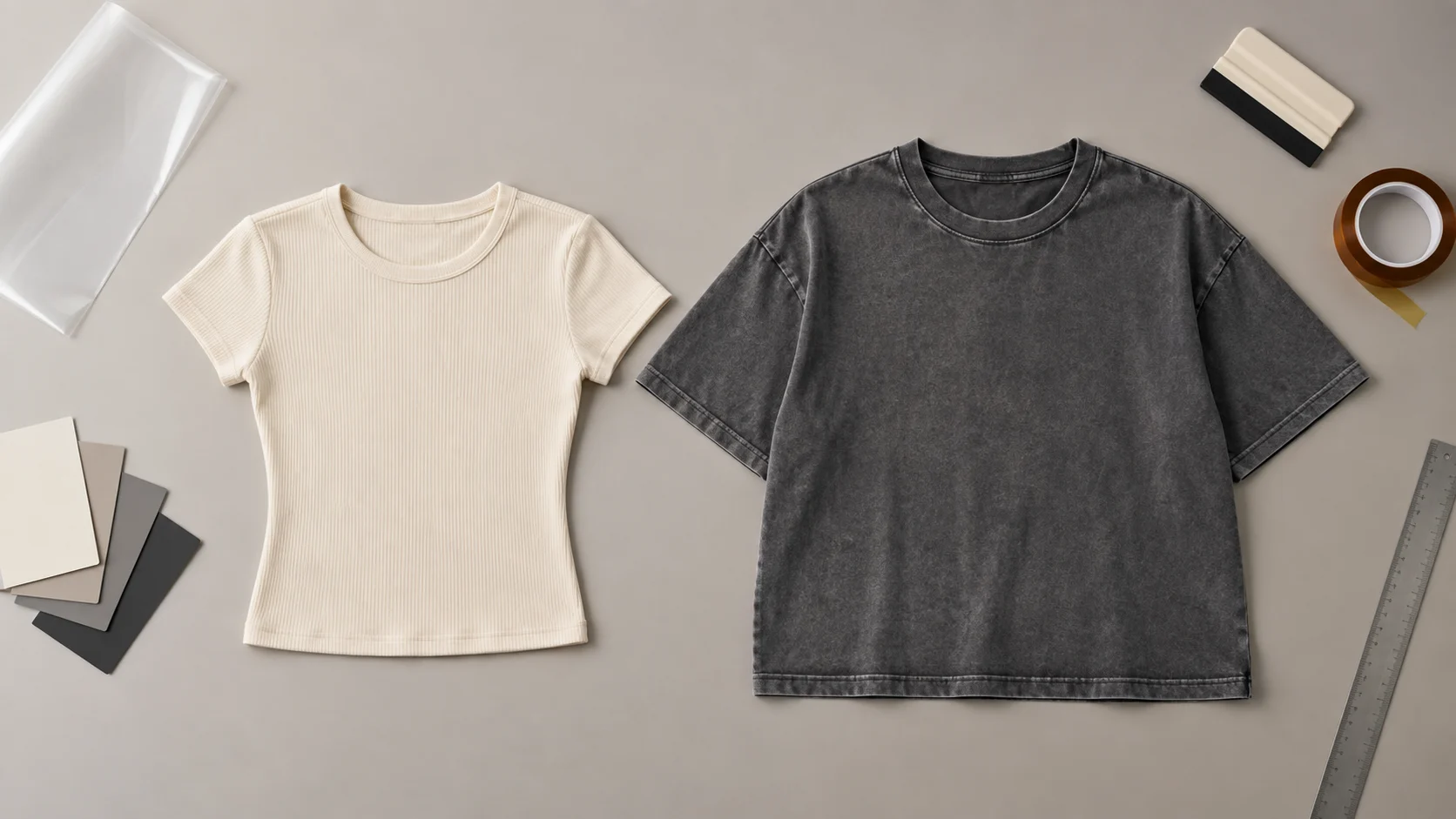
Quick answer: the BELLA CANVAS 1010 vs Comfort Colors 3023CL decision starts with silhouette, not a universal quality ranking. Sample the BELLA+CANVAS 1010 first when the brief calls for the manufacturer’s body-hugging, stretch-fit micro-rib baby tee. Sample the Comfort Colors 3023CL first when the brief calls for the manufacturer’s boxy, mid-length, garment-dyed tee with a higher published fabric weight. Test both when customer ease, artwork scale, label workflow, or sizing is still uncertain.
The two styles are not interchangeable women’s blanks. Current official sources list different fibers, fabric weights, body construction, labels, size menus, and measurement methods. This comparison keeps those distinctions visible without promising fit, comfort, stock, price, shrink performance, decoration results, or a one-setting DTF recipe.
BELLA+CANVAS 1010 vs Comfort Colors 3023CL: Source-Aware Comparison
Start with the live BELLA+CANVAS 1010 product page and Comfort Colors 3023CL product page. Then compare the seller listings with the current official BELLA+CANVAS 1010 page and official Comfort Colors 3023CL page. Product pages are useful decision inputs, but the received garment and production-equivalent sample should control final approval.
| Buying factor | BELLA+CANVAS 1010 | Comfort Colors 3023CL | Buyer action |
|---|---|---|---|
| Current official identity | Women’s Micro Rib Baby Tee | Heavyweight Women’s Boxy T-Shirt | Use the exact style code on samples and purchase records |
| Published fabric weight | 5.4 oz/yd² | 6.1 oz/yd² | Treat the 3023CL as the higher published weight; infer nothing about opacity, comfort, durability, or print quality |
| Main published fiber | 52% Airlume combed and ring-spun cotton / 48% polyester micro rib, 32 singles | 100% ring-spun U.S. cotton | Verify the received label and qualify the exact color and garment |
| Official silhouette wording | Body-hugging silhouette; stretch fit; women’s sizing | Boxy fit; mid-length | Choose the intended shape before comparing secondary details |
| Body construction | Side-seamed | Seamless body | Build placement templates from representative physical sizes |
| Label | Tear-away label | Signature twill label | Plan any replacement-label workflow before removing an original label |
| Current manufacturer size menu | XS–2XL | S–2XL | Do not treat a menu as live Beytees stock or proof of equivalent sizing |
The comparison does not produce an overall winner. It narrows the first sample to the model whose verified published construction is closer to the merchandise brief. Buyers who need deeper single-style context can read the BELLA+CANVAS 1010 wholesale guide and Comfort Colors 3023CL printing guide. Those prior guides do not replace current source checks or physical testing.
Baby-Tee vs Boxy, Mid-Length Silhouette
BELLA+CANVAS describes the 1010 as body-hugging with a stretch fit. Comfort Colors describes the 3023CL as boxy and mid-length. These are manufacturer terms, not universal fit standards. Neither phrase establishes that a garment is true to size, runs small, suits every body, or will produce a particular appearance on a wearer.
The current measurement charts also use different labels. BELLA+CANVAS publishes “body length from HPS at CF” and “chest” for the 1010. Comfort Colors publishes “width,” “length,” and “sleeve center back” for the 3023CL. Do not silently treat chest and width as the same measurement method or double either number into a circumference unless the source defines that conversion.
| Official chart | XS | S | M | L | XL | 2XL |
|---|---|---|---|---|---|---|
| 1010 body length from HPS at CF (in) | 18.5 | 19 | 19.625 | 20.375 | 21.125 | 21.875 |
| 1010 chest (in) | 13.5 | 14.25 | 15 | 16 | 17 | 18 |
| 3023CL length (in) | Not listed | 20 | 21 | 22 | 23 | 24 |
| 3023CL width (in) | Not listed | 18.25 | 20.25 | 22 | 24 | 26 |
| 3023CL sleeve center back (in) | Not listed | 15.625 | 16.5 | 17.375 | 18.375 | 19.25 |
Use those numbers within each manufacturer’s stated system, then measure received samples consistently. A same-letter-size comparison is not enough because the silhouettes, starting sizes, chart labels, and grading are different. If neither direction is settled, the wholesale cropped T-shirt guide gives broader silhouette context without making the 1010 and 3023CL equivalent.
Micro Rib vs Garment-Dyed Cotton
The 1010’s current official body lists a 5.4 oz/yd² 52/48 cotton/polyester micro rib at 32 singles. The 3023CL page lists a 6.1 oz/yd² 100% ring-spun U.S.-cotton garment-dyed fabric and calls the style heavyweight. These facts identify different substrates and finishes. They do not prove softness, comfort, opacity, stretch recovery, durability, colorfastness, wash life, or decoration quality.
A source caveat matters for the 1010: the current BELLA+CANVAS HTML document title contains stale generic wording that conflicts with the style-specific rendered body. This article follows the rendered 1010 product details and size chart, not the generic title metadata. Beytees currently describes the 1010 as pre-shrunk and lists an Athletic Heather fiber exception, but those statements were not present in the reviewed manufacturer body. Treat them as seller-page statements unless a current manufacturer document or received label confirms them.
The Comfort Colors raw HTML is a generic JavaScript application shell. The 3023CL facts used here come from the publicly rendered model-specific page and its opened product tabs and size chart, not from the shell alone.
Comfort Colors states that the 3023CL is garment-dyed and uses low-shrink wording. That is not a shrink-proof promise for a finished decorated garment. Test the exact received color and lot after decoration. Neither product’s finish should be converted into a performance or feel claim without evidence.
Side-Seamed vs Seamless Body: Plan Artwork on Samples
The 1010 is officially side-seamed; the 3023CL has a seamless body. This verified contrast can affect where a team establishes center lines, side references, and usable decoration fields. It does not establish dimensional stability or guarantee that one style is easier to print.
Scale the design on representative physical sizes. Check the neckline, sleeve opening, body length, side construction, and intended visual balance. A placement template developed for a standard unisex tee should not be copied to either silhouette without review. Record artwork dimensions and placement references for each approved style-size group rather than relying on one generic mockup.
When you want more Comfort Colors production context, see the Comfort Colors DTF overview. It is broader guidance, not a 3023CL-specific recipe or performance guarantee.
Tear-Away vs Signature Twill Label
BELLA+CANVAS confirms a tear-away label on the 1010. Comfort Colors identifies a signature twill label on the 3023CL and does not describe it as tear-away. That difference can influence workflow planning, but neither blank becomes legally ready for private-label sale merely because an original label can be removed.
The FTC’s textile labeling guidance explains that most covered textile products need fiber content, country of origin, and the identity of the manufacturer or another responsible business. It also explains conditions for replacing another company’s label and recordkeeping when a retailer substitutes a label. Exact obligations depend on the product, seller role, origin, placement, and current law; this article is not legal advice or a compliance guarantee.
Care labeling is separate. The FTC’s Care Labeling Rule guidance explains that instructions require a reasonable basis and must account for the whole finished garment. The blank, transfer, ink, pretreatment, replacement label, trim, and other components can affect supportable care instructions. Do not invent a wash temperature, dryer setting, ironing rule, bleach instruction, or dry-clean statement.
DTF Qualification Without an Unsupported Recipe
Neither exact manufacturer product page publishes a style-specific DTF time, temperature, pressure, peel, post-press, cure, or laundering formula. Follow the current instructions from the transfer-system supplier and qualify the actual press, transfer batch, garment, color, size, and placement. Published fiber content alone cannot award a DTF winner.
- Identify the sample: record style, color, size, received fiber label, lot, transfer batch, artwork, placement, press, platen, and operator.
- Follow the transfer supplier: use its current documented process with calibrated equipment instead of copying an unverified universal setting.
- Decorate production-equivalent garments: include every approved color or material variant and representative sizes.
- Inspect the 1010: evaluate adhesion, edge lift, stretch distortion, rib flattening, press marks, shine, scorching, color change, hand, and laundering without predicting an outcome.
- Inspect the 3023CL: evaluate the exact garment-dyed color and lot for shade response, press marks, color change, adhesion, edge lift, hand, and laundering.
- Retain evidence: keep an approved sample, test record, placement reference, and supported finished-garment care instructions; reopen qualification when a material variable changes.
Verify the Exact Variant at Order Time
At the September 22, 2026 research snapshot, the Beytees 1010 parent displayed 12 color labels, six size labels, and 72 parent variation IDs. The 3023CL parent displayed 14 color labels, five size labels, and 70 parent variation IDs. Both aggregate parent stock fields were false even though the records were purchasable. Those observations do not establish exact-variant inventory, price, orderability, replenishment, quantity, or delivery timing.
The official Comfort Colors page showed 13 current color choices while Beytees displayed 14 selector labels. Do not silently reconcile that difference. Confirm the exact requested color and size on the live page and again at order time. Browse the wider BELLA+CANVAS category or Comfort Colors category if the sampled style does not meet the brief.
Conversion step: open both exact product pages, choose the candidate color and size range, then verify live commercial terms before committing to a customer quote. Static article copy should never replace the current product and checkout evidence.
Buyer Decision Framework
| Merch brief | Reasonable first sample | Required gate before bulk |
|---|---|---|
| Body-hugging stretch-fit micro-rib direction, side seams, tear-away label, or an XS option | BELLA+CANVAS 1010 | Approve exact measurements, received label, decoration, placement, care evidence, and exact variant |
| Boxy, mid-length, garment-dyed, 100% cotton direction with a higher published fabric weight and seamless body | Comfort Colors 3023CL | Approve exact color and lot, measurements, decoration, placement, care evidence, and exact variant |
| Audience ease, body length, artwork scale, label workflow, or finish is undecided | Test both | Use representative samples and a written scorecard; do not decide from same-letter sizing |
| Margin or timing controls the program | Sample the closer silhouette, then compare live economics | Include freight, spoilage, sample cost, relabeling, packaging, labor, returns, and current exact-variant terms |
Choose the model whose verified sample matches the intended silhouette and finished-product brief. A specification sheet can prioritize a test; it cannot substitute for one. If both samples miss the target, return to the live categories rather than forcing a winner.
Production-Sample Checklist
- Confirm exact style code, color, size range, received fiber label, lot, and current supplier record.
- Measure representative garments using a documented method and preserve each manufacturer’s chart labels.
- Approve silhouette and ease with the intended audience; avoid “true to size” assumptions.
- Map seams, neckline, sleeve opening, body length, artwork dimensions, and placement references.
- Decorate exact production colors and sizes with the intended transfer system and equipment.
- Record immediate appearance, later observations, laundering evidence, and supported finished-garment care.
- Complete any replacement labeling before removing required original information.
- Verify live variant availability, commercial terms, freight, quantity, and timing at order time.
- Retain the approved sample and reopen testing after any material, supplier, process, or artwork change.
Frequently Asked Questions
What is the main difference between the BELLA+CANVAS 1010 and Comfort Colors 3023CL?
The 1010 is officially a body-hugging, stretch-fit 52/48 cotton-polyester micro-rib baby tee. The 3023CL is officially a boxy, mid-length, garment-dyed 100% cotton tee with a higher published fabric weight. Sample the silhouette that matches the brief.
Is the 1010 a fitted baby tee and the 3023CL a boxy tee?
BELLA+CANVAS uses body-hugging, stretch-fit, and baby-tee wording for the 1010. Comfort Colors uses boxy-fit and mid-length wording for the 3023CL. Those terms do not prove true-to-size behavior or a universal fit on every wearer.
Which shirt has the higher published fabric weight?
The 3023CL has the higher published weight at 6.1 oz/yd², compared with 5.4 oz/yd² for the 1010. Weight alone does not prove opacity, comfort, durability, print quality, or suitability for a specific customer.
Are both shirts 100% cotton?
No. The current 1010 manufacturer body lists 52% Airlume combed and ring-spun cotton and 48% polyester micro rib. The 3023CL page lists 100% ring-spun U.S. cotton. Verify the received label for the exact garment.
How do the current manufacturer size menus differ?
The 1010 menu currently runs from XS through 2XL, while the 3023CL menu runs from S through 2XL. A menu is not proof of stock, and same-letter sizes are not automatically equivalent across the two measurement systems.
Is the 1010 side-seamed and the 3023CL seamless?
Yes, according to the current official product pages: the 1010 is side-seamed and the 3023CL has a seamless body. Use physical samples to establish artwork centers, usable decoration fields, and size-specific placement references.
Which label is tear-away?
The 1010 has a manufacturer-confirmed tear-away label. Comfort Colors lists a signature twill label for the 3023CL, not a tear-away label. Label removability does not eliminate applicable replacement-label and care duties.
Which tee is better for DTF printing?
Neither is a universal DTF winner from the reviewed sources. The exact product pages provide no style-specific DTF recipe or decorated-garment guarantee. Follow the transfer supplier and test the actual garment, color, size, press, artwork, and placement.
What must be tested before decorating either style in bulk?
Test production-equivalent samples for measurements, placement, adhesion, edge lift, press marks, distortion, color or shade response, hand, laundering, and supportable finished-garment care. Retain an approved sample and reopen testing when a material variable changes.
What labeling and care issues matter when selling either style under a private label?
FTC guidance addresses fiber content, origin, responsible-business identity, replacement labels, records, and separate care-label duties. Preserve required information and use evidence for the whole decorated garment. Obtain qualified advice for the actual product and selling channel.
Final Recommendation
Sample the 1010 first for an intentional body-hugging stretch micro-rib baby-tee direction. Sample the 3023CL first for an intentional boxy, mid-length, garment-dyed cotton direction with the higher published weight. Test both if the audience, measurements, artwork scale, label plan, or exact color response remains open.
Ready to compare live options? Review the exact 1010 listing and 3023CL listing, verify the requested variants, and order only after the production-sample gates fit your merchandise brief.