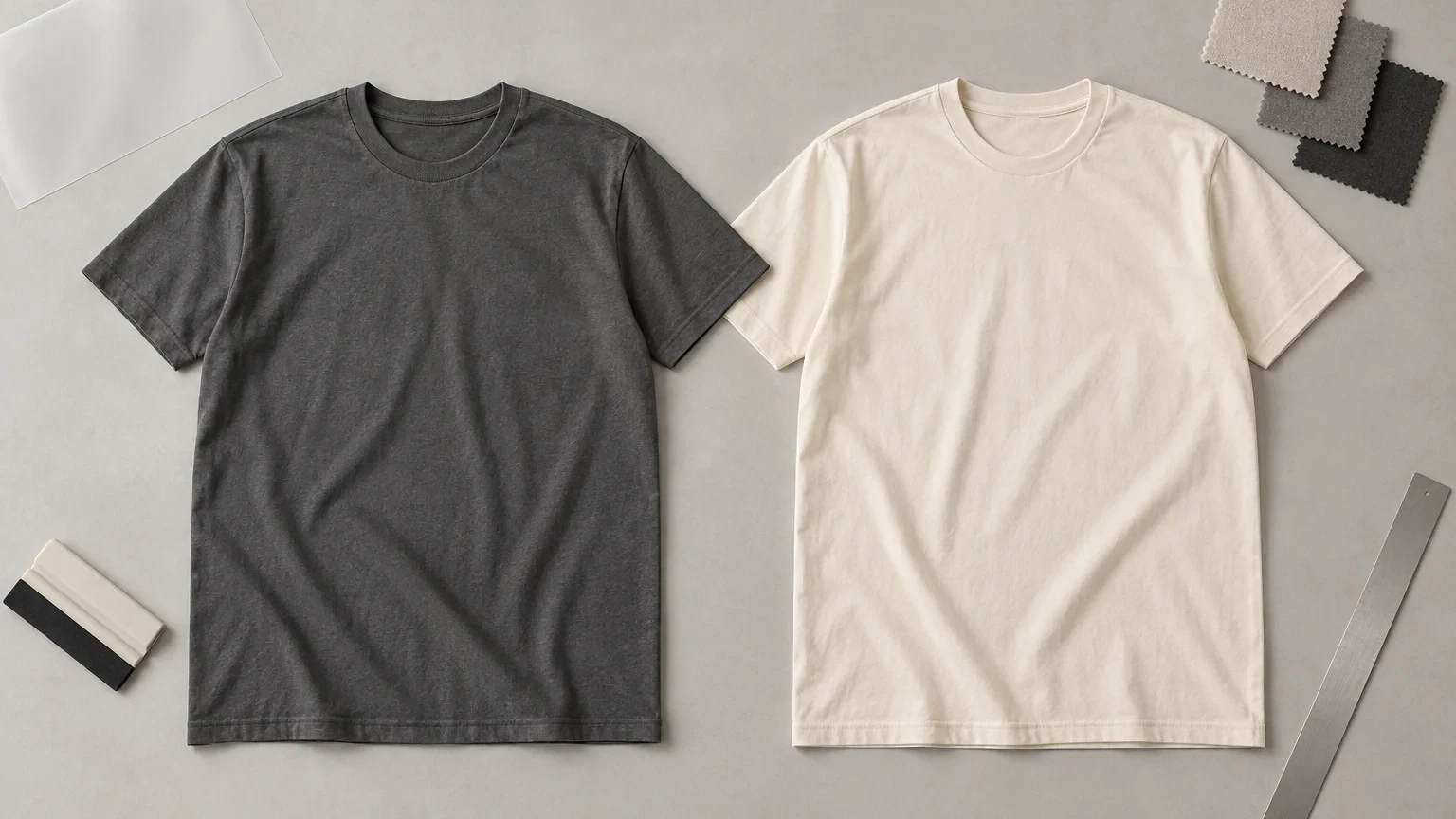
Quick answer: the Gildan 64000 and Tultex 202 are both ring-spun crewneck blanks worth sampling for everyday merch, but neither is a universal winner. Choose by the exact color’s fiber content, current garment measurements, seam construction in the sizes you will sell, and a production-equivalent decoration test. One important source conflict must stay visible: Beytees lists the Gildan 64000 at 4.5 oz/yd², while Gildan’s current official G64000 page lists 4.3 oz/yd². Confirm the current supplier document or received blank before making weight-sensitive decisions.
This Gildan 64000 vs Tultex 202 guide separates manufacturer specifications, current Beytees catalog signals, and practical buyer controls. It does not promise stock, price, fit, softness, wash life, decoration performance, certification, or a universal press recipe.
Gildan 64000 vs Tultex 202: Source-Aware Comparison
Start with the current Gildan 64000 product page and Tultex 202 product page. Then reconcile those seller listings with the current official Gildan G64000 page and official Tultex 202 page. A selector or marketing phrase is a useful lead, not a substitute for the received garment.
| Buying factor | Gildan 64000 / G64000 | Tultex 202 | Safe buyer action |
|---|---|---|---|
| Published fabric weight | Beytees: 4.5 oz/yd²; official Gildan: 4.3 oz/yd² | Beytees and Tultex: 4.5 oz/yd² | Do not call the styles equal-weight; verify current documentation or a received sample |
| Solid-color fiber | Official source says 100% ring-spun cotton | Official source says 100% ring-spun cotton unless otherwise noted | Confirm the exact color label because heather exceptions apply |
| Published fit wording | Modern classic fit | Beytees lists unisex; the reviewed Tultex page does not publish a precise fit class | Compare current measurements and physical samples rather than adjectives |
| Neck and shoulder details | Taped neck and shoulders; narrow-width rib collar on Beytees | Ribbed crew neck and taped neck/shoulders; Beytees also states back-neck and shoulder-to-shoulder taping | Inspect collar geometry and usable print clearance on each sample |
| Body construction | The reviewed exact sources do not verify tubular versus side-seamed construction | Tultex says tubular; Beytees says 4XL and 5XL have side seams | Check each ordered size before approving side or wrap placements |
| Removable label | Tear-away label | Tear Anywhere label; Beytees describes it as tear-away | Plan legally sufficient replacement labeling before removing the original |
| Current manufacturer size menu | Official page displayed XS–5XL | Official page displayed XS–3XL | Treat menus as current page observations, not measurements or Beytees inventory |
The 4.3-versus-4.5 oz Gildan conflict is not a reason to discard the style. It is a reason to stop treating one number as permanent truth. A distributor page, manufacturer retail page, warehouse specification, and received label can reflect different revisions or data paths. For a program where weight matters, capture the current supplier record and compare it with the actual lot.
Fiber Content Changes With Color
For applicable solids, both manufacturers describe ring-spun cotton. The important qualification is “applicable.” Polyester content changes how a garment can respond to heat, color migration, discharge processes, and care. Do not approve a solid and silently extend that approval to every heather.
| Style and color family | Published fiber content | Production implication |
|---|---|---|
| Gildan solids | 100% ring-spun cotton | Qualify the exact color, transfer, press, and finished care system |
| Gildan Sport Grey and Antique Heathers | 90% cotton / 10% polyester | Reopen heat and migration testing |
| Gildan Heathers | 65% polyester / 35% cotton | Use a blend-specific qualification; do not inherit solid results |
| Gildan Graphite Heather on Beytees | 50% cotton / 50% polyester | Verify the exact current variant record and garment label |
| Tultex Heather Grey | 90% cotton / 10% polyester | Test separately from solid cotton colors |
| Other Tultex Heathers | 50% cotton / 50% polyester | Include delayed color-shift and migration review |
Browse the wider Gildan catalog or Tultex catalog when the exact candidate does not meet the brief. For more context on the G64000’s role, use the Gildan 64000 buying guide, but verify live commercial terms rather than carrying forward an older price or availability statement.
Fit, Size Labels, and Seam Uncertainty
Gildan calls the 64000 a modern classic fit. Beytees calls the Tultex 202 unisex, while the reviewed Tultex product page does not provide a precise fit class or body-measurement table. Those labels are not interchangeable size charts, and neither proves “true to size,” relaxed, slim, or retail fit.
At the September 21, 2026 catalog check, both Beytees selectors displayed XS through 5XL. That shared label range does not prove matching chest width, length, sleeve geometry, tolerance, grading, or stock. Measure received garments from representative sizes and run wear checks with the audience the program actually serves. If the brief is still open, the BELLA + CANVAS 3001 versus Gildan 64000 comparison provides another light jersey decision path.
Seam evidence also differs. Tultex states tubular construction for the 202, while Beytees identifies a side-seam exception for 4XL and 5XL. The reviewed current Gildan and Beytees pages do not verify whether the G64000 body is tubular or side-seamed. Do not fill that gap with a third-party assumption. Inspect the exact size before placing art near a side, approving a wrap, or calculating a decoration field.
For other Gildan positions, compare the Gildan 5000 versus 64000 guide and Gildan 3000 versus 64000 guide. For a Tultex-only decision, the Tultex 202 versus 216 comparison separates two different styles without pretending their fit is identical.
A DTF Test Workflow, Not a Universal Recipe
Neither reviewed manufacturer source publishes a universal DTF time, temperature, pressure, peel, or cure recipe for this exact head-to-head. Gildan lists several decoration categories but does not explicitly list DTF on the reviewed G64000 page. Tultex discusses heat transfer and other methods in its decoration guidance and repeatedly uses test-first language. Its approximate fabric-drying guidance is not a 202-specific DTF formula. The manufacturer’s FAQ guidance also supports sample-led evaluation rather than a result guarantee.
- Freeze the variables: record style, color, size, fiber label, lot, transfer system, artwork, placement, platen, press identity, and operator.
- Follow current supplier instructions: use the transfer-system maker’s instructions and a calibrated press; do not copy an internet setting without validation.
- Decorate the exact garment: include every approved fiber/color family and sizes that change seam or placement conditions.
- Inspect immediately: look for adhesion gaps, edge lift, press marks, scorching or color change, distortion, shine, collar interference, and seam pressure.
- Observe later: recheck polyester-containing colors for delayed dye migration or color shift on the schedule appropriate to the materials.
- Run supported care tests: evaluate the full finished garment under substantiated care instructions, not an invented wash routine.
- Approve and retain a standard: keep a production-equivalent sample and recorded process; reopen approval when a material variable changes.
The broader wholesale blank T-shirts for DTF guide can help build a shortlist. The exact transfer, garment, color, press, and workflow still control the production decision. No style name guarantees adhesion, migration resistance, wash life, or a particular hand.
Tear-Away Labels and Private-Label Duties
A tear-away label makes removal easier; it does not make an unlabeled garment lawful or complete. The FTC’s textile labeling guidance explains that most covered textile products need fiber content, country of origin, and manufacturer or responsible-dealer identity. Businesses using an RN should confirm that the identifier and company relationship are correct for their program.
Care is a separate duty. The FTC’s Care Labeling Rule guidance describes the need for a reasonable basis and warns that instructions must account for the whole finished garment. A transfer, ink, embroidery, replacement label, or attached component can change what care instructions are supportable.
- Photograph and record the original garment labels before removal.
- Preserve or replace required fiber, origin, responsible-business, and care information.
- Base replacement care instructions on evidence for the blank plus decoration system.
- Keep invoices, lot records, approved samples, test results, and label artwork with the job.
- Use qualified legal or compliance support for the actual product and selling channel; this comparison is not legal advice.
The tear-away-label blank T-shirt guide offers broader category context. Its older product claims should not override the current sources and safeguards in this exact comparison.
Current Beytees Catalog Snapshot
Snapshot: September 21, 2026, 10:37 CDT. These are mutable catalog observations, not inventory or pricing promises. The Gildan 64000 parent showed 72 color selector labels, nine size labels from XS through 5XL, and 648 indexed parent variation IDs. The Tultex 202 parent showed 71 color labels, the same nine size labels, and 639 indexed parent variation IDs.
Both parent records were purchasable in the Store API while their aggregate is_in_stock fields were false. Five Tultex labels included “(disc),” but that text does not prove present stock, permanent discontinuation, or replenishment timing. Variation-level detail was unavailable through the tested public route. Confirm the exact color, size, live quote, quantity, and timing at order time; do not promise a customer from the parent selector alone.
Which Blank Should You Sample First?
| Scenario | Reasonable first move | Gate before bulk |
|---|---|---|
| Your specification calls for Gildan’s published modern classic fit or a particular G64000 color | Sample the Gildan 64000 first | Resolve the current weight record and verify fit, construction, decoration, and care on received units |
| Your placement depends on Tultex’s published tubular construction in sizes below the stated 4XL/5XL exception | Sample the Tultex 202 first | Inspect every production size and do not generalize the tubular statement to 4XL or 5XL |
| You need a polyester-containing heather | Order the exact heather from both candidates if available | Run separate heat, migration, appearance, and care qualification |
| Fit and hand drive the customer decision | Test both styles in representative sizes | Use measurements and wear feedback; do not decide from “modern classic” or “unisex” alone |
| Your margin is tight | Compare live landed economics after sampling | Include freight, spoilage, relabel labor, test cost, decoration yield, and current exact-variant pricing |
Production Checklist Before a Bulk Order
- Confirm the exact style, color, size range, fiber label, lot, and current supplier specification.
- Resolve the Gildan weight conflict if weight affects the brief or customer claim.
- Measure representative garments and approve fit with the intended audience.
- Inspect side-seam or tubular construction in every production size.
- Map collar, shoulder tape, hems, seams, and usable artwork area.
- Decorate the exact color/fiber families with production-equivalent materials and equipment.
- Document immediate appearance, delayed migration, laundering, and finished-garment care evidence.
- Finalize legally sufficient fiber, origin, business-identity, and care labeling before label removal.
- Confirm live variant availability, landed cost, freight, quantity, and timing.
- Retain an approved sample and reopen qualification after any material change.
Frequently Asked Questions
What is the main difference between the Gildan 64000 and Tultex 202?
The sources differ most clearly in published fit wording, seam evidence, color-specific fibers, and the Gildan weight conflict. Gildan calls the 64000 modern classic; Tultex publishes tubular construction for the 202, while Beytees notes side seams in 4XL and 5XL.
Are the Gildan 64000 and Tultex 202 the same fabric weight?
Do not claim that they are verified equal-weight blanks. Beytees lists both at 4.5 oz/yd², but Gildan’s current official G64000 page lists 4.3 oz/yd². Confirm current supplier documentation or a received sample.
Are both shirts always 100% cotton?
No. Applicable solids are listed as ring-spun cotton, but polyester-containing heathers exist in both style families. Verify the exact color’s fiber label and reopen decoration and care testing when the blend changes.
How does the Gildan modern-classic fit compare with the Tultex 202 unisex listing?
The reviewed sources do not provide enough directly comparable measurement evidence to convert those labels into a fit verdict. Measure current samples and run representative wear checks instead of assuming equivalent sizing.
Is the Gildan 64000 tubular or side-seamed?
The reviewed current Gildan and Beytees exact-product pages do not verify that construction detail. Inspect the received garment and supplier documentation rather than relying on an unsourced third-party description.
Which Tultex 202 sizes use side seams?
Tultex describes the style as tubular, while Beytees specifically states that 4XL and 5XL have side seams. Verify the exact ordered size before approving side prints, wraps, or seam-sensitive placement.
Which shirt is better for DTF transfers?
Neither is universally better from published specifications alone. Test the exact transfer, color, fiber blend, size, press, and placement for adhesion, edge lift, marks, distortion, migration, hand, and supported care performance.
Can both shirts be used for screen printing, DTG, or embroidery?
Both can be evaluated for multiple decoration methods, but the method and artwork must be engineered for the exact garment. Follow supplier guidance and approve a production-equivalent sample; do not treat a listed method as a result guarantee.
Do tear-away labels make either shirt ready for private labeling without replacement disclosures?
No. Label removability does not remove fiber, country-of-origin, responsible-business, care, or other applicable duties. Preserve the original information and use substantiated replacement labeling for the finished garment.
What should a buyer test before ordering Gildan 64000 or Tultex 202 blanks in bulk?
Verify current specifications, exact fibers, measurements, seam construction, artwork field, decoration behavior, delayed migration, laundering, care support, replacement labels, variant availability, landed economics, and a retained production-equivalent sample.
Final Recommendation
Use specifications to decide what to sample, not to declare a universal winner. Start with the Gildan 64000 when its current color, published fit positioning, and supplier documentation align with the brief. Start with the Tultex 202 when its exact color and documented construction fit the placement plan. Test both when fit, hand, or heather behavior drives the customer decision.
The defensible choice is the blank that passes your exact-size, exact-color, decoration, care, labeling, availability, and landed-cost gates. Keep the Gildan weight discrepancy visible, preserve uncertainty where the sources are silent, and approve the received garment rather than a product-page shortcut.
Leave a Reply