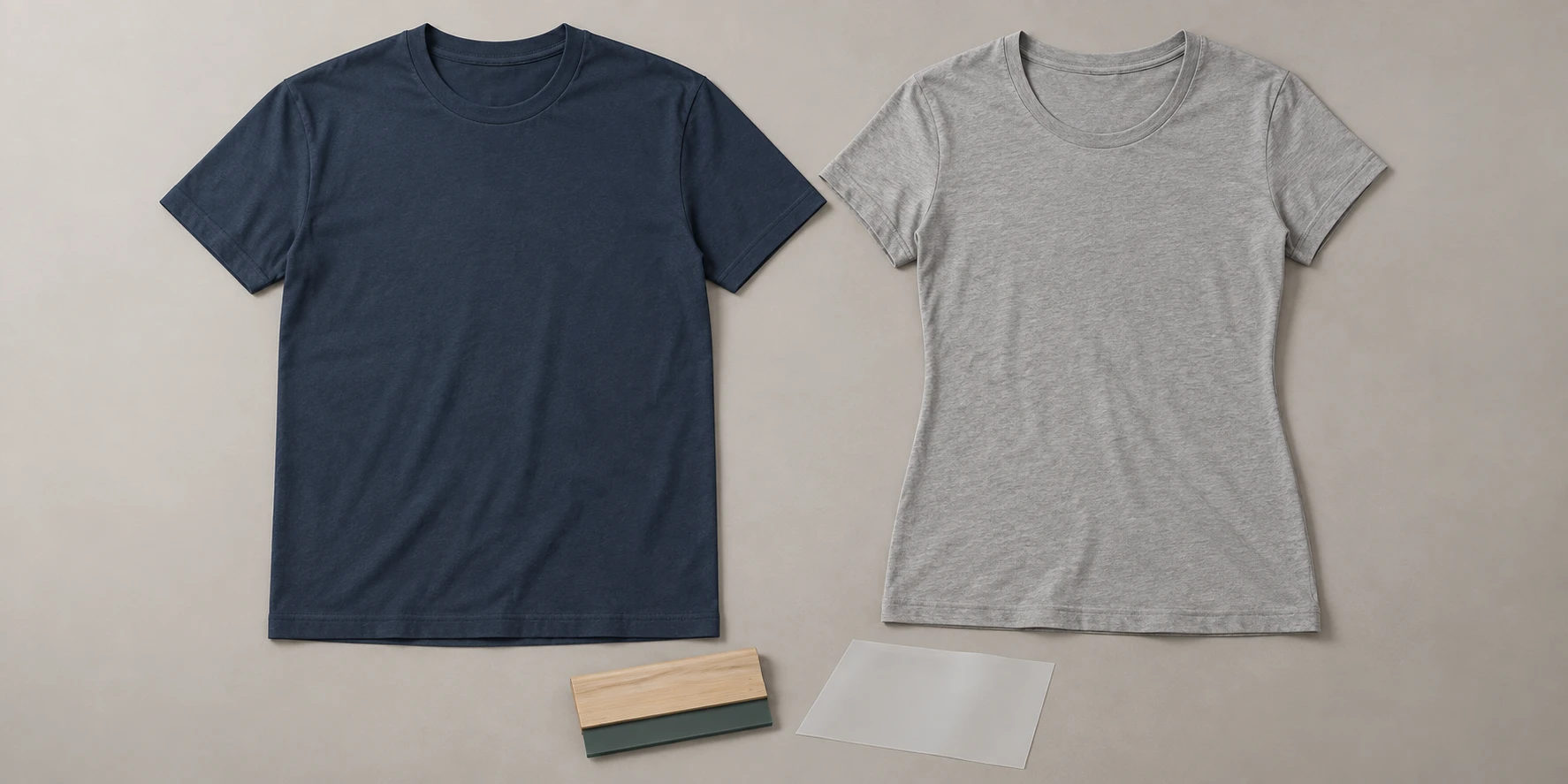
Choose the Tultex 202 when you need a straight, unisex blank with the broader seller-listed size and color selector. Choose the Tultex 216 when a women’s contoured, semi-fitted, side-seamed silhouette is the specific merchandising or uniform requirement. Both styles use the same published 4.5 oz fine-jersey base and the same solid/heather fiber rules, so this decision is mainly about silhouette, construction, and assortment—not fabric weight.
This Tultex 202 vs 216 comparison is for apparel brands, print shops, team buyers, event planners, uniform programs, and private-label sellers. It covers verified product facts and test-first decoration planning. It does not promise price, stock, delivery timing, shrink-proof performance, true-to-size fit, or one universal print recipe. Confirm the exact variation and approve a production-equivalent sample before a bulk order.
Key Takeaways
- Same published base: Both are 4.5 oz fine-jersey tees. Solid colors are listed as 100% ring-spun cotton and 30 singles; Heather Grey is 90/10 cotton/polyester, while other heathers are 50/50.
- 202 role: Beytees presents it as unisex, and its selector spans XS through 5XL. The straight/basic silhouette supports broad merch, event, team, and retail assortments.
- 216 role: Tultex describes a more generous feminine cut with a semi-fitted, contoured silhouette. Beytees lists S through 2XL.
- Construction difference: Tultex calls the 202 tubular, while Beytees specifically lists side seams for 4XL and 5XL. The 216 is side-seamed.
- Decoration rule: Screen print, DTG, discharge, heat transfer, DTF, and embroidery plans still need an exact-style, exact-color sample. Do not assume one placement or process setting fits both silhouettes.
Tultex 202 vs 216 Comparison
Beytees sells the Tultex 202 Unisex Fine Jersey T-Shirt and Tultex 216 Women’s Fine Jersey Classic Fit T-Shirt. Tultex’s own pages use the names 202 Basic Tee and 216 Basic Fitted Tee. Those display-name differences do not by themselves indicate different products.
| Specification | Tultex 202 | Tultex 216 | Decision impact |
|---|---|---|---|
| Seller positioning | Unisex fine jersey T-shirt | Women’s fine jersey classic-fit T-shirt | Straight/unisex assortment versus contoured women’s assortment |
| Published weight | 4.5 oz/yd² | 4.5 oz/yd² | Weight does not separate the two |
| Solid-color base | 100% ring-spun cotton; 30 singles | Same | Confirm the exact color because heathers differ |
| Heather Grey | 90/10 cotton/polyester | Same | Polyester content can affect decoration behavior |
| Other heathers | 50/50 cotton/polyester | Same | Do not apply cotton-only assumptions |
| Body construction | Tultex says tubular; Beytees lists side seams for 4XL/5XL | Side-seamed, semi-fitted, contoured | Verify platen support and placement on the exact size |
| Beytees size-selector labels observed September 17, 2026 | XS–5XL | S–2XL | Labels are not measurements or inventory promises |
| Beytees color-selector labels observed September 17, 2026 | 71 labels; five include “(disc)” | 11 labels | 202 has broader listed taxonomy, not guaranteed availability |
| Label system | Tear-away/Tultex “Tear Anywhere” | Same | Useful for relabeling only after a physical removal test |
Both listings also state reactive dye, pre-washed or pre-shrunk treatment as published, double-needle sleeve and bottom hems, and USMCA certification. Tultex says its cotton products use U.S.-grown ring-spun cotton. None of that supports calling either shirt shrink-proof or “Made in USA,” and double-needle construction is not a wear-life guarantee.
Unisex 202 vs Women’s Contoured 216 Fit and Construction
The 202 is the broad-program choice when the buyer wants a straight, unisex presentation. Tultex calls it a classic basic tee; Beytees calls it unisex. No reviewed source provided verified body measurements for this comparison, so terms such as relaxed, slim, oversized, or true to size would go beyond the evidence. Use current garment measurements or samples rather than translating a label into a fit promise.
The 216 has a more explicit shape. Tultex describes a more generous feminine cut and a side-seamed, semi-fitted contoured silhouette; Beytees calls it a classic fit with a contoured silhouette. That makes it the better starting point when a women’s cut is an intentional part of the assortment. It does not mean every wearer will prefer the same labeled size.
Construction also affects decoration layout. Tultex’s 202 page says tubular construction, while the Beytees listing adds a specific caveat: sizes 4XL and 5XL have side seams. Do not generalize one construction across every 202 size. The 216 is side-seamed throughout its published description, and artwork may need different horizontal scale or vertical placement to look balanced on its contoured body.
The neck details are not measured as identical, either. Both are crewnecks, but Tultex describes the 216 as a feminine ribbed crew neck. Without verified opening measurements, a buyer should not assume the neckline depth or width matches the 202.
Size and Color Selector Breadth
At the publication check, Beytees displayed nine size labels for the 202—XS, S, M, L, XL, 2XL, 3XL, 4XL, and 5XL—and five for the 216—S through 2XL. The 202 also displayed 71 color labels versus 11 for the 216. Five 202 color labels included “(disc),” reinforcing why selector taxonomy should not be presented as active inventory.
A selector label means the catalog recognizes an option. It does not prove that a particular color/size combination can be purchased now, and size labels are not garment or body measurements. Recheck the exact variation when planning, then obtain a current size chart or measure samples across representative sizes.
The wider 202 selector can simplify a program that needs extended seller-listed sizes or more color concepts. The narrower 216 selector can still be right when the contoured women’s silhouette is the actual requirement. Mixed programs can carry both, but should treat them as two fit blocks under a shared artwork system—not interchangeable bodies.
For more options, browse Tultex at Beytees. If the program needs a polo instead of fine jersey, compare the Tultex 400 sport-pique polo guide.
Screen Print, DTG, Discharge, Heat Transfer, DTF, and Embroidery
Tultex’s decoration guidance presents fine jersey as a platform for screen print, DTG, heat transfer, discharge, embroidery, and other methods, while its FAQ specifically lists both 202 and 216 among discharge-capable styles. That is useful process context, not a guarantee for every garment color, artwork, machine, or shop environment.
Screen printing
Fine jersey can be a practical screen-print surface, and screen printing can suit larger runs. Test registration, opacity, hand, flash behavior, cure, and laundering on the exact style and color. Tultex publishes approximate maximum post-print drying guidance of 170°C/340°F for five seconds on 100% cotton and 160°C/320°F for 3.5 seconds on 50/50 or 65/35 blends, with an explicit instruction to test. Those numbers are not a universal ink-cure recipe. The wholesale screen-printing blank guide adds broader selection context.
DTG and discharge
Tultex identifies fine jersey as suitable for DTG and discharge, and specifically names both styles for discharge. Results can change with fiber content, color, pretreatment or chemicals, equipment, environment, and temperature. Polyester does not discharge like cotton, so do not promise the same color or hand across solids and heathers. Follow the ink or chemical manufacturer’s procedure and document the approved sample.
Heat transfer and guarded DTF planning
Tultex supports heat transfer as a general category, but the reviewed product pages do not provide a style-specific DTF recipe or certify every variation for DTF. Follow the film, powder, and transfer supplier’s instructions. Test adhesion, edge lift, press marks, discoloration, dye migration, stretch, and laundering on the exact garment. The Beytees DTF blank guide can help with process selection, but it cannot replace a 202 or 216 production sample.
Use a platen or insert that supports the intended print area. Reconfirm artwork width and placement on the 216’s contoured body instead of copying the 202 setup automatically. One transfer size may look balanced on one silhouette and crowded on the other.
Embroidery and sublimation
Embroidery is a general Tultex decoration category, but neither style page supplies a backing, needle, density, or maximum-logo specification. A lightweight 4.5 oz tee needs qualified digitizing, stabilization, and a sewn sample to manage stiffness and distortion. Conventional direct-dye sublimation is intended for polyester-rich fabrics; do not position the solid 100% cotton versions as ordinary sublimation blanks.
Merch, Team, Uniform, and Private-Label Scenarios
| If your priority is… | Start with | Validate before bulk production |
|---|---|---|
| One straight/unisex merch silhouette | 202 | Representative fit, exact size range, and artwork grading |
| Extended seller-listed size labels through 5XL | 202 | Exact variation and the 4XL/5XL side-seam caveat |
| A women’s contoured program | 216 | Roster coverage, representative fit, and print balance |
| A mixed-gender team or retail assortment | Both | Two fit blocks, two placements, and a shared color plan |
| Private-label presentation | Either | Label removal, replacement-label compliance, and seam finish |
| A polo-based uniform | Neither | Review a purpose-built polo such as the Tultex 400 |
The removable label system can support relabeling, but “tear away” does not mean every production operator should remove it without testing. Check the removal point, remaining fibers, neck finish, replacement-label method, and applicable labeling rules. The tear-away-label blank T-shirt guide covers broader private-label planning; use the narrower verified origin wording in this comparison.
Sample and Bulk-Order Checklist
- Confirm the exact style, color label, size label, and fiber composition.
- Recheck the live seller variation without treating a selector as stock proof.
- Obtain current measurements or measure physical samples in representative sizes.
- Fit-test representative wearers; do not assume the same labeled size fits the same way in both silhouettes.
- Map seams, collar, sleeve, hem, platen support, artwork width, and vertical placement.
- Decorate the exact production color with the intended ink, pretreatment, transfer, or embroidery setup.
- Inspect registration, opacity, adhesion, hand, press marks, distortion, discoloration, edge lift, and seam interaction.
- Launder the decorated sample using the intended care instructions and document the result.
- Retain an approved sample and process notes for reorder control.
Frequently Asked Questions
What is the difference between the Tultex 202 and Tultex 216?
The 202 is positioned by Beytees as a unisex fine-jersey tee with a straight/basic assortment role and a broader seller-listed selector. The 216 is a women’s classic-fit tee with a side-seamed, semi-fitted contoured silhouette. Their published base weight and core fiber rules match.
Do the Tultex 202 and 216 use the same fabric weight?
Yes. Both publish a 4.5 oz/yd² base. Solid colors are listed as 100% ring-spun cotton and 30 singles; Heather Grey is 90/10 cotton/polyester, and other heathers are 50/50. Confirm the exact variation before decoration.
Is the Tultex 202 a unisex T-shirt?
Beytees names it the Tultex 202 Unisex Fine Jersey T-Shirt, while Tultex calls it the 202 Basic Tee. “Unisex” is a merchandising label, not a measurement or true-to-size promise, so review current measurements and physical samples.
How does the women’s Tultex 216 fit compared with the 202?
Tultex describes the 216 as a more generous feminine cut with a semi-fitted, contoured, side-seamed silhouette. The 202 is the straighter unisex/basic option. No verified measurement chart was used here, so fit-test representative wearers rather than prescribing a size change.
Which style has the broader published size and color selection at Beytees?
At the September 17, 2026 check, the 202 displayed XS through 5XL and 71 color labels; the 216 displayed S through 2XL and 11 color labels. These are selector labels, not body measurements, guaranteed stock, or a promise that every combination can be ordered.
Can Tultex 202 and 216 shirts be screen printed or printed with DTG?
Tultex presents fine jersey as suitable for screen print and DTG, and both styles share the published fine-jersey base. Test the exact style and color for registration, opacity, pretreatment, cure, hand, and laundering. Heather blends may behave differently from solid cotton.
Can DTF transfers be applied to Tultex 202 and 216 shirts?
Tultex supports heat transfer generally, but the reviewed sources do not publish a style-specific DTF recipe for every 202 or 216 variation. Follow the transfer supplier’s instructions and test adhesion, edge lift, press marks, dye migration, discoloration, stretch, placement, and laundering.
What should buyers test before ordering Tultex 202 or 216 shirts in bulk?
Test representative fit, measurements, exact fiber/color, artwork scale, placement, platen support, the full decoration process, finished hand, seam interaction, and laundering. For mixed programs, approve separate 202 and 216 samples rather than assuming one setup transfers unchanged.
Final Recommendation
For the Tultex 202 vs 216 decision, start with the Tultex 202 when a straight unisex blank, extended seller-listed size labels, or broad color taxonomy leads the brief. Start with the Tultex 216 when a women’s contoured, semi-fitted, side-seamed silhouette is the requirement.
Do not choose by fabric weight alone: the published base is the same. Choose by fit architecture and assortment role, then confirm the exact variation and approve a decorated physical sample before production.
Leave a Reply