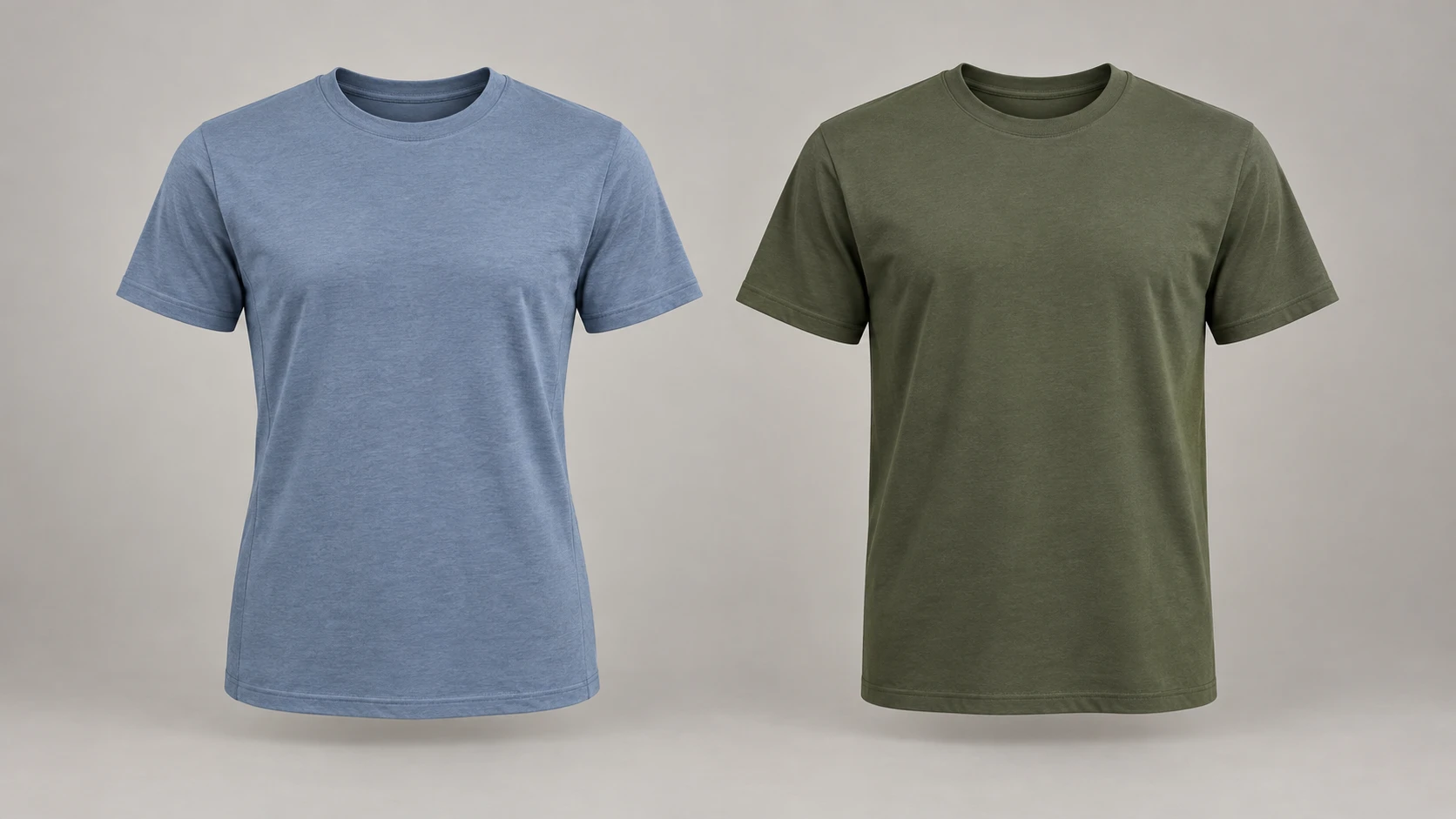
BELLA + CANVAS 3001 vs Tultex 202 is a specification and qualification decision, not a contest with one universal winner. Current sources place the 3001 at 4.2 oz/yd², 32 singles, and side-seamed construction. The current Tultex page places the 202 at 4.5 oz/yd² with tubular construction, while Beytees separately lists 30 singles and a side-seam exception for 4XL and 5XL. Those facts can guide the first sample, but they do not prove finished-shirt weight, fit, softness, opacity, durability, print quality, availability, or landed cost.
Use the written merch brief to choose the first sample. Then qualify the exact style, color, fiber label, size, artwork, transfer, press, replacement-label plan, and laundering process before bulk release. This guide stays narrow: the 3001-versus-202 procurement choice.
Quick answer: which jersey tee should you sample first?
Sample the 3001 first when the approved brief specifically calls for the current 4.2 oz Airlume, 32-singles, side-seamed specification. Sample the 202 first when the approved brief specifically calls for the current 4.5 oz Tultex fine-jersey specification and the exact construction used in every ordered size.
Test both when fit, hand, large-size seams, color-specific fiber content, relabeling, decoration, live availability, substitution, or complete landed economics could change the decision. Keep the test fair: use the same artwork revision and QC standard while allowing process settings and placement to follow the exact garment and transfer system. A successful sample on one color, size, or production lot does not approve all variants.
BELLA + CANVAS 3001 vs Tultex 202 at a glance
| Decision factor | BELLA + CANVAS 3001 | Tultex 202 | Buyer control |
|---|---|---|---|
| Published fabric weight | 4.2 oz/yd² | 4.5 oz/yd² | Treat the 0.3 oz/yd² gap as a fabric-area specification, not an outcome verdict |
| Published yarn figure | 32 singles on seller and manufacturer pages | 30 singles on Beytees; absent from the exact Tultex page | Keep the 202 figure seller-attributed |
| Base fiber wording | Airlume combed and ring-spun cotton, with an Ash exception | Ring-spun cotton unless noted, with heather exceptions | Verify the exact received fiber label |
| Fit wording | Beytees: retail; manufacturer: tailored in prose and classic in a feature line | Beytees: unisex; no precise fit class on the exact Tultex page | Use compatible measurements and samples |
| Body construction | Side-seamed | Tultex: tubular; Beytees: side seams for 4XL and 5XL | Inspect every production size before seam-sensitive art |
| Current manufacturer menu | XS through 5XL | XS through 3XL | Do not treat menus as stock or a permanent range |
| Label wording | Beytees says tear-away | Tultex says Tear Anywhere; Beytees says tear-away | Test removal and preserve required information |
| Universal DTF recipe | None verified | None verified | Qualify the exact production combination |
The published weight difference is 0.3 oz/yd², about 7.1% relative to the 3001 figure. That arithmetic compares fabric-area specifications, not complete garment weights. It does not establish a corresponding difference in warmth, opacity, shrinkage, comfort, durability, or decoration results. Review the live BELLA + CANVAS 3001 product page and Tultex 202 product page before quoting or ordering.
The BELLA + CANVAS 3001 vs Gildan 64000 comparison, Tultex 202 vs 216 comparison, and Gildan 64000 vs Tultex 202 comparison answer different pair-specific questions and serve only as navigation here.
BELLA + CANVAS 3001 profile
Beytees identifies this blank as the BELLA + CANVAS 3001 Jersey Tee; the manufacturer uses 3001 Unisex Jersey Short Sleeve Tee. The current exact sources list a 4.2 oz/yd² base, 32 singles, Airlume combed and ring-spun cotton, side seams, and shoulder taping. Beytees additionally describes a coverstitched collar and sleeves. Ash is listed as 99% cotton and 1% polyester, so an all-colors cotton claim would be inaccurate.
Fit labels conflict. Beytees says retail fit; the manufacturer page uses tailored fit in prose and classic fit in its feature line. These are not compatible measurements or same-letter fit advice. Beytees also uses pre-shrunk and tear-away wording absent from the exact manufacturer body, style landing page, and specification PDF reviewed here. Preserve attribution and inspect the garment.
The current official size evidence reaches XS through 5XL, and the specification PDF supplies chest width and body length from the high point shoulder for that range. The PDF also says specifications are subject to change. The exact manufacturer page is the appropriate live reference for the BELLA + CANVAS 3001 manufacturer page; a current record still does not promise exact-variant availability or future continuity.
Tultex 202 profile
Beytees identifies this blank as the Tultex 202 Unisex Fine Jersey T-Shirt, while the manufacturer uses 202 Basic Tee. The exact Tultex page currently lists a 4.5 oz ring-spun-cotton base unless otherwise noted, Heather Grey at 90% cotton and 10% polyester, and other heathers at 50% cotton and 50% polyester. It also lists reactive dye, pre-washed wording, a ribbed crew neck, taped neck and shoulders, double-needle sleeve and bottom hems, and a Tear Anywhere label.
For construction, the exact Tultex 202 manufacturer page says tubular. Beytees separately says 4XL and 5XL use side seams. Treat that seller line as a size-specific exception rather than flattening the style into “all tubular” or “all side-seamed.” The exact manufacturer page currently presents XS through 3XL, while the seller parent exposes size terms through 5XL. Page menus and parent taxonomy do not prove measurements, stock, or stable future assortment.
Keep the 30-singles figure, pre-shrunk wording, 4XL and 5XL seam exception, and OEKO-TEX and SMETA language seller-attributed; the exact Tultex product page did not display them. Its USA-cotton, North-American-made, and USMCA wording does not establish an unqualified Made in USA claim.
Fabric weight, yarn, fit wording, and construction
The useful comparison is literal. The 202 has the higher published fabric-area weight by 0.3 oz/yd². The 3001 has a verified 32-singles figure from both seller and manufacturer sources; the 202’s 30-singles figure appears on Beytees but not on the exact Tultex page. Yarn figures should therefore retain their source context. Neither figure alone establishes hand, softness, smoothness, strength, opacity, durability, print detail, or wearer preference.
Fiber content must follow the exact color and received label. The 3001 Ash exception differs from the 202 heather rules. One solid-color test cannot approve every heather or later lot. Retain the exact SKU and fiber label with the approved sample.
Fit adjectives are not a shared measurement system. “Retail,” “tailored,” “classic,” and “unisex” come from different records and cannot prove that corresponding size letters fit alike. Construction also varies in a way that affects workflow: the 3001 is published as side-seamed, while the 202 is manufacturer-described as tubular with the seller’s 4XL and 5XL exception. Inspect side bodies, collar, hems, and shoulder alignment before approving wraps, side prints, or placements near seams.
Size ranges and measurement approval
| Approval control | 3001 evidence | 202 evidence | Required action |
|---|---|---|---|
| Current manufacturer menu | XS through 5XL | XS through 3XL | Treat each menu as a dated page observation |
| Current seller taxonomy | XS through 5XL | XS through 5XL | Do not infer exact-variant availability |
| First-party measurements | Current PDF supplies chest width and HPS body length | No compatible current chart found in the exact page or linked assets | Do not publish a numeric cross-style fit table |
| Same-letter equivalence | Not established | Measure physical samples with one documented method | |
| Construction by size | Side-seamed | Tubular, with Beytees saying 4XL and 5XL are side-seamed | Inspect every ordered size before art approval |
The 3001 PDF lists chest widths from 16.5 inches at XS through 32 inches at 5XL and body lengths from HPS from 27 through 35 inches in one-inch steps. Those are current style-chart values, not body measurements, guaranteed tolerances, or proof of how the 202 fits. Without a current Tultex 202 first-party chart using compatible definitions, a numeric crosswalk would manufacture certainty.
Measure representative garments with one written method, including the smallest and largest ordered sizes and every construction change. Approve production-scale artwork for collar and seam clearance, edge proximity, and visual balance. Retain the measurements, artwork revision, size mix, placement reference, and decorated sample.
DTF and decoration qualification
No reviewed exact product source supplies a universal DTF time, temperature, pressure, peel, post-press, cure, or wash-life guarantee for either style. Tultex publishes general decoration guidance with approximate drying figures and an instruction to test, but it is not a 202-specific DTF recipe. Follow the current transfer-system instructions and qualify the exact garment rather than publishing a generic press formula.
Test the production combination: style, color, fiber label, size, artwork, transfer batch, press, platen, pressure method, moisture state, peel, post-press, placement, and laundering protocol. Inspect adhesion, edge lift, press marks, color change, migration where relevant, hand, clearance, distortion, and dimensional response. These are QC checks, not defect predictions.
Record the approved settings and sample, but keep requalification triggers explicit. A changed blank, color, fiber blend, size construction, artwork coverage, transfer material, press, platen, or laundering method can change the result. Other decoration methods need their own evidence; this source package does not declare a winner for screen printing, DTG, HTV, discharge, sublimation, or embroidery.
Private-label and replacement-label workflow
Beytees says both styles use removable labels, and Tultex calls its label Tear Anywhere. That feature can support workflow planning, but it does not make a blank automatically ready for every private-label program. Test removal on the exact received lot, inspect the result, and preserve the original garment information before any label is removed or covered.
The FTC textile labeling guidance explains general fiber, origin, and responsible-business labeling boundaries. The FTC care-label guidance addresses care instructions, permanence, and the need for a reasonable basis. Use current professional review for the finished garment and selling context; this comparison is an operational checklist, not legal advice.
Retain original-label images, supplier identity, SKU, fiber and origin wording, lot evidence, decoration process, and the basis for replacement care instructions. Do not turn USA cotton, North American manufacturing, or USMCA wording into an unqualified Made in USA statement. A blank-product page does not resolve every finished-garment duty.
Sample-to-bulk decision matrix and checklist
| Written brief or unresolved question | First sample | Source-aware reason | What can change the decision |
|---|---|---|---|
| Current 4.2 oz Airlume and side-seamed specification | 3001 | Its current seller and manufacturer records match that brief | Fit, exact color/fiber, decoration, availability, substitution, or landed economics |
| Current 4.5 oz Tultex fine-jersey specification | 202 | Its current manufacturer record matches the weight and base identity | Fit, exact color/fiber, size-specific construction, decoration, or landed economics |
| Unresolved same-letter sizing | Both | No compatible cross-style measurement equivalence was verified | Measured samples and wearer approval |
| Side, wrap, or seam-sensitive artwork | Both in production sizes | The styles and 202 size bands do not share one construction rule | Physical seam inspection and decorated placement tests |
| Private-label release | Both if either remains viable | Label wording does not settle finished-garment duties | Removal test, substantiated replacement information, and retained records |
Before bulk release, freeze brand, model, color, size terminology, supplier record, labels, measurement method, artwork revision, decorated sample, and QC limits. Recheck live variant availability and complete landed economics instead of embedding mutable commerce details in an evergreen article.
Write the substitution rule before ordering. A different brand, style, color, fiber blend, construction, label, artwork, or process is not automatically equivalent. Require a new approval when a frozen variable changes. Keep the accepted sample and its records for receiving inspection and reorders. This method makes the choice auditable without claiming that either shirt wins for every buyer.
Frequently asked questions
What is the main difference between the BELLA + CANVAS 3001 and Tultex 202?
The current 3001 sources list a 4.2 oz, 32-singles, side-seamed Airlume jersey. The current Tultex page lists a 4.5 oz ring-spun-cotton base and tubular construction, while Beytees adds a 30-singles statement and side seams for 4XL and 5XL. Those specifications guide sampling but do not establish a universal winner.
Which shirt has the higher published fabric weight?
The Tultex 202 is published at 4.5 oz/yd² and the BELLA + CANVAS 3001 at 4.2 oz/yd², a difference of 0.3 oz/yd², or about 7.1% relative to the 3001 figure. That fabric-area difference does not prove finished-shirt weight, opacity, warmth, durability, or comfort.
Are the 3001 and Tultex 202 100% cotton in every color?
No all-colors claim is safe. The 3001 sources map Ash to 99% cotton and 1% polyester. Tultex lists Heather Grey at 90% cotton and 10% polyester and other heathers at 50% cotton and 50% polyester. Verify the exact received fiber label.
How do the fit descriptions compare?
Beytees calls the 3001 retail fit, while the manufacturer page uses both tailored fit and classic fit. Beytees calls the 202 unisex, but the exact Tultex product page gives no precise fit class. Use compatible measurements and physical samples instead of treating these labels as a shared standard.
Do the BELLA + CANVAS 3001 and Tultex 202 use the same size range?
The current Beytees parent records show XS through 5XL for both styles. The current manufacturer pages show XS through 5XL for the 3001 and XS through 3XL for the 202. Menus are mutable and do not prove measurements, same-letter fit, or exact-variant stock.
Are both shirts side-seamed?
The 3001 is published as side-seamed. Tultex describes the 202 as tubular, while Beytees states that 4XL and 5XL have side seams. Inspect every production size before approving side prints, wraps, or seam-sensitive placement.
Which shirt is better for DTF printing?
No universal DTF winner or recipe was verified. Qualify the exact style, color, fiber label, size, artwork, transfer, press, platen, pressure method, peel, post-press, placement, and laundering process before bulk production.
Can both shirts be used for private-label merch?
Beytees says both use removable labels, and Tultex calls its label Tear Anywhere. Label removal does not remove fiber, origin, responsible-business, care, or other applicable duties. Preserve the original information and use substantiated replacement labeling for the finished garment.
Which shirt should a merch brand sample first?
Sample the 3001 first for a written 4.2 oz Airlume and side-seamed specification. Sample the 202 first for a written 4.5 oz Tultex fine-jersey specification and its exact size-specific construction. Test both when fit, hand, large-size seams, heather behavior, or landed economics drive the choice.
What should buyers verify before a bulk 3001 or Tultex 202 order?
Verify exact SKU, color, size terminology, received labels, compatible measurements, artwork, production-equivalent decorated samples, QC limits, live variant availability, replacement-label plan, substitution rules, current commercial terms, and complete landed cost.
Leave a Reply