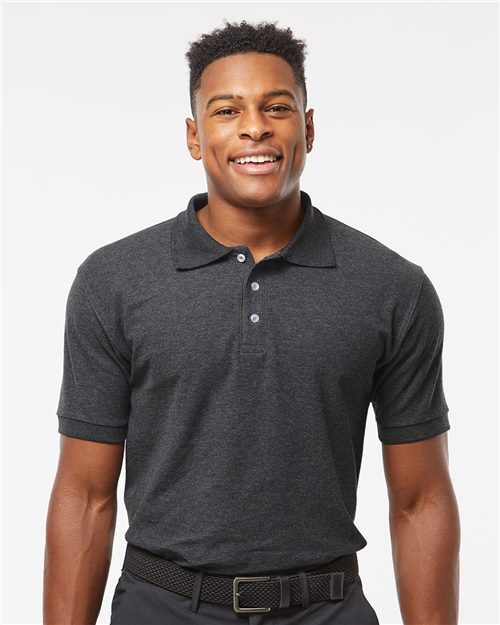
The Tultex 400 wholesale polo is built for buyers who want a substantial, traditionally textured uniform blank with a straightforward 50/50 cotton-polyester construction. At 6.7 oz./yd², this sport pique polo is heavier than many fashion-oriented polos, while its contoured welt collar and cuffs, three-button placket, banded sleeves, and double-needle bottom hem create a familiar team and workplace presentation.
The live Tultex 400 Men’s 50/50 Sport Pique Polo record lists seven catalog colors, sizes S through 2XL, a tear-away label, USMCA certification, OEKO-TEX Standard 100 qualification, and production in a facility holding SMETA audit certification. The style is relevant for school staff, clubs, service businesses, restaurant teams, events, and branded merchandise, provided the exact decoration is tested.
Tultex 400 specifications at a glance
| Feature | Published Tultex 400 specification | Why it matters |
|---|---|---|
| Fabric weight | 6.7 oz./yd² | Creates a substantial uniform hand and a stable starting point for decoration testing |
| Fiber content | 50% USA premium cotton, 50% polyester | Balances cotton character with polyester performance considerations |
| Knit | Pique textured knit | Provides the traditional polo surface that distinguishes it from jersey styles |
| Collar and cuffs | Contoured welt collar and cuffs | Supports a structured, coordinated uniform appearance |
| Placket | Three-button placket | Gives the garment a classic sport-polo front and defines decoration boundaries |
| Sleeves | Banded sleeves | Adds a finished sleeve edge and a more conventional uniform silhouette |
| Hem | Double-needle bottom hem | Provides a reinforced finish at a frequently stressed garment edge |
| Label | Tear-away label | Can simplify private-label programs when required garment information is handled correctly |
| Current Beytees catalog range | Seven listed colors; S through 2XL | Supports controlled team palettes and a focused adult size run |
The color and size range above reflects the options attached to the live Beytees product record on August 26, 2026. Catalog options are not a promise that every size-color combination is available at a particular moment. Confirm live inventory before approving a deadline, substitution policy, or color-critical reorder.
What does a 6.7 oz 50/50 pique polo feel like?
The 6.7 oz./yd² weight gives the Tultex 400 a more substantial starting point than a lightweight retail polo. Pique adds visible texture, while the equal cotton-polyester blend differs from all-cotton casual styles and high-polyester athletic polos. A physical sample remains essential.
A substantial polo may suit front desks, school staff, clubs, and service programs that value structure, while an outdoor crew may prefer a lighter performance fabric. Assess comfort in the real climate, with required layers, and through a normal work period.
Pique texture is also visual. It can make a small embroidered crest look at home on a classic uniform, but it creates a different surface for transfers and screen printing than smooth jersey. Our pique versus jersey polo comparison explains how texture affects presentation, artwork, sampling, and production choices.
Is the Tultex 400 good for embroidery?
The Tultex 400 is a logical embroidery candidate for left-chest logos, employee names, school marks, club crests, and compact sponsor graphics. Its 6.7 oz pique gives a substantial foundation, but it is still a knit garment. Poor digitizing, excessive stitch density, stretched hooping, inadequate backing, or an unsuitable needle can produce puckering, registration problems, distorted lettering, or an uncomfortable inside surface.
Digitize for the final logo size and actual pique texture. Fine lettering may need thicker strokes, wider counters, fewer tiny details, or a larger width. Excessive density can make the chest rigid and pull the knit. Approve the file, stabilizer, needle, thread, tension, hooping, and machine speed as one system.
Embroidery sample checklist
- Use the exact Tultex 400 color and a representative production size.
- Confirm the final logo dimensions and placement from the placket, shoulder seam, and center front.
- Digitize for pique rather than reusing an untested file created for a cap, woven jacket, or smooth tee.
- Select backing and needle components for the garment and the design’s real stitch count.
- Hoop or float consistently without stretching the polo out of shape.
- Run the sample at production speed and inspect small text, outlines, edges, registration, and fabric distortion.
- Finish the backing as planned, then check the inside for wearer comfort.
- Launder the sample and inspect puckering, thread appearance, collar shape, and placement again.
For programs comparing several styles, review the wholesale blank polo guide for corporate embroidery. It provides a wider framework for choosing among traditional pique, jersey, performance, and retail-oriented polos.
Can you use DTF transfers on the Tultex 400?
DTF can be tested on the Tultex 400, but 50% polyester and textured pique require controlled approval. Watch for dye migration, scorching, shine, dimensional change, press marks, visible texture, and incomplete transfer contact.
Do not copy a universal press recipe from a blog. Use the transfer supplier’s current instructions, calibrate the press, keep the decoration zone level, and prevent the placket or seams from changing pressure. Validate any pressing pillow or alternate platen.
DTF approval sequence for pique polos
- Record the exact Tultex 400 color, size, and transfer batch used in the test.
- Apply the production artwork at its final dimensions, not a reduced convenience sample.
- Follow the transfer supplier’s current application and peel directions.
- Inspect the knit valleys and artwork edges for incomplete contact or lifting.
- Check immediately for shine, scorching, platen marks, texture flattening, and garment distortion.
- Inspect again after full cooling for migration or a delayed color shift.
- Launder the test garment according to the intended care plan.
- Check adhesion, cracking, edge lift, surface feel, color, and knit recovery after washing.
- Keep the approved garment and production notes as the reorder standard.
Large solid transfers may feel stiff even when adhesion succeeds. Compact marks or artwork with negative space can preserve more of the natural hand; decide from a full-size sample.
Screen printing the Tultex 400
Screen printing can suit event teams, school programs, back graphics, and larger orders. The system must account for pique and 50% polyester. Mesh, ink, underbase, flash strategy, cure window, pressure, and artwork detail affect the result. A White approval does not prove a dark or heather color.
Keep the print clear of the raised placket unless the setup is engineered for it. Fine detail can break across the texture, while heavy coverage changes the hand. Judge a production-size sample and use the wholesale screen-printing blank guide for broader controls.
Color strategy for teams and uniform programs
The current Beytees record lists Black, Heather Charcoal, Heather Light Blue, Heather Navy, Heather Red, Navy, and White. This focused assortment covers common business neutrals, school and team directions, and several heather options. A narrow palette can simplify program management, but it also makes early color approval important.
A color name is not a physical standard. Review the garment under its real lighting and beside approved uniform pieces. Heather yarns vary visually, and a logo color may appear different against Black than against Heather Charcoal.
Test heat-applied and screen-printed decoration on each approved dark or heather shade. Keep a physical color approval and authorize a backup before inventory pressure causes an unapproved substitution.
Size planning: know the S–2XL boundary
The live Tultex 400 catalog currently lists S, M, L, XL, and 2XL. That range can support many adult team programs, but it is a controlled range rather than an extended-size solution. Before presenting this polo as the program standard, compare the needed roster with the actual size offering. A team that requires sizes above 2XL needs an approved companion style or a different primary polo.
Do not infer fit from “Men’s,” “sport,” or the size label alone. Order a try-on set, publish a fitting deadline, and record each wearer’s approved size. If the team is remote, share current garment measurements and explain how they were taken. Finished-garment measurements are not the same as body measurements, and a familiar label from another brand does not guarantee the same fit.
If broader size coverage is essential, compare the Tultex 400 with the Gildan 64800 Softstyle pique polo guide and the Gildan 8800 jersey polo guide. Those styles offer different fabric, surface, weight, color, and sizing tradeoffs. The right blank is the one that satisfies the complete roster and finished-product requirements, not simply the closest price.
Tultex 400 vs lighter pique and jersey polos
| Buyer priority | Tultex 400 direction | Alternative direction to test |
|---|---|---|
| Traditional texture and substantial hand | 6.7 oz 50/50 pique is the clearest match | A lighter pique if the team wants less weight |
| Flatter print surface | Possible with testing, but the pique remains visible | A jersey polo such as the Gildan 8800 |
| Compact embroidered crest | Strong use case after digitizing and wash approval | Compare lighter pique if wearer comfort takes priority |
| Sizes above 2XL | Current catalog boundary does not cover the need | Select a style with verified extended-size coverage |
| Broad fashion-color assortment | Focused seven-color catalog | Choose a program with more approved color paths |
| Athletic heat and fast-drying emphasis | Evaluate the 50/50 blend in a wear test | Test a performance-oriented polo in the real environment |
These are selection directions, not universal winners. A school office, restaurant host team, landscaping crew, bowling league, and conference staff may reach different conclusions. Sample the finalists with the actual decoration and have representative wearers approve the result.
Building a repeatable team uniform program
Team orders fail when the blank is approved but the system is not. A complete program defines who collects sizes, who approves artwork, how new employees are added, when inventory is checked, what happens if a color is unavailable, and whether personalized garments can be returned. For schools and clubs, the process may also need separate staff, student, sponsor, and fundraising quantities.
Use one roster with the wearer name, approved size, garment color, decoration version, personalization, quantity, and delivery location. Freeze it at a stated deadline and require one authorized approver for later changes. Our school and team bulk-ordering guide provides a broader framework for rosters, samples, approvals, deadlines, and reorder planning.
For recurring uniforms, retain the decorated sample and the specification record. “Same polo as last time” is not enough. The request should identify Tultex 400, garment color, sizes, artwork revision, dimensions, placement, thread or transfer details, pack-out, and the approved substitution rule.
Private labeling and the tear-away label
The Tultex 400’s published tear-away label can support a cleaner branded presentation, but removing a label does not eliminate legal or commercial labeling responsibilities. The reseller remains responsible for any required fiber-content, country-of-origin, care, identity, tracking, or other information that applies to the finished product and destination.
Test the removal process on a sample. Confirm that the label separates cleanly without opening the seam, leaving an uncomfortable edge, or damaging the collar area. Then approve the replacement-label position and attachment method. The tear-away label guide for private-label brands explains why the garment, replacement label, decoration, and pack-out should be approved together.
How to quote the Tultex 400 profitably
A wholesale quote should include more than the blank cost. Account for extended-size or color pricing, artwork cleanup, digitizing, stitch count, thread changes, transfer or ink cost, samples, spoilage, name personalization, folding, individual bagging, relabeling, freight, deadline risk, and replacement units. If the order mixes decoration methods, calculate each path separately.
Lock these fields before purchasing:
- Exact blank: Tultex 400 Men’s 50/50 Sport Pique Polo
- Approved garment color and authorized backup
- Roster and size quantities within the verified S–2XL range
- Decoration method, artwork revision, final dimensions, and placement
- Thread, ink, or transfer color references
- Sample approval date and approving contact
- Personalization, label, folding, bagging, and delivery requirements
- Inventory reservation or purchase deadline
- Reorder, shortage, substitution, and replacement policy
For programs that reorder throughout the year, use the controls in the custom apparel inventory management guide. Documented minimums, reorder points, approved alternatives, and sample retention reduce emergency decisions.
Final verdict
The Tultex 400 is a strong wholesale candidate when a team wants a substantial 6.7 oz pique polo, a simple 50/50 cotton-polyester blend, traditional collar and cuff details, a three-button placket, a tear-away label, and a focused core-color assortment. It is especially relevant for compact embroidery, school and club marks, workplace logos, and repeat uniform programs that fit within the current S–2XL catalog range.
Its main decision points are equally clear. Pique texture changes how transfers and screen prints look, 50% polyester requires migration and heat testing, and the size range needs to be checked against the complete roster. Approve the exact production color, decoration, and wash result before ordering at scale.
Visit the live Tultex 400 wholesale product page to review current options. Then compare live inventory with the roster, test the finished decoration, and keep the approved garment as the standard for future orders.
Frequently asked questions
What is the Tultex 400 made of?
The published specification lists a 6.7 oz./yd² pique knit made from 50% USA premium cotton and 50% polyester.
Is the Tultex 400 a heavy polo?
At 6.7 oz./yd², it has a substantial traditional-polo weight compared with many lightweight retail styles. A wear test is the best way to judge whether that weight suits the team’s climate and work environment.
Is the Tultex 400 good for embroidery?
It is a logical embroidery candidate for left-chest logos, names, and compact team marks. The file still needs to be digitized for pique, tested at the final size, and inspected after laundering.
Can the Tultex 400 be decorated with DTF?
DTF can be tested on the style, but the pique texture and 50% polyester content require exact-color sampling for adhesion, texture, shine, press marks, and dye migration. Follow the transfer supplier’s current instructions rather than a universal recipe.
Can you screen print the Tultex 400?
Yes, screen printing can be evaluated for chest, sleeve, and back artwork. The ink system, underbase, cure window, and artwork should be tested on the actual color because both pique texture and polyester content affect the result.
What sizes does Beytees currently list for the Tultex 400?
The live catalog record lists S, M, L, XL, and 2XL. Verify current inventory by color before committing to the roster or deadline.
What colors does Beytees currently list?
The current catalog lists Black, Heather Charcoal, Heather Light Blue, Heather Navy, Heather Red, Navy, and White. Catalog listing does not guarantee that every size-color combination is in stock.
Does the Tultex 400 have a tear-away label?
Yes. The published record lists a tear-away label. Private-label sellers must still handle any labeling information required for the finished garment and sales destination.
Is the Tultex 400 better for teams than a jersey polo?
It depends on the approved look and use. The Tultex 400 offers traditional pique texture and a substantial hand; jersey provides a flatter surface and different drape. Test both with the actual decoration and representative wearers.
What should be approved before a bulk Tultex 400 order?
Approve the exact color, roster, sizes, artwork revision, decoration method, placement, physical sample, wash result, pack-out, deadline, and substitution policy. Recheck live inventory before purchasing.
Leave a Reply