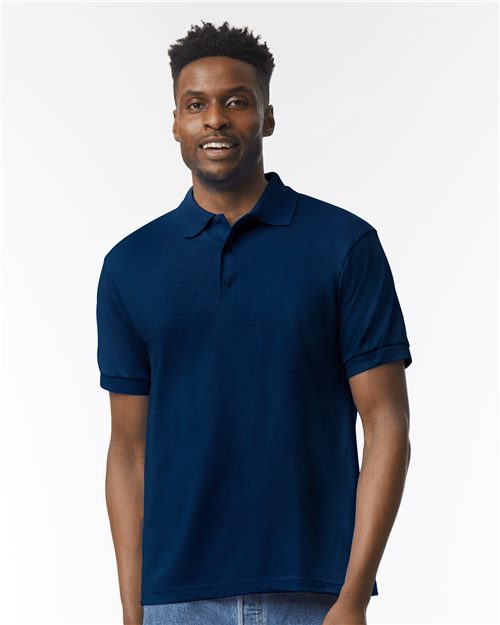
The Gildan 8800 wholesale polo is a practical choice for businesses that need a familiar uniform silhouette without the heavier texture of a traditional pique knit. It combines a 6 oz./yd² cotton-polyester jersey with moisture-wicking DryBlend positioning, a classic fit, a clean button placket, and a tear-away label. That combination makes it relevant for staff uniforms, school programs, service crews, event teams, branded merchandise, and other repeat-order apparel programs.
The live Gildan 8800 Unisex DryBlend Jersey Polo specification lists a 52% ring-spun cotton and 48% polyester knit at 20 singles. It also lists a contoured welt collar and cuffs, dyed-to-match buttons, and a clean-finished placket. These details give decorators several workable branding paths, including left-chest embroidery, tested DTF transfers, and screen printing.
Gildan 8800 specifications at a glance
| Feature | Published Gildan 8800 specification | Why it matters |
|---|---|---|
| Fabric weight | 6 oz./yd² in the U.S. specification | A midweight polo that can balance everyday wear with a more substantial hand than a lightweight tee |
| Fiber content | 52% ring-spun cotton, 48% polyester knit | Combines cotton hand feel with a substantial polyester component that requires decoration testing |
| Yarn | 20 singles | Helps describe the fabric construction, but should not replace a physical sample assessment |
| Fabric family | DryBlend moisture-wicking cotton-poly blend | Useful for uniforms, teams, events, and active work environments |
| Fit | Classic fit | Supports a familiar uniform profile and broad group programs |
| Collar and cuffs | Contoured welt collar and cuffs | Creates a traditional polo finish and defines the available decoration area |
| Placket | Clean-finished placket with dyed-to-match buttons | Keeps the front presentation coordinated and professional |
| Label | Tear-away label | Can support custom branding when legal garment-label requirements are handled correctly |
| Current Beytees catalog range | 19 listed colors; S through 5XL | Offers core business, school, team, and promotional shades with an extended-size path |
The catalog range above reflects the options attached to the live Beytees product record on August 25, 2026. A listed size or color is not a promise that every combination is in stock at a particular moment. Verify live availability before committing to a deadline or color-critical reorder.
What makes the Gildan 8800 different from a pique polo?
The word “polo” describes the garment format, not one universal fabric. The Gildan 8800 uses a jersey knit, while many traditional uniform polos use pique. Jersey generally presents a flatter, smoother face and a softer drape. Pique has a more visible texture and often creates a more structured, traditional uniform appearance.
That distinction affects decoration and merchandising. A flatter jersey face can be a convenient starting surface for DTF and screen-printed graphics, provided the exact garment color and 48% polyester content pass testing. Pique texture can complement embroidery, but the peaks and valleys can make larger transfers or fine printed details more challenging. The best option depends on the finished look, not on a claim that one knit is universally superior.
If the buyer is undecided, compare the 8800 with the Gildan 64800 Softstyle Pique Polo. Our detailed pique versus jersey polo comparison explains the tradeoffs in structure, print surface, embroidery, comfort, and uniform presentation.
Fabric, hand feel, and moisture management
The 8800’s published 52/48 cotton-polyester blend is close to balanced, but the cotton side is slightly higher. Ring-spun cotton can contribute a comfortable hand, while polyester supports the DryBlend moisture-wicking positioning. For teams and workplaces, that can be more useful than choosing a blank solely because it feels soft on a hanger.
Moisture-wicking does not mean waterproof, stain-proof, cooling in every environment, or immune to odor. It describes how the fabric is designed to move moisture. The actual wearer experience will also depend on climate, garment color, fit, physical activity, laundering, and what is worn underneath. A warehouse team in Texas, a restaurant host, and a trade-show staff member may all evaluate the same polo differently.
Use a sample group before placing a large uniform order. Ask testers to wear the polo through a normal shift, wash it according to the intended care instructions, and report on collar shape, sleeve comfort, heat perception, drape, and overall fit. That field test turns a published fabric description into evidence for your specific program.
Fit and uniform presentation
Gildan describes the 8800 as a classic fit. For group ordering, that familiar shape can simplify adoption because it does not depend on a fashion-slim or intentionally oversized silhouette. It can work across office support teams, delivery crews, volunteer groups, school staff, customer-facing service teams, and event personnel.
Do not build the size curve from the word “classic” alone. Order a try-on set in representative sizes, publish a fitting deadline, and record each wearer’s approved size. For remote staff or distributed teams, provide current garment measurements and explain how those measurements were taken. A body-size label and a finished-garment measurement are not interchangeable.
The live Beytees catalog currently lists S, M, L, XL, 2XL, 3XL, 4XL, and 5XL. Extended sizing can help keep a team in one style, but stock depth can vary by color. If an inclusive size run is non-negotiable, check every needed size before the customer approves the color. Also document an alternate shade or substitute style before an urgent reorder exposes a gap.
Color planning for uniforms, teams, and merch
The current product record lists 19 catalog colors: Ash, Black, Carolina Blue, Dark Heather, Forest Green, Gold, Graphite Heather, Kelly Green, Light Blue, Maroon, Navy, Orange, Purple, Red, Royal, Sand, Sapphire, Sport Grey, and White. That range covers common corporate neutrals, school colors, team shades, safety-adjacent bright colors, and several heather options.
A digital swatch is not a color standard. Review a physical garment under the lighting where it will be worn and next to any existing uniform pieces. If the program requires a close match to a logo, vehicle wrap, cap, apron, or jacket, approve those pieces together. Different fiber blends and knit structures can make the same color name appear different across garments.
Heather and dark colors deserve separate decoration tests. Polyester content can contribute to dye migration under heat, and a transfer that looks correct immediately after pressing can shift after cooling. White and very light colors can also reveal show-through or platen marks that are less visible on a sample mockup. Approve the exact style, color, decoration method, and artwork as one production combination.
Is the Gildan 8800 good for embroidery?
Yes, the 8800 can support embroidery, especially for conventional left-chest logos, names, and simple uniform marks. Its 6 oz./yd² fabric gives a useful starting point, but jersey is still a knit that can stretch, distort, or pucker when the design, needle, thread, tension, hooping, and stabilizer are not matched correctly.
Start with a digitized file designed for the final size. A detailed logo reduced to a small chest mark may need simplified lettering, wider gaps, fewer fine outlines, and a different stitch path. More stitches do not automatically create a more premium result. Excessive density can make the logo stiff, pull the fabric, and create rippling around the design.
Embroidery sample checklist
- Use the exact production color and size, not a leftover shirt with a different fabric behavior.
- Confirm the final logo width, height, thread colors, and placement from the placket and shoulder seam.
- Select the backing and needle for the actual jersey knit and design density.
- Hoop or float consistently without stretching the polo out of shape.
- Run a full sample at production speed and inspect outlines, small lettering, registration, and fabric distortion.
- Remove or finish backing according to the approved process, then inspect the inside for wearer comfort.
- Launder the sample and check puckering, thread appearance, collar shape, and logo position again.
For a broader assortment strategy, see our wholesale blank polo guide for corporate embroidery. It can help when the customer is comparing jersey, pique, performance, and fashion-oriented options.
Is the Gildan 8800 good for DTF printing?
The 8800 can be a useful DTF polo when the transfer system and exact garment color are tested together. Jersey provides a flatter surface than many pique knits, which can help a transfer sit evenly. The main caution is the fabric’s 48% polyester content. Heat can create color migration, scorching, shine, press marks, or dimensional change, particularly on sensitive dark and heather shades.
Do not copy a single time, temperature, pressure, peel, or repress setting from an article. Use the current instructions from the transfer supplier for the specific film, adhesive powder, ink system, and garment type. Calibrate the press, account for seams and the placket, and keep the decoration area level. A pressing pillow or platen setup can help manage construction differences, but it must not create uneven pressure under the artwork.
Practical DTF approval sequence
- Record the exact Gildan 8800 color and garment size used for the test.
- Use the production artwork at its final dimensions.
- Follow the transfer manufacturer’s current application and peel instructions.
- Keep the placket, collar, sleeve seam, and side seam from disrupting pressure.
- Inspect the garment immediately after pressing for shine, scorching, marks, and edge lift.
- Inspect it again after full cooling for dye migration or color change.
- Launder the sample according to the customer care plan and check adhesion, cracking, stretch, and color.
- Save the approved garment, transfer batch information, and press record for reorders.
For more selection controls, review our guide to wholesale blanks for DTF printing. The same principles for blend verification, migration testing, and production sampling apply to polos even though construction and placement differ.
Screen printing the Gildan 8800
The jersey surface can also support screen printing for staff apparel, event graphics, sleeve marks, and promotional designs. The mesh, ink, underbase, cure window, and additive strategy must account for the cotton-polyester blend and garment color. Keep the print clear of the raised placket unless the setup is engineered for that location, and do not reuse a White approval on a dye-sensitive dark or heather shade without testing. Our wholesale screen-printing blank guide covers broader fabric and artwork considerations.
When another polo may be better
Choose a different blank if the buyer wants a clearly textured, structured pique presentation. The Gildan 64800 is the logical same-brand comparison. A performance-focused synthetic polo may be a better starting point when fast-drying athletic use matters more than a cotton-rich hand. A fashion polo may be more appropriate when the buyer prioritizes a retail silhouette, premium trim, or a lighter drape.
The decoration can also decide the blank. An extremely dense embroidered crest, oversized transfer, specialty ink, or demanding color-match requirement may perform better on a different fabric or construction. Presenting an alternative is not a failure to sell the 8800. It is evidence that the garment is being selected for the finished product rather than for a familiar style number.
Wholesale ordering and quoting controls
A profitable polo program requires more than a low blank cost. The quote should account for extended-size upcharges, artwork cleanup, digitizing, embroidery stitch count, thread changes, transfer or ink cost, samples, spoilage, folding, individual bagging, name personalization, freight, and deadline risk.
Lock the following fields before ordering:
- Exact style name and number: Gildan 8800
- Approved garment color and backup color
- Size quantities, including extended sizes
- Decoration method, artwork revision, and final dimensions
- Thread, ink, or transfer color references
- Placement measurements and tolerance
- Sample approval date and approving contact
- Pack-out, labeling, personalization, and shipping requirements
- Inventory reservation or purchase deadline
- Reorder and substitution policy
For recurring programs, keep the approved sample and production record. A customer saying “same polo as last time” is not enough protection against a different shade, revised logo, alternate transfer batch, or new size mix. Our custom apparel inventory management guide explains how documented blanks, reorder points, and alternate products reduce emergency substitutions.
Final verdict
The Gildan 8800 is a strong wholesale candidate when a program needs a classic jersey polo, a cotton-rich 52/48 DryBlend fabric, core uniform colors, extended sizing through 5XL, and several decoration options. Its flatter jersey surface distinguishes it from a traditional pique polo, while the contoured collar, cuffs, and clean placket maintain a recognizable uniform appearance.
Its best results come from disciplined sampling. Polyester content matters for heat-applied and screen-printed designs, while jersey stretch and logo density matter for embroidery. Test the production color, approve the finished sample after laundering, and quote from live inventory rather than from a generic specification.
Browse the live Gildan 8800 wholesale product page to review current options. If you are still choosing between polo constructions, compare it with the Gildan 64800 pique polo guide before approving the program.
Frequently asked questions
What is the Gildan 8800 made of?
The published Gildan 8800 specification lists a 6 oz./yd², 20-singles knit made from 52% ring-spun cotton and 48% polyester. Gildan positions the DryBlend fabric as moisture-wicking.
Is the Gildan 8800 a jersey or pique polo?
It is a jersey polo. Jersey generally has a flatter, smoother face and softer drape than textured pique. Buyers who want a more traditional textured polo should compare it with a pique style such as the Gildan 64800.
Is the Gildan 8800 good for uniforms?
Yes. Its classic fit, contoured collar and cuffs, coordinated buttons, broad catalog colors, and S through 5XL size range make it a practical candidate for staff, school, team, event, and service uniforms. Always verify current size-color availability.
Can the Gildan 8800 be embroidered?
Yes. It can support left-chest logos, names, and other tested embroidery. The digitizing, stitch density, backing, needle, tension, hooping, and placement must be matched to the jersey knit to control puckering and distortion.
Can the Gildan 8800 be used for DTF printing?
Yes, after testing. Its jersey face offers a relatively flat transfer surface, but the 48% polyester content can create heat sensitivity or dye-migration risk on some colors. Follow the transfer supplier’s instructions and approve the exact garment color after cooling and laundering.
Can the Gildan 8800 be screen printed?
Yes. Screen-print the exact production color with an ink and cure strategy appropriate for the cotton-polyester blend. Dark, heather, and dye-sensitive colors should receive separate migration and cure testing.
Does the Gildan 8800 have a tear-away label?
Yes, the published product specification lists a tear-away label. Businesses adding custom branding must still preserve or replace all legally required fiber, care, origin, and business-identification information.
What sizes does the Gildan 8800 come in?
The live Beytees catalog listed S, M, L, XL, 2XL, 3XL, 4XL, and 5XL on August 25, 2026. A catalog size does not guarantee availability in every color, so check stock before quoting.
How many colors are available?
The live Beytees product record listed 19 color terms on August 25, 2026. The assortment includes core neutrals, school and team colors, heathers, and several bright shades. Options can change over time.
What is the difference between the Gildan 8800 and 64800?
The key construction difference is jersey versus pique. The 8800 is a 6 oz./yd² 52/48 cotton-polyester jersey polo. The 64800 is a Softstyle pique polo with a more visibly textured fabric. Compare physical samples, decoration tests, fit, colors, and live availability.
Leave a Reply