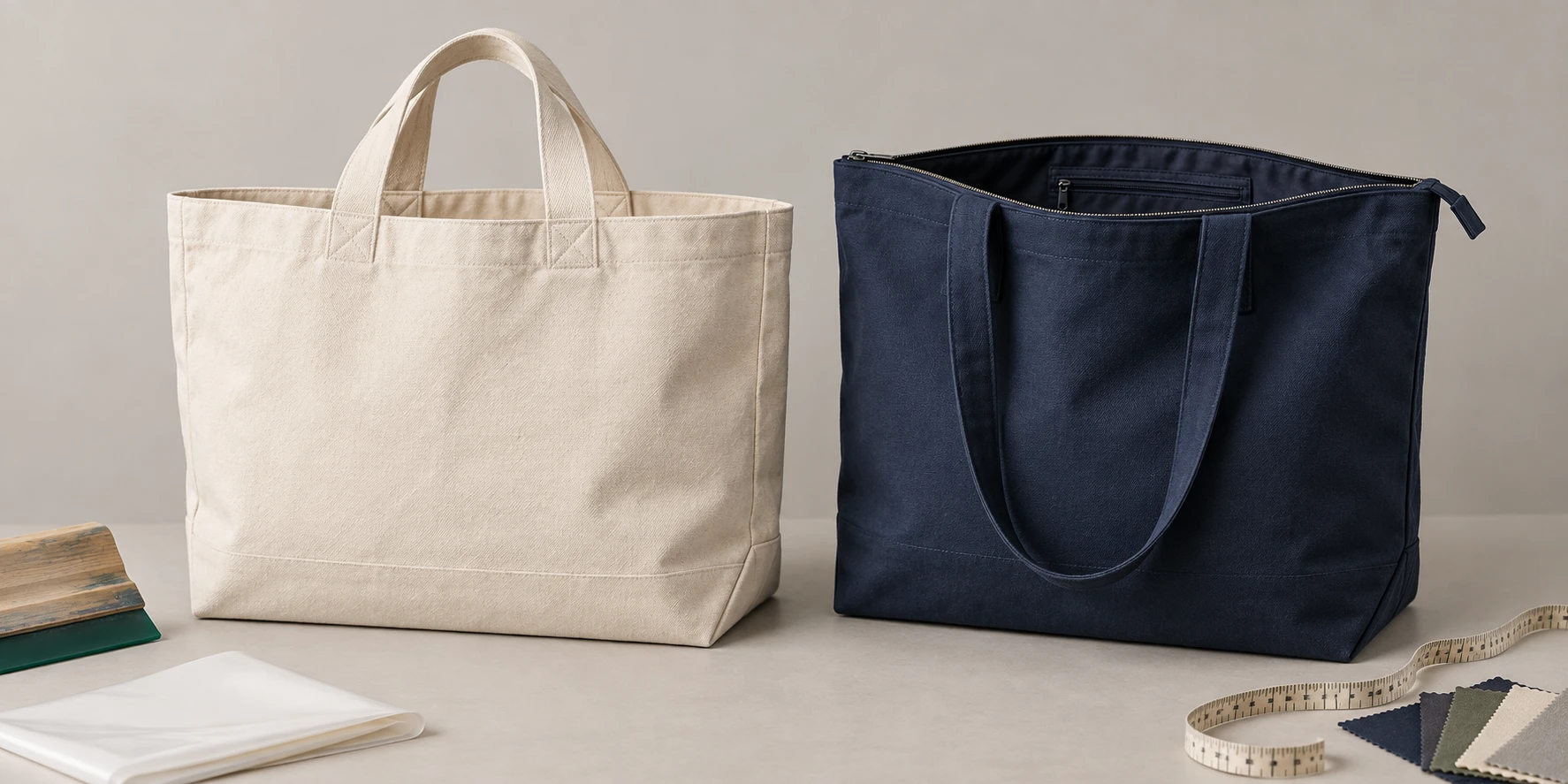
Choose the Q-Tees Q600 when open-top access, fast loading, and a mechanically simpler decoration surface matter most. Choose the Q-Tees Q611 when a zippered main compartment and an inside zippered flap pocket justify extra production planning. Both are 25 L heavy-cotton-canvas totes with the same published 20 W × 15 H × 5 D-inch dimensions and 14 W × 10 H-inch suggested imprint area. The real decision is access versus closure, not capacity.
This wholesale tote bags comparison is for event buyers, retailers, promotional-product teams, screen printers, DTF decorators, and embroidery operators. It covers verified construction and practical sample checks; it does not promise a price, stock level, warehouse, delivery date, minimum quantity, or universal decoration recipe. Confirm live purchasing details on the exact product page before ordering.
Key Takeaways
- Shared platform: Both styles are one size, 25 L, 100% heavy cotton canvas, and 20 W × 15 H × 5 D inches, with a published ±1-inch tolerance.
- Q600 advantage: The open top and lack of pockets make access fast and reduce hardware and layered areas around the decoration zone.
- Q611 advantage: A zippered main compartment and inside zippered flap pocket help retain and organize contents.
- Handle difference: Q600 has 23-inch canvas-webbed handles with a 10-inch drop; Q611 has 25-inch self-fabric handles with an 11-inch drop.
- Decoration rule: Treat 14 × 10 inches as a suggested imprint field, not blanket approval. Sample the exact color, artwork, process, placement, and finished feel.
Q-Tees Q600 vs Q611 Comparison
The Q-Tees Q600 25L Jumbo Tote and Q-Tees Q611 25L Zippered Tote share more specifications than their names suggest. The Q-Tees branded Q600 specification sheet and Q611 specification sheet document the common size, capacity, fabric, tolerance, gusset, and suggested imprint field. Their main differences are closure, interior storage, handles, and the production obstacles those details create.
| Specification | Q-Tees Q600 | Q-Tees Q611 | Decision impact |
|---|---|---|---|
| Capacity | 25 L | 25 L | No published capacity advantage |
| Fabric | 100% heavy cotton canvas; 12 oz/yd² US / 20 oz/L yd CA | Same | Use cotton-canvas-specific production tests |
| Finished size | 20 W × 15 H × 5 D in | 20 W × 15 H × 5 D in | Same nominal envelope; ±1 in tolerance applies |
| Top | Open; no closure | Zippered main compartment | Fast access versus contents retention |
| Interior pocket | None listed | Inside zippered flap pocket | Q611 adds organization and a layer to isolate during decoration |
| Handles | 23-in canvas-webbed; 10-in drop | 25-in self-fabric; 11-in drop | Sample carry comfort with intended load |
| Bottom | Gusseted | Gusseted | Both gain depth when loaded |
| Suggested imprint area | 14 W × 10 H in | 14 W × 10 H in | Keep artwork inside the field, then sample |
Beytees additionally describes the Q611 zipper as approximately 18 inches. Treat that as a seller-published detail, not a substitute for measuring the received sample. Finished-bag tolerance, seam position, pocket position, and how the tote sits on a platen can all affect usable clearance.
Which Tote Should You Choose?
For events, the Q600 is the practical default when staff will load bags quickly, guests need frequent access, or the tote functions as a handout carrier. Its open top removes the zipper step and its simpler front-panel construction gives decorators fewer hardware conflicts to manage. That does not make it automatically easier for every design: seams, gusset folds, handle attachments, and canvas texture still require testing.
The Q611 is the stronger candidate when contents should remain enclosed or separated. Retail purchases, employee kits, registration materials, travel-oriented packs, and organized client gifts can benefit from a zippered main compartment and inside pocket. Buyers should decide whether those functions are worth the added sample work and potential fixture complexity.
| If your priority is… | Start with | Reason to validate |
|---|---|---|
| Fast event loading and open access | Q600 | Confirm the open-top experience suits the contents and venue |
| Fewer zipper/pocket conflicts during decoration | Q600 | Still map seams, handles, gusset, and insert position |
| Closing the main compartment | Q611 | Test zipper operation before and after decoration |
| Separating small items inside the bag | Q611 | Confirm pocket size and placement on the physical sample |
| Building a color assortment | Either | Selector options can change and do not prove stock |
| Choosing strictly by capacity or nominal size | Either | Both publish the same 25 L and 20 × 15 × 5-in specifications |
For other bag silhouettes, browse Q-Tees products at Beytees or use the wholesale blank tote bag guide. A color name or online selector entry is an option, not an inventory commitment; recheck the chosen variation and purchasing details at order time.
Decoration Planning for Screen Printing, DTF, and Embroidery
The published 14 W × 10 H-inch imprint area is a starting boundary. It does not approve every screen-print setup, DTF transfer, embroidery design, ink system, press setting, or platen. Keep artwork inside that field, identify the centerline on an actual tote, and approve a production-equivalent sample in the exact production color.
Screen printing
Test ink opacity and cure on the exact canvas and color. Dark bags may require an underbase, but the correct ink, mesh, off-contact, cure method, and sequence depend on the shop’s system and artwork. The screen-printing blank guide provides broader blank-selection context; the operator must still establish the tote-specific process.
DTF transfers
Follow the transfer supplier’s cotton-canvas parameters instead of borrowing a generic garment recipe. Test adhesion, edge lift, canvas texture showing through the graphic, discoloration or scorching, and the post-cure handle. Use a suitable insert or platen, and never press over the Q611 zipper. The DTF blank buying guide explains broader selection factors without replacing a bag sample.
Embroidery
Let the embroidery operator choose backing, needle, thread, hooping, and fixture strategy after inspecting the bag. Verify seam and handle clearance, stiffness, registration, interior finish, and whether the Q611 pocket has been isolated so it is not accidentally sewn closed. No universal embroidery recipe is safe for every logo or machine.
Q611 Zipper and Pocket Controls
Before decorating Q611, open the bag and locate the main zipper tape, pull, inside flap pocket, pocket zipper, seams, and folded layers. Build the setup so heat and pressure do not land on the zipper or create an uneven stack beneath the artwork. A suitable insert, platen, or fixture should support the print area while keeping hardware outside the pressure zone.
After decoration, operate both zippers repeatedly and inspect teeth alignment, pull travel, pocket access, nearby stitching, print edges, and any pressure marks. Load the sample with representative contents and check whether the decoration, pocket, and closure behave normally together. Q600 avoids these exact hardware checks, but it still needs panel, handle, seam, and gusset inspection.
Printable Sample-Approval Checklist
- Confirm the exact style, seller variation, and production color.
- Measure the received tote and account for the published ±1-inch tolerance.
- Keep artwork within 14 W × 10 H inches and map handles, seams, gusset folds, and hardware.
- Use the intended screen-print, DTF, or embroidery setup on a physical sample.
- Inspect registration, opacity or adhesion, cure, texture, edge quality, stiffness, and discoloration.
- For Q611, isolate the zipper and pocket; never press over the zipper or sew through the pocket.
- Test handle comfort, open/close behavior, pocket access, and the intended representative load.
- Retain one approved decorated sample and process notes for reorder control.
Freight and timing can affect a program decision, but they are dynamic. Use the wholesale blank apparel shipping guide for planning questions, then confirm the current order-specific details before committing to an event or retail launch.
Frequently Asked Questions
What is the difference between the Q-Tees Q600 and Q611?
Q600 is an open tote with no listed interior pocket, 23-inch canvas-webbed handles, and a 10-inch drop. Q611 has a zippered main compartment, inside zippered flap pocket, 25-inch self-fabric handles, and an 11-inch drop. Their published capacity, fabric, dimensions, gusset, and suggested imprint area otherwise match.
Are the Q600 and Q611 the same size?
Yes at the published nominal level: both are one size, 25 L, and 20 W × 15 H × 5 D inches. The specification sheets state a ±1-inch tolerance, so measure the received sample when exact placement or packaging fit matters.
Which tote is better for events and giveaways?
Q600 is usually the more direct event choice when staff need fast loading and recipients need open access. Choose Q611 when retaining contents or separating small items is more important. Test the intended contents and handling flow rather than deciding by style name alone.
Which tote is better for retail purchases or staff kits?
Q611 can add value when a zippered main compartment and inside zippered pocket support the kit. Q600 works when simplicity, open access, and straightforward loading matter more. Both need a representative-load sample before bulk approval.
Can Q-Tees Q600 and Q611 totes be screen printed?
The 14 × 10-inch field is a suggested imprint area, not blanket process approval. A qualified printer should test the exact canvas and color for placement, opacity, cure, texture, and finished feel. Dark colors may require an underbase; no universal mesh, ink, or cure recipe applies.
Can DTF transfers be applied to Q600 and Q611 canvas totes?
Any DTF plan should follow the transfer supplier’s cotton-canvas parameters and pass a physical sample. Test adhesion, edge lift, texture, discoloration or scorching, and handle. On Q611, use an appropriate support and never press over the zipper, pull, pocket, seams, or folded layers.
What is the suggested imprint area?
Both Q600 and Q611 publish a suggested imprint area of 14 W × 10 H inches. Keep artwork within that boundary, then verify the actual centerline, seam clearance, hardware clearance, and finished appearance on the received tote.
What should decorators test around the Q611 zipper and pocket?
Map and isolate the main zipper, pull, interior flap pocket, pocket zipper, seams, and folded layers. Verify even support, safe heat and pressure clearance, zipper travel, pocket access, nearby stitching, print edges, and pressure marks before approving production.
Final Recommendation
For this wholesale tote bags comparison, start with Q600 when event speed, open access, and a simpler panel are the priorities. Start with Q611 when closure and interior organization improve the buyer’s real use case. Because capacity and nominal size are the same, choose by function and production clearance—not by an assumed size advantage.
Confirm the live variation and purchasing details, order the exact color, and approve a decorated physical sample. That process is more reliable than treating either tote—or the shared 14 × 10-inch suggested imprint area—as universally compatible with every job.
Leave a Reply