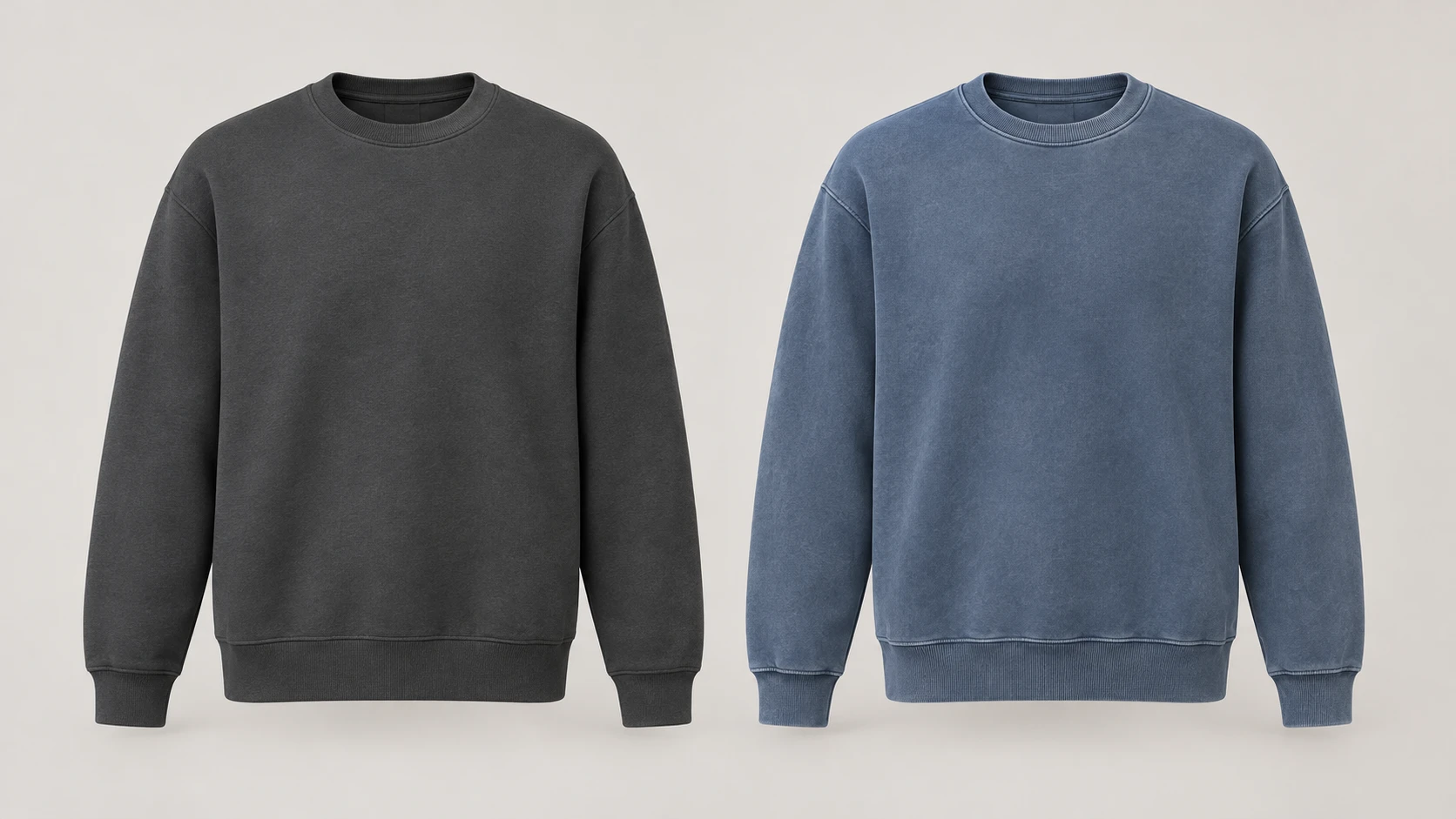
Quick Answer: Which Crewneck Should You Sample First?
Sample the Independent Trading Co. SS3000 first when the approved brief calls for an 8.5 oz midweight fleece crewneck with a standard or classic fit direction, split-stitch construction, and a conventional clean-color presentation. Sample the Comfort Colors 1566 first when the brief specifically calls for a 9.5 oz relaxed crewneck, three-end cotton-face fleece, and garment-dyed color character. The difference is not simply one ounce of listed fabric weight. Fit language, dye treatment, color-level fiber statements, seam details, artwork interaction, and reorder controls all change the buying decision.
Neither blank is a universal winner for comfort, print quality, durability, wash life, margin, or customer preference. The current SS3000 seller and manufacturer pages also disagree on face-yarn count, selected heather blends, and fit wording. Keep that conflict visible, qualify the exact received color, and approve a production-equivalent sample rather than blending the two records into one specification.
The current Comfort Colors manufacturer page supports the 1566 identity, listed weight, base blend, garment-dyed construction language, fleece details, relaxed fit, and side-seamed body. Its dye and shrinkage statements remain manufacturer claims, not independent performance tests. Use the comparison below to build a sample plan, then verify current measurements, labels, artwork, decoration settings, care results, availability, terms, and complete landed cost before bulk release.
Verified Independent SS3000 vs Comfort Colors 1566 Comparison
Start with the live Independent Trading Co. SS3000 product page and Comfort Colors 1566 product page. They identify the exact Beytees catalog records. The matching manufacturer destinations provide current maker context, but the SS3000 records conflict in several material details and the Comfort Colors page is dynamically rendered. Source scope matters.
| Decision factor | Independent SS3000 | Comfort Colors 1566 | Buyer treatment |
|---|---|---|---|
| Listed U.S. weight | 8.5 oz./yd² | 9.5 oz./yd² | Use as a construction signal, not proof of comfort, warmth, or durability |
| Base construction | Cotton/polyester fleece; exact blend changes by color | 80/20 ring-spun U.S. cotton/polyester fleece | Verify the exact received color and fiber label |
| Face and fleece wording | Manufacturer currently lists 100% cotton 32-singles face yarn on its color groups; Beytees says 20 singles for a narrower group | Three-end cotton-face fleece made with 100% cotton threads | Do not merge conflicting or non-equivalent terms |
| Fit direction | Manufacturer says standard fit; Beytees says classic fit | Relaxed fit | Compare current measurements and physical samples |
| Color treatment | Clean conventional and heather or camo options by current assortment | Garment-dyed plus direct or reactive color families on the current maker page | Approve exact shade, lot variation, and artwork contrast |
| First-sample logic | Midweight, standard crewneck program | Garment-dyed, relaxed merch program | Test both when actual fit, process, reorder, or cost decides |
The one-ounce listed difference does not settle the order. A buyer should compare the complete received garment, including measurements, face, dye treatment, rib, seams, neck treatment, label, color, artwork field, decoration response, care result, and current commercial terms.
Independent Trading Co. SS3000 Midweight Fleece Profile
The current Independent Trading Co. SS3000 manufacturer page identifies an 8.5 oz, 280 gm midweight crewneck. Its live detail text lists solid colors and camo at 80% cotton and 20% polyester with a 100% cotton 32-singles face yarn. It groups Gunmetal Heather and Grey Heather at 75/25, Ash Heather at 60/40, and all other heather colors at 55/45, each with 32-singles face-yarn wording.
The same current maker record lists split-stitch double-needle sewing on all seams, twill neck tape, a tear-away neck label, 1×1 ribbing at the collar, cuffs, and waistband, and a standard fit. These are source claims about construction, not independent proof of seam life, rib recovery, print smoothness, comfort, or fit consistency.
SS3000 is the logical first sample when a program calls for a clean midweight fleece platform, conventional solid or heather direction, and the listed seam and neck details. Keep each test tied to the exact color. Do not extend one solid-color approval to heathers or camo, and do not quote the disputed face-yarn or blend details without naming the source and checking the received label.
Comfort Colors 1566 Garment-Dyed Crewneck Profile
The dynamically rendered Comfort Colors 1566 manufacturer page identifies the Adult Crewneck Sweatshirt as 9.5 oz./yd² fleece with an 80% ring-spun U.S. cotton and 20% polyester base. Its current feature panel describes garment-dyed styling, three-end cotton-face fleece made with 100% cotton threads, 1×1 rib at the collar, cuffs, and waistband, a rolled-forward shoulder, back-neck patch, twill label and tape, relaxed fit, and side-seamed body.
The maker also uses lived-in and almost-no-shrinkage wording. Treat that language as supplier positioning, not a guarantee for every color, lot, decoration, dryer setting, or end user. The live page separates pigment-dye and direct or reactive color families, so do not describe every 1566 color as the same dye treatment without checking the selected option.
Sample 1566 first when garment-dyed character, relaxed positioning, and the listed three-end fleece construction are part of the approved merch brief. Approve actual shade, seam-area variation, measurements, artwork contrast, neck treatment, decoration, and care behavior before selling a repeatable program.
Source Conflicts and Claim Boundaries
The SS3000 pages agree on 8.5 oz fleece, split-stitch double-needle seams, twill neck tape, rib at collar, cuffs, and waistband, and a tear-away label. They do not agree on every fiber detail. Beytees currently says 100% cotton 20-singles face yarn for solid, camo, and Gunmetal Heather, while the manufacturer currently says 32 singles, places Gunmetal with Grey Heather at 75/25, and separately lists Ash at 60/40. Beytees says classic fit; the maker says standard fit.
For this article, the manufacturer page is the primary current maker statement, and the Beytees page remains the exact conversion target and seller record. The conflict is not silently corrected. Before quoting a purchase order, capture the live pages, verify the ordered color and received label, and ask for current technical documentation when the disputed detail affects decoration or customer disclosure.
The Comfort Colors maker page corroborates the major 1566 construction points after dynamic rendering. A basic static response may show only generic brand content, so the limitation must remain disclosed. Neither brand page independently validates decorated performance, wearer preference, inventory, price, freight, lead time, margin, or reorder continuity.
DTF, Screen Print, Heat Transfer, and Embroidery Qualification
Neither exact manufacturer page supplies a universal production recipe. Cotton-face language may help define a test candidate, but it does not approve a transfer, ink system, or stitch program. Qualify the exact style, color, size, lot, artwork, equipment, consumables, operator, settings, and supported care cycle. Keep SS3000 and 1566 approvals separate.
| Control | What to record | Why the styles stay separate |
|---|---|---|
| Blank identity | Style, size, color, label, lot or order reference, measurements, and received condition | SS3000 color blends vary; 1566 color treatment can vary |
| DTF or heat transfer | Artwork size, insert, pressure, time, temperature, peel, marks, adhesion, and edge condition | Fleece body, dye treatment, seams, and fit direction differ |
| Screen print | Platen, mesh, stencil, ink, underbase, flash, cure verification, deposit, hand, and opacity | Face-yarn statements are not the same as a finished-print test |
| Embroidery | Design size, density, needle, thread, stabilizer, hooping, distortion, puckering, and reverse-side condition | Weight alone does not prove stitch support or wearer acceptance |
| Care review | Supported instructions, defined cycle count, measurements, shade, cracking, lift, distortion, and appearance | Garment and decoration must be evaluated together |
| Change control | Approved sample, defect standard, substitution owner, and resampling trigger | Any style, color, lot, art, or process change can invalidate approval |
Stop when an unexplained result appears. Do not compensate during production without documenting the change and reapproving the finished garment.
Garment-Dye Variation, Color, and Reorder Controls
Garment-dyed positioning makes color character part of the 1566 decision. Approve the exact current color in the physical format the customer will receive. Review shade, seams, rib, neck area, artwork contrast, and representative sizes under consistent lighting. A screen image cannot prove the received appearance or the acceptable range within a future lot.
For SS3000, preserve color-specific blend groups and test the ordered color rather than relying on the base solid specification. For both styles, record supplier, style, color name, size run, order date, label, measurements, artwork, process, and accepted sample. If the supplier, fiber label, dye family, dimensions, shade, or construction changes, stop and resample.
Do not promise exact shade matching across orders. Set an approval range, decide how mixed lots will be handled, and define who may accept a substitution. Recheck live inventory and terms at quote and release; this article freezes no stock, price, minimum, return, shipping, delivery, or continuity promise.
Crewneck Merch and Business Decision Matrix
Keep this page focused on the direct pair. The SS3000 vs Gildan 18000 comparison owns the different midweight-versus-value-platform decision. The Comfort Colors 1466 vs 1566 comparison owns lightweight versus substantial garment-dyed fleece. Use the blank crewneck guide for wider model discovery and the garment-dyed sweatshirt guide for broader washed-fleece context.
| Approved brief | First sample | Reason to start there | Still to approve |
|---|---|---|---|
| Clean midweight crewneck program | SS3000 | 8.5 oz platform with listed split-stitch and neck-tape details | Exact color blend, current spec conflict, measurements, decoration, care, and cost |
| Garment-dyed relaxed merch | 1566 | 9.5 oz three-end cotton-face fleece and garment-dyed positioning | Dye family, shade range, measurements, decoration, care, and cost |
| Multiple heathers or special colors | Test both | Color-level construction or treatment can change | Labels, lot, artwork contrast, process, and description |
| Large front graphic | Test both | Listed face details do not prove finished print behavior | Usable field, placement, hand, cure or adhesion, and wash result |
| Embroidery or mixed decoration | Test both | Garment structure and finished art interact | Support, density, distortion, comfort, appearance, and care |
| Long-term reorder program | Quote and sample both | No page guarantees continuity or total economics | Current supply, substitution rule, resampling gate, and landed cost |
Sample-to-Bulk Checklist for Crewneck Programs
Build one controlled specification. Record brand, exact style, size, color, source, label, fiber statement, weight, measurements, fit wording, dye family, face-yarn wording, seams, shoulder, neck treatment, rib, side seams, label type, received condition, and order or lot reference. Attach dated source captures when a disputed SS3000 detail affects the job.
Approve artwork at physical size. Document placement reference points, print or stitch method, equipment, platen or hoop, insert or stabilizer, consumables, settings, operator, and inspection criteria. Evaluate marks, shade change, migration, adhesion or cure, edge condition, hand, distortion, puckering, artwork contrast, and appearance before and after the supported care test.
Before bulk release, verify live availability, exact quantities and sizes, commercial terms, freight, production allowance, spoilage, packaging, required date, and complete landed cost. Name the substitution decision owner. Any unapproved change in blank, color, lot, fiber label, measurements, dye treatment, artwork, process, source, or packaging should stop release and trigger review or resampling.
Frequently Asked Questions
What is the main difference between Independent SS3000 and Comfort Colors 1566?
The SS3000 is currently positioned as an 8.5 oz midweight fleece crewneck with a standard or classic fit direction and split-stitch construction. The 1566 is a 9.5 oz relaxed crewneck with garment-dyed positioning and three-end cotton-face fleece. These facts guide sampling, not a universal winner.
Is Comfort Colors 1566 heavier than Independent SS3000?
Yes by the current listed U.S. fabric weights: 9.5 oz./yd² for 1566 and 8.5 oz./yd² for SS3000. That one-ounce difference does not by itself prove warmth, comfort, durability, drape, decoration quality, or customer preference.
What fabrics do SS3000 and Comfort Colors 1566 use?
The 1566 currently lists an 80/20 ring-spun U.S. cotton and polyester base. SS3000 uses cotton and polyester fleece with color-specific groups. Its current seller and manufacturer pages disagree on selected blends and face-yarn count, so verify the exact color and received label.
Do Independent SS3000 and Comfort Colors 1566 fit the same?
Do not assume the same fit. The current SS3000 manufacturer page says standard fit, the Beytees page says classic fit, and the 1566 maker page says relaxed fit. Compare current finished measurements and production-equivalent samples across intended sizes.
Which crewneck is better for DTF or heat transfer?
Neither is universally better. Test the exact style, color, size, lot, artwork, transfer system, insert, time, temperature, pressure, peel, marks, adhesion, edge condition, shade response, and supported care cycle before production.
Which crewneck is better for screen printing?
There is no automatic winner. Qualify artwork, placement, platen, mesh, stencil, ink, underbase, flash, cure verification, deposit, hand, opacity, shade response, and wash result separately for SS3000 and 1566.
Does cotton-face fleece guarantee a smooth print?
No. Cotton-face and face-yarn statements describe source-listed construction, not a guaranteed decorated result. Surface texture, color, lot, artwork, process, equipment, operator, and cure or adhesion controls still require a production-equivalent test.
Does garment-dyed mean every Comfort Colors 1566 has the same finish?
No. The current maker page separates pigment-dye and direct or reactive color families. Verify the selected color, received shade, seam-area character, fiber label, and approved variation range instead of generalizing one treatment across every option.
Which style is better for premium merch or repeat programs?
Premium and repeatable are program goals, not guaranteed product traits. Sample SS3000 first for a clean midweight brief and 1566 first for a garment-dyed relaxed brief, then compare actual quality controls, current supply, substitution rules, and complete landed cost.
What should buyers verify before a bulk crewneck order?
Verify exact style, size, color, label, measurements, current source record, dye family, artwork, placement, decoration test, approved care result, quality tolerances, packaging, live availability, terms, substitution rule, resampling trigger, and complete landed cost before release.
Leave a Reply