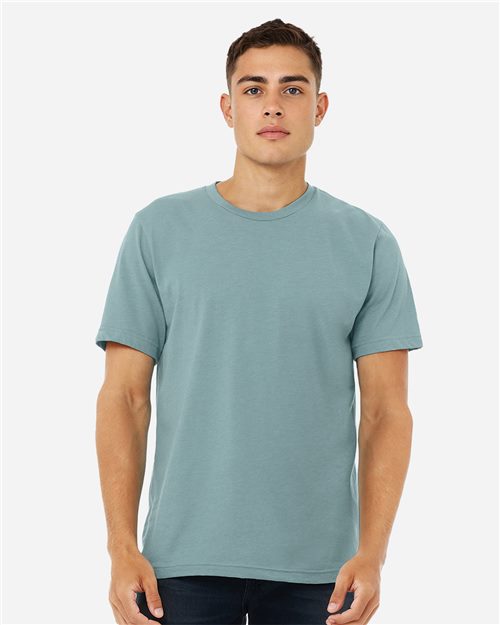
Quick answer: The best wholesale blank CVC T-shirts for DTF printing combine a smooth, tightly knit face with enough cotton for a soft retail feel and enough polyester for shape retention and everyday durability. For most adult merch programs, the BELLA + CANVAS 3001CVC is the strongest choice when color range and a modern retail fit matter. The Gildan 64000CVC is an excellent alternative when you want a slightly heavier, modern-classic blank with a smooth printing surface. Specialized programs can extend the assortment with CVC V-necks and a coordinated youth tee.
CVC shirts have become a practical middle ground for decorators who do not want to choose between the familiar print surface of cotton and the resilience of polyester. A well-selected cotton/polyester CVC tee can feel soft enough for premium merchandise, hold its fit through repeat wear, and accept a properly produced DTF transfer with sharp detail and strong color. That makes CVC blanks useful for print shops, school-spirit sellers, event merch companies, private-label brands, and businesses building dependable reorder programs.
This guide compares the CVC styles currently listed by Beytees, explains the fabric and decoration tradeoffs, and gives you a testing framework for choosing a blank. Product colors and availability change, so confirm the live product page before committing to a production run.
What does CVC mean in a T-shirt?
CVC stands for chief value cotton. In practical apparel terms, it describes a cotton/polyester blend in which cotton is the majority fiber. Common examples include 52% cotton/48% polyester and 60% cotton/40% polyester. The exact ratio is important, but it is only one part of the buying decision. Yarn quality, knit density, fabric weight, dye behavior, construction, and fit can matter just as much when the shirt reaches the heat press.
The cotton majority usually gives a CVC tee a softer, more natural hand than a polyester-dominant performance shirt. The polyester component can improve dimensional stability, help the garment recover its shape, and contribute to a lighter, drapier feel. Compared with many basic open-end cotton shirts, ring-spun CVC fabrics also tend to present a smoother face for fine DTF detail.
CVC is not the same as tri-blend. A tri-blend typically combines cotton, polyester, and rayon and often has a very soft, fluid, vintage character. That can be attractive, but the lighter and more textured surface may be less predictable for tiny details or large, solid transfers. CVC is often the more repeatable all-purpose choice when print consistency matters.
Why CVC T-shirts work well for DTF printing
DTF transfers sit on the surface of the garment rather than relying on the fiber to accept ink in the same way as direct-to-garment printing or sublimation. That makes DTF compatible with a broad range of cotton/polyester blends. A good CVC blank offers several advantages:
- Smooth print face: Combed and ring-spun yarns or a high-stitch-density knit can support clean edges, halftones, small type, and bright white underbase areas.
- Retail-friendly hand: Majority-cotton fabrics feel familiar to customers and can support a higher-value merch presentation.
- Shape retention: Polyester can help the tee maintain its silhouette through handling and laundering.
- Versatile decoration: The same blank can often support DTF, screen printing, heat transfer, and other methods, giving a shop more production flexibility.
- Color opportunity: Heathered CVC programs can open a large color assortment without forcing a brand into a heavy or athletic-looking blank.
The main caution is dye migration. Polyester content means some garment dyes can move into the transfer when exposed to heat, especially on saturated reds, maroons, neons, and certain dark heathers. A shirt can look correct immediately after pressing and develop discoloration later. This is why a real production test includes a cooling period and a delayed inspection, not just a quick peel at the press.
Best wholesale blank CVC T-shirts for DTF printing: comparison
| Style | Published fabric | Fit and construction | Best use |
|---|---|---|---|
| BELLA + CANVAS 3001CVC | 4.2 oz., typically 52/48 Airlume combed and ring-spun cotton/polyester; select colors differ | Retail fit, unisex sizing, side seams, tear-away label | Premium merch, brand launches, broad color programs |
| Gildan 64000CVC | 4.6 oz., 60/40 cotton/polyester, 30 singles | Modern classic fit, narrow rib collar, taped neck and shoulders, tear-away label | High-volume programs, uniforms, repeatable everyday merch |
| BELLA + CANVAS 3005CVC | 4.2 oz., typically 52/48 Airlume combed and ring-spun cotton/polyester | Retail fit, unisex sizing, V-neck, side seams, tear-away label | Retail collections and elevated event merchandise |
| BELLA + CANVAS 6405CVC | 4.2 oz., typically 52/48 Airlume combed and ring-spun cotton/polyester | Women’s relaxed fit, V-neck, side seams, tear-away label | Fit-specific collections and coordinated staff apparel |
| BELLA + CANVAS 3001YCVC | Majority-cotton CVC jersey; select colors differ | Youth retail fit, unisex sizing, side seams, tear-away label | Schools, teams, camps, family-size merch programs |
The blend can vary by color within a style. Athletic Heather, Black Heather, prism effects, and other specialty shades may not use the core ratio shown for the main assortment. Always read the specific color data before approving a heat-sensitive production job.
1. BELLA + CANVAS 3001CVC: best overall for premium merch and color depth
The BELLA + CANVAS 3001CVC is the most flexible starting point for brands that want a soft retail hand, a modern silhouette, and extensive color choice. The current Beytees listing specifies a 4.2 oz. 52/48 Airlume combed and ring-spun cotton/polyester fabric for the core program, with a 32-singles knit. It is pre-shrunk, side-seamed, shoulder-to-shoulder taped, and finished with a tear-away label.
Those details matter in a DTF workflow. The fine ring-spun surface helps detailed transfers look crisp. Side seams support a consistent retail shape, and the tear-away label is useful when a merch seller plans a compliant private-label finish. At the time of this guide, the product page displayed 85 colors, giving designers room to build tonal collections instead of forcing every graphic onto black, white, and navy.
The tradeoff is purchasing complexity. A large palette creates more opportunity for color-specific behavior. The published composition changes for some heathers and prism shades, and dark or saturated polyester-bearing colors deserve a migration test. Do not assume a press recipe approved on White will automatically qualify Heather Red or Black Heather.
Choose the 3001CVC when: perceived softness, retail styling, color breadth, and rebranding flexibility are more important than choosing the heaviest blank in the stack.
2. Gildan 64000CVC: best for a smooth, dependable modern-classic program
The Gildan 64000CVC is a strong choice for buyers who want a slightly more substantial CVC tee with straightforward construction and a smooth printing face. The current listing specifies 4.6 oz. 60/40 cotton/polyester fabric at 30 singles. Gildan describes the fabric as soft ring-spun cotton and cotton blend with a high stitch density. The shirt has a modern classic fit, narrow rib collar, taped neck and shoulders, and a tear-away label.
The product was previously numbered 67000; the current Beytees listing notes that the style number changed to 64000CVC without a product change. That detail is useful for shops matching an older customer specification or purchase order.
At the time of review, the product page displayed 25 colors. All colors except Pitch Black and White were described as having a subtle heather texture. That gives the range a soft visual character while retaining a practical everyday silhouette. The 60/40 ratio also gives buyers a little more cotton content than a 52/48 blend, though a successful DTF result still depends on the transfer system, garment dye, and press conditions.
Choose the 64000CVC when: you want an adaptable modern-classic fit, a slightly heavier listed weight, smooth printability, and a focused color assortment for repeat programs.
3. BELLA + CANVAS 3005CVC: best unisex CVC V-neck
The 3005CVC Unisex Heather CVC V-Neck brings the familiar 4.2 oz., 52/48 Airlume combed and ring-spun construction to a V-neck retail fit. It is pre-shrunk, side-seamed, shoulder-taped, and equipped with a tear-away label. The current page displayed 19 colors when this guide was prepared.
A V-neck is not just a fashion variation. It changes the usable decoration area. A wide standard transfer positioned from the neckline can feel too close to the V or visually sag into it. Build a separate placement template, measure from stable shoulder or center references, and test each size instead of reusing a crewneck platen mark without adjustment.
Choose the 3005CVC when: you want an alternate neckline in a coordinated retail collection and are prepared to maintain a dedicated placement standard.
4. BELLA + CANVAS 6405CVC: best women’s relaxed CVC V-neck
The 6405CVC Women’s Relaxed Heather CVC V-Neck is designed for programs that want a fit-specific option rather than placing every customer into one unisex silhouette. The published core fabric is 4.2 oz. 52/48 Airlume combed and ring-spun cotton/polyester, with a relaxed fit, side seams, and tear-away label. The live page displayed 12 colors at the time of review.
For DTF, the same placement discipline applies: qualify the artwork size and vertical position across the actual size run. A transfer that looks balanced on a larger unisex crewneck can overwhelm a smaller V-neck body. A better workflow stores separate art templates for each garment family.
Choose the 6405CVC when: your customers value a women’s relaxed silhouette and you want it to coordinate with a premium CVC assortment.
5. BELLA + CANVAS 3001YCVC: best youth companion style
The 3001YCVC Youth CVC Jersey Tee gives schools, teams, camps, reunions, and family merch programs a youth-specific CVC option. The listing describes majority-cotton Airlume combed and ring-spun CVC jersey, a youth retail fit, unisex sizing, side seams, pre-shrunk fabric, and a tear-away label. The product page displayed 34 colors when reviewed.
Youth production needs its own artwork rules. Reduce transfer dimensions intentionally rather than scaling by eye at the press, and make sure the graphic does not extend into seams or underarm curvature. If the order spans youth and adult garments, keep the approved transfer size for each group on the work order.
Choose the 3001YCVC when: you need a coordinated youth offering and want a softer retail presentation than a basic youth tee.
CVC vs 100% cotton vs tri-blend for DTF
CVC vs 100% cotton
A 100% cotton ring-spun tee is often the simplest substrate to qualify because it removes polyester dye migration from the equation. It can also deliver a natural hand that customers already understand. CVC adds shape retention, a drapier feel, and a broad heather palette, but the polyester component adds another variable under heat. If you are still deciding by fabric mass and print method, use our blank T-shirt weight guide as a companion reference.
CVC vs tri-blend
Tri-blends can feel exceptionally soft and vintage, but their rayon content and often lighter, more fluid knit can make large transfers feel more noticeable. A fine CVC jersey is frequently the easier balance between softness and a stable print platform. Choose by sample, not by fiber label alone.
CVC vs polyester performance tees
Polyester performance shirts are useful for sports and moisture-management programs, but they can bring greater dye-migration risk and a different hand. A CVC blank feels more like a retail cotton tee and may be easier to position as everyday merchandise. Performance garments still win when athletic function is the primary requirement.
How to press DTF transfers on CVC shirts
There is no universal temperature, time, pressure, or peel rule for every DTF transfer and every CVC shirt. Follow the transfer supplier’s instructions first, then validate the recipe on the exact style and color. Film, adhesive powder, ink system, curing method, heat-press calibration, platen condition, and garment dye can all change the result.
- Confirm the exact blank. Record style, color, size, and published fiber blend. Do not qualify only the generic words “CVC shirt.”
- Inspect the garment. Check for moisture, wrinkles, contamination, seams, pockets, and uneven areas that can interfere with pressure.
- Pre-press only as needed. A short pre-press can remove moisture and flatten the print area, but excessive heat exposure can encourage dye movement or leave a press box.
- Position with a repeatable reference. Use a placement guide or laser system and a written measurement for each garment family.
- Press to the transfer system specification. Verify actual platen temperature with appropriate equipment and apply consistent pressure.
- Peel as directed. Hot, warm, and cold peel films behave differently. Guessing can create lifted edges or a rough surface.
- Perform the finishing press if required. Use the specified cover sheet and duration. More heat is not automatically better.
- Inspect immediately and later. Check adhesion, edge quality, texture, discoloration, gloss, and garment marking after cooling and again after the dye has had time to migrate.
If you are building a broader blank lineup, compare these CVC selections with our best wholesale blank T-shirts for DTF printing.
How to reduce dye migration on CVC fabric
Dye migration appears when garment dye moves into the transfer layer, shifting white ink toward pink, gray, blue, or another unwanted tone. Because migration can develop after pressing, an immediate visual check is not enough.
- Test the exact style and color from production inventory.
- Use a DTF system intended for the substrate and consider a blocker solution when the supplier recommends it.
- Avoid unnecessary time and temperature beyond the validated recipe.
- Let the sample rest before approval and inspect it under neutral light.
- Wash-test a representative garment before a large repeat program.
- Keep an approved sample and record the transfer batch, press, operator, pressure setting, time, and temperature.
White and light garments often present less visible migration risk, but they still need adhesion and wash testing. Dark, saturated, and specialty heather colors should receive extra scrutiny.
Artwork choices that improve CVC DTF results
The soft feel of a CVC shirt can be undermined by an unnecessarily large rectangle of ink and adhesive. Good artwork engineering protects both appearance and comfort.
- Use negative space so the garment can flex and breathe between printed elements.
- Avoid giant solid underbase areas unless the design requires them.
- Set small type and fine lines to the proven limits of your transfer provider.
- Check transparency, gradients, and edge cleanup on the final production file.
- Build separate adult, youth, and V-neck placement templates.
- Evaluate contrast against the actual heather color, not only a white artboard.
A transfer can be technically durable and still be the wrong design for the garment. The best result is a system match: artwork, transfer, fabric, color, fit, and placement working together.
Wholesale buying checklist for CVC DTF programs
Before ordering a full production quantity, use a controlled buying process:
- Define the customer promise. Is the program selling softness, durability, a retail fit, a broad palette, or low replacement risk?
- Select two finalists. For many adult programs, compare the 3001CVC and 64000CVC on the same artwork.
- Order representative colors and sizes. Include the darkest or most saturated production color and the smallest and largest garment sizes.
- Press identical test art. Do not compare different designs on different shirts.
- Record the result. Score hand feel, color, detail, stretch recovery, press marks, migration, and wash performance.
- Confirm live availability. Stock and delivery timing can change by color, size, and warehouse.
- Approve substitutes in advance. Decide whether a different color, size split, or second style is acceptable before a deadline becomes urgent.
Beytees offers wholesale access with no minimum order on the listed products, which makes sampling easier before a bulk commitment. When private labeling is part of the program, also review our guide to wholesale blank T-shirts with tear-away labels.
Which CVC blank should your business choose?
For premium merchandise and creator brands
Start with the BELLA + CANVAS 3001CVC. Its retail fit, fine jersey surface, tear-away label, and large current color program give a brand more ways to create a recognizable collection.
For uniforms and repeat corporate programs
Start with the Gildan 64000CVC. Its modern-classic fit, slightly heavier published weight, smooth high-density surface, and focused color range make it easy to understand and reorder.
For events with fit and neckline choice
Pair a crewneck core with the 3005CVC unisex V-neck or 6405CVC women’s relaxed V-neck. Keep separate placement specifications so the graphic remains balanced across necklines.
For schools, camps, and family collections
Use the 3001YCVC as the youth companion, then qualify a coordinating adult CVC based on color and fit. For a deeper youth-specific workflow, see our guide to wholesale youth T-shirts for DTF printing.
Common mistakes when printing DTF on CVC shirts
- Assuming every color has the same blend: Specialty and heather colors can use different fiber ratios.
- Skipping delayed migration checks: A transfer can change color after it leaves the press.
- Using one placement for every body: Adult crewnecks, youth tees, and V-necks need separate standards.
- Overheating to solve adhesion: Excessive heat can create shine, press marks, distortion, or migration without fixing the root cause.
- Ignoring the transfer supplier’s peel rule: Peeling at the wrong stage can lift details and edges.
- Approving from a digital mockup: Heather texture, garment color, and transfer hand must be evaluated on a physical sample.
- Buying the full run before testing: Sampling is inexpensive compared with replacing a decorated order.
Frequently asked questions about CVC shirts for DTF
Are CVC shirts good for DTF printing?
Yes. CVC shirts are generally well suited to DTF because the transfer can bond to cotton/polyester blends and a fine CVC knit can provide a smooth surface. You still need to test the exact shirt color, transfer system, and press recipe.
What CVC blend is best for DTF?
Both 52/48 and 60/40 cotton/polyester blends can perform well. The best choice depends on knit quality, dye stability, weight, fit, and the transfer system—not the ratio alone. Majority-cotton CVC blends are popular because they balance a cotton-like hand with polyester-assisted stability.
Is the BELLA + CANVAS 3001CVC good for DTF?
It is a strong DTF candidate because its core 52/48 Airlume combed and ring-spun fabric has a fine surface, while its retail fit, side seams, broad color range, and tear-away label suit merchandise programs. Test each production color because specialty color blends can differ.
Is the Gildan 64000CVC the same as the Gildan 67000?
The current Beytees listing says 67000 was the previous style number and that no product changes were made when it became 64000CVC. Buyers matching older records should confirm the current product page and SKU details when ordering.
Will CVC shirts have dye migration?
They can. CVC fabric contains polyester, and some polyester dyes can migrate when heated. Risk varies by style, color, dye lot, transfer system, and press conditions. Test dark and saturated colors, inspect after cooling, and perform a delayed check.
What temperature should I use for DTF on CVC?
Use the time, temperature, pressure, and peel instructions supplied with your specific DTF transfer, then validate them on the exact CVC style and color. There is no single setting that is correct for every film, powder, ink, press, or garment.
Can I use the same DTF transfer on CVC and 100% cotton?
Many transfer systems support both substrates, but the approved press recipe and migration risk may differ. Treat each garment as a separate qualification and follow your transfer provider’s substrate guidance.
Which CVC tee has the most color choices?
Among the CVC styles reviewed here, the BELLA + CANVAS 3001CVC had the broadest live color display when this guide was prepared. Color count and stock can change, so use the current product page for purchasing decisions.
Are tear-away labels useful for custom apparel brands?
Yes. A tear-away label can simplify rebranding, but it does not remove the seller’s responsibility to provide accurate and legally compliant fiber, origin, care, and identity information where required.
Should I wash-test a CVC DTF sample?
Yes. A wash test helps evaluate adhesion, cracking, edge lift, color change, shrink interaction, and overall hand. Use the intended care instructions and document the test before approving a large production run.
Final recommendation
For the widest range of premium adult merch applications, begin with the BELLA + CANVAS 3001CVC. For a smooth, slightly heavier modern-classic option, compare it directly with the Gildan 64000CVC. Add the 3005CVC, 6405CVC, or 3001YCVC only when neckline, fit, or youth sizing solves a real assortment need.
The winning blank is not simply the one with the softest fabric or longest color list. It is the shirt that survives your complete process: sourcing, pressing, delayed migration inspection, laundering, customer wear, and reliable reordering. Start with samples, record the press recipe, and approve the exact style-color combination before production. Explore the linked products on Beytees to review current colors and availability.
Leave a Reply