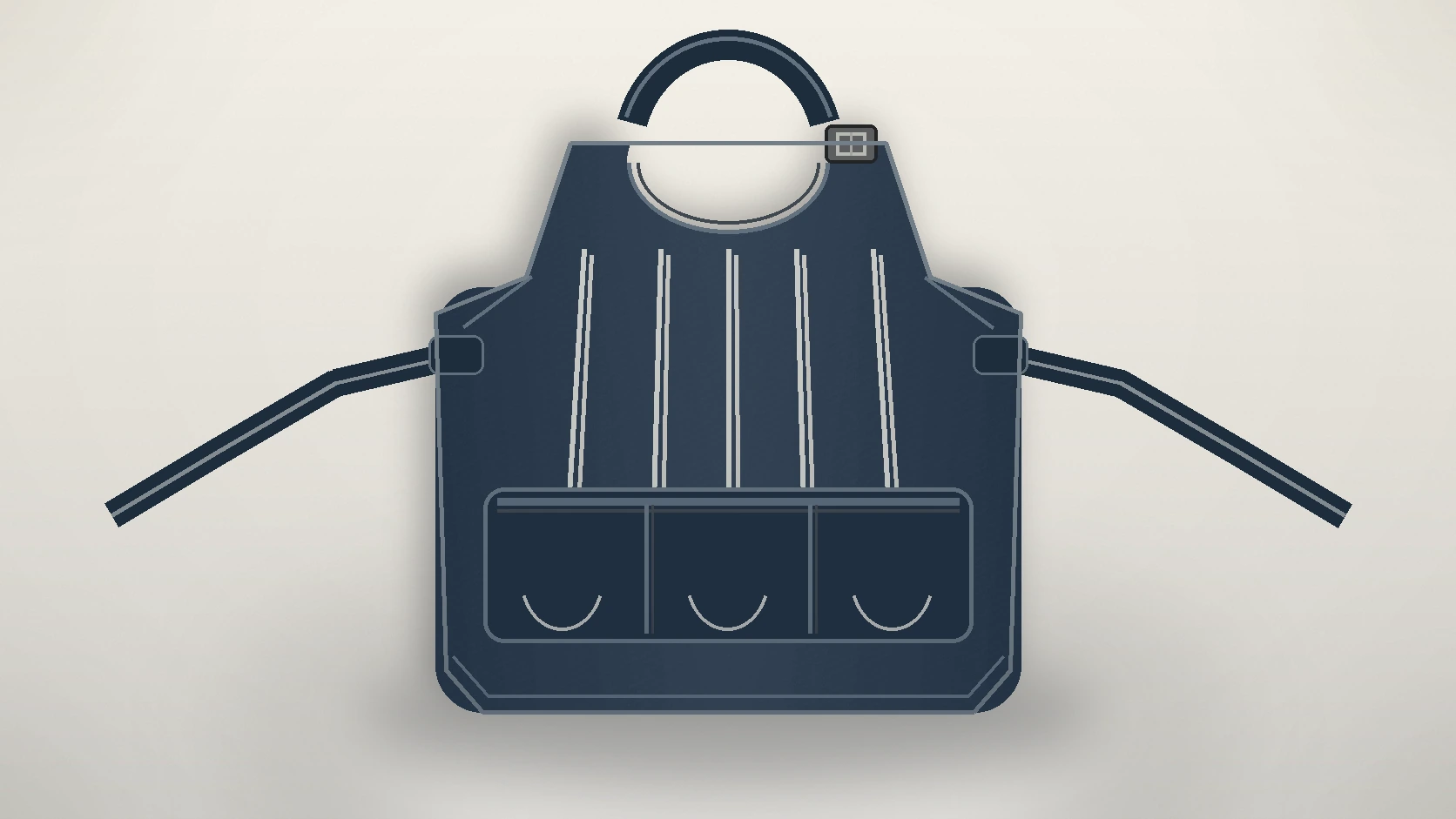
Q-Tees Q4250 wholesale evaluation starts with a practical question: does this exact apron’s layout support the staff role, artwork, and ordering controls in your brief? Q-Tees publishes a 22-inch-wide by 24-inch-high cotton/poly twill apron with a full-width, eight-inch-deep, three-compartment pouch, extra-long waist ties, an adjustable neck strap, and a 10-inch-wide by 12-inch-high imprint area. Those are useful planning facts, not guarantees of fit, decoration performance, protection, stock, or complete landed cost.
Use this guide to choose a first sample and build a controlled approval process. Verify the exact received apron, color, label, measurements, pouch access, artwork position, decoration method, laundering basis, staff movement, and substitution rule before releasing a bulk order. No fixed price or availability is stated here because those commercial details can change.
Quick Answer: Is the Q4250 the Right Staff Apron?
Sample the Q4250 first when the written brief calls for medium-length coverage, an adjustable neck strap, extra-long waist ties, and a divided full-width pouch. Its published form can support an apron-led uniform program for service, hospitality, retail, event, craft, or workshop roles, but the exact role still determines whether the coverage, pocket layout, and decoration area are appropriate.
Do not treat an apron as personal protective equipment unless the exact product has separately verified performance evidence for the hazard. The reviewed Q4250 pages do not establish heat, flame, cut, chemical, water, stain, puncture, or food-safety protection. For broader assortment planning, compare the model-specific decision here with Beytees’ wholesale blank apron guide.
Q4250 Specifications at a Glance
| Specification | Current published wording | Buyer verification |
|---|---|---|
| Style | Q-Tees Q4250 medium-length apron with pouch | Match the received style and supplier SKU |
| Fabric | Cotton/poly twill; percentages and weight not published on the exact manufacturer page | Read the received fiber label and do not infer a ratio |
| Body dimensions | 22 inches wide by 24 inches high | Measure the sample flat with one documented method |
| Pouch | Full width, eight inches deep, three compartments, binding trim | Measure compartment access and test the intended carried items |
| Waist ties | One inch wide and described as extra-long | Check tie reach, knot position, and movement on representative wearers |
| Neck strap | One inch wide with a sewn-on buckle for adjustment | Check adjustment range and comfort without assuming universal fit |
| Imprint area | 10 inches wide by 12 inches high | Confirm real clearance from pouch, seams, buckle, ties, folds, and tolerances |
| Listed colors | Black, Forest Green, Natural, Navy, Red, Royal, and White | Confirm the exact variant and received shade when quoting |
Review the live Q-Tees Q4250 product page for the current seller destination and the official Q-Tees Q4250 page for the manufacturer’s current model wording. A color selector or catalog term does not prove exact-variant stock, future continuity, price, freight, or delivery.
The manufacturer also shows a case field of “6 Dz.” Treat that as a catalog observation, not a Beytees minimum, guaranteed pack, available quantity, or buying requirement. Confirm current unit, pack, case-break, and commercial terms with the seller when preparing a quote.
Construction, Coverage, and Fit Controls
The 22-by-24-inch published body dimensions describe the apron panel, not a wearer-size range. The adjustable neck strap and extra-long waist ties create fitting options, but they do not prove one-size comfort, identical drape, or equal coverage across every wearer. Measure received samples and run movement checks with the clothing staff will actually wear underneath.
The cotton/poly twill description does not include a fiber percentage or fabric weight on the exact manufacturer page. Do not invent either value or assume that all colors behave identically under heat, ink, needles, washing, or wear. The received label, supplier documentation, and production-equivalent test should control the approval.
Coverage should be evaluated against the task. Observe reaching, bending, walking, carrying, counter work, and repeated pocket access. Check whether the buckle, strap, tie knot, and pouch sit comfortably and whether the apron shifts during normal activity. If a role has a real hazard, select separately verified protective equipment instead of extending an ordinary uniform-apron description into a safety claim.
Staff Uniform Programs and Role Mapping
Q-Tees presents baristas, waitstaff, florists, cooks, restaurants, cafes, catering, events, crafts, and related settings as examples. Convert each example into a written role brief. A cashier may prioritize a consistent logo position and light pocket use; a server may prioritize notepad access and movement; an event team may prioritize fast fitting and visual consistency. None of those needs can be approved from a product-page label alone.
| Role brief | First sample focus | Approval evidence |
|---|---|---|
| Front counter or barista | Logo visibility, repeated reaching, pouch access, neck adjustment | Wear test during representative counter tasks and decorated sample |
| Waitstaff or event service | Tie security, movement, notepad or small-tool access | Loaded-pouch movement check and placement approval |
| Florist, craft, or retail demonstration | Coverage, compartment organization, interaction with tools | Task observation with approved carried items |
| Kitchen-adjacent visual uniform | Coverage and laundering basis without a protective-use assumption | Operational review, received care label, decorated wash test |
| Multi-role staff program | Shared appearance versus role-specific pocket and movement needs | Representative wearer panel and written exceptions |
Build the rest of the uniform separately. Beytees’ blank work shirt guide covers a structured shirt layer, while its corporate polo guide addresses another front-of-house route. Those pages solve garment-layer questions; this article stays focused on the Q4250 apron.
Decoration Planning Around the Apron Layout
The published 10-by-12-inch imprint area is a starting envelope. It does not guarantee that every artwork shape, press platen, screen frame, hoop, backing, or placement fits safely on every received unit. Before designing to the maximum, lay the sample flat, identify the pouch opening and compartment seams, locate the neck hardware and waist ties, and mark an approved artwork origin.
Scale the design from the usable area rather than the catalog rectangle alone. A centered mark may need different spacing from a left-position logo; a tall design may approach the pouch opening; a wide design may interact with folds or body curvature. Record the physical design dimensions and distance from stable reference points, then retain a photograph and decorated approval sample.
| Potential zone | Planning opportunity | Risk to control | Required check |
|---|---|---|---|
| Upper body panel | Primary staff or brand mark | Neck strap, buckle, folds, and wearer curvature | Measure flat and confirm on representative wearers |
| Area above pouch | Horizontal wordmark or compact emblem | Clearance from pouch opening and press or hoop access | Use the actual sample and production equipment |
| Pouch face | Secondary mark or role identifier | Multiple fabric layers, compartment seams, pocket closure, reduced utility | Test access and function after decoration |
| Near side edges | Small identifier when the brief requires it | Waist ties, edge binding, curvature, and inconsistent visible position | Approve on-body location, not only flat artwork |
| Straps or ties | No default recommendation | Narrow width, hardware, movement, knotting, and difficult registration | Use only after a dedicated process test |
If the same program includes branded carry goods, the Q-Tees QTB vs Q125900 tote comparison is a separate accessory decision. Do not assume an apron approval transfers to a bag: construction, layers, seams, platen access, and use conditions differ.
Pouch, Seams, Hardware, and Usable Areas
The full-width pouch is published as eight inches deep and divided into three compartments with binding trim. That layout creates utility, but it also creates boundaries for artwork and equipment. The exact page does not publish individual compartment widths, seam allowances, load ratings, or an approved tool list. Measure each received sample and test only the items named in the role brief.
Decoration through a pouch can join layers, narrow a compartment, block access, or place backing and thread where carried items contact the fabric. Heat processes can also encounter stacked material and seams that change pressure. If pouch decoration is requested, approve both visual quality and post-decoration function. Put each intended item into its compartment and repeat the movement check.
Keep artwork clear of the sewn-on buckle, neck strap, waist ties, binding, and unstable folds unless a dedicated sample proves the placement. Record no-decoration zones in the production file. A flat mockup is useful for communication, but only a physical sample can show how the mark reads while worn and whether the pouch remains usable.
DTF, Heat Transfer, and Screen Printing Qualification
No reviewed exact source provides a universal DTF or heat-transfer time, temperature, pressure, peel, post-press, platen, or wash-life recipe for the Q4250. Follow the current transfer-system instructions and qualify the exact apron color and received fabric on calibrated equipment. Avoid letting the pouch, seams, binding, straps, or buckle create uneven pressure.
Freeze the test variables: supplier SKU, color, received label, lot when available, artwork revision, physical dimensions, transfer or film batch, press identity, platen, temperature verification, pressure method, time, peel, post-press, placement origin, and laundering method. Inspect immediate adhesion, edge lift, press marks, gloss, shade change, distortion, texture, and interference with pocket access.
For screen printing, test screen, ink system, underbase where relevant, flash, cure verification, hand, detail, and wash response on the exact blank. Twill construction alone does not prove a preferred mesh, deposit, cure setting, or result. Large solids, fine lines, and multi-color registration impose different demands. Retain the decorated and laundered approval sample rather than relying on a verbal pass.
Requalify after a changed color, label, lot, artwork coverage, transfer material, ink system, press, platen, screen, operator method, placement, or care basis. A successful test on one configuration does not approve every variation.
Embroidery Qualification
Embroidery may suit a compact staff mark, but the exact Q4250 pages do not provide a digitizing, needle, thread, backing, hooping, stitch-density, placement, or wash specification. Start with the actual artwork and sample. Evaluate registration, distortion, puckering, show-through, backside feel, hoop marks, strap and buckle clearance, and pocket function.
Choose a placement that allows the garment to be hooped or framed without trapping hardware or sewing through unintended layers. If the design intersects the pouch, determine whether the pocket must remain open and whether the machine path can preserve that function. Do not assume the published imprint rectangle is an embroidery field.
Approve the smallest and largest embroidery variants actually planned, especially if names or job titles change the stitch count or width. Keep the digitized file version, thread specification, backing decision, machine settings, placement references, finished sample, laundering result, and QC tolerance together. Re-test any material or construction change instead of treating prior approval as permanent.
Wholesale Sampling, Labeling, and Reorder Checklist
Begin with one controlled configuration: exact style, seller SKU, color, received fiber and origin wording, measurements, and intended staff role. Confirm the current seller page, quote terms, pack or case handling, freight, delivery, and return conditions at the time of purchase. The live page is the place to check; this evergreen guide does not freeze them.
Before removing, covering, or replacing any label, preserve the original information and determine what the finished item requires. The FTC textile labeling guidance explains general fiber, origin, responsible-business, replacement-label, advertising, and recordkeeping boundaries. The FTC care-label guidance discusses care instructions and a reasonable basis. Obtain qualified review for the actual product and selling context; this article is not legal advice.
Release production only after the blank sample, wearer test, artwork proof, physical placement, decoration test, laundering result, pouch function, and QC limits are approved. Define acceptable variation and inspect incoming goods against the retained sample. If a color, label, construction, supplier, or decoration input changes, stop and determine whether a new approval is required.
A useful reorder record includes purchase date, supplier, SKU, color, lot evidence when available, received-label photos, flat measurements, artwork and digitizing revisions, placement coordinates, production settings, operator or machine identity, sample images, wash protocol, QC findings, carton or pack terms, and complete landed cost. Write the substitution rule before the order: no different style, color, fiber statement, construction, or process becomes equivalent by assumption.
The practical decision is straightforward. Choose the Q4250 for further testing when its medium-length panel, adjustable strap, extra-long ties, three-compartment pouch, and published decoration area match the role brief. Approve the program only when the exact decorated sample works for staff and production. That keeps the uniform decision evidence-based without inventing protection, performance, price, or availability.
Frequently Asked Questions
What are the published dimensions of the Q-Tees Q4250 apron?
Q-Tees publishes the Q4250 at 22 inches wide by 24 inches high. Those are apron-panel dimensions, not a guaranteed wearer-size range. Measure the received sample flat and test coverage, movement, neck adjustment, and tie reach on representative staff.
What fabric is the Q4250 made from?
The exact manufacturer page describes cotton/poly twill but does not publish the fiber percentages or fabric weight. Read the received label, keep the exact color and supplier record, and test the production decoration instead of inferring a blend ratio or performance result.
How many pocket compartments does the Q4250 have?
Q-Tees describes a full-width pouch that is eight inches deep and divided into three compartments with binding trim. Individual compartment widths and load limits are not published on the exact page, so test the intended carried items and movement.
What imprint area does Q-Tees publish for the Q4250?
The published imprint area is 10 inches wide by 12 inches high. Treat it as a planning envelope, not automatic production approval. Measure the received apron and confirm clearance from the pouch, seams, binding, neck hardware, waist ties, folds, and equipment.
Is the Q4250 adjustable?
The manufacturer lists a one-inch-wide neck strap with a sewn-on buckle for adjustment and one-inch-wide extra-long waist ties. Those features provide adjustment points but do not guarantee universal fit, comfort, coverage, or tie reach. Run representative wearer checks.
Which decoration method is best for the Q4250?
No universal winner or recipe was verified. Select DTF, another heat transfer, screen printing, or embroidery from the artwork, quantity, finish, equipment, and role brief, then qualify the exact color, fabric label, placement, process, and laundering method.
Can the three-compartment pouch be embroidered?
Only after a dedicated sample proves access and function. Embroidery can join fabric layers, narrow a compartment, add backing inside the pouch, or interfere with carried items. Confirm machine access, stitch quality, backside condition, compartment opening, and loaded-pouch movement.
Is the Q4250 suitable for restaurant and cafe uniforms?
Q-Tees presents restaurants, cafes, baristas, waitstaff, cooks, and catering as example settings. Suitability still depends on the exact role, coverage, fit, pouch use, decoration, care process, and workplace requirements. No protective or food-safety certification was verified.
Which Q4250 colors are currently listed?
The reviewed manufacturer page lists Black, Forest Green, Natural, Navy, Red, Royal, and White, and Beytees displayed seven color choices. Listed colors do not prove exact-variant stock or future continuity. Confirm the selected color and received shade when ordering.
What should a buyer approve before a wholesale reorder?
Approve exact style, seller SKU, color, received labels, measurements, wearer checks, artwork revision, placement, decorated and laundered sample, pouch function, QC limits, current commercial terms, pack handling, substitution rules, and complete landed cost. Requalify any material change.
Leave a Reply