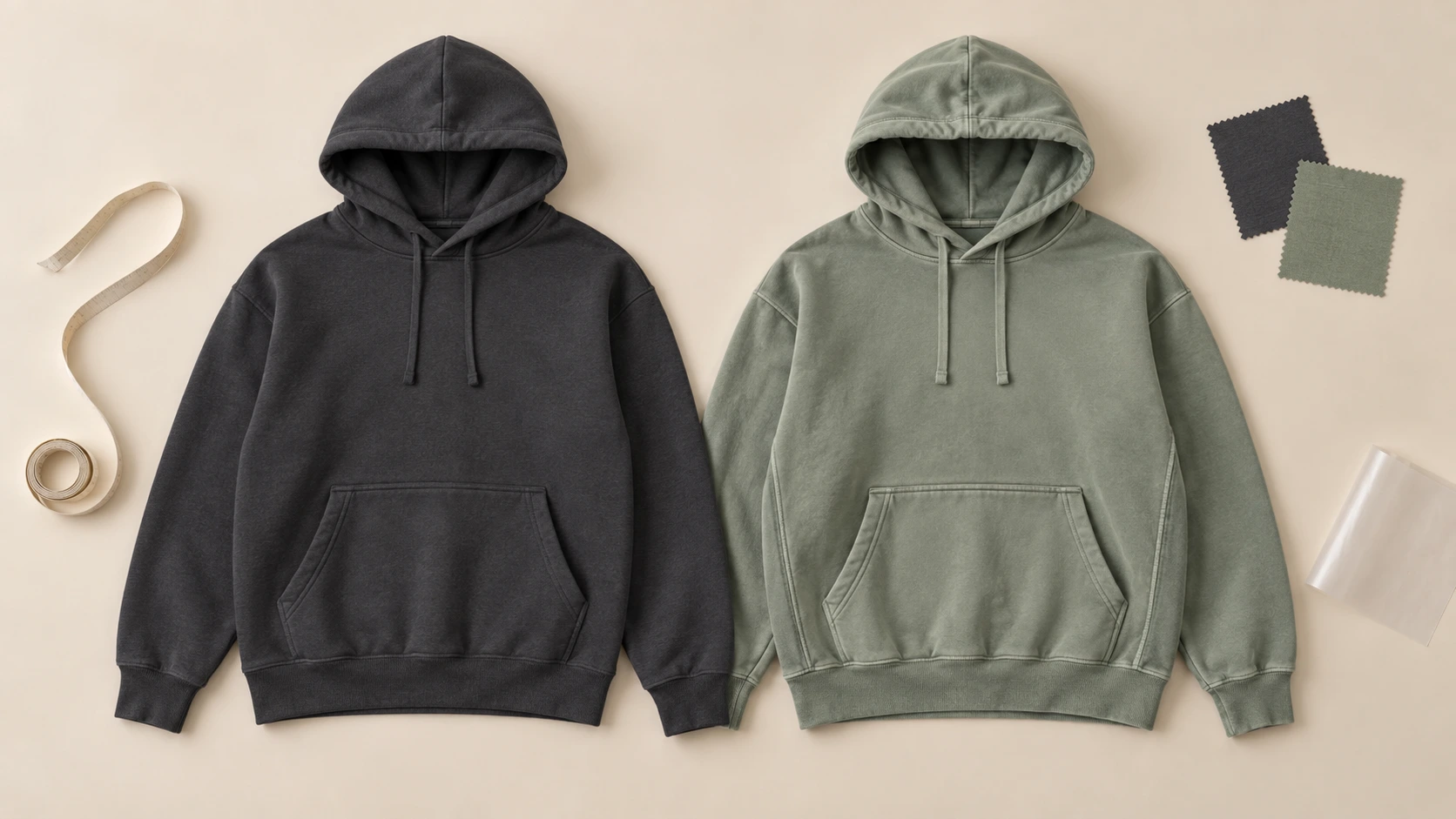
Quick answer: the Gildan 18500 vs Comfort Colors 1567 decision is an 8.0 oz/yd² classic-fit Heavy Blend hoodie versus a 9.5 oz/yd² garment-dyed, cotton-face, relaxed-fit hoodie. Sample the Gildan 18500 first when the program calls for a core midweight fleece platform, a double-lined hood, or a tear-away label. Sample the Comfort Colors 1567 first when the brief calls for a heavier published fabric weight, garment-dyed character, side seams, a jersey-lined hood, or a back-neck customization patch.
Neither hoodie is a universal winner. Weight, fiber, dye, fit, construction, label treatment, artwork, and live commercial terms must be evaluated as one program. Test both when physical hand, wearer fit, shade character, decoration behavior, relabeling, or reorder consistency can change the decision.
Gildan 18500 vs Comfort Colors 1567: Source-Aware Comparison
Begin with the current Gildan 18500 Beytees product page and Comfort Colors 1567 Beytees product page. Then compare the seller records with the official Gildan G18500 page and official Comfort Colors 1567 page. The received garment, sewn label, exact color, and production-equivalent sample remain the controlling evidence.
| Buying factor | Gildan 18500 | Comfort Colors 1567 | Buyer action |
|---|---|---|---|
| Published fabric weight | 8.0 oz/yd² | 9.5 oz/yd² | Use the 1.5 oz/yd² difference to plan samples, not to infer exact finished weight, warmth, comfort, or durability |
| Primary fiber statement | Solids: 50% U.S. cotton, 50% polyester; heather wording varies by channel | 80% ring-spun U.S. cotton, 20% polyester with a 100% cotton face | Verify the exact color and received label before decoration approval |
| Dye or finish | No garment-dyed claim on the reviewed official page | Garment-dyed; current colors include pigment and direct/reactive groups | Do not describe every 1567 shade as pigment-dyed |
| Fit wording | Classic fit for loose comfort | Relaxed fit | Do not equate size letters, drape, or wearer preference |
| Hood | Double-lined hood with color-matched drawcord | Jersey-lined hood with color-matched flatcord | Approve hood bulk, drawcord control, and upper-front placement on samples |
| Body details | Reviewed official page does not establish a tubular or side-seamed claim | Side-seamed body and rolled-forward shoulder | Build model-specific artwork and alignment references |
| Label system | Tear-away label | Signature twill label, back-neck twill tape, and back-neck patch | Plan compliant replacement labeling before removing information |
| Current manufacturer selector | S–5XL, with size availability varying by color | S–3XL | Treat menus as mutable assortment signals, not stock promises |
For deeper single-style context, use the Gildan 18500 wholesale buying guide. The Comfort Colors 1467 vs 1567 comparison provides related 1567 context, while the Gildan 18500 vs Independent Trading SS4500 comparison covers a different 18500 decision. This article stays limited to the 18500 and 1567.
8.0 oz Heavy Blend vs 9.5 oz Cotton-Face Fleece
The published area weights differ by 1.5 oz/yd²: 8.0 oz/yd² for the 18500 and 9.5 oz/yd² for the 1567. Area weight is useful for specifying a sample direction, but it does not prove exact finished-garment weight, warmth, softness, drape, durability, or decoration quality. Those outcomes require physical comparison.
Gildan describes 18500 solids as 50% U.S. cotton and 50% polyester. Its official material summary describes heathers broadly as 40% U.S. cotton and 60% polyester, while the current Beytees copy names several heathers as 60% polyester and 40% cotton. Treat this as a channel-wording conflict: record the selected color, verify the received label, and do not move a solids process to a heather automatically.
Comfort Colors lists the 1567 as 80% ring-spun U.S. cotton and 20% polyester, with a 100% soft ring-spun U.S. cotton face. A cotton face can be relevant to surface evaluation, but it does not make the whole hoodie 100% cotton or guarantee a specific print result. Compare the exact garments with the intended artwork and process.
Garment Dye, Pigment Shades, Reorders, and Care
The 1567 is garment-dyed, but its current official selector separates nine pigment-dye colors from two direct/reactive colors. “Every 1567 is pigment-dyed” is therefore inaccurate. Pigment and direct/reactive selections should be recorded and qualified as separate color groups, and every production lot should be checked against the approved sample.
Comfort Colors’ official care guidance says garment-dyed products should be washed separately before wearing, that loose pigment may remain on pigment-dyed shades, and that pigment shades should be washed with like colors. It recommends cold water to reduce staining risk and describes shade variation as inherent in garment dyeing. The manufacturer also uses pre-shrunk and “almost no shrinkage at home” wording; that is not a shrink-proof guarantee for a decorated finished garment.
Shade character and possible lot-to-lot variation belong in the purchasing plan. Keep an approved sample, document the selected dye group and lot, and decide in advance what visual range is acceptable for the merch program. Reorder matching should be checked with current physical evidence rather than promised from a product-page color swatch.
Classic Fit vs Relaxed Fit: Do Not Equate Size Letters
Gildan describes the 18500 as a classic fit for loose comfort. Comfort Colors describes the 1567 as a relaxed fit. Those catalog terms do not establish equal ease, body width, length, sleeve geometry, coverage, or wearer preference. A medium in one model is not evidence that a medium in the other will fit the same.
The current official Gildan selector exposes S–5XL and warns that not every size is available in every color. Beytees currently exposes an additional XS catalog term, but channel menus and variation IDs are mutable. The official Comfort Colors selector exposes S–3XL and publishes width, length, and sleeve-center-back measurements from S through 3XL. Because the reviewed Gildan page does not provide an equivalent exact-style numerical table, avoid manufacturing a line-by-line numerical comparison.
Measure production-equivalent samples with one documented internal method. Include the smallest and largest planned sizes, check front and back artwork fields, and approve fit with the intended wearer group. The decision should be based on the written merchandise brief, not shared words such as “unisex,” “loose,” or “relaxed.”
Hoods, Seams, Pockets, Shoulders, and Label Systems
The 18500 uses a double-lined hood with a color-matched drawcord, a pouch pocket, rib cuffs and bottom band with spandex, and double-needle stitching at listed stress areas. The reviewed official page does not establish whether its body is tubular or side-seamed, so this comparison makes no unsupported seam claim.
The 1567 uses a jersey-lined hood with a color-matched flatcord, side seams, a rolled-forward shoulder, a pouch pocket, rib cuffs and waistband, back-neck twill tape, a signature twill label, and a back-neck customization patch. These details can affect artwork references, hooping, loading, and neck-branding plans, but they do not establish that one hoodie is easier or faster to decorate.
Gildan lists a tear-away label for the 18500. Comfort Colors lists a signature twill label for the 1567, not a tear-away label. The FTC’s textile labeling guidance addresses fiber content, origin, responsible-business identity, replacement labels, secure attachment, and recordkeeping. Its Care Labeling Rule guidance calls for complete instructions supported by a reasonable basis for the finished garment. A removable label is not permission to sell an unlabeled or incompletely labeled hoodie.
Qualify DTF, Screen Printing, and Embroidery on Exact Samples
Neither reviewed exact-style source supplies a universal DTF recipe, wash-life guarantee, migration guarantee, embroidery result, or production-yield promise. Follow the current instructions from the transfer, ink, thread, stabilizer, and equipment suppliers. Record the hoodie model, color, fiber or dye group, size, lot, artwork, coverage, process batch, press or machine, platen or hoop, operator, placement, and date.
DTF and other heat-transfer processes
Do not publish or inherit one time, temperature, pressure, peel, cure, repress, or wash formula. For 18500 heathers, verify the exact fiber content and check heat and migration behavior by color. For 1567 pigment shades, inspect surface-color response, loose pigment, staining or transfer, press boxes, shine, scorching, adhesion, and edge lift. Test direct/reactive shades separately. Keep hood bulk, drawcords, pouch-pocket seams, and ribbing outside the pressure field when the equipment and design allow.
Screen printing and DTG
Gildan lists screen printing and DTG among manufacturer decoration techniques for the 18500, and Comfort Colors describes the 1567 cotton face as enhancing printability. These statements support testing, not a guaranteed result. Qualify ink or pretreatment, cure, opacity, hand, color response, registration, and laundering on the exact garment and artwork. The broader blank sweatshirts for DTF guide offers category context but does not replace exact-model qualification.
Embroidery, patches, and neck customization
For embroidery, test digitizing, backing, hooping, stitch density, distortion, interior comfort, hood and pocket interference, and laundering. For patches or neck branding, confirm usable space and construction before production. The blank hoodies for embroidery guide can frame the evaluation, while the approved stitched sample must control the order.
Catalog, Stock, Price, Freight, and Lead-Time Caveats
At the research snapshot, the Beytees 18500 parent exposed 423 variation IDs, 47 color terms, and nine size terms, while the 1567 parent exposed 66 variation IDs, 11 color terms, and six size terms. Both public parent records returned is_in_stock=false. A live page, purchasable flag, color term, size term, or variation ID does not prove current stock or delivery.
Do not freeze color counts, size-color matrices, price, freight, replenishment, warehouse source, lead time, or delivery dates into an evergreen purchasing promise. At order time, verify the exact variant, required quantity, current availability, landed cost, spoilage allowance, relabeling labor, packaging, exchanges, and reorder plan. The blank-apparel shipping guide provides planning context, but live checkout and order confirmation remain authoritative.
If the program needs broader garment-dyed discovery before committing to the 1567 direction, the blank garment-dyed hoodie guide can help define category criteria. It should not be used to override the exact two-model comparison or current order-time evidence.
Strict Two-Model Decision Framework
| Written merch brief | First sample | Required approval gate |
|---|---|---|
| 8.0 oz core fleece platform, classic-fit manufacturer wording, double-lined hood, or tear-away label | Gildan 18500 | Approve exact color/fiber label, size set, artwork field, decoration, replacement label, care basis, and live terms |
| 9.5 oz 80/20 cotton-face fleece, garment-dyed character, relaxed side-seamed construction, jersey-lined hood, or back-neck patch | Comfort Colors 1567 | Approve exact dye group and lot, size set, shade range, artwork field, decoration, label plan, care basis, and live terms |
| Hand, perceived weight, fit, shade, placement, relabeling, decoration behavior, reorder matching, or landed economics is unresolved | Test both | Score production-equivalent samples against one written brief and retain the approved control |
This framework does not add a third model or name an overall winner. If neither hoodie satisfies the brief, reopen product discovery rather than forcing a decision from catalog adjectives.
Sample-to-Production Approval Checklist
| Gate | Evidence to retain | Stop condition |
|---|---|---|
| Identity | Exact model, color, size, lot, dye or fiber group, and received labels | Unknown or conflicting garment identity |
| Fit and measurements | Documented method, representative smallest/largest sizes, wearer approval | Approval based only on shared size letters |
| Artwork and equipment | Actual art dimensions, placement references, platen/hoop, operator, calibrated process | Untested template or obstructed pressure/hoop field |
| Decoration | Immediate appearance, adhesion or stitch result, shade response, laundering evidence | Unsupported settings or unreviewed color/fiber/dye group |
| Labels and care | Replacement disclosures, durable attachment plan, whole-garment care basis | Missing required information or unsupported care instruction |
| Commercial terms | Exact-variant availability, quantity, cost, freight, spoilage, labor, lead time, and reorder plan | Decision relies on stale catalog counts or assumed stock |
Frequently Asked Questions
What is the main difference between the Gildan 18500 and Comfort Colors 1567?
The Gildan 18500 is an 8.0 oz/yd² classic-fit Heavy Blend hoodie with a double-lined hood and tear-away label. The Comfort Colors 1567 is a 9.5 oz/yd² garment-dyed, cotton-face, relaxed-fit hoodie with side seams, a jersey-lined hood, and a back-neck patch. These facts direct sampling, not a universal winner.
Which hoodie has the higher published fabric weight?
The Comfort Colors 1567 has the higher published fabric weight at 9.5 oz/yd², compared with 8.0 oz/yd² for the Gildan 18500. The 1.5 oz/yd² difference does not prove exact finished weight, warmth, comfort, durability, or decoration quality.
How do the Gildan 18500 and Comfort Colors 1567 fiber blends differ?
Gildan lists 18500 solids as 50% U.S. cotton and 50% polyester, while heather wording varies by channel. Comfort Colors lists the 1567 as 80% ring-spun U.S. cotton and 20% polyester with a 100% cotton face. Verify the exact color and received label.
Is every Comfort Colors 1567 color pigment-dyed?
No. The current official selector separates nine pigment-dye colors from two direct/reactive colors. Record and qualify the selected shade and dye group instead of applying an all-pigment claim to the complete 1567 range.
How do classic fit and relaxed fit compare?
They are manufacturer fit descriptions, not equivalent measurement systems. The 18500 is described as classic fit for loose comfort, while the 1567 is described as relaxed fit. Compare production-equivalent samples and do not assume that matching size letters create matching fit.
How do the hood and body construction differ?
The 18500 has a double-lined hood with a color-matched drawcord. The 1567 has a jersey-lined hood with a color-matched flatcord, side seams, and rolled-forward shoulders. Both have pouch pockets. The reviewed Gildan source does not establish a tubular or side-seamed body claim.
Which hoodie has a tear-away label?
The Gildan 18500 has the manufacturer-listed tear-away label. The Comfort Colors 1567 has a signature twill label, back-neck twill tape, and a back-neck customization patch. Any private-label workflow must preserve required textile and care information.
Which hoodie is better for DTF or screen printing?
Neither is a universal decoration winner from the reviewed evidence. Follow current transfer, ink, and equipment instructions and test the exact model, color, fiber or dye group, size, lot, artwork, process, and placement before production.
What garment-dyed care and shade-variation issues matter for the 1567?
Comfort Colors says garment-dyed products should be washed separately before wearing, pigment shades with like colors, and cold water used to reduce staining risk. Loose pigment may remain, and shade variation is inherent. Attribute those instructions to the manufacturer and verify finished-garment care.
What should decorators test before a bulk hoodie order?
Test identity, measurements, wearer fit, artwork fields, hood and pocket interference, exact colors and lots, decoration appearance, shade or migration response where relevant, adhesion or stitch quality, laundering, replacement labels, care instructions, availability, cost, freight, and reorder controls.
Final Recommendation
Sample the Gildan 18500 first for a core 8.0 oz Heavy Blend direction with classic-fit wording, a double-lined hood, and a tear-away label. Sample the Comfort Colors 1567 first for a 9.5 oz garment-dyed cotton-face direction with relaxed side-seamed construction, a jersey-lined hood, and back-neck customization.
Test both whenever fit, hand, shade, artwork scale, labeling, decoration behavior, reorder matching, or landed economics can change the decision. Approve the hoodie that satisfies the written B2B program brief, retain production evidence, and verify every live commercial term when ordering.
Leave a Reply