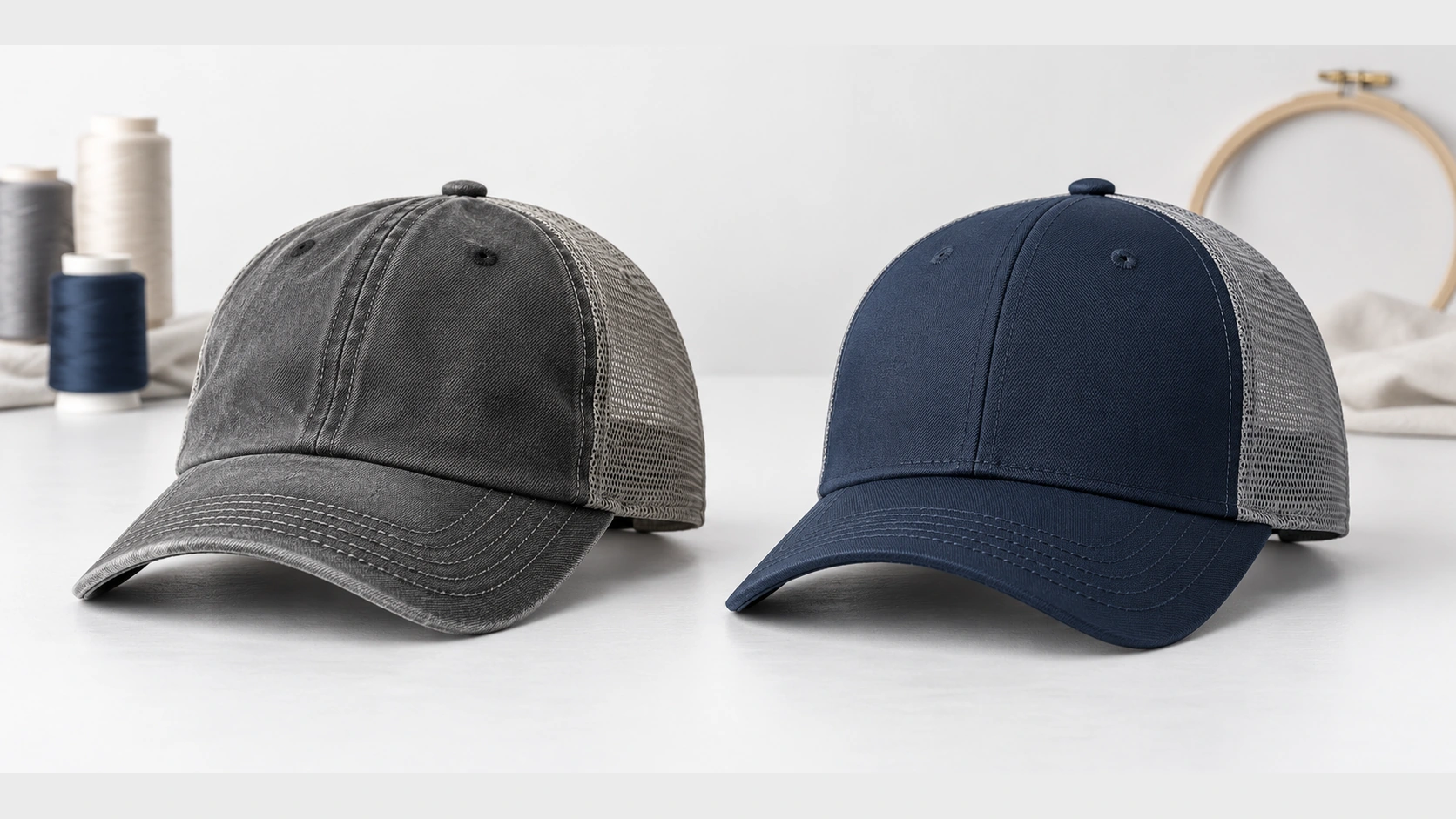
Quick Answer: Which Trucker Cap Should You Sample First?
Sample the Richardson 111 first when the brief calls for garment-washed character and a relaxed, unstructured crown. Sample the Richardson 115 first when the brief calls for a more defined structured Low Pro shape. That is a sourcing direction, not a universal winner. Both are adjustable adult six-panel trucker caps with low profiles, precurved bills, snapback closures, and polyester mesh backs. Their front fabrics, structure, shape language, wash treatment, sizing options, and decoration behavior still need program-specific approval.
The important distinction is not “low profile versus not low profile.” Richardson currently lists both caps with a low profile. The 111 pairs that profile with a relaxed, unstructured, garment-washed cotton-twill front and soft mesh. The 115 pairs a named Low Pro shape with a structured 60/40 cotton-polyester twill front and trucker mesh. Buyers should decide which silhouette belongs in the written brief, then prove fit and decoration on production-equivalent samples.
Test both when direct embroidery, patch geometry, transfer application, panel seams, crown support, wearer fit, visual consistency, or complete landed cost decides the order. Approve the exact style, color, sizing option, artwork, placement, materials, equipment, settings, inspection standard, and wear or care protocol before production.
Verified Richardson 111 vs 115 Comparison
Start with the exact Richardson 111 product record and Richardson 115 product record. They support current identity and construction, while the matching first-party pages provide the manufacturer’s technical language. Product pages do not freeze price, inventory, availability, lead time, shipping, or decoration outcomes.
| Decision factor | Richardson 111 | Richardson 115 | Buyer treatment |
|---|---|---|---|
| Shape and structure | Relaxed and unstructured | Low Pro shape and structured | Approve the intended crown presentation with the actual decoration |
| Panel and profile | Six panel; low profile | Six panel; low profile | Do not describe the 115 as the only low-profile option |
| Front composition | 100% cotton twill front | 60/40 cotton-polyester twill front | Fiber content alone does not prove hand, comfort, or stitch quality |
| Back composition | 100% polyester soft mesh | 100% polyester trucker mesh | “Mesh” does not establish a universal airflow or comfort result |
| Bill and closure | Precurved contrast-stitched bill; snapback | Precurved bill; snapback | Check placement clearance and representative wearer fit |
| Finish direction | Garment-washed character | No garment-wash claim on the reviewed exact page | Set visual tolerances from received samples, not naming alone |
| Manufacturer decoration menu | Embroidery, patch, transfer, leather, and applique families shown | Embroidery, patch, transfer, leather, and applique families shown | Options are not guarantees; qualify the chosen method and supplier route |
Use this table to choose the first candidate, not to skip sampling. No reviewed source proves that one style is always more comfortable, breathable, durable, stable, premium, profitable, or easier to decorate.
Richardson 111: Relaxed Garment-Washed Direction
The current Richardson 111 first-party page identifies the style as the 111 Garment Washed Trucker. Its technical specifications list a relaxed shape, adjustable fit, six-panel construction, snapback closure, low profile, unstructured crown, precurved bill, cotton-twill front, soft polyester mesh, and standard sweatband. The composition is listed as 100% cotton at the front and 100% polyester at the back.
For a buyer, “relaxed” and “unstructured” describe the intended construction direction. They do not promise how every decorated cap will sit on every wearer. Dense embroidery can pull or stiffen a panel; a large patch can bridge a curve; and handling during hooping can change presentation. Approve the blank and the finished sample together.
The garment-washed identity makes the 111 relevant to vintage, outdoor, hospitality, lifestyle, and casual merch briefs that intentionally want less formal crown character. Define an acceptable visual range at receiving. Do not turn the product name into a promise that every unit will have identical wash marks, softness, fade, shade, or aging.
Richardson 115: Structured Low Pro Direction
The current Richardson 115 first-party page identifies the style as the 115 Low Pro Trucker. Its technical specifications list a Low Pro shape, adjustable fit, six-panel construction, snapback closure, low profile, structured crown, precurved bill, cotton-polyester twill front, trucker mesh, and standard sweatband. The composition is listed as 60% cotton and 40% polyester at the front and 100% polyester at the back.
The structured crown gives buyers a different starting architecture for a logo or patch, but structure is not proof that every design will look sharper or stitch more cleanly. Front seams, crown curve, digitizing, backing, hooping, machine setup, artwork size, and operator technique remain material variables. A sample should include the actual decoration at the actual physical dimensions.
The 115 can fit merch, team, promotional, work, and lifestyle programs whose brief asks for a streamlined, defined Low Pro silhouette. Keep that positioning separate from the Richardson 115 vs 112 comparison, which answers a different low-profile-versus-classic-structured trucker decision.
Construction, Fit, Sizing, and Visual Consistency
Both caps are adult adjustable six-panel snapbacks with low profiles and precurved bills, but matching category labels do not make them interchangeable. The 111’s relaxed, unstructured crown can conform differently around a wearer and around decoration. The 115’s structured crown is intended to hold a more defined form. Neither description establishes universal wearer preference or identical internal volume.
The current manufacturer pages present different sizing options for the two styles. Treat those options as current technical references, not permanent assortment or stock claims. Request the latest chart when the program is fit-sensitive, then place physical samples on representative wearers. Record style, sizing option, closure position, wearer feedback, and decoration state; a blank fit check alone may not predict the finished cap.
Front composition also differs: cotton twill on the 111 versus cotton-polyester twill on the 115. The backs are both polyester mesh, with different source wording. Do not infer comfort, airflow, moisture behavior, fade, stretch, durability, needle response, or heat tolerance from fiber percentages or the word “mesh” alone.
For broader garment-washed category discovery, use the wholesale garment-washed and pigment-dyed cap guide. For the classic Richardson trucker baseline, the Richardson 112 wholesale buying guide provides separate context. Those pages should not replace this exact 111-versus-115 decision.
Direct Embroidery Controls for Both Caps
Richardson presents standard and direct embroidery among its customization options for both exact styles. That confirms embroidery is an intended decoration family; it does not guarantee a specific stitch count, 3D result, detail level, registration, production speed, comfort, or wash life. Treat manufacturer decoration examples as capability context, not a universal recipe for an independent shop.
Build a cap-specific test plan. Freeze the artwork revision and physical dimensions. Record digitizing type, stitch count, underlay, density, pull compensation, backing or stabilizer, needle, thread, tension, speed, hoop or cap-frame setup, crown support, starting sequence, and machine. Inspect registration, panel distortion, puckering, thread breaks, seam interaction, bill clearance, interior finish, and wearer comfort.
For the 111, verify that the relaxed panel remains acceptable after stabilization and stitching. For the 115, verify that the structured crown, center seam, and chosen frame support the intended placement without distortion. Neither cap should be called the better embroidery blank until the exact art and production system pass the same approval standard.
Patch, Transfer, Leather, and Applique Controls
Richardson’s current customization menu for both styles includes patch, transfer, leather, and applique families. Buyers using a decorator other than Richardson should not assume identical materials, attachment systems, machinery, or results. Confirm which party supplies the decoration and which specifications control the finished order.
For patches, check finished dimensions, shape, thickness, edge treatment, flexibility, crown curve, seam clearance, bill clearance, placement, and attachment method. A flat design file does not prove that a patch will sit cleanly on a curved six-panel front. Test both the attachment and the finished cap under the program’s handling and wear protocol.
For heat-applied transfers or patches, obtain current instructions for the exact blank and decoration system. Record platen or fixture, temperature, time, pressure, protective materials, cooling or peel method, crown support, visible marks, shade change, mesh exposure, bond, edge lift, deformation, and wear result. Do not publish or reuse a universal heat recipe. For stitched leather, applique, or labels, verify needle path, backing, edge security, flex, interior comfort, and applicable labeling or trademark obligations.
For a different structured-versus-unstructured cap choice, see the Richardson 112 vs Valucap VC300A guide. It is useful background, but its dad-hat alternative does not answer the 111-versus-115 trucker question.
Business Use-Case Decision Matrix
Use-case guidance identifies the first sample. The approved decorated sample, wearer review, receiving standard, current commercial terms, and quality record decide production.
| Written program brief | First sample | Source-backed reason | What remains to prove |
|---|---|---|---|
| Relaxed, garment-washed trucker character | Richardson 111 | Garment-washed identity; relaxed, unstructured low-profile construction | Visual range, fit, decoration, consistency, current terms, and cost |
| Defined structured Low Pro trucker shape | Richardson 115 | Structured six-panel Low Pro construction | Fit, logo presentation, production handling, current terms, and cost |
| Direct embroidery with dense or dimensional art | Test both | Both list embroidery options; specifications do not prove an outcome winner | Digitizing, support, distortion, registration, comfort, and repeatability |
| Large or rigid front patch | Test both | Both list patch options; crown architecture differs | Curve, seam clearance, attachment, flex, comfort, and wear |
| Heat-applied decoration | Test both under exact instructions | Both list transfer options without a universal process recipe | Heat response, pressure support, marks, bond, deformation, and wear |
| Fit-sensitive team or uniform program | Test both with representative wearers | Both adjust, but structure, shape, and sizing options differ | Actual fit, closure range, comfort, approval, and substitution rules |
Sample-to-Bulk Checklist and Reorder Gate
Use one controlled record from brief through reorder. A “same model” reorder still needs review when the color, sizing option, lot, artwork, decoration material, supplier, equipment, or required date changes.
| Gate | Required check | Evidence to retain |
|---|---|---|
| Brief | Audience, use case, silhouette, quantity, color direction, size needs, decoration, quality standard, and required date | Approved written specification |
| Blank identity | Exact style, color, sizing option, fiber statement, construction, bill, closure, labels, and received condition | Current source record and receiving photos |
| Fit | Representative wearers, closure positions, blank and decorated fit, and exception handling | Dated fit approvals |
| Artwork | Revision, physical dimensions, placement, colors, stitch or patch build, and clearance | Approved production file and placement proof |
| Process | Materials, equipment, fixture, settings, operator, blank lot, and environment where relevant | Production-equivalent sample record |
| Quality | Shape, shade range, placement, registration, puckering, distortion, attachment, defects, comfort, and sampling frequency | Written tolerances and retained sample |
| Commerce | Current price, availability, quantity, freight, lead time, terms, setup, labor, spoilage, rework, packaging, and compliance costs | Current quote and landed-cost worksheet |
| Change control | Substitution approval and triggers for retesting before production or reorder | Named approver, date, and archived decision |
Do not let an evergreen comparison act as a purchase guarantee. Recheck current commercial facts privately at quote time, while the public article remains focused on stable identity, construction, and qualification controls.
Frequently Asked Questions
What is the main difference between the Richardson 111 and 115?
The Richardson 111 is a garment-washed, relaxed, unstructured six-panel trucker with a cotton-twill front and soft polyester mesh back. The Richardson 115 is a structured six-panel Low Pro trucker with a 60/40 cotton-polyester twill front and polyester trucker mesh. Both have low profiles, precurved bills, adjustable snapbacks, and different sample priorities; neither is a universal winner.
Is the Richardson 111 also a low-profile cap?
Yes. The current Richardson 111 technical specifications list a low profile. Its distinguishing direction is the relaxed, unstructured, garment-washed construction. The 115 uses Richardson’s Low Pro shape name with a structured crown, so “low profile” alone does not separate the two.
Is the Richardson 115 structured?
Yes. Richardson and Beytees both describe the 115 as structured. Structure helps define its intended crown shape, but it does not guarantee identical fit, logo presentation, or wearer preference across sizes, colors, lots, and decoration methods.
What fabrics do the Richardson 111 and 115 use?
The 111 is listed with a 100% cotton front and 100% polyester soft-mesh back. The 115 is listed with a 60% cotton and 40% polyester front and a 100% polyester mesh back. Those fiber statements do not by themselves prove comfort, airflow, durability, or decoration quality.
Which cap is better for direct embroidery?
There is no universal direct-embroidery winner. The relaxed 111 and structured 115 create different hooping and stabilization problems. Test the exact cap, panel location, digitizing, backing, needle, thread, density, speed, tension, crown support, distortion, puckering, interior finish, and wear result before production.
Can both caps use patches?
Richardson presents patch decoration as an option for both styles, but a successful result is not guaranteed. Confirm patch dimensions, shape, edge finish, attachment method, crown curve, seam clearance, bill clearance, heat exposure where relevant, adhesion or stitching, flex, and wear on production-equivalent samples.
Does the Richardson 111 garment wash guarantee a vintage appearance on every unit?
The 111 is identified as garment washed and has a relaxed construction, but exact shade, wash character, and unit-to-unit appearance still require sample and receiving approval. Define an acceptable visual range instead of promising identical results or a specific degree of aging.
Do the Richardson 111 and 115 fit the same?
No identical fit is established. Both are adjustable adult six-panel snapbacks with low profiles, but their shape and structure differ, and the current manufacturer pages present different sizing options. Approve actual samples with representative wearers rather than treating size labels or closures as equivalent.
Which cap should a brand sample for a relaxed merch look?
Sample the 111 first when the written brief prioritizes garment-washed character and a relaxed, unstructured crown. Sample the 115 first when the brief prioritizes a more defined structured Low Pro shape. Test both when artwork, fit, patch geometry, wearer approval, or production handling decides the program.
What should buyers verify before a bulk cap order?
Verify the exact style, color, sizing option, fiber statement, construction, closure, artwork revision, placement, decoration method, approved sample, fit feedback, wash or wear result, QC tolerance, substitution rule, current commercial terms, and complete landed cost. Revalidate any change before a reorder.
Leave a Reply