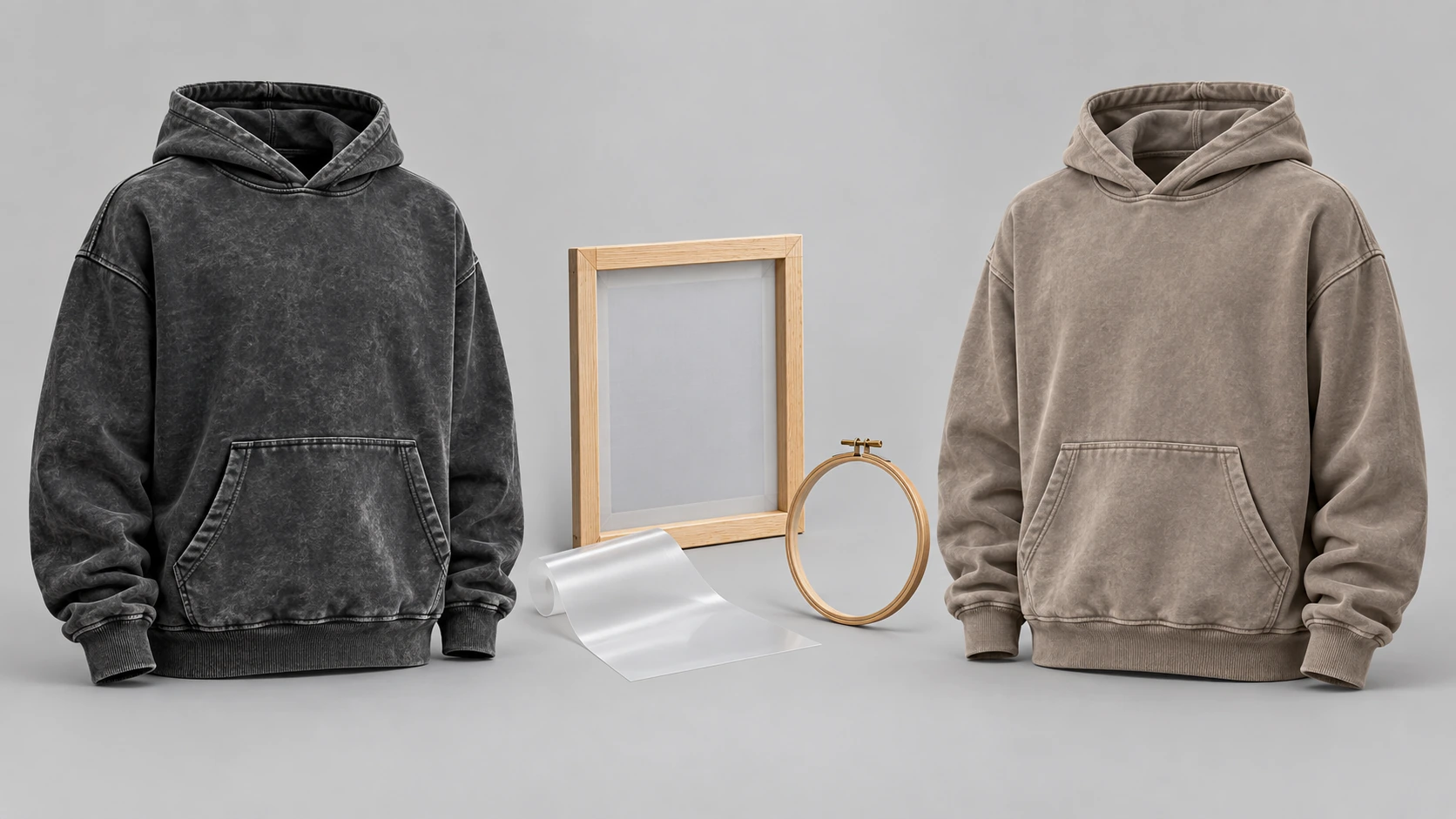
Quick Answer: Which Hoodie Should You Sample First?
Choose the finish and program structure first, then prove the choice with production-equivalent samples. Sample the Independent Trading Co. PRM4500MW first when the written brief requires a one-color mineral-wash hoodie with intentionally individual vintage character. Sample the Comfort Colors 1567 first when the brief requires a broader garment-dyed color program, a relaxed side-seamed body, or a back-neck customization patch.
That is a sourcing direction, not a universal winner. The PRM4500MW is listed at 9.0 oz./yd² US, while the 1567 is listed at 9.5 oz./yd² US. Both are 80/20 cotton/polyester cotton-face hoodies, but their finish, fit wording, construction, color systems, care evidence, and decoration warnings differ. Listed weight alone does not prove finished garment weight, warmth, softness, durability, opacity, print quality, or value.
Test both when actual hand, fit, shade character, artwork interaction, decoration behavior, care, availability, reorder consistency, or complete landed cost decides the order. Approve the exact color, size, lot, artwork, equipment, settings, wash result, and quality tolerance before bulk production.
Verified PRM4500MW vs Comfort Colors 1567 Specification Comparison
Begin with the exact Independent Trading Co. PRM4500MW product record and Comfort Colors 1567 product record. Product pages, selectors, and variation records identify current catalog terms, not guaranteed inventory. Recheck the exact channel and variant when quoting or ordering.
| Decision factor | PRM4500MW | Comfort Colors 1567 | Buyer treatment |
|---|---|---|---|
| Listed weight | 9.0 oz./yd² US; 300 gsm first-party listing | 9.5 oz./yd² US | Do not infer warmth, comfort, durability, or quality from 0.5 oz./yd² alone |
| Base fabric | 80/20 ring-spun cotton/polyester; 100% cotton 30-singles face yarn | 80/20 ring-spun U.S. cotton/polyester; 100% soft ring-spun U.S. cotton face | A cotton face is not a 100% cotton garment; compare received samples |
| Finish | Garment-dyed mineral wash with explicit unit-to-unit variation | Garment-dyed range with pigment and direct/reactive color groups | Approve shade range and lot controls for the exact program |
| Fit wording | First party says standard; Beytees says classic | Relaxed fit and side-seamed body | Use current measurements and representative fit samples |
| Current official range | Mineral Wash Black; XS–3XL | 11 colors; S–3XL | Treat colors, sizes, price, and availability as mutable |
| Customization details | Beytees lists a woven label; no tear-away claim established | Signature twill label and back-neck customization patch | Plan relabeling and legal disclosures separately |
| Decoration evidence | Exact plastisol, poly-blocker, test-first, and no-discharge warning | Cotton-face printability wording, without a universal process guarantee | Qualify the exact color, lot, artwork, process, and care cycle |
This comparison selects a first sample; it does not authorize production. Neither source establishes a universal winner for softness, warmth, durability, print output, embroidery, care, availability, margin, sustainability, or reorder consistency.
Independent Trading Co. PRM4500MW: Mineral-Wash Character
The current Independent PRM4500MW first-party page lists a 9 oz., 300 gsm, 80% cotton and 20% polyester platform with ring-spun cotton and a 100% cotton 30-singles face yarn. Verified construction includes a jersey-lined hood, split-stitch double-needle sewing, twill neck tape, 1×1 rib cuffs and waistband, and sewn eyelets. The reviewed source does not establish a drawcord claim, so do not add one by analogy.
The manufacturer describes a full garment-dyeing process that creates mineral-wash vintage character and says no two garments are exactly the same. That variability is part of the design language, but a buyer still needs an accepted shade range, lot policy, and customer communication plan. The current official selector shows Mineral Wash Black in XS through 3XL; those are mutable catalog terms, not a stock promise.
Fit wording is not perfectly aligned: the first-party page uses standard fit language, while Beytees uses classic fit. Preserve that conflict. Review current measurements and fit-test actual samples rather than converting either label into a promise about body shape, drape, or size equivalence.
Comfort Colors 1567: Garment-Dyed Color System
The current Comfort Colors 1567 first-party page lists 9.5 oz./yd², 80% ring-spun U.S. cotton and 20% polyester, with a 100% soft ring-spun U.S. cotton face. Verified construction includes a jersey-lined hood with color-matched flatcord, rolled-forward shoulder, pouch pocket, relaxed fit, side-seamed body, 1×1 rib collar, cuffs and waistband, back-neck twill tape, signature twill label, and a back-neck customization patch.
The 1567 is garment-dyed, but not every current color belongs to one dye group. The current official assortment contains 11 colors divided into nine pigment-dye colors and two direct/reactive colors, with sizes S through 3XL. Confirm the exact color and dye group instead of describing the entire range as pigment-dyed. Color names, counts, sizes, and inventory can change.
The manufacturer says the cotton face is intended for enhanced printability. Treat that as attributed source wording, not a guarantee of DTF, screen-print, embroidery, migration, wash-life, or production performance. Sample the exact variant and retain the approved result.
Mineral Wash, Garment Dye, Fit, Sizing, Labels, and Care
This is not a garment-dyed-versus-undyed comparison. Both styles use garment-level dye or finish processes. The commercial decision is the PRM4500MW’s one-color mineral-wash character versus the 1567’s broader garment-dyed color system and different body details. Both systems make shade control important. PRM4500MW explicitly varies from unit to unit, while Comfort Colors says shade variation is inherent in garment dyeing.
For official 1567 care context, review the Comfort Colors care instructions. They say to wash separately before wearing, note that loose pigment can remain on pigment-dyed shades, recommend washing pigment-dyed garments with like colors, and say cold water reduces staining risk. The same source describes the garments as pre-shrunk during dye and wash for “almost no shrinkage at home.” Do not rewrite that attributed wording as shrink-proof or zero shrinkage.
No exact current PRM4500MW care protocol was found on the reviewed product page. Do not apply the Comfort Colors instructions to the Independent style or invent water temperature, drying, bleach, ironing, dry-cleaning, or wash-life directions. Follow the received care label and current exact-style manufacturer guidance.
Size letters are not equivalent across the two charts. PRM4500MW currently runs XS through 3XL, while 1567 currently runs S through 3XL, and their reported widths, lengths, and sleeve measurements differ. Compare the latest charts, inspect production-equivalent samples, and document the exact sizes approved by representative wearers.
Neither reviewed exact source establishes a tear-away label for these styles. The PRM4500MW Beytees record says woven label; the 1567 first-party record says signature twill label and back-neck customization patch. A customization patch can support a branding workflow, but it does not replace fiber, origin, care, trademark, or other applicable labeling requirements.
Keep adjacent decisions separate. Use the PRM4500MW vs SS4500 comparison for mineral wash versus a solid Independent platform, the Comfort Colors 1467 vs 1567 comparison for that brand’s lightweight-versus-heavyweight question, and the Gildan 18500 vs Comfort Colors 1567 comparison for a Heavy Blend alternative. For broader discovery rather than this exact pair, use the wholesale garment-dyed hoodie guide.
DTF Qualification for Exact Colors and Lots
Neither manufacturer source provides an exact DTF recipe or a universal result guarantee. The wholesale blank sweatshirt DTF guide can support category-level planning, but it does not replace exact-style testing. Qualify both hoodies with the intended color, lot, size, artwork, transfer, equipment, operator, and care cycle.
| Control | What to verify | Approval evidence |
|---|---|---|
| Blank identity | Style, color, dye group where relevant, size, lot, labels, and received condition | Purchase and receiving record |
| Transfer system | Film, powder, ink, artwork revision, physical size, color, and underbase | Approved production file and material record |
| Application | Current heat, pressure, time, peel, and repress instructions | Recorded equipment and settings |
| Immediate result | Adhesion, edges, press marks, glossing, shade change, distortion, and migration | Full-view and close-up inspection |
| Care result | Approved wash and dry protocol, adhesion, lifting, cracking, shade, and garment response | Documented test and retained sample |
| Repeatability | Representative sizes, placements, lots, and production conditions | QC tolerance and signed approval |
Record failures as well as approvals. A successful test on one color or lot does not establish performance across the full assortment. Decide in advance which changes trigger a new test, especially blank color, dye group, lot, transfer materials, artwork coverage, equipment, or care process.
Screen Printing and Embroidery Controls
The PRM4500MW has an unusually specific first-party screen-print boundary: mineral-wash garments can be printed with plastisol, but a poly blocker base is required to avoid dye migration; testing is required before bulk production; and mineral-wash garments do not discharge. Preserve all parts of that warning. Do not advertise discharge printing on the style or omit the blocker and test requirements.
For both candidates, qualify the intended screen-print system on the exact color and lot. Record ink, blocker and underbase, mesh, screen tension, off-contact, squeegee, flash, cure, dryer conditions, artwork coverage, delayed migration, hand, wash result, and repeatability. Comfort Colors’ cotton-face printability statement does not supply a universal recipe or outcome guarantee.
Both hoodies may enter an embroidery sample, but neither exact source guarantees the result. The wholesale embroidery hoodie guide supports method-level selection only. Test digitizing, backing or stabilizer, hooping, needle, thread, density, speed, tension, distortion, puckering, interior comfort, hood and pocket interference, placement, and laundering on the intended blank.
Business Use-Case Decision Matrix
Use-case recommendations identify the first sample, not the final production winner. Availability, buyer approval, decoration output, care, quality controls, and landed economics still need proof.
| Written brief | First sample | Source-backed reason | What remains to prove |
|---|---|---|---|
| Mineral-wash black with intentionally individual vintage character | PRM4500MW | Exact mineral-wash process, one current official color, 9 oz. platform | Accepted shade range, fit, artwork, process, care, availability, and cost |
| Broader garment-dyed color program with relaxed fit | Comfort Colors 1567 | 11 current colors, relaxed side-seamed body, 9.5 oz. platform | Exact dye group, shade tolerance, fit, output, care, availability, and cost |
| Back-neck customization is part of the brief | Comfort Colors 1567 | Verified back-neck customization patch | Branding method, disclosures, comfort, durability, and compliance |
| Plastisol on the mineral-wash style | PRM4500MW after controls | First party allows plastisol with a required poly blocker and testing | Blocker, underbase, flash, cure, delayed migration, hand, and wash result |
| DTF, embroidery, large artwork, or fit-sensitive program | Test both | Specifications do not establish a universal process or fit winner | Production-equivalent output, wearer approval, QC, and landed cost |
| Reorder-sensitive shade program | Test both and document lot controls | Both finishes carry variation considerations | Supply, lot matching, tolerance, substitutions, and customer communication |
Sample-to-Bulk Checklist and Reorder Record
- Freeze the brief: audience, use case, quantity, color direction, size range, decoration method, quality standard, and required date.
- Confirm the candidate: exact style, current product title, color, dye group where applicable, size, fiber statement, measurements, construction, labels, and care source.
- Recheck commerce: verify live channel, price, availability, quantity, freight, lead time, and terms without carrying static article assumptions into the quote.
- Inspect received blanks: identity, lot, shade, dimensions, seams, hood, pocket, ribbing, labels, damage, and consistency.
- Fit-test representative sizes: record the exact style, color, and size each approver evaluated.
- Set a shade tolerance: define acceptable variation, lot-matching rules, customer disclosure, and rejection handling before decoration.
- Approve artwork: physical dimensions, placement, color, blocker, underbase or digitizing revision, and intended production file.
- Decorate production-equivalent samples: record equipment, materials, settings, operator, blank lot, and environmental conditions where relevant.
- Test care: use the approved exact-style protocol and document garment shade, dimensions, decoration, and comfort after the planned cycle.
- Define QC: measurement, shade, placement, coverage, adhesion or stitches, distortion, defects, and sampling frequency.
- Set substitution rules: require review before changing style, color, dye group, size, lot, artwork, transfer, ink, thread, or process.
- Calculate landed cost: use current blank, decoration, setup, freight, labor, spoilage, rework, packaging, and compliance evidence.
- Archive approval: retain the exact blank record, sample, photos, artwork version, settings, tests, tolerance, approver, and date.
- Revalidate reorders: confirm current identity, source guidance, availability, received goods, lot, and every change that could affect fit, shade, or output.
The comparison narrows candidates. The approved sample, recorded process, accepted tolerance, and current commercial evidence control production.
Frequently Asked Questions
What is the main difference between PRM4500MW and Comfort Colors 1567?
PRM4500MW centers on one-color mineral-wash character, a listed 9.0 oz./yd² platform, and standard/classic fit wording. Comfort Colors 1567 offers a broader garment-dyed color system, a listed 9.5 oz./yd² platform, relaxed fit, side seams, and a back-neck customization patch. Neither is a universal winner.
Which hoodie has the higher listed fabric weight?
Comfort Colors 1567 is listed at 9.5 oz./yd² US, while PRM4500MW is listed at 9.0 oz./yd² US. That 0.5 oz./yd² listed difference does not by itself prove finished garment weight, warmth, comfort, durability, opacity, or print quality.
Do PRM4500MW and Comfort Colors 1567 use the same fabric?
Both are listed as 80/20 cotton/polyester cotton-face hoodies. PRM4500MW specifies ring-spun cotton and a 100% cotton 30-singles face yarn; 1567 specifies ring-spun U.S. cotton and a 100% soft ring-spun U.S. cotton face. Their source wording and finishes differ, so identical hand or performance is not established.
Is PRM4500MW also garment-dyed?
Yes. The first-party PRM4500MW page describes a full garment-dyeing process. Its mineral-wash treatment creates a distinct vintage effect, and the manufacturer says no two garments are exactly the same.
Do PRM4500MW and Comfort Colors 1567 fit the same?
No identical fit is established. Independent uses standard fit language while Beytees says classic fit for PRM4500MW; Comfort Colors describes 1567 as relaxed. Compare current charts and approve production-equivalent sizes with representative wearers.
What color and size ranges are currently listed?
The current official PRM4500MW selector shows Mineral Wash Black in XS through 3XL. The current official 1567 page shows 11 colors in S through 3XL, split into nine pigment-dye and two direct/reactive colors. These are mutable catalog terms, not stock promises.
Which hoodie is better for DTF?
There is no universal winner. Test the exact color, lot, transfer, artwork, heat, pressure, time, peel, repress, press marks, shade change, adhesion, migration, and wash behavior on production-equivalent samples.
Can PRM4500MW be screen printed or discharge printed?
The manufacturer says PRM4500MW can be printed with plastisol, requires a poly blocker base to avoid dye migration, and requires testing before bulk production. It also says mineral-wash garments do not discharge.
Can both hoodies be embroidered?
Both can enter an embroidery sample, but neither exact source guarantees the result. Verify digitizing, backing or stabilizer, hooping, density, distortion, puckering, interior comfort, hood and pocket interference, placement, and laundering.
What should buyers verify before a bulk order?
Verify exact style, channel, color, dye group, size, measurements, labels, care, live price and availability, artwork, decoration sample, wash result, QC and shade tolerance, substitution rule, and complete landed cost. Archive the approved evidence for reorders.
Leave a Reply