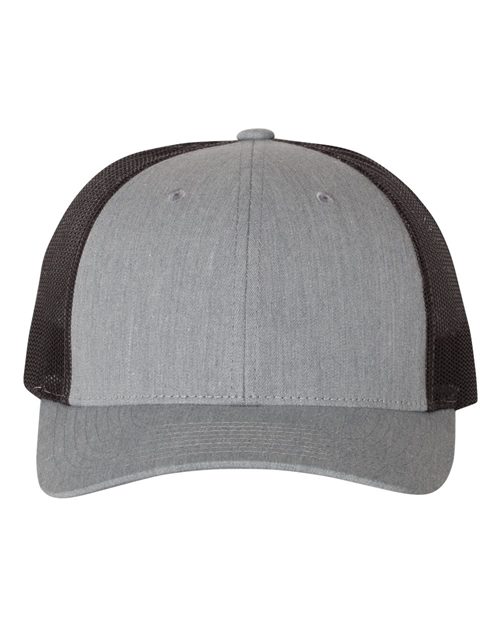
The Richardson 112 and Richardson 115 are two of the most recognizable wholesale trucker caps for decorated merchandise, but they are not the same cap with different style numbers. The decisive difference is the crown profile: the Richardson 112 Snapback Trucker Cap uses a structured, six-panel, mid-pro profile, while the Richardson 115 Low Pro Trucker Cap uses a structured, six-panel, low-pro profile. That change affects how the hat sits, how much visual room a logo appears to have, and which silhouette best matches a brand.
For most traditional team, company, outdoor, and event programs, the Richardson 112 is the more versatile default. Its mid-pro crown creates the classic trucker-cap shape and generally gives taller embroidery or patches a more natural visual home. The Richardson 115 is the better choice when the audience prefers a lower, closer-fitting crown and the artwork can be kept compact. This Richardson 115 vs 112 comparison explains the verified construction, decoration tradeoffs, sizing, color planning, sampling, costing, and quality-control steps buyers should consider before placing a wholesale order in 2026.
Richardson 115 vs 112: The Quick Verdict
- Choose the Richardson 112 for the classic mid-profile trucker silhouette, broad team and corporate use, taller front decoration, extensive listed color choices, or an order that may need both OSFM and XL options.
- Choose the Richardson 115 for a low-profile look, a closer crown shape, compact embroidery, small patches, modern lifestyle merch, or buyers who consistently dislike taller trucker caps.
- Choose neither from a mockup alone. Decorate and fit-test the actual cap in the intended color before committing to production quantities.
Neither model wins every category. The 112 wins on traditional trucker-cap presence and breadth of the current catalog listing. The 115 wins when a lower crown is part of the design brief rather than a compromise.
Richardson 112 vs 115 Specifications at a Glance
| Feature | Richardson 112 | Richardson 115 |
|---|---|---|
| Profile | Structured, six-panel, mid pro | Structured, six-panel, low pro |
| Front fabric | 60/40 cotton/polyester | 60/40 cotton/polyester twill |
| Back | 100% polyester mesh | 100% polyester mesh |
| Bill | Pre-curved | Pre-curved |
| Closure | Adjustable plastic snapback | Snapback closure |
| Sizes listed by Beytees at review | OSFM and XL | M/L |
| Color terms listed at review | 84 | 42 |
| Best starting use | Classic trucker merch, teams, uniforms, larger front marks | Low-profile lifestyle merch, compact marks, closer crown preference |
Color and size terms describe the live catalog records reviewed for this guide; they do not guarantee that every variation is currently in stock. Open the product pages to confirm the exact color, size, quantity, and price immediately before ordering.
What the Richardson 112 and 115 Have in Common
Both styles are structured six-panel trucker caps with a pre-curved bill, polyester mesh back, and adjustable snapback. The structured front helps the crown retain its intended shape and provides a more stable decoration area than an unstructured dad hat. The mesh back supports airflow and creates the familiar trucker-cap appearance. Both current Beytees product records also identify Richardson’s partnership with Captains for Clean Water under a responsible-mindset designation.
These shared features mean the purchasing decision should not be reduced to “structured versus unstructured” or “flat bill versus curved bill.” Both are structured and both have pre-curved bills. The profile, fit options, listed color range, artwork proportions, and audience are the meaningful differences.
The Main Difference: Low-Pro vs Mid-Pro Crown Shape
The Richardson 112’s mid-pro crown delivers the silhouette most buyers picture when they hear “classic Richardson trucker.” It has more visible crown presence than a low-profile cap and can balance a medium-size embroidered logo, wordmark, shield, circle patch, or team mark. The crown shape is useful when the cap needs to read clearly from a distance or when the decoration is the main merchandising feature.
The Richardson 115’s low-pro crown sits lower and produces a more compact silhouette. That can feel more natural to customers who avoid tall-front trucker hats, and it can fit lifestyle, golf, retail, brewery, and casual company merch particularly well. The tradeoff is that artwork designed for the 112 may look crowded or overly tall when transferred unchanged to the 115.
“Low profile” is not automatically more fashionable, and “mid profile” is not automatically a better embroidery cap. The right profile is the one that supports the wearer’s preference and the approved decoration. Put both blanks on actual members of the target audience. Front, side, and three-quarter photos reveal crown differences much more reliably than a flat product image.
Richardson 115 Low Pro Trucker Cap: Best Uses
The Richardson 115 is the stronger candidate when the brief starts with a lower crown. Its verified construction includes a 60/40 cotton/polyester twill front, 100% polyester mesh back, structured six-panel low-pro profile, pre-curved bill, and snapback closure. The current Beytees listing uses an M/L size term and presents 42 color terms, ranging from core combinations such as black, black/white, charcoal/white, navy, navy/white, and red/white to softer and more specialized palettes.
That assortment supports both dependable programs and limited color capsules. A company uniform order might begin with black, navy, or charcoal. A lifestyle collection could use loden, patina green/birch, smoke blue/aluminum, sunkissed peach/birch, or another brand-relevant combination after sampling. Do not assume a color name will match apparel from another manufacturer; compare physical items under the same light.
Choose the 115 when:
- The customer specifically asks for a low-profile trucker cap.
- The logo is compact, horizontal, or easy to simplify.
- A small woven, embroidered, leather-look, or sublimated patch suits the brand.
- The collection aims for a quieter lifestyle or retail presentation.
- The target wearers have tested the M/L listing and prefer its crown shape.
The 115 is less forgiving when a buyer insists on tall artwork, several lines of text, or a patch built for a larger mid-profile crown. Redesigning the mark is usually better than shrinking it until small details disappear.
Richardson 112 Snapback Trucker Cap: Best Uses
The Richardson 112 uses a 60/40 cotton/polyester front, 100% polyester mesh back, structured six-panel mid-pro profile, pre-curved bill, and adjustable plastic snapback. It is the safer first sample for a classic trucker-hat program because its shape works naturally for outdoor brands, landscaping and construction crews, school organizations, sports teams, restaurants, festivals, dealerships, corporate uniforms, and broad retail merchandise.
At the time of review, Beytees listed 84 color terms and OSFM plus XL size terms for the 112. That does not mean every color-size combination is available at every moment, but it gives the style a broad planning range. Core black, white, navy, charcoal, red, royal, and team-color combinations can support repeat programs. Multi-color combinations can support school, event, or outdoor collections. The XL listing is especially relevant when a one-size program has produced fit complaints, though the actual audience should test it rather than assuming a label solves every fit issue.
For a complete model-specific overview, see the Richardson 112 wholesale buying guide. This comparison focuses on choosing between the 112 and 115 rather than repeating every general trucker-hat buying point.
Choose the 112 when:
- The buyer wants the recognizable mid-profile trucker look.
- The front mark needs more visual height or presence.
- The program requires broad listed color options.
- The order may need OSFM and XL choices.
- The cap will serve teams, crews, uniforms, events, or mixed audiences.
Which Is Better for Embroidery?
The Richardson 112 is the better general default for embroidery because its mid-pro crown gives a standard front logo more visual breathing room. That does not make the 115 unsuitable. A well-digitized compact logo can look excellent on the 115, and the lower crown may make the finished merchandise more wearable for the intended buyer.
Embroidery success depends on much more than style number. The shop should digitize specifically for caps, sew from the center outward when appropriate, account for the center seam, use suitable backing, hoop consistently, and test thread tension on the actual blank. A file that sews well on a flat polo or unstructured cap is not automatically production-ready for either Richardson trucker.
Embroidery guidelines for both caps
- Keep tiny lettering realistic. Narrow gaps, hairline strokes, and very small text can close during sewing.
- Respect the center seam. Fine detail directly over the seam may distort or sink. Adjust the art, sequencing, or placement after a test sew.
- Use cap-specific proportions. A tall mark that looks balanced on the 112 may overwhelm the 115.
- Approve thread on the real color. Digital proofs cannot show sheen, contrast, or how heather and multi-color panels affect readability.
- Inspect inside and outside. Backing, thread tails, tension, registration, and comfort matter in a retail-quality order.
If the artwork is tall, complex, or built around a prominent crest, sample the 112 first. If the artwork is a short wordmark, initials, a small icon, or tonal mark, sample both and let the preferred silhouette decide.
Which Is Better for Patches?
The Richardson 112 is usually easier for medium or taller patches because the mid-pro front supports a more substantial visual shape. Round, oval, shield, rectangle, and leather-look patches commonly suit the 112 when their dimensions are planned around the crown. The 115 works best with a smaller patch that complements rather than fights its low profile.
Patch material changes the result. Woven patches can reproduce finer lines and small text. Embroidered patches emphasize thread texture but may need simpler details. Printed or sublimated patches can carry gradients and full color. Faux-leather and other specialty materials create a strong outdoor or workwear look, but the supplier must verify the attachment method and care requirements.
Whether the patch is sewn, heat applied, or attached with a combined method, test it on the finished cap. Check that every edge follows the crown, the patch does not buckle across the center seam, the backing does not create a hard pressure point, and heat does not mark the front fabric. A rectangular mockup on a screen cannot predict how a rigid or thick patch behaves on a curved crown.
Can You Use DTF or Heat Transfers on the 112 and 115?
DTF and other heat-applied transfers may work on a suitable front panel, but trucker caps are more demanding than flat T-shirts. The crown curves, the center seam interrupts pressure, the bill limits platen access, and panel materials may react to heat. Use cap-specific equipment, follow the transfer supplier’s current instructions, and keep the design inside a reliably pressable area.
The 112’s mid-pro crown may provide a more comfortable visual area for a transfer, while the 115 requires a more compact footprint. That does not guarantee easier application; equipment geometry and the exact seam position still control pressure. Test for edge lift, incomplete adhesion, scorching, gloss, color change, panel distortion, and dye behavior after cooling. Gently flex the crown and perform an appropriate wash or wear test before approving production.
Sublimation should not be treated as a default decoration method for the cotton/polyester front panels simply because the back is polyester mesh. Full sublimation requires a compatible substrate and usually works best on light, intentionally sublimation-ready surfaces. If photographic detail is needed, a suitable patch or tested transfer is often the more controlled route.
Fit and Size Planning
A snapback increases adjustability, but it does not make every crown universally comfortable. Crown depth, head shape, hair, preferred snap position, and the angle of the bill all affect fit. The 115’s M/L listing and low-pro crown target a different experience from the 112’s OSFM and XL listings.
For a small merch launch, recruit several testers representing the audience and record which style they choose without prompting. For a company or team program, include people who normally report that standard hats feel too tall, too shallow, too tight, or too loose. If the 112 is selected, determine whether XL quantities are needed from actual fitting rather than a guess. If the 115 is selected, confirm that the lower crown works across the intended group.
Fit testing also protects decoration decisions. A logo may look centered while the cap sits on a display form but appear too high or low when worn. Approve the art and cap as one finished product.
Color Selection and Reorder Strategy
The 112 currently has the larger listed color range, making it the more flexible platform for school colors, corporate palettes, team programs, and future line extensions. The 115 still offers a substantial range, including dependable neutrals, two-tone combinations, heathers, earth tones, and trend-led accents. The best assortment is not the one with the most swatches; it is the one customers understand and the seller can replenish.
Start with two or three coordinated choices: one dark neutral, one lighter neutral or two-tone option, and one brand color. Photograph all approved caps together and document the exact manufacturer color names. “Navy,” “charcoal,” “loden,” and “birch” are not universal formulas across brands or fabrics. For broader palette planning, use the 2026 blank apparel color guide, then validate every choice with physical samples.
Before accepting a deadline-sensitive order, recheck the live product page for the required color and size. Do not promise a future reorder based on today’s inventory snapshot. Define an approved substitute in advance, but never substitute the 112 for the 115—or the reverse—without customer approval because the crown profile changes the product.
Best Cap by Business Use Case
Outdoor brands, crews, and trade uniforms
Start with the Richardson 112. Its classic mid-pro shape, extensive listed colors, and OSFM/XL options make it a practical uniform platform. The 115 can be offered as a lower-profile alternate when wearers request it.
Breweries, coffee shops, and lifestyle retailers
Sample both. The 115 can create a quieter, low-profile retail look with a small patch or compact embroidery. The 112 is stronger when the logo needs more front presence or the brand leans into traditional outdoor trucker styling.
Schools, sports teams, and spirit wear
The 112 is usually the more efficient starting point because of its classic shape and broad team-color listing. Verify that the selected sizes fit the actual participants and simplify mascots or crests for clean cap embroidery.
Corporate gifts and event merchandise
Choose based on audience and artwork. The 112 reads as a familiar promotional trucker cap and supports a prominent front logo. The 115 feels more compact and can be a better gift when a lower crown aligns with the recipients’ preferences.
Private-label and limited merch drops
The 115 can distinguish a low-profile capsule, while the 112 provides the safer high-recognition silhouette. Limit the first drop to a few colors, approve the decorated samples, and use real sales data before expanding.
Buyers exploring softer, unstructured, or washed alternatives should also review the wholesale garment-washed and pigment-dyed cap guide. Those styles create a different crown and finish from the structured Richardson 112 and 115.
How to Cost a Decorated Richardson Cap
Do not calculate margin from the blank price alone. Include the blank, inbound freight, digitizing or patch setup, decoration labor, stitch count or patch cost, sample expense, spoilage allowance, labeling, inside cleanup, shaping, packaging, payment fees, outbound shipping, and customer-service overhead. A complex patch can cost more than the cap. A high-stitch logo can slow production and increase the remake risk.
The lower-priced option on a given day is not automatically the better value. The cap that fits the audience, decorates consistently, and supports a stronger selling price may produce a better margin even if its blank cost is higher. Compare landed decorated cost and expected sell-through, not just the product-page price.
Current prices and availability can change by variation and date, so use the live Beytees pages for a quote. When planning transit and deadlines, review the wholesale blank apparel shipping guide and leave time for sampling, decoration, quality control, and carrier movement.
Production Approval Workflow
- Define the audience. Record whether buyers prefer a low or mid-profile crown and whether multiple size options matter.
- Select the blank. Order the 112, the 115, or both in the exact proposed colors.
- Adapt the artwork. Build cap-specific versions instead of reusing a garment file unchanged.
- Produce physical samples. Use the intended thread, patch, transfer, backing, equipment, and placement.
- Fit-test the finished caps. Evaluate front, side, comfort, snap position, and logo balance on real wearers.
- Document approval. Save the exact style, color, size, artwork version, decoration dimensions, placement, materials, and production settings.
- Recheck inventory. Confirm live stock before promising the order or launch date.
- Run a controlled first batch. Inspect early units before the entire quantity is completed.
This workflow prevents the most common error in a Richardson 115 vs 112 order: choosing a cap from a catalog image, applying one generic logo file, and discovering after production that the crown and artwork do not fit each other visually.
Quality-Control Checklist
- Verify Richardson style 112 or 115 against the purchase order.
- Confirm the exact named color and requested size.
- Check crown shape, mesh, seams, bill, and snapback for damage.
- Compare logo or patch dimensions and placement with the approved sample.
- Inspect fine lettering, registration, thread tension, patch edges, and transfer adhesion.
- Confirm the center seam has not distorted important artwork.
- Check the inside for loose thread, sharp backing, adhesive, and production debris.
- Test the closure and verify the cap has not been crushed during handling.
- Count by style, color, and size before packing.
- Use cartons that protect the crown and pre-curved bill in transit.
Frequently Asked Questions
What is the main difference between the Richardson 115 and 112?
The Richardson 115 is a structured six-panel low-pro trucker cap, while the Richardson 112 is a structured six-panel mid-pro trucker cap. Both have pre-curved bills, polyester mesh backs, and snapback closures. The crown profile is the most important difference because it changes fit, silhouette, and artwork proportions.
Is the Richardson 115 lower profile than the 112?
Yes. Beytees lists the 115 as low pro and the 112 as mid pro. The 115 therefore creates the lower, more compact crown shape of the two.
Which is better for embroidery, Richardson 112 or 115?
The Richardson 112 is the better all-purpose starting point for embroidery, especially for taller or more prominent front marks. The 115 can be excellent for compact embroidery when the lower crown is preferred. Both require cap-specific digitizing and a finished sample.
Which Richardson cap is better for patches?
The 112 generally supports medium or taller patches more naturally because of its mid-pro crown. The 115 works well with smaller patches designed for its low-profile front. Patch shape, thickness, attachment method, and placement must be tested on the actual cap.
Does the Richardson 112 come in more colors than the 115?
At the time this guide was reviewed, the Beytees catalog listed 84 color terms for the 112 and 42 for the 115. Those figures describe listed options, not guaranteed live stock. Check the product pages for the exact current variation availability.
What sizes are listed for the Richardson 112 and 115?
Beytees currently lists OSFM and XL size terms for the Richardson 112 and M/L for the Richardson 115. Fit is affected by more than the label, so test the cap on the intended audience before ordering.
Can DTF transfers be applied to Richardson trucker caps?
A tested DTF transfer may work with suitable cap equipment and a compatible front-panel area. Curvature, the center seam, material, temperature, pressure, and platen access all matter. Test adhesion, heat marks, color change, and distortion before production.
Which model is better for a company uniform?
The Richardson 112 is usually the safer default because its mid-pro trucker shape is widely recognizable, it has a broad listed color range, and Beytees lists OSFM and XL options. Offer or test the 115 when team members prefer a lower crown.
Which model is better for a retail merch brand?
Either can work. Choose the 115 for a compact low-profile silhouette and smaller decoration. Choose the 112 for a classic trucker look and more prominent front branding. The audience and physical sample should decide.
Where can I buy the Richardson 112 and 115 wholesale?
Beytees carries the Richardson 112 Snapback Trucker Cap and Richardson 115 Low Pro Trucker Cap. Open each page to review current colors, sizes, inventory, and pricing before ordering.
Final Recommendation
Choose the Richardson 112 when you need a classic mid-profile trucker cap, a larger-looking front decoration area, broad color planning, or OSFM and XL size options. Choose the Richardson 115 when the design brief specifically calls for a low-profile crown, compact embroidery or a smaller patch, and a closer lifestyle silhouette.
If the audience has not expressed a profile preference, sample the 112 first because it is the more versatile general-purpose trucker. Then sample the 115 beside it before final approval, especially for retail merchandise where fit and silhouette can matter as much as the logo. The winning cap is not the one with the longer feature list; it is the one your target customer will wear, your decorator can reproduce consistently, and your business can reorder at a profitable landed cost.
Leave a Reply