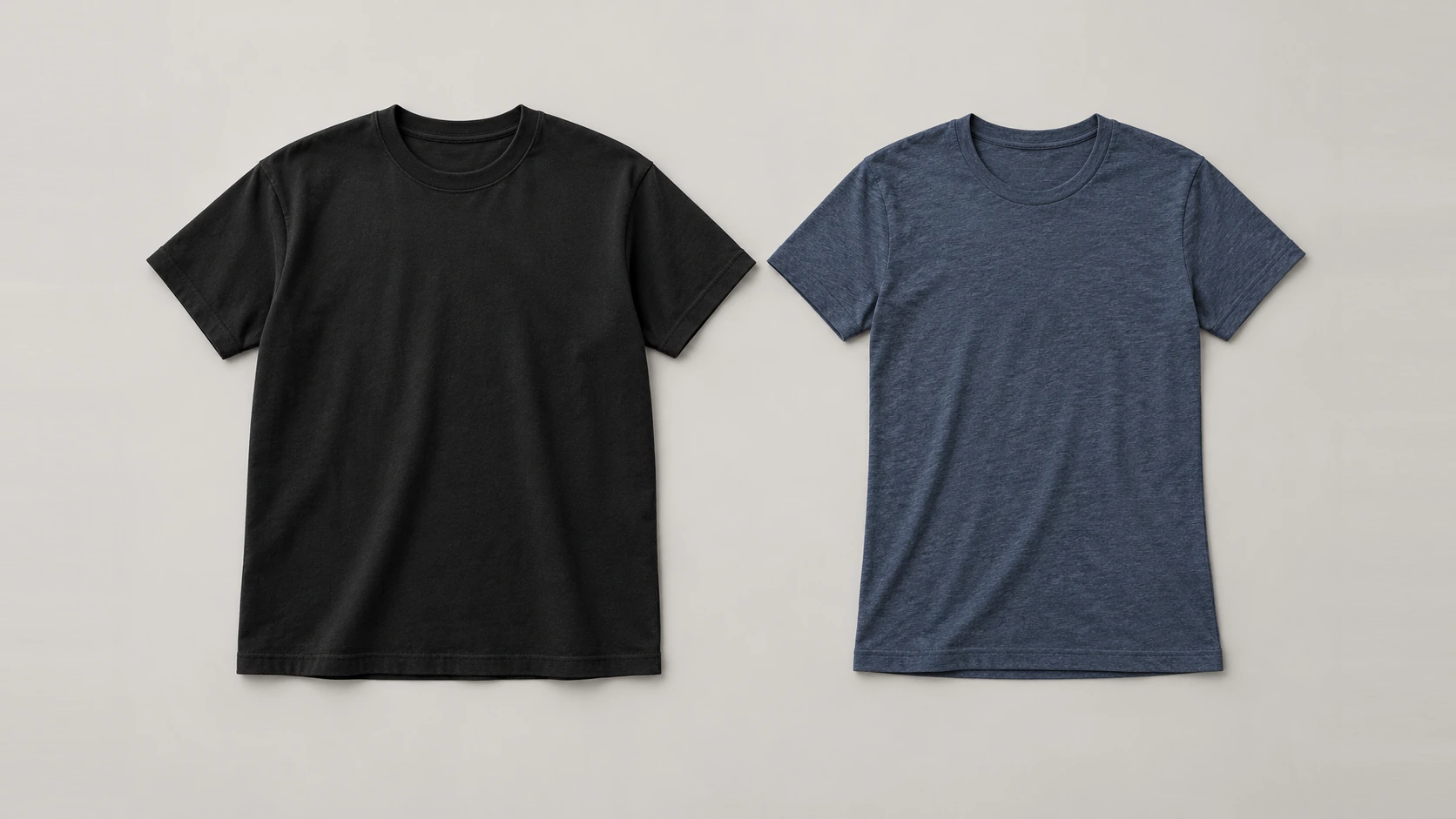
Gildan 5000 vs Bella Canvas 3001 is mainly a heavier-classic versus lighter-jersey sampling decision. The current seller records place the Gildan 5000 at 5.3 oz./yd² and 20 singles, while the BELLA + CANVAS 3001 is listed at 4.2 oz./yd² and 32 singles. Those numbers help choose a first sample, but they do not prove fit, hand, opacity, durability, decoration quality, or total program cost.
Choose from the written brief, then qualify the exact style, color, fiber label, size, artwork, decoration process, label plan, and laundering basis. This comparison gives decorators, merch teams, schools, events, and wholesale buyers a controlled path to a decision without naming a universal winner.
Quick Answer: Which Tee Should You Sample First?
Sample the Gildan 5000 first when the approved brief asks for the heavier listed 5.3 oz./yd² platform, 20-singles specification, and classic-fit wording. Sample the 3001 first when the brief asks for a lighter listed 4.2 oz./yd² jersey, 32 singles, side seams, and the seller’s retail-fit positioning.
Sample both when wearer fit, color-dependent fiber content, broad artwork, seam-sensitive placement, label treatment, or decoration behavior could change the answer. Keep the artwork revision and acceptance standard consistent, but let process settings follow the exact garment and current equipment or consumable instructions. One successful sample does not approve every color, size, or lot.
Gildan 5000 vs BELLA + CANVAS 3001 at a Glance
| Decision factor | Gildan 5000 | BELLA + CANVAS 3001 | Buyer control |
|---|---|---|---|
| Published US fabric weight | 5.3 oz./yd² | 4.2 oz./yd² | Use as a sampling signal, not an outcome verdict |
| Published yarn figure | 20 singles | 32 singles | Do not treat yarn count as an automatic quality ranking |
| Base fiber wording | 100% cotton, with color exceptions | 100% Airlume combed and ring-spun cotton, with exceptions | Verify the received color’s fiber label |
| Seller fit wording | Classic fit | Retail fit and unisex sizing | Measure and wear-test; do not equate letter sizes |
| Body construction | Not universally resolved by the reviewed exact sources | Side-seamed | Inspect before side or wrap placement |
| Label wording | Tear-away | Tear-away | Test removal and preserve required information |
Review the current Gildan 5000 product page and BELLA + CANVAS 3001 product page before ordering. The 1.1 oz./yd² difference compares fabric-area specifications, not complete garment weights or guaranteed differences in warmth, drape, opacity, shrinkage, or wear life.
Nearby guides answer different questions. The 3001 versus Gildan 64000 comparison covers a lighter Gildan alternative, while the Gildan 5000 versus 64000 guide stays within Gildan. Use them as decision branches, not evidence that replaces this exact pair.
Gildan 5000 Heavy Cotton Profile
The current Beytees record lists 5.3 oz./yd² in the US, 8.8 oz./L yd in Canada, base 100% cotton, and 20 singles. It also lists a classic fit, rib collar, taped neck and shoulders, and a tear-away label. These facts make the 5000 the logical first sample when the written brief prioritizes a more substantial listed fabric platform and familiar classic positioning.
Fiber content changes by color. The seller record lists multiple heather and special colors at 50/50 cotton/polyester, Antique colors and Sport Grey at 90/10, and Ash Grey at 99/1. Freeze the exact color before testing; a solid-cotton approval cannot be extended automatically to a heather, safety, neon, antique, or other exception.
The official Gildan Heavy Cotton page confirms the current adult style 5000 identity and manufacturer positioning. Marketing and listed decoration techniques are useful screening context, not guaranteed print, embroidery, bleach, tie-dye, comfort, or wash outcomes. The Gildan 3000 versus 5000 guide is useful when the buyer wants another within-brand weight branch.
BELLA + CANVAS 3001 Lightweight Jersey Profile
The current Beytees record lists 4.2 oz./yd² in the US, 7 oz./L yd in Canada, base 100% Airlume combed and ring-spun cotton, and 32 singles. It also lists pre-shrunk wording, retail fit, unisex sizing, coverstitched collar and sleeves, shoulder-to-shoulder taping, side seams, and a tear-away label.
The official BELLA + CANVAS 3001 page supports the 4.2 oz., 32-singles, Airlume cotton, Ash 99/1, side-seam, shoulder-taping, and unisex facts. Its marketing sentence says tailored fit, while its feature list says classic fit; the seller page says retail fit. Those phrases should remain source wording, not be converted into one measurement promise.
The 3001 is the logical first sample when the brief prefers the lighter listed jersey platform or verified side-seamed construction. That direction is not proof of softness, drape, print detail, comfort, or a better fit. For another lightweight-jersey decision, the 3001 versus Tultex 202 guide covers a different exact pair.
Weight, Yarn, Fit, and Color Controls
Weight and yarn figures are decision inputs, not finished-product grades. The broader blank T-shirt weight guide explains category context, but the exact two product records and physical samples control this comparison.
| Variable | Published evidence | What remains unknown | Required approval |
|---|---|---|---|
| Weight | 5000: 5.3 oz./yd²; 3001: 4.2 oz./yd² | Finished garment weight and performance | Handle and decorate exact samples |
| Yarn | 5000: 20 singles; 3001: 32 singles | Softness, opacity, strength, and print detail | Use a written sample standard |
| Color blend | Both records contain exceptions | Whether one color represents another | Freeze color and read the received label |
| Fit | Classic versus retail/unisex, with mixed official 3001 wording | Same-letter measurement equivalence | Measure and wear-test representative units |
| Seams | 3001 side seams; universal 5000 construction unresolved | Placement behavior on the received 5000 | Inspect each production size |
| Label | Both seller records say tear-away | Removal result and finished-label duties | Test removal and preserve source records |
Measure representative garments with one documented method, including key order sizes. Record chest, body length, sleeve and shoulder observations only when the method and garment are comparable. Add wearer movement checks for the actual use. Do not translate classic, retail, tailored, or unisex wording into unsupported same-letter equivalence.
For artwork near a side, collar, sleeve, or seam, inspect the physical garment and mark stable placement references. Keep received-label photos, supplier identity, style, color, size, lot, measurements, and the accepted undecorated sample together. Reopen approval when a controlled variable changes.
DTF and Heat-Transfer Qualification
No reviewed exact source provides a universal DTF time, temperature, pressure, peel, post-press, or wash formula for either shirt. Start from current transfer-system instructions and calibrated equipment, then qualify the exact style, color, fiber label, artwork dimensions, coverage, placement, transfer batch, press, platen, pressure method, peel, and post-press.
Inspect immediate adhesion, edges, opacity, surface feel, press gloss, distortion, shade response, seam or collar interference, and artwork readability. Compare a decorated sample with an undecorated control. Launder using the written test basis, then inspect adhesion, cracking, edge behavior, dimensional change, and garment response again.
A heavier listed base is not automatically better for DTF, and a lighter 32-singles jersey is not automatically better for detail. Release only the tested combination. Requalify after a change to blank, color, blend, size construction, artwork coverage, transfer material, equipment, operator method, placement, or care instruction.
Screen Printing and Other Decoration Methods
Both shirts can be investigated for screen printing, but no source here proves one universal winner, ink system, mesh, underbase, flash, cure, or wash result. Build trials around the actual artwork and color. Review detail, opacity, deposit, hand, registration, cure evidence, garment distortion, and laundering against the buyer’s written standard.
The 5000’s heavier listed platform may be the first sample for a brief seeking more garment substance beneath broad coverage. The 3001’s lighter 32-singles jersey may be the first sample for a brief prioritizing that fabric direction. These are sampling choices, not finished-result guarantees; screen, ink, artwork, press, cure control, operator, and exact blank remain material.
Qualify embroidery, bleaching, and tie dye separately if the program considers them. Use the intended needle, thread, backing, stitch density, chemistry, artwork, placement, and care basis. Inspect distortion, puckering, shade response, comfort, and wash results rather than relying on a technique name from a marketing page.
Bulk, Merch, and Private-Label Controls
Both seller records list tear-away labels, which can help plan a relabeling workflow. That feature does not make either shirt automatically ready or compliant for private-label sale. Test removal on the received lot, photograph the original information, inspect the result, and obtain qualified guidance for the finished garment and selling context.
Create one approved configuration per style, color, size range, artwork revision, placement, decoration method, label treatment, and QC standard. Retain the accepted undecorated and decorated samples. A substitution to another style, blend, shade, construction, label, lot, transfer, ink, equipment path, or artwork coverage requires review and may require a new decorated approval.
Keep mutable commerce outside the evergreen comparison. Recheck current variant availability, commercial terms, freight, production capacity, and complete landed economics when quoting. Build receiving time and inspection into the project plan without publishing a delivery promise, stock guarantee, margin, or cost winner.
Decision Matrix and Sample Approval Checklist
| Written brief or open question | First sample | Source-aware reason | Release evidence |
|---|---|---|---|
| Heavier listed classic platform | Gildan 5000 | 5.3 oz./yd², 20 singles, classic-fit seller wording | Exact color label, measurements, decorated and washed sample |
| Lighter listed jersey platform | BELLA + CANVAS 3001 | 4.2 oz./yd², 32 singles, retail-fit/unisex seller wording | Exact color label, measurements, decorated and washed sample |
| Fit or wearer preference unresolved | Both | No shared measurement standard is established | One measurement method and representative wearer checks |
| Side or wrap placement | Both in production sizes | 3001 side seams are verified; universal 5000 construction is unresolved | Physical seam inspection and placement trial |
| Color-specific decoration risk | Both exact colors | Fiber constructions vary by color | Received label plus exact-color process test |
| Private-label or reorder release | Every viable configuration | Tear-away wording and prior approval are incomplete controls | Label file, receiving check, retained samples, change review |
Before bulk release, freeze brand, style, color, size terminology, supplier record, received labels, measurement method, artwork revision, physical placement, process inputs, equipment identity, decorated and laundered sample, QC limits, label plan, receiving checks, and substitution rule. Keep an accepted sample available for production comparison.
The decision is therefore practical rather than absolute: choose the 5000 first for the heavier classic specification, choose the 3001 first for the lighter jersey specification, and test both when fit, color blend, hand, seam placement, decoration, relabeling, or program economics could change the outcome.
Frequently Asked Questions
Is the Gildan 5000 heavier than the BELLA + CANVAS 3001?
Yes by the current published fabric-area figures: 5.3 oz./yd² for the Gildan 5000 and 4.2 oz./yd² for the 3001. The 1.1 oz./yd² difference does not prove finished garment weight, opacity, warmth, durability, comfort, or decoration performance.
What is the published fabric difference between the two shirts?
The Gildan seller record lists a base 100% cotton, 20-singles specification with color-dependent blends. The 3001 record lists a base 100% Airlume combed and ring-spun cotton, 32-singles specification, with Ash at 99/1 cotton/polyester. Verify the exact ordered color.
Which shirt should I sample first for DTF?
Sample the Gildan 5000 first when the brief prioritizes its heavier classic specification, and the 3001 first when it prioritizes a lighter jersey platform. Neither has a universal DTF recipe or guaranteed result, so qualify the exact garment, artwork, transfer, press, and laundering basis.
Which shirt should I sample first for screen printing?
Start with the 5000 for a brief seeking the heavier listed base and with the 3001 for a lighter 32-singles jersey direction. Test the exact color, artwork, screen, ink system, cure method, hand, opacity, detail, and washed sample before choosing.
Does 32 singles make the 3001 automatically softer?
No. The published 32-singles figure is a useful yarn specification, but yarn count alone does not prove softness, smoothness, strength, opacity, durability, print detail, or wearer preference. Compare production-equivalent samples using a written approval standard.
Do the Gildan 5000 and 3001 fit the same?
No same-letter equivalence is established. The seller records use classic fit for the 5000 and retail fit with unisex sizing for the 3001, while the official 3001 page contains mixed tailored-fit and classic-fit wording. Measure and wear-test exact samples.
Are all colors in both styles 100% cotton?
No. The Gildan record lists multiple 50/50, 90/10, and 99/1 color exceptions, while the 3001 records list Ash at 99/1 and exact variants still require checking. Freeze the color and verify the received fiber label before production.
Is the BELLA + CANVAS 3001 side-seamed?
Yes, both the current Beytees and official 3001 pages list side seams. The reviewed exact sources do not establish one universal body-construction statement for every Gildan 5000 variant, so inspect the received 5000 before seam-sensitive placement.
Can either tee support a private-label merch program?
Both seller records list tear-away labels, which can support workflow planning. Label removal does not settle fiber, origin, responsible-business identity, care, recordkeeping, or other applicable finished-garment duties. Test removal and preserve substantiated source information.
What should buyers approve before a bulk reorder?
Approve exact style, color, size terminology, fiber label, measurements, artwork revision, placement, production-equivalent decorated and laundered sample, QC limits, label plan, receiving checks, substitution rule, and current commercial terms. Requalify any material change.
Leave a Reply