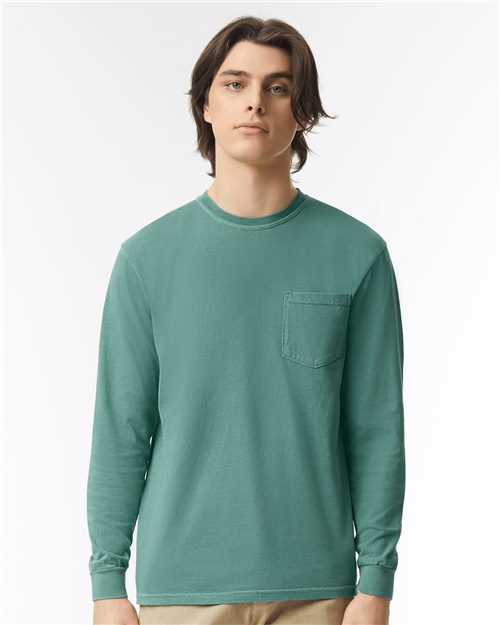
Choose the Comfort Colors 4410 when a functional left-chest pocket is part of the product concept. Choose the Comfort Colors 6014 when you want the largest uninterrupted front decoration area and the broader current color assortment. In a Comfort Colors 4410 vs 6014 comparison, almost every core fabric and fit specification is shared. Both are 6.1 oz./yd², 100% ring-spun cotton, 20-singles, garment-dyed long-sleeve tees with a relaxed fit, rib cuffs, cotton thread, shoulder taping, and a signature twill label. The pocket is the defining product difference.
That one construction change has consequences for artwork, production speed, pricing, inventory, and customer expectations. The 4410 supports workwear-inspired, outdoors, campus, fishing, resort, and utility merchandise, but its pocket reduces the flat left-chest print field. The no-pocket 6014 is easier to use for full-front graphics, centered chest prints, and decoration systems that need a level platen.
This wholesale guide compares the live Comfort Colors 4410 pocket long sleeve and Comfort Colors 6014 long sleeve. It covers construction, current colors and sizes, DTF, screen printing, DTG, embroidery, pricing, inventory, artwork placement, and the production controls that matter before a bulk order goes to press.
Comfort Colors 4410 vs 6014: key takeaways
- Same core platform: Both are listed at 6.1 oz./yd², 100% ring-spun cotton, 20 singles, with a relaxed fit and garment-dyed finish.
- 4410 advantage: A real left-chest pocket adds function and a recognizable utility or outdoor-merch look.
- 6014 advantage: No pocket means a cleaner, larger, and generally faster front decoration area.
- Current assortment: Beytees currently lists 29 colors for the 4410 and 50 for the 6014, with S through 3XL shown for both.
- Best production rule: Approve the exact style, color, decoration method, placement, and garment lot together. A successful 6014 print setup does not automatically approve the pocketed 4410.
Comfort Colors 4410 vs 6014: Quick Verdict
| Decision factor | Comfort Colors 4410 | Comfort Colors 6014 |
|---|---|---|
| Best overall role | Premium pocket long sleeve for utility, outdoor, campus, and workwear-inspired merch | Premium no-pocket long sleeve for large front graphics and flexible retail collections |
| Fabric weight | 6.1 oz./yd² | 6.1 oz./yd² US |
| Primary fabric | 100% ring-spun cotton, 20 singles, with cotton thread | 100% ring-spun cotton, 20 singles, with cotton thread |
| Dye and finish | Garment-dyed for a lived-in feel | Garment-dyed for a lived-in feel |
| Fit | Relaxed | Relaxed |
| Chest construction | Left-chest pocket | No pocket |
| Front decoration field | Interrupted by pocket seams and extra fabric layers | Open and comparatively simple to load |
| Current Beytees color count | 29 catalog colors | 50 catalog colors |
| Current Beytees size range | S through 3XL | S through 3XL |
| Cuffs | Rib cuffs | Rib cuffs |
| Label | Signature twill label | Signature twill label |
| Simplest full-front choice | No | Yes |
The quickest decision is simple. If customers will use or visually value the pocket, start with the 4410. If the artwork is the hero and needs a clean centered chest or full-front field, start with the 6014. Do not pay for a pocket and then design production as though it is not there.
The two styles can coexist in one catalog, but they should have clear jobs. A 4410 can be the outdoor, staff, or utility option, while a 6014 carries the main graphic collection. That structure gives customers a real choice instead of two nearly identical listings competing against each other.
Comfort Colors 4410 and 6014 Specifications Compared
The live Beytees records show that the 4410 and 6014 share the specifications that create the recognizable Comfort Colors heavyweight long-sleeve experience. Both use a 6.1 oz./yd², 100% ring-spun cotton, 20-singles fabric with 100% cotton thread. Both are garment-dyed, use a relaxed fit, have rib cuffs and shoulder-to-shoulder taping, and carry the Comfort Colors signature twill label.
The 4410 is described with a topstitched, classic-width rib collar. The 6014 is described with a topstitched, classic-width collar and twill-taped neck and shoulders. The central functional distinction remains the 4410’s left-chest pocket. Buyers should verify received garments against the current product record because suppliers can revise colors, construction language, measurements, or availability.
Both product records state that the garments are made with U.S. Cotton Trust Protocol participation, OEKO-TEX certified low-impact dyes, and salt-free clean pigment-dye colors. They also identify social-manufacturing programs and certifications connected with their facilities. If a customer needs substantiation, use the current documents for the exact product and review what the U.S. Cotton Trust Protocol actually covers. Do not convert a named program into an unsupported claim such as organic, recycled, carbon neutral, or impact free.
The product description says garment dyeing creates a lived-in feel and almost no shrinkage at home. That is not a substitute for a wash test. Decoration heat, laundering, drying, garment color, and production lot can affect appearance and dimensions. The approved sample should go through the same decoration and care process expected for customer garments.
How the 4410 Pocket Changes the Product
A pocket is not a cosmetic line in a mockup. It is an additional fabric layer with a top edge, side seams, bottom corners, and an opening that must continue to function after decoration. Those features change platen loading, pressure, ink contact, artwork size, embroidery stabilization, quality control, and production time.
The pocket also changes the garment’s visual language. A heavyweight garment-dyed long sleeve with a chest pocket can read as coastal, fishing, camp, workwear, hardware-store, brewery, ranch, landscape, construction, or outdoor lifestyle merchandise. A small mark above or on the pocket can feel intentional even when the artwork is restrained.
The 6014 presents a cleaner front. It is the safer starting point for a large centered logo, full-front illustration, concert graphic, college crest, destination design, or detailed DTF transfer. The operator can load the body without navigating a sewn-on pocket, and the designer can establish placement from the garment center rather than balancing against a pocket.
A buyer should choose the 4410 only when the pocket earns its place. It may provide utility, support a desired style, or become part of the design. If the pocket will never be used and forces the main graphic to the back, sleeve, or opposite chest, the 6014 may deliver the same fabric story with fewer production constraints.
Fit, Feel, and Wholesale Sizing
Both live catalog records list a relaxed fit and the same current S through 3XL size range. That makes them closer than many blank-apparel comparisons, but it does not prove that every finished measurement, pocket position, or wearable impression is identical. Pocket construction can change how the left chest drapes, and normal manufacturing tolerance still applies.
Do not treat a letter size as a body measurement. For online sales, publish current finished-garment measurements, explain how they are taken, and state a reasonable manufacturing tolerance. For uniforms, teams, staff programs, and large groups, distribute representative size samples before the roster is locked.
The 6.1 oz fabric creates a more substantial long-sleeve tee than a lightweight layering shirt. The 20-singles ring-spun cotton, relaxed fit, rib cuffs, and garment-dyed finish help both styles support premium merch positioning. Buyers comparing fabric weights can use the blank T-shirt weight guide for print methods to separate fabric weight from yarn, fit, dye, and finish.
When a program already uses the 6014, sample the 4410 before calling it a pocket version of the same approved fit. Put both garments on the intended wearer, compare chest width, body length, sleeve behavior, cuff, collar, pocket location, and overall drape, then document which measurements matter to the customer.
Current Comfort Colors 4410 vs 6014 Color Assortment
At the time of this August 28, 2026 review, the public Beytees catalog lists 29 color names for the Comfort Colors 4410 and 50 for the 6014. Both list six adult sizes, but a catalog color or variation is not a guarantee that every size-color combination is physically available at the same moment. Check live inventory before quoting and immediately before purchasing.
The two styles currently share 27 colors: Berry, Black, Blue Jean, Brick, Butter, Chalky Mint, Chambray, Crimson, Crunchberry, Denim, Flo Blue, Granite, Grey, Ice Blue, Island Green, Island Reef, Lagoon, Light Green, Midnight, Orchid, Pepper, Seafoam, Terracotta, True Navy, Violet, Watermelon, and White.
The 4410 currently adds Boysenberry and Topaz Blue beyond that shared set. The 6014 currently adds 23 choices that are not listed on the 4410: Blossom, Blue Spruce, Bright Salmon, Burnt Orange, China Blue, Espresso, Grape, Graphite, Hemp, Hydrangea, Ivory, Khaki, Melon, Mustard, Navy, Neon Red Orange, Paprika, Peachy, Red, Royal Caribe, Sandstone, Washed Denim, and Yam.
The 6014 therefore wins on total palette breadth. The 4410 can still cover a strong range of neutrals, washed blues, brights, and vintage colors, and the two pocket-exclusive names may matter to a specific collection. A practical paired program starts with a color shared by both styles. That creates a clearer visual relationship, but the garments must still be approved side by side. A shared color name does not guarantee an exact cross-style or cross-lot match.
Keep the first collection tight. Two or three approved colors are easier to photograph, stock, reorder, and explain than a large speculative palette. The 2026 blank apparel color guide can help structure a commercial mix of neutrals and expressive colors without letting a long catalog list control the buying decision.
Artwork Placement on Pocket and No-Pocket Long Sleeves
The 6014 supports familiar centered-chest, full-front, left-chest, right-chest, full-back, upper-back, and sleeve placements. The exact printable field changes by garment size, so a transfer approved on 2XL should not automatically be used on S. Build a placement rule for each meaningful size group and test the smallest garment in the run.
The 4410 requires a more deliberate map. Common approaches include:
- Small mark on the pocket: The graphic must fit inside the stable pocket field and remain clear of the opening and seam allowances.
- Mark above the pocket: Useful for a name, compact logo, or embroidery, but placement must be checked on the smallest size.
- Right-chest mark: Preserves the pocket but creates an intentionally asymmetrical layout.
- Large back graphic: Keeps the front functional and makes the back the primary decoration area.
- Sleeve print: Supports brand text or location graphics but requires sleeve-specific loading and seam control.
- Combination layout: A small pocket or chest mark with a larger back graphic can make the pocket feel purposeful.
Do not bridge a transfer or screen-print image across a pocket opening unless the full construction and use case have been specifically engineered and tested. A design can adhere to the body and pocket while sealing the opening, cracking at movement points, or producing inconsistent pressure at the seam. The cleanest production art respects the garment construction.
DTF, Screen Printing, DTG, HTV, and Embroidery
DTF printing
Both garments are logical DTF test candidates because their listed base fabric is 100% cotton. The 6014 generally offers the simpler front setup: load a flat body area, follow the exact transfer supplier’s current time, temperature, pressure, and peel instructions, then inspect the garment-dyed surface for shine, press boxes, shade change, incomplete adhesion, and hand.
On the 4410, identify what sits behind the transfer zone. A pocket print can have at least two layers plus seam allowances, while an adjacent chest print may sit partly over a pocket edge if placement is careless. Use an appropriate pocket platen, pressing pillow, or loading method only after testing proves level pressure. Keep the pocket opening functional and protect rib, seams, buttons or labels from unintended pressure.
Large solid transfers can fight the soft, washed identity customers expect from either shirt. Negative space, distressed art, halftones, or a smaller graphic can preserve more drape. Evaluate the fully cooled and washed garment on body, not only the transfer immediately after pressing. The DTF printing on Comfort Colors guide provides additional garment-dyed testing controls.
Screen printing
The 6014 is the more efficient full-front screen-printing platform. A clean body field reduces the need for special pocket loading and gives the designer more freedom. Control mesh, ink deposit, off-contact, flash, cure, and final garment temperature. Garment-dyed colors can react differently to heat and ink systems, so approve every color in the run.
The 4410 can produce excellent pocket prints, small chest marks, sleeves, and backs, but the press setup must account for the pocket’s layers and seams. A dedicated pocket platen or jig can improve repeatability. Register production art to the pocket or a documented garment reference point, not to a guess made from a digital mockup.
Water-based, discharge-style, soft-hand, or vintage ink concepts may complement the washed presentation, but results vary with garment color, ink, additives, cure, and process. Never promise a discharge result from a color name alone. Print and wash the exact received color before the customer approves the run.
Direct-to-garment printing
DTG requires control of pretreatment, white underbase, color, cure, wash performance, and hand. The 6014’s open front is easier to pretreat and print consistently. The 4410 may be better suited to a back graphic unless the printer has a repeatable pocket or offset-chest workflow.
Garment-dyed colors must be tested individually. A recipe that works on White, Ivory, or a pale shade does not approve Pepper, Crimson, Blue Jean, or another deep color. Pretreatment can also change the visible surface. Keep a washed reference sample and do not substitute a new color or lot without review.
Heat-transfer vinyl and specialty transfers
Small, flexible HTV names, numbers, and logos can work on both styles. Watch for shine, scorching, dye movement, carrier-box marks, stiff hand, and incomplete pressure around pocket seams. Sleeve graphics require a sleeve platen or loading method that keeps the seam outside the active pressure field.
Embroidery
Compact embroidery can suit the premium, outdoors, uniform, or lifestyle direction of both garments. The 4410 naturally supports a small mark on or above the pocket. The 6014 provides a conventional left-chest field. In either case, heavyweight T-shirt jersey is not a structured cap, woven shirt, or sweatshirt. Control stitch density, needle, backing, hoop tension, design size, and interior comfort.
Test the actual garment after laundering. Check puckering, distortion, pocket access, thread appearance, backing, drape, and wearer comfort. A dense design that looks impressive in software can make a soft long-sleeve tee hang poorly.
Wholesale Pricing, Decoration Labor, and Margin
Do not compare the 4410 and 6014 using only the displayed parent price. Wholesale cost can change by color, size, supplier availability, and timing. Build the quote from the exact available variations and include the cost of turning the blank into a finished product.
The 4410 may carry a different blank cost because of the pocket, and pocket decoration can add setup or handling time. A small pocket logo is not automatically cheaper than a larger 6014 front graphic if the operator needs a special platen, slower alignment, and extra quality control. Measure the actual production cycle.
A complete quote should include:
- Exact blank cost by approved style, color, and size
- Inbound freight and supplier or warehouse split costs
- Artwork cleanup, separations, digitizing, screens, or transfer setup
- Ink, transfer, pretreatment, thread, backing, and consumables
- Special pocket, sleeve, or alternate-platen handling
- Sampling, wash testing, spoilage, and replacement allowance
- Folding, bagging, labeling, barcodes, and fulfillment
- Payment processing, platform fees, customer service, and returns
- Required profit and a buffer for replenishment changes
The 6014 may create the better margin when a large graphic is fast to print and the wider color range supports repeat retail drops. The 4410 may command a higher retail price when the pocket makes the product feel more distinctive or useful. Margin depends on sell-through and production efficiency, not on the style number alone.
Which Garment-Dyed Long Sleeve Is Best for Your Program?
Choose the Comfort Colors 4410 for:
- Fishing, lake, coastal, hunting, camping, and outdoor merchandise
- Breweries, ranches, hardware shops, garden centers, and workwear-inspired brands
- Campus organizations and destination merch that benefits from a pocket tee identity
- Staff apparel where the pocket has a real practical use
- Small pocket marks with a larger back or sleeve graphic
- Collections built around Boysenberry or Topaz Blue, subject to live availability
The 4410 is strongest when the product description and photography make the pocket visible. If the customer sees only a front-facing graphic mockup that ignores construction, they may not understand why the garment was selected or why the price differs.
Choose the Comfort Colors 6014 for:
- Large centered chest, full-front, or highly detailed graphics
- Artist, band, creator, podcast, souvenir, and campus merchandise
- Retail collections needing the broader current Comfort Colors palette
- Production teams that want a simpler flat front loading process
- Minimal or premium graphics that rely on the garment-dyed blank for value
- Programs that already use the 6014 and have approved decoration recipes
For a wider comparison against a value long sleeve, read the Gildan 5400 vs Comfort Colors 6014 guide. The best wholesale blank long-sleeve T-shirts guide also places these styles in a broader print, layering, and budget context.
Inventory, Color Matching, and Reorder Planning
The 6014’s larger catalog assortment can become an inventory advantage or an expensive distraction. More colors create more possible collections, but every color adds photographs, samples, mockups, size curves, customer questions, reorder risk, and working capital. Start with the colors that have a defined audience and decoration plan.
If a program uses both styles, shared colors make the catalog easier to understand. Still, approve actual garments together. Garment-dyed products can show natural shade variation between styles and production lots. A customer who needs an exact uniform match may be better served by a different product family with tighter color expectations.
Record the exact style, color, size quantities, purchase date, supplier source, received lot details when available, decoration recipe, and approved sample. Before a reorder, compare a new blank with the retained control. If the shade or construction is materially different, show the customer before production rather than after delivery.
The custom apparel inventory management guide explains reorder points, size curves, approved substitutes, and retained-sample controls for recurring programs.
Comfort Colors 4410 vs 6014 Sampling and Production Checklist
- Define the audience, product role, artwork, retail price, order quantity, and delivery date.
- Decide whether the pocket provides functional or visual value.
- Select the exact 4410 or 6014 product record; do not quote only “Comfort Colors long sleeve.”
- Confirm live color and size availability immediately before committing to the customer.
- Order the exact production color and representative sizes.
- Approve fabric weight, fit, shade, collar, cuffs, sleeve behavior, and label.
- For the 4410, approve pocket size, position, function, and intended decoration relationship.
- Create artwork at production size for the smallest relevant garment.
- Mark the exact placement from stable garment reference points.
- Choose a platen or loading method that creates level pressure and protects seams.
- Test the exact transfer, ink, pretreatment, HTV, thread, backing, and equipment.
- Inspect for shine, shade change, pressure marks, incomplete adhesion, cure, distortion, and hand.
- Wash and dry the sample according to the intended care plan.
- Check dimensions, shade, print or embroidery, cuffs, pocket access, and drape after laundering.
- Retain the approved sample and complete production record.
- Lock the style, color, size roster, artwork revision, placement, packaging, and deadline.
- Purchase a controlled spoilage and replacement buffer.
- Compare production units with the approved sample throughout the run.
- Complete final quality control for garment, decoration, pocket function, labels, and pack-out.
Frequently Asked Questions
What is the main difference between Comfort Colors 4410 and 6014?
The Comfort Colors 4410 has a left-chest pocket. The 6014 has no pocket. Their live core fabric, weight, dye, fit, cuff, and size specifications are otherwise very similar, so the pocket and current color assortment drive the decision.
Are the Comfort Colors 4410 and 6014 the same weight?
Yes. Both live Beytees product records list 6.1 oz./yd² fabric in the United States. Both are described as 100% ring-spun cotton at 20 singles with cotton thread.
Do the Comfort Colors 4410 and 6014 fit the same?
Both are described as relaxed fit and currently list S through 3XL. That does not guarantee every finished measurement or wearable impression is identical. Compare current measurements and physical samples before treating them as fit substitutes.
Which style has more colors, the 4410 or 6014?
The public Beytees catalog listed 29 colors for the 4410 and 50 for the 6014 when this guide was prepared on August 28, 2026. The two styles shared 27 color names. Catalog assortment and live size-color stock can change.
Is the Comfort Colors 4410 good for DTF printing?
It is a logical DTF test candidate, but the pocket adds layers and seams that affect pressure and placement. Use a tested pocket or alternate platen workflow, keep the opening functional, and approve the exact garment color and transfer system after laundering.
Is the Comfort Colors 6014 better for full-front printing?
Usually, yes. The no-pocket front provides a larger uninterrupted decoration area and is generally easier to load for DTF, screen printing, and DTG. The exact artwork size and placement should still be approved on the smallest relevant garment.
Can you screen print directly on the 4410 pocket?
Yes, a pocket print can be tested with production-size artwork and a repeatable pocket platen or jig. Keep the design within the stable print field, account for seams and multiple layers, and confirm that the pocket remains usable.
Can the same DTF settings be used on both styles?
Do not assume so. The base fabric specifications are similar, but the 4410 pocket changes pressure and layering. The exact style, color, lot, transfer, press, time, temperature, pressure, peel, and wash result should be approved as one system.
Can you embroider the Comfort Colors 4410 and 6014?
Compact embroidery can work on both. Test stitch density, backing, needle, hoop tension, placement, interior comfort, puckering, and wash behavior. The 4410 supports pocket or above-pocket concepts; the 6014 provides a conventional left-chest field.
Do shared Comfort Colors color names match exactly across the two styles?
Do not promise an exact match from the name alone. Garment-dyed products can vary by style and lot. Approve the actual 4410 and 6014 garments together when they will appear in the same collection.
Which style is better for a merch brand?
Choose the 4410 when the pocket strengthens the brand story or adds utility. Choose the 6014 when artwork flexibility, full-front printing, or broader color selection matters more. The better commercial choice is the one that meets the design brief and can be produced repeatedly at the required margin.
Where can I check current Comfort Colors 4410 and 6014 wholesale availability?
Review the live Comfort Colors 4410 wholesale product page and Comfort Colors 6014 wholesale product page for current catalog options, pricing, and inventory. Recheck exact size-color availability before accepting a time-sensitive order.
Final Verdict: Pocket Function or Front-Print Freedom?
The Comfort Colors 4410 and 6014 are built on nearly the same premium garment-dyed heavyweight long-sleeve idea. Both offer 6.1 oz ring-spun cotton, a relaxed fit, rib cuffs, lived-in color, and a current S through 3XL catalog range. The decision is not about which shirt is universally better.
The 4410 wins when the pocket is useful, visually important, or integrated into a pocket-and-back decoration system. The 6014 wins when the front graphic needs maximum freedom, production speed matters, or the collection needs the broader current color assortment.
Choose from the finished product brief, not from a style number. Approve the actual color and fit, build artwork for the real garment construction, wash-test the exact decoration system, verify live inventory, and retain the sample. That process turns either Comfort Colors long sleeve into repeatable wholesale merchandise instead of an avoidable production experiment.
Leave a Reply