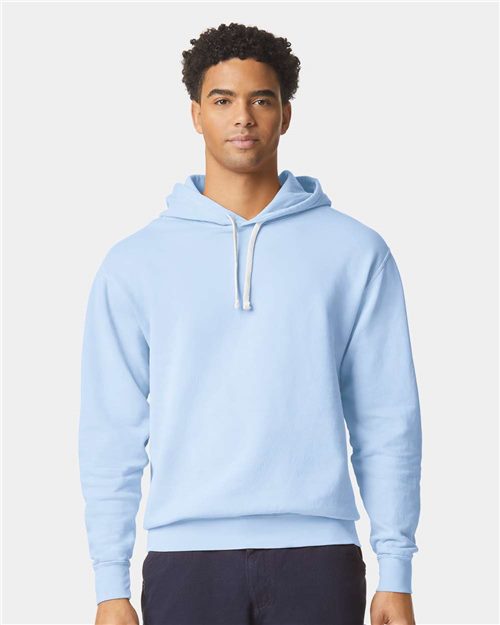
Choose the Comfort Colors 1467 when you want a lighter, 6.4 oz, 100% ring-spun cotton hoodie for year-round layering and warm-climate merch. Choose the Comfort Colors 1567 when you want a more substantial, 9.5 oz, 80/20 cotton-polyester hoodie with three-end cotton-face fleece, a pouch pocket, side seams, and a back neck patch for customization.
That is the short answer to the Comfort Colors 1467 vs 1567 decision. The better wholesale hoodie depends on how the finished garment should feel, when customers will wear it, what decoration process you will use, and how much blank cost your program can carry. Both styles are garment-dyed, relaxed-fit hoodies sold by Beytees in sizes S through 3XL, but they are not interchangeable blanks.
Start with the live Comfort Colors 1467 wholesale product page and Comfort Colors 1567 wholesale product page. Product pricing, size-color inventory, warehouse availability, and delivery estimates can change. Confirm the exact variation before promising a launch date or accepting a customer order.
Comfort Colors 1467 vs 1567: Quick Answer
- Choose the 1467 for lightweight comfort. Its published 6.4 oz fabric is 100% ring-spun U.S. cotton with 31 singles. It works as a seasonless layer, a warm-weather evening hoodie, and a coordinated match for the lightweight 1468 shorts and 1469 sweatpants.
- Choose the 1567 for a heavier premium feel. Its published 9.5 oz fabric is an 80/20 ring-spun cotton-polyester blend with three-end cotton-face fleece and 100% cotton threads.
- Choose the 1467 when cotton composition is central to the brief. The body is published as 100% cotton. Always verify the sewn label on the exact production unit when fiber-content labeling matters.
- Choose the 1567 when structure and cold-weather utility matter more. It has a pouch pocket, side seams, and a back neck patch for easy customization in the current product specification.
- Sample both for decoration. The 1467 has less fabric mass, while the 1567 is thicker and blended even though it has a cotton face. DTF, screen printing, DTG, HTV, and embroidery settings must be approved on the exact color and style.
- Do not choose from mockups alone. Weight, drape, hood shape, dye character, artwork scale, and wearer preference are physical decisions.
Comfort Colors Hoodie Comparison Table
| Specification | Comfort Colors 1467 | Comfort Colors 1567 |
|---|---|---|
| Published fabric weight | 6.4 oz/yd² US | 9.5 oz/yd² US |
| Published fiber content | 100% ring-spun cotton | 80/20 ring-spun cotton/polyester |
| Yarn detail | 31 singles | 30 singles |
| Face and thread detail | Soft ring-spun cotton fabric with 100% cotton threads | Three-end cotton-face fleece with 100% cotton threads |
| Fit | Relaxed | Relaxed |
| Hood | Jersey lined, natural flat drawcord; white drawcord on White | Jersey lined, color-matched flat drawcord |
| Shoulder | Rolled forward | Rolled forward |
| Cuffs and waistband | 1×1 rib | 1×1 rib |
| Additional published construction | Signature twill label | Back neck patch, pouch pocket, side seams, signature twill label |
| Current Beytees size range | S through 3XL | S through 3XL |
| Current Beytees color count | 11 listed colors | 11 listed colors |
| Best starting use case | Lightweight layers, spring and summer programs, travel, resort, and coordinated lounge sets | Fall and winter merch, substantial premium hoodies, campus programs, and cold-weather retail |
The 1567 is 3.1 oz/yd² heavier by the published U.S. fabric figures, which is about 48% more nominal fabric weight than the 1467. That percentage describes the listed fabric weight, not the exact shipping weight of a finished garment. Hoods, pockets, seams, rib, dye, size, and manufacturing tolerance also affect the physical unit.
The Biggest Difference Is Fabric Weight and Composition
A hoodie can look similar in a front-facing catalog image while feeling entirely different on a person. The Comfort Colors 1467 uses a 6.4 oz, 100% ring-spun cotton construction. Comfort Colors describes it as lightweight, seasonless fleece intended for year-round wear. It is the clearer starting point when the product brief calls for breathable layering, a softer transition between a long-sleeve shirt and traditional fleece, or a hoodie that can remain relevant beyond cold weather.
The 1567 uses 9.5 oz, 80/20 ring-spun cotton-polyester fabric. Its three-end cotton-face fleece gives decorators a published cotton face while the polyester content remains part of the body construction. The extra mass makes it the more substantial option for a classic premium hoodie experience, colder weather, and a retail program in which perceived weight is part of the value story.
Neither weight is universally better. A heavy hoodie can feel impressive in a fall drop but too warm for an outdoor summer event. A lightweight hoodie can be ideal for layering and travel but may not satisfy a customer specifically shopping for thick winter fleece. Define the selling season, climate, indoor or outdoor use, target price, and wearer expectation before ordering samples.
If you are also building crewnecks, the Comfort Colors 1466 vs 1566 crewneck comparison applies the same lightweight-versus-substantial decision to companion sweatshirt styles. For a broader category view, use the wholesale garment-dyed hoodie guide.
What the Garment-Dyed Finish Means
Both hoodies are garment-dyed for the lived-in Comfort Colors appearance. The current product records also say the process produces almost no shrinkage at home. Treat that as the manufacturer’s published product statement, not a license to promise zero change under every wash condition. Follow the sewn care label, provide the customer with approved care instructions, and wash-test a decorated sample.
Garment dye is part of the product character. It can create a softer, broken-in visual direction that works for vintage merch, destination retail, alumni collections, lifestyle brands, and relaxed corporate apparel. It also means the blank should not be sold as if it were a perfectly flat, laboratory-matched color surface. Approve a physical production color under the lighting used for sales and photography.
Decoration can interact with the dyed surface. Heat, pressure, pretreatment, curing, adhesive, cleaning chemistry, and repeated laundering can affect the finished appearance. Do not transfer a recipe from an undyed sweatshirt, a different color, or the other Comfort Colors hoodie without a production-equivalent test.
Color Assortment: Shared Core Colors and Different Merch Directions
The live Beytees catalog currently lists 11 colors for each style. The five shared color names are Blue Jean, Crimson, Grey, Pepper, and White. Those shared names help a shop build a related assortment, but they do not eliminate the need to compare physical units. Fabric construction, dye lot, surface, and garment geometry can change how the same named color appears.
The 1467 currently adds Black, Butter, Hydrangea, Ivory, Neon Violet, and Peachy. That group supports a useful mix of neutral, pastel, and bright lifestyle directions. Butter, Hydrangea, Ivory, and Peachy can work in spring, resort, bridal-party, creator, and gift programs. Black and Neon Violet can support stronger graphic or event concepts.
The 1567 currently adds Blue Spruce, Denim, Flo Blue, Light Green, Seafoam, and True Navy. This palette leans into blue, green, coastal, campus, outdoor, and traditional dark-neutral stories. True Navy can make the 1567 easier to position in classic school or organization programs, while Blue Spruce and Seafoam support a more washed lifestyle direction.
These are current catalog observations, not inventory promises. A listed color-size combination may be unavailable at the warehouse needed for your deadline. Recheck the live variation, quantity, shipping estimate, and substitute policy immediately before the purchase order is approved.
Fit, Sizing, Hood, and Wear Experience
Both styles are published as relaxed fit and currently appear on Beytees in S through 3XL. A shared size label does not guarantee the same perceived fit. Fabric weight changes drape, layering capacity, warmth, and how the garment settles around the torso, shoulders, sleeves, cuff, and waistband.
The 1467 is the more natural candidate for wearing over a T-shirt in mild weather. Its lighter cotton body should be evaluated for the desired amount of flow and cling after decoration. The 1567 has more fleece mass, so test it over the actual base layer a customer will wear in fall or winter. Do not size a bulk program from a flat measurement chart alone.
Both have rolled-forward shoulders, jersey-lined hoods, and 1×1 rib cuffs and waistbands. The drawcord treatment differs. The 1467 uses a natural-colored flat drawcord, except White uses a white drawcord. The 1567 uses a color-matched flat drawcord. That detail affects the front presentation and should be visible in product photography and artwork approval.
Order representative sizes in both styles. Record chest width, body length, sleeve behavior, hood coverage, waistband recovery, layering room, and post-wash measurements. If a program includes unisex customers with different fit preferences, publish the measured sample information and garment photos rather than relying only on “relaxed fit.”
Comfort Colors 1467 vs 1567 for DTF Printing
Both hoodies can be considered for DTF, but the 1467 and 1567 need separate approvals. The 1467 is a 100% cotton lightweight garment. The 1567 is an 80/20 blend with a published cotton face. Transfer film, powder, artwork, press, platen, garment moisture, temperature, time, pressure, peel, and post-press procedure all affect the result.
On the 1467, the lighter fabric makes hand feel and press evidence especially important. A large, solid transfer may visually dominate a lightweight hoodie or make the decorated panel feel much less flexible than the blank. Test the artwork at production size. Consider whether the design can use negative space, a smaller print area, or separated elements while still delivering the brand message.
On the 1567, thicker fleece changes how the garment sits on the platen and how seams, the pouch pocket, drawcord, and hood affect contact. The cotton face can be useful for decoration, but the polyester in the body means the style should not be treated as if it were identical to a 100% cotton blank. Stabilize the printable area and follow the current transfer and equipment instructions for the exact garment.
For both styles, keep seams, pocket edges, drawcords, and hood bulk out of the press contact area when the equipment and design allow. Test for color change, gloss, pressure marks, scorching, dye interaction, edge lift, adhesion, cracking, and wash durability. The DTF printing on Comfort Colors guide provides a broader production workflow, while the wholesale sweatshirt DTF guide helps compare other fleece blanks.
Screen Printing and DTG Considerations
The 1467’s 100% ring-spun cotton body is a straightforward material starting point for shops experienced with cotton screen printing or DTG. The 1567’s three-end cotton face also gives the print surface a published cotton construction, even though the overall garment is an 80/20 blend. Fiber content alone does not approve an ink system, pretreatment, cure profile, or finished claim.
For screen printing, test ink opacity and cure on every approved color. A lighter hoodie may need artwork and ink deposit choices that preserve flexibility. A more substantial 1567 can carry a heavier visual treatment, but an unnecessarily thick ink film can still produce a stiff finished garment. Inspect color accuracy, underbase, surface texture, stretch, cure, and wash performance.
For DTG, verify pretreatment behavior, white-ink opacity, color reproduction, hand feel, and wash results on the garment-dyed surface. Do not assume the same pretreatment volume or curing method should be used across both weights. The 1567’s polyester component also makes a production sample necessary even with a cotton face.
Print at the actual retail dimensions and view the result on a person. A graphic that looks balanced on the thicker 1567 may feel oversized on the lighter 1467. Likewise, a small minimalist design selected for the 1467 may not communicate enough value on a premium winter hoodie unless the blank itself is central to the product story.
Embroidery, Applique, and Neck Customization
The 1567 is the stronger starting sample when the decoration brief includes substantial left-chest embroidery, applique, or a premium outerwear treatment. Its heavier fleece provides more body, and the published back neck patch gives decorators a defined customization feature. That does not guarantee that a dense logo will sew cleanly. Digitizing, stabilizer, needle, thread, hooping, placement, stitch count, and garment construction still need approval.
The 1467 can support embroidery when the design is engineered for lightweight cotton fleece. Favor realistic letter size, controlled density, appropriate underlay, and a backing system that supports the design without turning the panel into a rigid board. Inspect puckering, pull compensation, edge quality, interior comfort, and how the garment hangs after sewing.
Never move the same digitized file unchanged between the two styles just because the logo dimensions match. Run one decorated sample of each finalist. Compare the finished chest on a hanger and on a wearer, then wash according to the approved care process. If embroidery is the main purchase driver, review the wholesale blank hoodie embroidery guide for alternative styles and production questions.
Which Hoodie Fits Each Merch Program?
Choose the 1467 for lightweight lifestyle collections
The 1467 is well suited to spring releases, beach and lake destinations, summer evenings, travel, studio and wellness brands, warm-climate schools, creators, festivals, and transitional retail. Its 100% cotton composition and 6.4 oz weight let the hoodie occupy a space between a long-sleeve tee and traditional heavy fleece.
It also coordinates with the Comfort Colors 1468 lightweight sweat shorts and 1469 sweatpants. The Comfort Colors 1468 sweat shorts guide explains how to build a related set without assuming named colors will always match perfectly across garments or dye lots.
Choose the 1567 for premium cold-weather drops
The 1567 is the more logical starting point for fall collections, winter merch, bookstores, campus and alumni programs, coffee shops, breweries, outdoor brands, employee gifts, premium event goods, and retail customers who evaluate hoodies by weight. Its pouch pocket and heavier fleece support the familiar cold-weather hoodie use case.
The 1567 can also carry a higher perceived product tier when the blank, decoration, packaging, and photography all support that position. Do not assume a higher blank cost automatically creates higher value. The finished product needs strong artwork, correct color selection, clean production, a useful size mix, and a retail price the audience accepts.
Use both only when the assortment logic is clear
A brand can sell the 1467 as a lightweight seasonal layer and the 1567 as a substantial core hoodie. Name the distinction clearly in product copy. Customers should understand the weight, fiber content, and intended wear before choosing. Avoid offering two nearly identical mockups with no explanation, because that creates confusion and returns instead of useful choice.
Blank Cost, Decoration Cost, and Retail Margin
The live Beytees catalog currently positions the 1467 below the 1567 in blank price, which matches the difference in weight and construction. Prices can change by size, quantity, inventory source, and time, so use the live product page for every quote. Do not copy today’s price range into a permanent customer proposal without an expiration date.
Calculate the finished unit cost, not just the blank. Include artwork cleanup, film or screens, pretreatment, ink or transfer, embroidery digitizing, stitch time, setup, test garments, spoilage, relabeling, neck customization, folding, bagging, barcode labels, cartons, freight, rush fees, payment fees, returns, and replacement units.
The lighter 1467 can open a lower retail tier or protect margin in a warm-weather program. The 1567 can support a higher ticket when the audience values weight and cold-weather utility. Neither margin works unless the finished retail price is tested against the actual customer and selling channel.
Use Published Sustainability Language Carefully
The current Beytees records for both styles say they use OEKO-TEX certified low-impact dyes and salt-free clean pigment dye colors. They also identify the products as Made With Respect and state that Comfort Colors is a member of the U.S. Cotton Trust Protocol. The product records further say the manufacturing mill partnered with the Fair Labor Association and that the facility is WRAP certified.
Use those statements only in their verified scope and current wording. Do not convert them into unsupported claims such as “organic,” “carbon neutral,” “fair trade,” “plastic-free,” or “made in the USA.” Fiber origin, sewing origin, certification scope, dye claim, and facility claim are different facts. If sustainability language is central to a campaign or institutional bid, obtain current documentation for the exact product and claim.
A Practical Buying Decision Workflow
- Define the customer, climate, selling season, use case, target retail price, quantity, and delivery date.
- Decide whether a lightweight 6.4 oz cotton layer or a 9.5 oz blended fleece hoodie better matches the promise.
- Select exact live Beytees colors rather than using a manufacturer palette as a stock guarantee.
- Order the same representative sizes in both styles for side-by-side fit and hand-feel review.
- Photograph the blanks on the intended wearer with the actual base layer.
- Prepare production-size artwork for each garment rather than applying one mockup automatically.
- Run the intended DTF, screen print, DTG, HTV, embroidery, or applique process on the exact colors.
- Inspect print area, seams, hood, drawcord, pocket, rib, puckering, press evidence, opacity, adhesion, and hand feel.
- Wash and dry the decorated samples according to the approved care method, then compare them with undecorated controls.
- Measure the samples before and after care, and record any change rather than promising zero shrinkage.
- Build a size mix from real demand and fit testing, not a generic ratio copied from another hoodie.
- Calculate complete landed and decorated cost, then validate the retail price and margin.
- Recheck live inventory, warehouse timing, price, and substitutions before accepting the deadline.
- Retain the approved sample, artwork revision, color name, production settings, care test, and quality standard.
- Inspect production throughout the run and again at final pack-out.
Recurring programs should document reorder points, approved alternatives, and retained samples using the custom apparel inventory management guide. If freight timing is part of the decision, review the Beytees wholesale shipping guide.
Final Verdict
The Comfort Colors 1467 wins the lightweight brief. Its 6.4 oz, 100% ring-spun cotton construction is the better starting point for year-round layering, warm-weather merch, travel, coordinated lounge sets, and customers who want a hoodie without traditional heavy fleece.
The Comfort Colors 1567 wins the substantial hoodie brief. Its 9.5 oz, 80/20 construction, three-end cotton face, pouch pocket, side seams, and back neck patch make it the stronger starting point for fall and winter retail, premium cold-weather merch, and programs where weight is part of the value.
The final decision should come from two physical samples and two decorated tests. Compare fit, warmth, drape, color, artwork scale, press or sew behavior, wash performance, blank cost, and retail margin. Then use the live Comfort Colors 1467 and Comfort Colors 1567 pages to confirm current pricing and exact size-color availability.
Frequently Asked Questions
What is the main difference between Comfort Colors 1467 and 1567?
The 1467 is a 6.4 oz, 100% ring-spun cotton lightweight hoodie. The 1567 is a 9.5 oz, 80/20 ring-spun cotton-polyester hoodie with three-end cotton-face fleece, a pouch pocket, side seams, and a back neck patch.
Is the Comfort Colors 1467 100% cotton?
Yes. The current Beytees and Comfort Colors 1467 product records publish the style as 100% soft ring-spun U.S. cotton with cotton threads. Verify the sewn label on the exact unit when legal fiber labeling is required.
Is the Comfort Colors 1567 a heavyweight hoodie?
The 1567 is published at 9.5 oz/yd², making it substantially heavier than the 6.4 oz 1467. The official product name is Adult Hooded Sweatshirt. Whether a seller markets 9.5 oz as heavyweight should be stated with the exact weight rather than used as an undefined promise.
Which is warmer, Comfort Colors 1467 or 1567?
The 1567 is the stronger starting choice for warmth because its published fabric weight is 9.5 oz versus 6.4 oz for the 1467. Actual comfort also depends on fit, base layers, weather, activity, moisture, and individual preference.
Which Comfort Colors hoodie is better for summer?
The 1467 is the better starting sample for summer evenings and warm climates because Comfort Colors positions its 6.4 oz fleece for seasonless, year-round wear. Test it in the actual climate and use case before making a comfort claim.
Which Comfort Colors hoodie is better for DTF printing?
Both can be used for a DTF sample. The 1467 is lightweight 100% cotton, while the 1567 is a heavier 80/20 blend with a cotton face. Approve separate transfer and press tests because weight, fiber content, garment dye, seams, and fleece thickness change production behavior.
Which hoodie is better for embroidery?
The heavier 1567 is the stronger starting sample for substantial embroidery, while the 1467 can work with artwork and stabilization engineered for lighter fleece. Neither style removes the need for capably digitized artwork, backing tests, wear review, and wash testing.
Do the 1467 and 1567 fit the same?
Both are published as relaxed fit and currently run from S through 3XL at Beytees. The different fabric weights can change drape, layering, and perceived fit, so compare physical samples in the sizes your customers will wear.
Do Comfort Colors 1467 and 1567 come in the same colors?
They share Blue Jean, Crimson, Grey, Pepper, and White in the current Beytees catalog. Each also has six distinct listed colors. Availability can change by size and warehouse, and the same color name should still be approved on the physical style.
Does the Comfort Colors 1567 have a pouch pocket?
Yes. The current Comfort Colors 1567 manufacturer record and Beytees product record list a pouch pocket. The 1567 specification also lists side seams and a back neck patch for easy customization.
Does the Comfort Colors 1467 match the 1468 sweat shorts?
Comfort Colors presents the 1468 shorts and 1469 sweatpants as matching lightweight companions to the 1467. Confirm exact color names, physical shade, current inventory, and dye-lot appearance before promising a perfectly matched set.
Will Comfort Colors hoodies shrink?
The current product records say garment dye provides almost no shrinkage at home. Do not translate that into a zero-shrink guarantee. Follow the care label, measure a decorated sample before and after laundering, and publish the tested care instructions.
Can one decoration file be used on both styles?
Use the same brand artwork as a starting point, but approve production separately. The lighter 1467 and heavier 1567 can require different print dimensions, transfer choices, platen setup, ink deposit, embroidery density, backing, or placement.
Where can I buy Comfort Colors 1467 and 1567 wholesale?
Beytees lists both styles online with current variations and wholesale ordering. Review the live product pages, select the exact color and size, confirm inventory and delivery, and order representative samples before approving a decorated bulk run. You can also browse the complete Beytees wholesale blank apparel catalog.
Leave a Reply