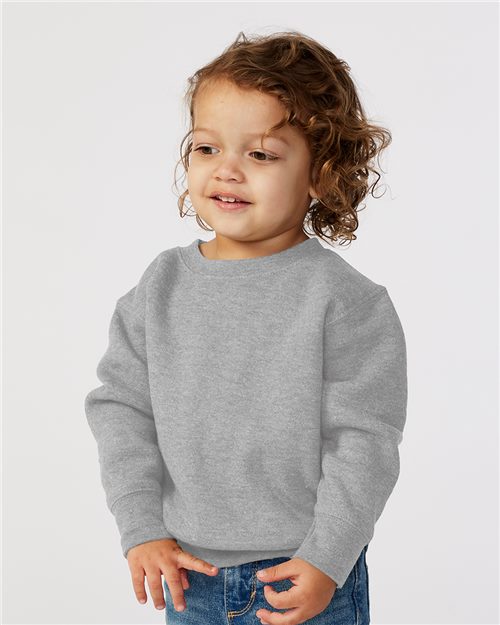
The Rabbit Skins 3317 Toddler Fleece Crewneck Sweatshirt is a practical wholesale blank for preschools, children’s brands, family events, personalized gifts, school spirit programs, and decorators who need a toddler-sized fleece surface for DTF, screen printing, heat transfer vinyl, or embroidery. The current style uses a 7.5 oz. 60/40 cotton and polyester fleece, reinforced coverstitching, side seam construction, an EasyTear™ label, and a CPSIA-compliant tracking label in the side seam. Its crewneck shape also gives decorators a clear front and back canvas without a hood or pouch pocket competing with the artwork.
Toddler apparel requires more planning than simply shrinking an adult graphic. Garment proportions are smaller, size changes are meaningful, seams sit closer to the print area, and parents expect a comfortable result that survives regular washing. A successful Rabbit Skins 3317 wholesale program therefore starts with the right blank, but it also depends on artwork scaling, physical samples, documented press settings, clear care instructions, and careful order management.
This guide covers the current Rabbit Skins 3317 specifications, size planning, DTF testing, artwork placement, decoration alternatives, preschool and children’s brand applications, quality control, and wholesale ordering. Buyers can also review the live Rabbit Skins 3317 Toddler Fleece Crewneck Sweatshirt product page for current availability and ordering information.
Rabbit Skins 3317 Specifications at a Glance
| Feature | Current Rabbit Skins 3317 specification | Why it matters |
|---|---|---|
| Fabric weight | 7.5 oz./yd² in the United States, 12.5 oz./L yd in Canada | Provides a useful fleece layer without the bulk of a heavy adult workwear sweatshirt |
| Primary fiber content | 60% cotton and 40% polyester | Balances softness, warmth, durability, and practical care |
| Heather and camo content | Granite Heather, Heather, Natural Heather, and Vintage Camo are 55% cotton and 45% polyester | Color-specific fiber content can affect heat testing and decoration decisions |
| Construction | Coverstitched collar, shoulders, armholes, ribbed cuffs, and waistband | Reinforces high-use areas on an active toddler garment |
| Body construction | Side seamed | Creates a defined garment shape and useful reference points for alignment |
| Label | EasyTear™ label | Helps decorators create a cleaner branded or private-label presentation |
| Youth compliance detail | CPSIA-compliant tracking label in the side seam | Important for children’s apparel sourcing and production records |
| White construction note | White is sewn with 100% cotton thread | A useful detail for buyers with specific decoration or product requirements |
| Manufacturing note | Made in a WRAP-certified facility, according to the current Beytees product listing | Supports more informed sourcing conversations with organizations and retail buyers |
The standard fiber blend should not be assumed for every color. The current Beytees listing identifies Granite Heather, Heather, Natural Heather, and Vintage Camo as 55/45 cotton and polyester. That difference matters when a decorator is evaluating heat behavior, dye movement, surface appearance, and the feel of a finished transfer. Verify the exact current color specification and inventory before approving a large order.
Why the Rabbit Skins 3317 Works for Toddler Apparel Programs
1. The fleece weight fits many everyday uses
At 7.5 oz., the 3317 provides a practical fleece layer for cool classrooms, fall events, winter family photos, spring field trips, birthday parties, preschool spirit wear, holiday merchandise, and everyday retail collections. It is substantial enough to feel like a sweatshirt while remaining easier to layer than many heavier adult-style fleece garments.
A toddler crewneck can be worn over a T-shirt and under a jacket without adding a hood behind the neck. That makes it useful for programs that want one decorated style to work across several seasons. It also gives families more opportunities to use the garment after the original event, which can improve perceived value.
2. The crewneck creates an efficient decoration surface
The front of a toddler hoodie is interrupted by a pouch pocket, and its hood can partially cover upper-back artwork. The 3317 crewneck avoids both issues. Decorators receive a more continuous front surface for a preschool logo, child’s name, holiday design, birthday graphic, mascot, or small retail illustration. The back is also available for a compact event mark, brand statement, or sponsor line.
The available area is still small. Side seams, the collar, armholes, cuffs, and waistband sit closer to the design than they do on an adult sweatshirt. The advantage is not unlimited space. It is a cleaner, more predictable canvas when the artwork is deliberately sized for a toddler garment.
3. Reinforced construction supports repeat wear
Coverstitching at the collar, shoulders, armholes, cuffs, and waistband reinforces areas that move frequently. Toddlers stretch sleeves, pull garments over their heads, crawl, play, sit on floors, and generate more frequent washing than many adult apparel customers. No garment is indestructible, but thoughtful seam construction is valuable for products expected to see regular use.
4. The EasyTear label helps branded programs
An EasyTear label can simplify the process of creating a cleaner branded presentation. Children’s boutiques, personalized gift sellers, event merch programs, and private-label startups may want the customer experience to center on their own brand. A removable label supports that goal, but sellers must still preserve all legally required information and should never remove or obscure the CPSIA tracking label.
5. Toddler-specific sizing is easier to merchandise
The 3317 is built for toddler sizing rather than offered as a reduced adult silhouette. That helps a brand create a more coherent collection for young children. It also coordinates well with toddler T-shirts, infant bodysuits, youth sweatshirts, and adult fleece when a family, school, or event wants the same visual identity across age groups.
Rabbit Skins 3317 Size Guide and Sample Planning
Current wholesale references list the 3317 in sizes 2T, 3T, 4T, 5/6, and 7. Representative garment measurements commonly published for the style are shown below. Measurements can vary within normal manufacturing tolerances, so use the chart for planning and confirm the current supplier chart plus a physical sample before creating production artwork or publishing a customer-facing size guide.
| Size | Body width, laid flat | Body length | Sleeve length |
|---|---|---|---|
| 2T | 13 in. | 15 in. | 11.75 in. |
| 3T | 13.5 in. | 16 in. | 12.25 in. |
| 4T | 14 in. | 17 in. | 13.75 in. |
| 5/6 | 15 in. | 18 in. | 16 in. |
| 7 | 15.5 in. | 19 in. | 16.75 in. |
Do not choose a toddler sweatshirt size based only on the child’s age. Growth patterns differ, families have different layering preferences, and a child may fall between categories. For preschools, parties, teams, or online stores, provide garment measurements and explain how they were taken. A representative sample set is even better because parents can compare an actual garment instead of guessing from a generic age label.
When measuring an existing favorite sweatshirt, lay it flat without stretching. Measure across the chest from side seam to side seam, then measure body length from the high point near the shoulder to the bottom band. Compare those numbers with the current 3317 chart. Leave room for the intended base layer and follow the seller’s exchange policy before the order closes.
Is the Rabbit Skins 3317 Good for DTF Printing?
Yes, the Rabbit Skins 3317 can be a strong candidate for DTF printing when the decorator tests the exact garment color, transfer system, heat press, pressure, time, temperature, and peel method before production. DTF is useful for full-color preschool mascots, birthday art, gradients, detailed illustrations, names, small batch retail collections, and family sets that include several garment styles.
However, fleece does not behave like a smooth jersey T-shirt. The fabric has more loft and texture, the garment is thicker, and polyester content introduces heat and dye considerations. A recipe that works on a white cotton T-shirt does not automatically approve a colored 60/40 or 55/45 fleece sweatshirt. Every selected color should be treated as a distinct test condition.
The small body also changes the pressing setup. Seams and ribbing can fall inside the heat press area if the sweatshirt is loaded carelessly. Uneven pressure may create incomplete bonding, edge lift, or visible pressure marks. A platen or support setup should isolate the printable panel as much as practical while keeping the collar, armholes, side seams, and waistband away from the pressure zone.
DTF Printing Workflow for the Rabbit Skins 3317
Step 1: Confirm the exact blank and color
Record the Rabbit Skins 3317 style number, size, color, supplier, and lot information when available. Confirm whether the chosen color uses the standard 60/40 blend or the listed 55/45 heather and camo blend. Do not substitute a toddler hoodie, T-shirt, or youth crewneck without a new artwork and production review.
Step 2: Inspect every garment before heat
Check the sweatshirt for stains, holes, seam problems, uneven dye, surface contamination, wrong sizing, and wrong color. Compare the blank with the order record before applying a transfer. A defect discovered after pressing costs both the blank and the transfer, and it becomes harder to determine whether the issue began in manufacturing or decoration.
Step 3: Measure the real print area
Lay each sample naturally and measure between the collar, armholes, side seams, and waistband. Do this on the smallest and largest sizes in the order. A design that looks balanced on size 7 may overwhelm 2T. A design created only for 2T may look undersized on 5/6 or 7.
Step 4: Build a toddler-specific artwork system
Create at least one artwork version specifically for the toddler garment. A two-size transfer system often produces better visual balance across 2T through 7 than one universal transfer. The exact grouping should come from physical measurements and approval samples. Keep essential text readable, simplify extremely fine lines, and protect breathing room around the graphic.
Step 5: Prepare a flat pressing surface
Load the sweatshirt so the front panel is flat and supported. Keep thick seams, ribbing, and the collar out of the active pressure area when possible. Use the appropriate platen, pressing pillow, or pad only when the setup calls for it. The goal is even contact under the transfer, not maximum force across every garment component.
Step 6: Pre-press conservatively
A brief pre-press may remove moisture and flatten loose surface fibers. Excess time, temperature, or pressure can flatten fleece, create shine, or expose the garment to unnecessary heat. Use the shortest validated preparation that works with the selected transfer system.
Step 7: Follow the transfer supplier’s current recipe
Use the stated temperature, dwell time, pressure, and peel method for the actual transfer film. Hot peel, warm peel, and cold peel films are not interchangeable. If a shop buys transfers from multiple suppliers, maintain a separate approved recipe for each system. Label every test so the result can be traced to the correct garment color and press settings.
Step 8: Complete the finishing press
Many DTF systems require a second press after the carrier is removed. Use the recommended cover sheet or finishing material and the documented time. The finishing press can affect texture, edge bonding, and durability, so it should be treated as part of the production recipe rather than an optional step when the supplier requires it.
Step 9: Inspect and wash test
Let the sweatshirt cool and recover before judging the surface. Inspect for edge lift, incomplete adhesion, cracks, gloss, scorching, pressure marks, dye movement, missing detail, or an off-center graphic. Wash the approval sample using the intended care instructions. Evaluate adhesion, shape, color, and surface feel after washing and drying. Retain the approved sample and written recipe for repeat programs.
For a broader look at fleece selection and transfer variables, read the Beytees guide to the best wholesale blank sweatshirts for DTF printing.
How to Size Artwork for a Toddler Crewneck Sweatshirt
There is no universal Rabbit Skins 3317 print size that works for every design and every garment size. A compact square mascot, a wide preschool name, a tall birthday illustration, and a small left-chest logo use the available area differently. Measure the garment, preserve margins, and approve the artwork on a physical sample.
- Full front: Center the visual between the collar and waistband, then check it while the sweatshirt hangs or is worn naturally.
- Left chest: Reduce both the logo and the offset for a toddler body. An adult left-chest measurement will usually sit too low or too far outward.
- Full back: Keep important text away from the collar and leave clear space around the side seams.
- Upper back: Use a compact child’s name, class mark, event label, or brand detail.
- Sleeve: Treat as an advanced placement. Test the platen and seam clearance before selling long names or vertical designs.
Use a physical placement template or a documented measurement from the neckline for each artwork size. The production traveler should identify garment style, garment color, size, artwork version, placement, personalization, and press recipe. Toddler orders often contain many unique names or age numbers, so a clear matching process is just as important as the press settings.
Best Uses for Rabbit Skins 3317 Wholesale Orders
Preschool and daycare spirit wear
A preschool logo, mascot, class name, or graduation year fits naturally on a toddler crewneck. Programs can offer one core body color and one approved design to simplify ordering. Staff and families can receive coordinated youth or adult fleece in related styles without forcing one transfer size across every garment.
Birthday parties and family events
The 3317 works for birthday themes, family reunions, holiday gatherings, sibling sets, and family photos. DTF can support detailed full-color illustrations and individualized names. Sellers should set a firm personalization deadline and require customers to approve spelling before production.
Children’s boutiques and private-label brands
The EasyTear label and toddler-specific construction make the sweatshirt useful for small retail collections. A boutique can build seasonal graphics, local themes, simple embroidered marks, or coordinated capsule drops. The strongest programs usually begin with a limited color range and a focused design language rather than trying to stock every possible variation.
Personalized gifts
Names, initials, birth years, sibling roles, holiday messages, and family titles can turn a blank fleece into a gift product. Personalization increases the need for proofing. Use a written approval record, verify capitalization and punctuation, and separate customer-approved artwork from internal notes.
Schools, teams, and clubs
Younger siblings, preschool divisions, early childhood programs, dance groups, and community teams may need toddler sizing alongside youth and adult garments. The 3317 can fill that gap without converting a youth style into an uncertain toddler fit. For older participants, compare the Gildan 18000B youth crewneck sweatshirt wholesale guide.
Choosing Garment Colors for Toddler Programs
Choose colors based on more than a screen mockup. The body color affects transfer contrast, heat testing, dye behavior, inventory, reorderability, and the overall retail position of the product. Approve a physical garment whenever color accuracy matters.
Start with one or two core colors. Every additional garment color creates another inventory path, another product photo, another transfer contrast decision, and another heat-test combination. A focused collection is easier to quote, order, decorate, count, photograph, and reorder. Expand only when actual demand supports the added complexity.
Use the exact supplier color name in every record. Labels such as pink, blue, gray, or camo are not precise enough. Confirm the current fiber content for heather and camo options. Test dark and saturated colors for dye movement, scorching, or visible pressure effects before production. A white-garment approval does not approve the same recipe on every other color.
Rabbit Skins 3317 vs a Toddler Hoodie
| Decision factor | Rabbit Skins 3317 crewneck | Toddler pullover hoodie |
|---|---|---|
| Front print area | Continuous front without a pouch pocket | Pouch pocket can limit lower-front artwork |
| Back decoration | No hood covering upper-back artwork | Hood can cover part of the back design when worn |
| Press setup | Generally simpler front setup | Pocket seams may require additional support |
| Layering | Fits easily under many jackets | Hood adds bulk behind the neck |
| Merchandising | Classic school, boutique, event, and everyday silhouette | Casual hooded look with added lifestyle appeal |
Choose the 3317 when uninterrupted artwork space, easy layering, and an efficient platen setup are priorities. Choose a toddler hoodie when the hood and pouch pocket are central to the customer’s preferred look. Some programs offer both, but each style needs its own printable-area review and approval sample.
Rabbit Skins 3317 vs Toddler T-Shirts
A toddler T-shirt is lighter, usually costs less to decorate, and can serve warm-weather events. The 3317 fleece sweatshirt provides more warmth, a higher perceived seasonal value, and a different retail position. Many brands use toddler tees as the year-round foundation and add crewneck fleece for fall, holiday, and winter collections.
The artwork should not be transferred between the two garments without review. Fleece and jersey differ in texture, thickness, pressure needs, and printable area. A T-shirt graphic may need to be rescaled or simplified for the sweatshirt. For blank tee selection, read the wholesale blank toddler T-shirts for DTF printing guide.
DTF vs Screen Printing, HTV, and Embroidery
DTF printing
DTF is useful for full-color illustrations, gradients, personalization, small batches, and orders that combine several garment styles. It reduces the need to create a separate screen for every color. The decorator must validate adhesion, feel, heat response, and wash performance on the exact 3317 color.
Screen printing
Screen printing can be efficient for larger quantities with a limited number of ink colors. It is a strong choice for bold preschool marks, event graphics, and repeat retail designs. Fine detail, ink cure, underbase decisions, and the textured fleece face require testing. The small toddler body also limits how large the screen image can be.
Heat transfer vinyl
HTV works well for simple names, numbers, initials, and low-color designs. It can be practical for one-off personalization or small local programs. Layered vinyl can become heavy on a small sweatshirt, so limit unnecessary layers and verify the material supplier’s application instructions.
Embroidery
Embroidery can create a premium result for compact logos, initials, and boutique branding. Keep stitch count and density appropriate for a small fleece garment. Use suitable stabilization and test the finished back for comfort. A large, dense embroidered panel may feel stiff on a toddler body and can distort the sweatshirt.
The best method depends on design complexity, order quantity, personalization, customer expectations, equipment, and production schedule. A decorator may use screen printing for a large core run, DTF for a multicolor limited release, HTV for names, and embroidery for a premium boutique variation.
Wholesale Ordering Strategy for the Rabbit Skins 3317
1. Start with a physical sample
Order the smallest and largest expected sizes in the main garment color. Evaluate fit, fabric, seam placement, print area, and decoration behavior. A sample costs less than replacing a full order built on incorrect assumptions.
2. Separate garment approval from artwork approval
The customer should approve the blank style, size plan, garment color, artwork, placement, and personalization. These are distinct decisions. A digital mockup can communicate layout, but it does not prove physical fit, exact color, or final surface feel.
3. Build a size assortment from real demand
A preschool roster, preorder form, customer history, or comparable product data is more reliable than an even split across sizes. For a new retail program, begin conservatively and track sales by size and color. Reorder the combinations that move instead of carrying excess depth in slow variations.
4. Confirm live inventory before promising a date
Wholesale inventory changes by color and size. Recheck availability after the customer approves the order and before collecting an irreversible production commitment. If an event deadline is fixed, identify an acceptable backup color or style in advance.
5. Order a controlled overage
An overage can cover a defective blank, press mistake, personalization error, or late size adjustment. The appropriate amount depends on order size, deadline, decoration method, replacement lead time, and the value of avoiding a partial delivery. Overages should be deliberate, not an excuse for weak quality control.
6. Preserve reorder records
Save the supplier, style, exact color, garment sizes, artwork files, transfer versions, placement measurements, press recipe, approval photos, and wash-test result. Repeat business becomes faster and safer when the production history is complete.
Quality Control Checklist
- Confirm the garment is Rabbit Skins style 3317.
- Verify exact color and size against the order.
- Inspect seams, fabric, dye, and surface before decoration.
- Use the correct toddler artwork version.
- Confirm spelling, capitalization, and personalization.
- Keep collar, armholes, side seams, cuffs, and waistband away from the active pressure area when possible.
- Follow the approved press or decoration recipe.
- Inspect alignment, adhesion, color, detail, and surface condition.
- Verify the CPSIA tracking label remains intact and readable.
- Count finished garments by size and personalization before packing.
- Include accurate care instructions.
- Retain an approval sample or clear production photos for repeat orders.
Care Instructions for Decorated Rabbit Skins 3317 Sweatshirts
Care instructions should reflect both the garment and the decoration system. The blank may allow machine washing and low-temperature drying, while the transfer, ink, vinyl, or embroidery process may add specific requirements. Follow the most restrictive validated instruction.
For many decorated fleece programs, turning the garment inside out, washing with mild detergent, avoiding chlorine bleach unless specifically permitted, and limiting excessive dryer heat can help preserve the surface. Do not publish a universal care claim unless it has been verified with the actual decoration. Give the customer a simple printed or digital care guide and retain the same instructions in the order record.
Frequently Asked Questions
What is the Rabbit Skins 3317 made of?
The standard Rabbit Skins 3317 is a 7.5 oz. 60/40 cotton and polyester fleece. The current Beytees listing identifies Granite Heather, Heather, Natural Heather, and Vintage Camo as 55/45 cotton and polyester. White is sewn with 100% cotton thread. Verify the current color-specific specification before production.
What sizes are available in the Rabbit Skins 3317?
Current wholesale references list toddler sizes 2T, 3T, 4T, 5/6, and 7. Inventory can vary by color and size, so check live availability before confirming an order or event deadline.
Is the Rabbit Skins 3317 good for DTF printing?
Yes. Its fleece surface can support detailed full-color DTF designs when the exact garment color and transfer system are tested first. Use a toddler-specific platen setup, keep thick seams outside the pressure area, and complete adhesion plus wash testing before a full run.
Can the Rabbit Skins 3317 be embroidered?
Yes, compact embroidery can work well for initials, small logos, and boutique branding. Use appropriate stabilization, control stitch density, and inspect the back for comfort. Avoid oversized, dense designs that make a small toddler sweatshirt stiff.
Does the Rabbit Skins 3317 have a removable label?
It has an EasyTear label that supports rebranding and a cleaner private-label presentation. The CPSIA-compliant tracking label in the side seam serves a different purpose and should remain intact and readable.
Is the Rabbit Skins 3317 CPSIA compliant?
The current product specification states that the sweatshirt has a CPSIA-compliant tracking label in the side seam. Businesses selling children’s products should maintain appropriate sourcing and production records and confirm any additional requirements that apply to their operation.
Should one transfer size be used for every toddler size?
Usually not without testing. The printable area changes meaningfully between 2T and size 7. Measure physical garments and consider a two-size artwork system so the design remains balanced across the range.
Can the same artwork be used on toddler T-shirts and sweatshirts?
The same visual identity can be used, but the production file should be reviewed for each garment. Fleece and jersey have different dimensions, textures, seam positions, and decoration behavior. Approve separate transfer sizes and placement standards.
How should a preschool or brand collect sizes?
Provide current garment measurements, use representative samples when practical, state the fit and exchange policy clearly, and require customers to confirm sizes before the order closes. Avoid relying only on age labels.
Where can I order the Rabbit Skins 3317 wholesale?
Check the Rabbit Skins 3317 wholesale product page at Beytees for current ordering information. Beytees serves custom apparel businesses, schools, teams, organizations, and growing brands with wholesale blank apparel and shipping options from Texas.
Final Buying Recommendation
The Rabbit Skins 3317 is a strong wholesale toddler crewneck for decorators and brands that want a useful fleece weight, reinforced construction, a clean front and back decoration area, toddler-specific sizing, an EasyTear label, and a CPSIA-compliant tracking label. It can serve preschool spirit wear, birthday and family apparel, personalized gifts, children’s boutiques, seasonal retail drops, and coordinated multi-age collections.
The best results come from treating the 3317 as its own production canvas. Order samples, confirm current color specifications, measure the real print area, create toddler-specific artwork, test each garment and decoration combination, protect required labeling, and document every approved setting. That process turns a promising blank into a repeatable wholesale product.
For adjacent age groups and coordinated product lines, explore the Beytees guides to wholesale blank infant bodysuits for DTF printing, wholesale blank toddler T-shirts, and the Gildan 18000B youth crewneck sweatshirt. When the 3317 matches the program, review the live product page, confirm availability, and build the order around approved physical samples.
Leave a Reply