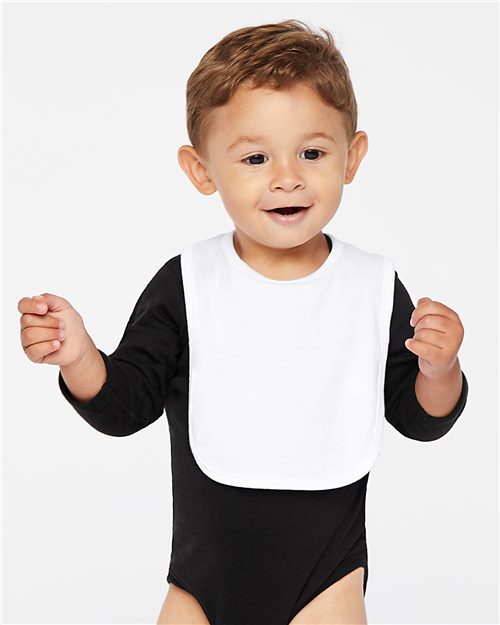
The Rabbit Skins 1005 Infant Premium Jersey Bib is a simple blank with a surprisingly large number of business uses. Baby boutiques can personalize it for gift sets, print shops can add it to family and event orders, and apparel brands can use it as a low-cost companion product beside infant bodysuits. The key is to treat a bib as its own decoration category. Its small printable area, single-ply jersey construction, binding, and hook-and-loop closure require more careful artwork sizing and heat-press setup than a standard T-shirt.
This 2026 wholesale guide explains the verified construction of the style, the best decoration methods, artwork placement, quality control, safety considerations, and bulk-order planning. If you are ready to check current colors, inventory, and pricing, view the Rabbit Skins 1005 Infant Premium Jersey Bib product page.
Rabbit Skins 1005 Specifications at a Glance
Start with the blank itself. Decoration decisions should be based on the actual fabric and construction, not on a generic baby-bib template.
| Feature | Rabbit Skins 1005 specification | Why it matters |
|---|---|---|
| Fabric weight | 5.5 oz./yd² in the U.S. specification | Substantial jersey for an infant accessory, while still requiring controlled pressure and heat |
| Solid colors | 100% combed ring-spun cotton jersey | Smooth cotton surface suits several common print methods |
| Heather | 90% combed ring-spun cotton, 10% polyester | Blend content should be included in transfer and color testing |
| White sewing thread | 100% cotton thread | A useful verified detail when evaluating the complete blank |
| Construction | One-ply jersey with self-binding | The body is flexible, so large or heavy decorations can distort the bib |
| Closure | Reinforced hook-and-loop closure | The closure must stay outside the heat and pressure zone |
| Label | EasyTear label | Useful for branded programs that follow proper relabeling practices |
| Tracking label | CPSIA-compliant tracking label in the side seam | Supports product identification requirements for the blank |
| Manufacturing note | Made in a WRAP-certified facility | Relevant to buyers with socially conscious sourcing requirements |
The construction creates a good canvas for names, initials, compact logos, holiday art, short phrases, and small illustrations. It is less suitable for oversized graphics that reach into the binding or closure. A successful Rabbit Skins 1005 program uses artwork made specifically for the bib rather than shrinking a full-size shirt design at the last minute.
Why the Rabbit Skins 1005 Works for Personalized Baby Products
1. Combed ring-spun cotton provides a smooth print surface
Combed ring-spun cotton generally presents a smoother face than a coarse open-end fabric. That matters when a design includes small lettering, thin outlines, or compact shapes. The surface can support DTF, screen printing, heat transfer vinyl, and direct-to-garment workflows when the decorator tests the complete process on the selected color.
The Heather version includes 10% polyester, so it should not automatically inherit settings approved on a solid-color sample. Fabric color and fiber content can change how a transfer looks after pressing and washing. Approve each important color group separately.
2. The bib can extend an existing infant collection
A bib is an easy companion to a baby bodysuit, toddler tee, blanket, hat, or gift box. That creates useful merchandising options for baby boutiques, online personalization shops, hospital gift programs, family events, and print businesses. A customer who already approved a design for an infant garment can often use a simplified version on the bib, provided the artwork is resized and rebalanced for the smaller field.
For a broader infant assortment, compare this style with our guide to the best wholesale blank infant bodysuits for DTF printing. The bodysuit can carry the primary design, while the bib carries a name, monogram, short phrase, or matching icon.
3. The EasyTear label supports branded presentation
The EasyTear label is helpful for businesses building a branded collection. It does not remove the seller’s labeling responsibilities. Before altering any label, confirm the rules that apply to fiber content, country of origin, care information, tracking, and the finished children’s product. Preserve the side-seam tracking label and keep complete production records.
4. No-minimum purchasing supports sampling and small programs
The Beytees product listing advertises wholesale pricing with no minimum order. That allows a decorator to order a physical sample, validate the process, and build product photography before committing to a larger run. Current inventory, colors, pricing, and shipping estimates can change, so verify the live product page before promising a customer deadline.
Is the Rabbit Skins 1005 Good for DTF Printing?
Yes, the Rabbit Skins 1005 can be a practical DTF blank when the transfer is sized for the bib and the press operator protects the closure, binding, and seams. DTF is especially useful for personalized orders, multicolor artwork, photographic detail, and short runs that would not justify separate screen-print screens.
The biggest risk is not whether DTF can adhere to cotton. It is whether the operator can create an even pressing surface on a small, flexible item. The self-binding and reinforced hook-and-loop closure create changes in thickness. If either one sits under the platen, pressure can become uneven across the transfer. A small heat-press pillow, pressing pad, or appropriately sized lower platen can help isolate the printable area.
Use the transfer supplier’s current time, temperature, pressure, peel, and finishing instructions. Do not copy a setting from an unrelated transfer. Test solid and Heather colors separately, then conduct a wash test before production.
DTF Printing Workflow for the Rabbit Skins 1005
Step 1: Confirm the blank, color, and artwork version
Match the purchase order, packing list, blank color, and decoration file before pressing. Personalized baby orders often contain many similar names, dates, and initials. A printed production sheet or barcode workflow reduces the chance of applying the correct design to the wrong bib.
Step 2: Inspect the undecorated bib
Check the front surface, binding, closure, stitching, label, and tracking label. Set aside any item with contamination, damage, irregular construction, or a surface problem. It is faster to isolate a questionable blank before decoration than to investigate it after heat has been applied.
Step 3: Measure the real printable field
Do not assume every bib-shaped mockup has the same printable area. Lay the physical sample flat and define a safe field that remains inside the self-binding, below the neck opening, and away from the closure. Record that approved field in your artwork template.
Use the smallest bib as the master because the Rabbit Skins 1005 is sold as an infant accessory rather than a broad garment size run. Even so, normal manufacturing tolerance can affect placement. Keep a visible safety margin around the design.
Step 4: Simplify artwork for the small format
A compact design should remain readable at normal viewing distance. Increase the size of important text, remove unnecessary fine lines, and avoid squeezing a long sentence into a narrow space. Names, initials, one short phrase, and a simple icon usually perform better than a miniature shirt graphic.
If the design also appears on an infant bodysuit or toddler shirt, create a dedicated bib version. Preserve the concept, colors, and type style, but rebalance the composition. Our toddler T-shirt DTF guide explains why youth and toddler artwork should be scaled by the real garment field instead of using an adult transfer unchanged.
Step 5: Build a flat pressing surface
Open the hook-and-loop closure and position the bib so the closure, binding, and seams are outside the active pressure area. Use a pressing aid sized to the printable field when needed. The goal is a level surface under the transfer without creating a hard ridge.
Keep the hook-and-loop components away from direct heat. Do not let the closure fold under the decorated area. Confirm that the neck opening and binding are not stretched during loading.
Step 6: Pre-press conservatively
A short pre-press can remove surface moisture and flatten the printing field, but excessive heat can affect the fabric, binding, or closure. Use only the pre-press needed for your approved transfer process. After pre-pressing, let the material relax flat before aligning the transfer.
Step 7: Align with a repeatable reference
Use a physical alignment guide, light line, or measured template that references the center of the bib and the approved distance below the neck opening. Avoid aligning only by eye. On a small product, a minor shift is visually obvious.
Before pressing, compare the personalization one final time with the production sheet. This last check is especially important for birth announcements, first names, dates, and monograms.
Step 8: Press according to the transfer recipe
Follow the exact transfer manufacturer’s settings and use calibrated equipment. Pressure should be sufficient and even across the graphic, not excessive. If part of the transfer sits near a binding ridge, redesign or reposition the artwork instead of trying to solve the problem with more pressure.
Step 9: Peel and finish correctly
Use the specified hot, warm, or cold peel. If a finishing press is required, protect the surface with the recommended sheet and keep the closure outside the heat zone. Let the bib cool in a flat, unstretched position.
Step 10: Inspect and wash test
Inspect edge adhesion, fine details, surface texture, alignment, and the complete blank. Bend the decorated area gently and look for lifting or cracking. Wash-test the exact blank, color, transfer, and approved settings. Record the result so reorders use the same validated process.
Artwork Placement and Design Tips
The best placement is usually centered in the visible front panel, with a comfortable gap below the neck opening and inside the binding. Exact dimensions should come from the physical sample because the design shape, font, and artwork ratio affect the visual center.
- Names and monograms: Use a legible typeface with adequate spacing. Very thin scripts can lose clarity at small sizes.
- Short phrases: Limit the number of lines. Make the most important word visually dominant.
- Small logos: Simplify tiny registered marks, taglines, or complex borders when the brand permits.
- Photo-style art: Increase local contrast and review the image at the final physical size, not only on a large monitor.
- Matching family sets: Use the same color system across garments, but create a separate bib composition.
- White ink: Review opacity and feel on darker colors during the sample stage.
Keep hard, raised, or detachable decorative pieces away from the infant’s neck and face. Rhinestones, loose studs, and similar small components may create hazards and should not be treated as ordinary apparel decoration. The seller and decorator are responsible for evaluating the finished product and all applicable requirements.
Best Decoration Methods for the Rabbit Skins 1005
| Method | Best use | Main control point |
|---|---|---|
| DTF | Personalization, multicolor art, short runs, detailed graphics | Flat pressing surface and transfer size |
| Screen printing | Repeated designs and larger production quantities | Stable loading, compact artwork, ink cure validation |
| HTV | Names, numbers, simple shapes, one-off orders | Film thickness, edge adhesion, and closure protection |
| DTG | Detailed cotton-focused artwork and on-demand production | Pretreatment control, platen fit, and finished hand feel |
| Embroidery | Small monograms and minimal premium marks | Light stitch count, correct backing, and puckering prevention |
Screen printing
Screen printing can be efficient when many bibs share the same design. The operator needs a secure loading method that keeps the bib flat without stretching it. Use artwork designed for the available field and validate ink deposit, curing, hand feel, and wash durability on the actual blank. Our wholesale blank screen-printing guide covers broader blank-selection principles, but the bib still requires its own platen and placement test.
Heat transfer vinyl
HTV is practical for simple names and small personalized shapes. Avoid building many heavy layers on one-ply jersey. Follow the film supplier’s instructions, keep the closure outside the press, and inspect the edges after cooling. A soft, flexible film may provide a more appropriate finished feel than a thick stack of material.
Direct-to-garment printing
The cotton-rich surface can suit DTG, particularly on solid colors, but the shop needs a platen or fixture that holds the bib correctly. Pretreatment must be controlled so it does not collect at the binding or create an uneven appearance. Approve color, wash performance, and hand feel before listing the product.
Embroidery
Embroidery should be light and compact. The one-ply jersey can pucker or distort under a dense design. Use appropriate backing, a suitable needle and thread combination, and a conservative stitch count. Keep the back of the finished decoration in mind because the bib will be worn against clothing and near an infant’s skin. A soft finishing layer may be appropriate when it is compatible with the design and safety requirements.
Sublimation
Standard dye sublimation is not the natural first choice for a 100% cotton solid bib. The Heather version also contains only 10% polyester. Decorators seeking a sublimated look would need a compatible specialty system and complete testing. For most shops, DTF, screen printing, HTV, DTG, or light embroidery will be more direct options.
Popular Uses for Rabbit Skins 1005 Wholesale Orders
Baby showers and personalized gifts
Names, initials, event dates, family roles, and simple illustrations make the bib a useful baby-shower product. A coordinated bodysuit and bib can increase the perceived completeness of a gift without requiring unrelated inventory.
Hospital and newborn gift programs
Hospitals, photographers, and family-service businesses can use a restrained logo or welcome message. Keep branding tasteful, use an approved artwork size, and preserve traceability for each batch.
Children’s boutiques and online shops
Boutiques can merchandise the bib by theme, season, or name. Product photography should show the actual decorated blank, not only a digital mockup. State the fiber content, care information, and personalization details accurately in the listing.
Restaurants, cafés, and family events
A compact event logo or family phrase can turn the bib into a practical keepsake. For commercial food-service use, test repeated laundering and avoid designs that are unnecessarily heavy or difficult to care for.
Birthdays and family matching sets
The Rabbit Skins 1005 can coordinate with toddler and youth apparel for reunions, birthdays, holidays, and announcements. For colder-weather family collections, the Rabbit Skins 3317 toddler crewneck guide provides a related decoration workflow.
Private-label baby collections
A private-label seller can use the EasyTear label as part of a compliant branding workflow, but should never remove required information blindly. Define the finished label package, care instructions, tracking records, packaging, and quality checks before production begins.
Wholesale Ordering Strategy
1. Buy a sample before building the listing
Use a physical sample to confirm color, fabric, closure, printable area, photography, packaging, and decoration settings. A digital catalog image cannot answer every production question.
2. Approve the blank and decoration separately
First approve the undecorated Rabbit Skins 1005. Then approve the transfer, ink, vinyl, or embroidery process. This separation makes troubleshooting faster because the team knows which variables were accepted.
3. Build a color matrix
Record each color offered, its fiber content, approved decoration method, artwork version, and test result. Solid colors and Heather should have separate entries. If a color has not been tested, do not label it production-ready.
4. Confirm inventory before making a delivery promise
Wholesale availability moves. Check live inventory and the destination’s estimated transit time before giving the buyer a firm in-hand date. If the order must match bodysuits or toddler garments, confirm all styles together because one missing component can delay the complete set.
5. Add a controlled overage
For an event or dated program, consider a small overage based on order size, process risk, and replacement lead time. Do not rely on an arbitrary percentage for every job. Use historical spoilage and the actual cost of being short.
6. Preserve reorder details
Save the style number, color, purchase date, supplier lot details when available, artwork version, decoration recipe, placement guide, and quality-control result. Reorders become much easier when the approved process is documented.
If you are building a new personalization company, read our guide to starting a custom apparel business with wholesale blanks. The same principles of sampling, costing, workflow control, and honest delivery promises apply to baby accessories.
Pricing a Personalized Infant Bib
Do not calculate the selling price from the blank cost alone. Include the blank, inbound freight, transfer or ink, labor, setup, artwork preparation, personalization handling, packaging, payment fees, expected spoilage, customer service, and replacement risk. Personalized orders usually require more data checking than a repeated stock design.
Bundle pricing can help when the bib is sold with an infant bodysuit or gift package, but the bundle must remain profitable after every component and fulfillment step. Use the current wholesale price from the Rabbit Skins 1005 product listing when preparing a quote.
Quality Control Checklist
- Correct style, color, and quantity received
- Front panel free of contamination or visible defects
- Binding, stitching, and hook-and-loop closure intact
- Side-seam CPSIA tracking label present
- EasyTear label handled according to the approved branding plan
- Correct customer name, date, initials, or artwork version
- Graphic centered inside the approved printable field
- No part of the design pressed across the binding or closure
- Transfer, ink, vinyl, or embroidery fully finished
- No lifting, scorching, puckering, pressure marks, or residue
- Finished bib cooled flat and inspected from front and back
- Wash test passed for the approved blank, color, and method
- Care and product information accurate on the listing and packaging
- Finished-product safety review completed
Care Instructions for Decorated Bibs
Care guidance must match the decoration system and the blank. A common conservative starting point is to close the hook-and-loop fastener, wash with like colors using a gentle cycle, avoid chlorine bleach unless the approved process allows it, and use moderate drying conditions. DTF, HTV, screen print, DTG, and embroidery can have different requirements, so the decorator should publish the instructions validated during testing.
Do not promise stain resistance or unlimited wash life. Bibs are high-use accessories. Honest care instructions and a validated wash test are more valuable than an unrealistic durability claim.
Safety, Compliance, and Traceability
The Rabbit Skins 1005 includes a CPSIA-compliant tracking label in the side seam. That is an important feature of the blank, but it does not automatically certify every decoration, added label, package, or finished product. The business that modifies and sells the item should determine its obligations and retain the records needed for the finished goods.
Do not cover, cut out, or make the tracking label unreadable. Avoid small detachable decorations and rough components near the neck. Confirm that ink, transfer film, adhesive, thread, backing, packaging, and any added trim are appropriate for the intended infant product. When legal or testing requirements are unclear, consult a qualified compliance professional or laboratory.
Frequently Asked Questions
What is the Rabbit Skins 1005 made of?
Solid colors are 100% combed ring-spun cotton jersey. Heather is 90% combed ring-spun cotton and 10% polyester. The U.S. fabric-weight specification is 5.5 oz./yd².
Is the Rabbit Skins 1005 good for DTF printing?
Yes. Its smooth cotton-rich jersey can work well with DTF. Use a bib-specific artwork size, create a flat pressure surface, keep the binding and closure outside the pressing area, follow the transfer supplier’s settings, and wash-test the result.
Can the Rabbit Skins 1005 be screen printed?
Yes. Screen printing is especially practical for repeated designs in larger quantities. Use a secure bib fixture, compact artwork, and an ink-and-cure process validated on the actual color.
Can it be embroidered?
It can support small, light embroidery. Because the bib is one-ply jersey, dense or oversized embroidery can pucker the fabric. Test backing, needle, thread, stitch count, and the finished back surface before production.
Does it have a removable label?
It has an EasyTear label. It also has a CPSIA-compliant tracking label in the side seam. A seller should preserve required information and confirm all labeling obligations before making changes.
What type of closure does it use?
The Rabbit Skins 1005 uses a reinforced hook-and-loop closure. Keep the closure out of the heat-press area and inspect it after decoration.
Is it suitable for sublimation?
Standard dye sublimation is not the natural method for the 100% cotton solid colors, and Heather contains only 10% polyester. DTF, screen printing, HTV, DTG, or light embroidery are usually more direct choices unless a decorator has a tested specialty sublimation system.
How large should the artwork be?
There is no universal artwork size for every design. Measure a physical sample, establish a safe field inside the binding and below the neck opening, then size the artwork for readability. Keep a visible margin around every edge.
Can the same transfer used on an infant bodysuit be used on the bib?
Usually not without adjustment. The bib has a smaller and differently shaped print field. Create a dedicated version that preserves the design concept but uses larger readable details and a balanced composition.
Does Beytees require a minimum order?
The current product listing advertises no minimum order. Check the live listing for current price, colors, inventory, and shipping availability before quoting a customer.
Where can I buy Rabbit Skins 1005 infant bibs wholesale?
Check current availability and wholesale pricing on the Beytees Rabbit Skins 1005 product page. Beytees serves custom-apparel businesses with online ordering and shipping from Texas.
Final Buying Recommendation
The Rabbit Skins 1005 is a versatile wholesale infant bib for personalized gifts, boutique collections, matching family sets, event programs, and add-on products. Its 5.5 oz. combed ring-spun cotton jersey, self-binding, reinforced hook-and-loop closure, EasyTear label, and side-seam tracking label make it a practical blank when the decorator respects the product’s small format.
For the best result, order a sample, measure the real printable field, create bib-specific artwork, isolate the closure during pressing, test each important color and fiber group, and document the approved workflow. That process produces a more consistent product than simply shrinking a T-shirt design and hoping it fits.
Leave a Reply