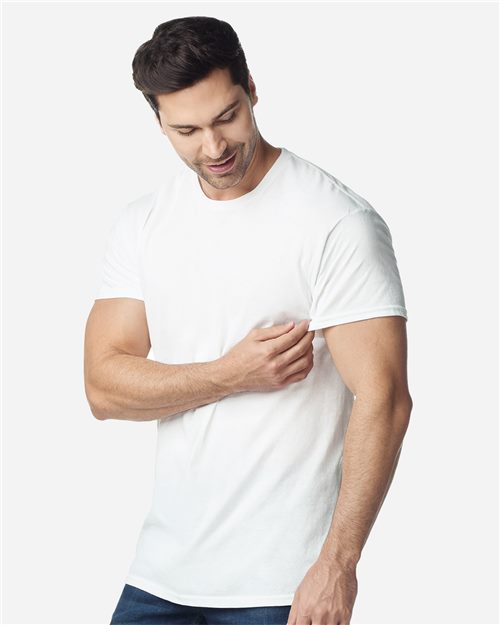
Choosing between the Gildan 3000 and Gildan 64000 is less about finding one universally better shirt and more about matching the blank to the customer, artwork, color plan, and reorder strategy. Both are lightweight, modern-classic unisex tees built for decoration. Their published weights are almost identical. The meaningful differences are the cotton story, blend map, catalog breadth, size ceiling, and the way each style fits into a wholesale apparel program.
The Gildan 3000 Unisex Light Cotton T-Shirt is a 4.45 oz./yd², 30-singles style made with 100% U.S. cotton in its solid cotton colors. Gildan describes its Light Cotton family as remastered for improved printability, quality, and comfort. The Gildan 64000 Unisex Softstyle T-Shirt is a 4.5 oz./yd², 30-singles style whose solid cotton colors use ring-spun cotton. Gildan specifically highlights the 64000’s high stitch density and smooth printing surface.
That 0.05 oz./yd² published weight difference is too small to make weight alone a useful buying rule. The better decision comes from your required colors, extended-size needs, decoration testing, and the type of finished product you want to sell. This guide breaks those factors down without pretending that one heat-press recipe or ink setup works across every color, transfer, press, and production room.
Gildan 3000 vs Gildan 64000 at a glance
| Decision factor | Gildan 3000 Light Cotton | Gildan 64000 Softstyle |
|---|---|---|
| Published fabric weight | 4.45 oz./yd² | 4.5 oz./yd² |
| Published yarn | 30 singles | 30 singles |
| Solid-color cotton story | 100% U.S. cotton | 100% ring-spun cotton |
| Fit | Modern classic fit | Modern classic fit |
| Collar and shoulder construction | Narrow-width rib collar; taped neck and shoulders | Narrow-width rib collar; taped neck and shoulders |
| Label | High-performing recycled tearaway label | Tear-away label |
| Current Beytees catalog colors | 47 listed colors | 72 listed colors |
| Current Beytees catalog sizes | XS through 6XL | XS through 5XL |
| Best starting use case | Lightweight cotton programs that value U.S.-cotton positioning and a 6XL option | Programs that prioritize a ring-spun hand, broad color merchandising, and an established smooth print surface |
Catalog colors and sizes describe the options attached to the live Beytees product records on August 24, 2026. They are not a promise that every size-color combination is in stock at a particular moment. Check the product page before quoting a deadline or accepting a color-critical reorder.
The weight difference is not the real difference
Buyers often treat style comparisons as a weight contest. Here, the published numbers are 4.45 oz./yd² for the 3000 and 4.5 oz./yd² for the 64000. A difference of five-hundredths of an ounce per square yard should not drive a production program by itself. Both belong in the lightweight everyday-tee category, especially when compared with 6.0- to 6.1-ounce heavyweight blanks.
If your client asks for a noticeably heavier shirt, neither style becomes heavyweight simply because one number is slightly larger. Start with our blank T-shirt weight guide and confirm whether the customer actually wants a denser hand, a more structured silhouette, better opacity, or simply a premium-feeling finished garment. Those needs can point to different blanks.
For the 3000 versus 64000 decision, focus on the fabric specification, shade family, size run, and physical samples. A sample tells you how the shirt drapes, how a selected color looks under your lighting, how the collar sits after laundering, and how your actual decoration behaves. A decimal on a spec sheet cannot answer all four questions.
Fabric and blend differences
Gildan 3000 Light Cotton fabric map
The 3000’s solid cotton specification is 100% U.S. cotton at 30 singles. Its published exceptions matter when you decorate blended colors:
- Ash Grey is 99% cotton and 1% polyester.
- Sport Grey is 90% cotton and 10% black polyester.
- Dark Heather, Graphite Heather, and Heather Safety colors are 50% cotton and 50% polyester.
The live product record also notes that Natural is not a dyed fabric, so visible specks can be fibers and cotton seeds rather than a defect. That detail is important for customer expectations. If a buyer expects a perfectly uniform cream surface, show a physical sample before approving the run.
Gildan 64000 Softstyle fabric map
The 64000’s solid cotton specification is 100% ring-spun cotton at 30 singles. Its published blend exceptions are different:
- Antique colors and Sport Grey are 90% cotton and 10% polyester.
- Dark Heather and Heather colors are 65% polyester and 35% cotton.
- Graphite Heather is 50% cotton and 50% polyester.
This means “Gildan 64000” is not one universal fabric recipe across all 72 catalog colors. A solid White 64000 and a heathered 64000 can react differently to heat, moisture, ink, pretreatment, and dye migration. The same principle applies to the 3000. Build your decoration test around the exact style, color, size, and artwork combination you plan to sell.
Hand feel, print surface, and customer positioning
The 64000 has the clearest product-page language for a soft retail-oriented story. Gildan describes its high stitch density, soft ring-spun cotton, and cotton-blend fabric as offering a smooth printing surface. For merch, creator brands, event retail, and customer programs where “soft” is part of the sales pitch, Softstyle is easy for buyers and sales teams to understand.
The 3000 approaches the lightweight category through Gildan’s newer Light Cotton platform. The product copy emphasizes 100% U.S. cotton in solid cotton colors and a remastered fabric intended to improve printability, quality, and comfort. That can suit value-conscious programs that still need a current, modern-classic blank rather than a coarse promotional tee. It also gives sellers a specific U.S.-cotton sourcing statement they can accurately repeat for applicable colors.
Do not turn either description into an unsupported universal claim. “Ring-spun” does not guarantee that every customer will prefer the 64000, and “Light Cotton” does not mean the 3000 is fragile. Order both in the target color, decorate them with the same artwork, launder them using the care instructions you will provide, and let the finished samples settle the subjective part of the decision.
Fit and construction
Both live product descriptions list a modern classic fit, a narrow-width rib collar, and taped neck and shoulders. Those shared construction details make the comparison closer than the branding might suggest. Neither should be sold as an oversized streetwear blank without testing the intended size-up strategy, and neither should be described as a fashion-slim fit based on the style name alone.
The 3000 uses a high-performing recycled tearaway label; the 64000 uses a tear-away label. Tear-away construction helps decorators who want to add a printed neck label or build a more brand-forward package. It does not remove the need to inspect the remaining seam and confirm that your relabeling process meets legal fiber-content, country-of-origin, care, and business-identity requirements.
Size samples are especially useful for group programs. A modern classic unisex fit can cover many customers efficiently, but the final size curve should come from the people or audience you serve. Avoid estimating a school, company, or event size breakdown from intuition alone. Use a try-on set, collect sizes before the order cutoff, and reserve a controlled overage for exchanges.
Color assortment and size range
At the time of this comparison, the live Beytees catalog lists 47 color terms for the 3000 and 72 for the 64000. That gives the 64000 a clear advantage when a merch program depends on a wide assortment, heather storytelling, fan colors, or coordinated seasonal drops. A broader catalog can also reduce the need to switch styles when a customer adds a new campaign color.
The 3000 still covers core commercial shades plus fashion and heather options, and it extends through 6XL in the live catalog. The 64000 currently extends through 5XL. If a 6XL option is essential, the 3000 deserves early consideration. If the campaign needs a specific antique, heather, team, or niche color, the 64000 may offer the cleaner assortment path.
Catalog breadth is only the first filter. Before the client approves a palette, check current stock for every required size. A color that looks strong in a digital swatch can be a poor operational choice if the required size curve is fragmented. For repeat programs, document an approved alternate color and an approved substitute style before an urgent reorder makes the decision for you.
Which is better for DTF printing?
Both styles can support DTF programs, but the correct setup must follow the exact blank and transfer system. For solid cotton colors, both shirts give you a lightweight cotton-dominant base. The 64000 adds a ring-spun, high-stitch-density surface that Gildan explicitly positions for smooth printing. The 3000 is likewise marketed for improved printability within the Light Cotton family.
The biggest DTF variable is often not “3000 or 64000”; it is solid cotton or heather blend. Polyester-rich heather colors can behave differently under heat and can raise dye-migration or scorching concerns. The 64000’s general heather composition is 65% polyester and 35% cotton, while several 3000 heather and safety colors are 50/50. Those are meaningful differences. Run a decorated sample on the exact color, allow the print to cool as required by the transfer supplier, complete any required second press, then inspect it again after curing and laundering.
Use the transfer manufacturer’s current time, temperature, pressure, peel, and repress instructions as your starting point. Confirm platen accuracy, protect seams from uneven pressure, and avoid copying a universal setting from an article or another shop. Our guide to wholesale blank T-shirts for DTF printing explains the wider selection process.
Practical DTF test sequence
- Choose the exact style, color, and size that will represent production.
- Record the garment’s fiber blend instead of assuming all colors match.
- Verify the press surface and temperature with appropriate calibration tools.
- Use the transfer supplier’s instructions for the specific film, powder, ink, and artwork.
- Place the test artwork where seams and collars will not distort pressure.
- Inspect color shift, gloss, edge adhesion, stretch response, and visible press marks.
- Launder the sample according to the care plan you will give the customer.
- Approve the production recipe only after the post-wash result passes.
Which is better for screen printing?
The 64000 is the familiar choice when a shop wants a soft ring-spun surface with high stitch density, particularly for detailed retail graphics and soft-hand ink strategies. The 3000 is a compelling lightweight alternative when the U.S.-cotton statement, 6XL size, or Light Cotton program fits the customer better. Both can handle screen-print work when the mesh, ink, cure, underbase, artwork, and garment color are properly matched.
Again, heathers deserve their own test. Polyester content can affect ink selection, cure strategy, and migration risk. A production approval on a solid Black sample does not automatically approve Dark Heather or a safety shade. Separate test records by style and color family. If a campaign includes multiple fabric blends, plan the screens, ink systems, and quality checks before the first full run.
For broader blank-selection guidance, see our wholesale screen-printing blank guide. If you are comparing the 64000 with a more traditional, heavier open-end cotton option, our Gildan 5000 versus 64000 comparison addresses that different decision.
Best use cases for the Gildan 3000
- Broad unisex programs needing 6XL: the live catalog’s extended size ceiling can simplify inclusivity.
- Lightweight cotton campaigns: solid cotton colors use 100% U.S. cotton at 30 singles.
- High-volume decorated basics: the modern classic fit, taped shoulders, narrow collar, and tearaway label support repeatable programs.
- Programs that want a newer product story: the Light Cotton platform gives sellers a distinct comfort and printability narrative.
- Core-color uniforms or promotions: when the required palette is already covered, 47 catalog colors may be more than enough.
Best use cases for the Gildan 64000
- Retail and merch programs: Softstyle’s ring-spun cotton and smooth-surface positioning are easy to communicate.
- Color-heavy collections: the live 72-color catalog supports more themed, heather, fan, and seasonal directions.
- Detailed print programs: Gildan specifically highlights the style’s high stitch density and smooth printing surface.
- Established repeat orders: many decorators already know the 64000, which can reduce sampling friction when the client has approved it before.
- Soft-hand brand positioning: the Softstyle name aligns naturally with comfort-focused product copy.
Wholesale buying and quoting controls
A strong blank choice can still become an unprofitable job if the quote ignores operational details. Price the whole decorated program, not only the base shirt. Include extended-size upcharges, color-count or transfer costs, sample time, art cleanup, personalization, relabeling, folding, packaging, freight, spoilage allowance, and deadline risk.
For each quote, lock these fields:
- Exact style number and product title
- Approved colors and alternate colors
- Size curve, including extended-size quantities
- Decoration method and artwork revision
- Placement dimensions by garment size group
- Finished-sample approval date
- Inventory reservation or purchase deadline
- Pack-out, labeling, and shipping requirements
- Reorder substitution policy
If you are building your first apparel line, our custom apparel business guide covers assortment and inventory planning in more depth.
A simple decision framework
Start with the non-negotiable constraint. If the program needs 6XL and the current 64000 catalog stops at 5XL, test the 3000 first. If the program depends on a specific Softstyle heather or fan color unavailable in the 3000 assortment, test the 64000 first. If neither assortment nor size range decides it, order samples in the actual campaign color.
Decorate both samples with the same artwork and production method. Show the finished garments to the buyer without overselling one. Compare hand feel, drape, opacity, collar appearance, print detail, wash result, and total decorated cost. Then record the approved style, color, and recipe. That small approval process is more reliable than choosing from marketing names alone.
Final verdict: Gildan 3000 or 64000?
Choose the Gildan 3000 when your program values the Light Cotton platform, 100% U.S. cotton in applicable solid colors, an available 6XL size, and a focused but substantial color range. It is a practical lightweight blank for uniforms, promotions, team programs, and decorated basics.
Choose the Gildan 64000 when the ring-spun Softstyle story, broader color catalog, high stitch density, and familiar smooth print surface are the stronger selling points. It is especially attractive for merch and retail programs where softness and color variety help define the finished product.
For many shops, the correct answer is to stock neither blindly. Keep approved samples, quote from live availability, and assign each customer program its own documented blank. Browse the live Gildan 3000 and Gildan 64000 product pages to compare current options before ordering.
Frequently asked questions
Is the Gildan 3000 heavier than the Gildan 64000?
No. The published 3000 weight is 4.45 oz./yd², while the 64000 is 4.5 oz./yd². The 64000 is nominally 0.05 oz./yd² heavier, but that difference is too small to classify the shirts differently. Both are lightweight tees.
Is the Gildan 3000 ring-spun cotton?
The live 3000 product specification says 100% U.S. cotton and 30 singles for applicable solid colors. It does not make the same ring-spun claim shown on the 64000 product record. Use the published specification rather than assuming the yarn process.
Is the Gildan 64000 always 100% cotton?
No. Solid cotton colors are listed as 100% ring-spun cotton, but Antique colors, Sport Grey, Dark Heather, other Heather colors, and Graphite Heather use published cotton-polyester blends. Check the exact color before decoration.
Which style has more colors?
The live Beytees catalog listed 72 color terms for the 64000 and 47 for the 3000 on August 24, 2026. Catalog options can change, and a listed color does not guarantee every size is currently available.
Which style offers the larger size?
The current Beytees catalog lists the 3000 through 6XL and the 64000 through 5XL. Verify live stock in the required color before promising an extended-size order.
Which is softer, the Gildan 3000 or 64000?
The 64000 is explicitly positioned as Softstyle and uses ring-spun cotton in applicable solid colors. The 3000 is positioned as remastered Light Cotton for comfort and printability. Softness is subjective, so compare finished samples in the actual campaign colors.
Which is better for DTF printing?
Both can work for DTF. The exact color blend matters as much as the style number. Test the transfer supplier’s recipe on the production color, especially for polyester-rich heathers, then inspect and launder the sample before approval.
Which is better for screen printing?
The 64000 has an explicit high-stitch-density, smooth-printing-surface claim, while the 3000 is marketed for improved printability. Either can be effective when the ink, screen, cure, artwork, and fabric color are tested together.
Do both shirts have tear-away labels?
Yes. The 3000 lists a high-performing recycled tearaway label, and the 64000 lists a tear-away label. Decorators must still follow applicable labeling rules when relabeling.
Do both shirts have the same fit?
Both live descriptions call the fit modern classic and list narrow-width rib collars plus taped necks and shoulders. Always use current samples and size data for customer-facing fit decisions.
Can one press setting be used for every color?
Do not assume so. Fiber blends vary by color, and transfer systems vary by manufacturer. Follow the transfer supplier’s instructions, calibrate the press, and test each meaningful style-color family before production.
Which shirt is best for a new clothing brand?
The 64000 is a strong candidate when softness and color variety lead the brand story. The 3000 is a strong candidate when the Light Cotton story, U.S.-cotton specification for applicable solids, or 6XL option matters more. Decorated sample testing should make the final decision.
Leave a Reply