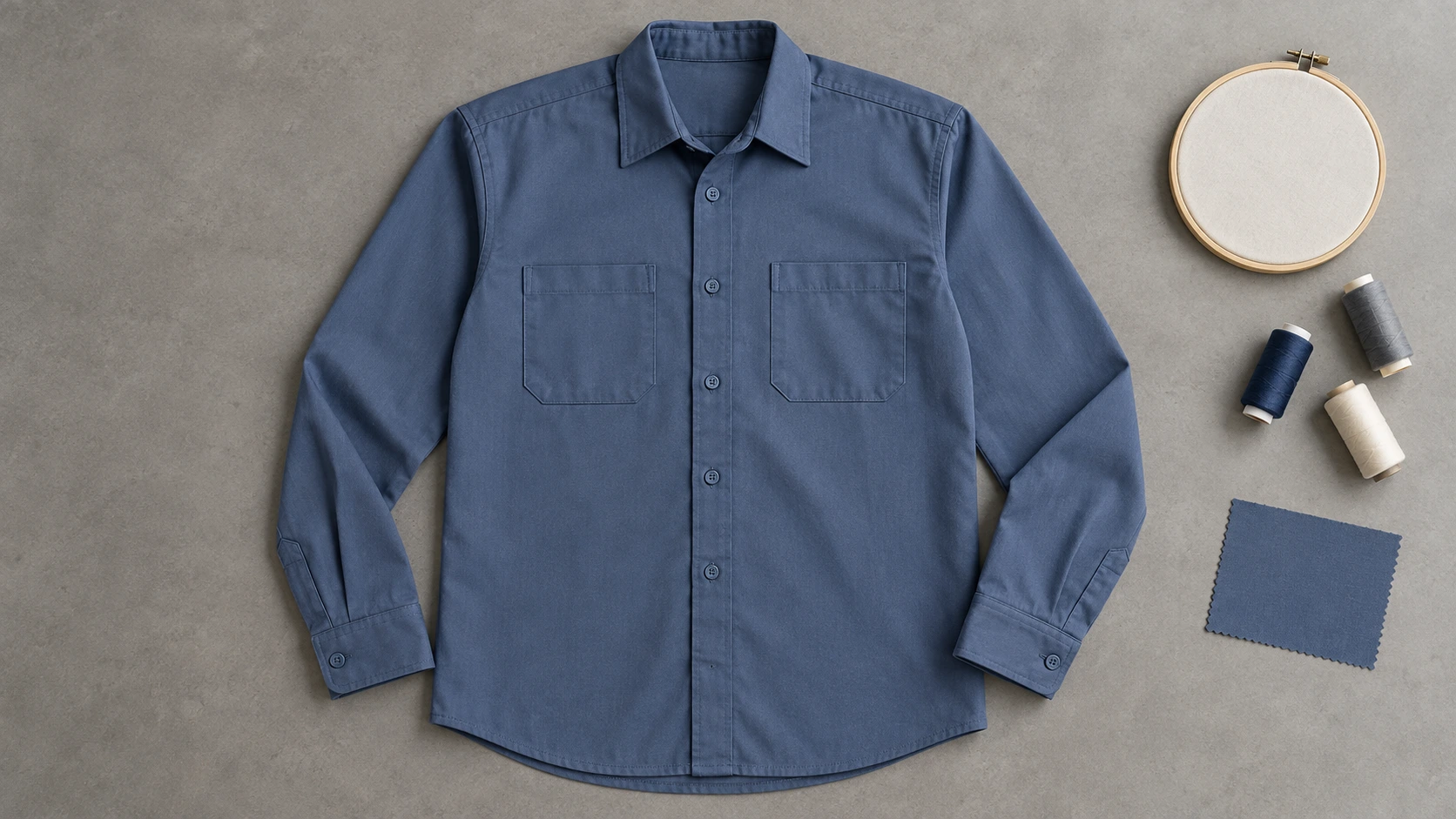
The Red Kap SP14 is a practical starting point when a uniform program needs a long-sleeve, collared work shirt with two chest pockets and a 65/35 polyester/cotton poplin base. Buyers still need to approve the exact pattern, color, size, logo placement, decoration process, and care result before a bulk rollout. The two biggest planning issues are that the published fabric weight changes for microcheck options and that the pockets, pencil stall, buttons, bartacks, placket, and collar limit uninterrupted decoration space.
This Red Kap SP14 wholesale guide is for uniform buyers, embroidery shops, service businesses, facilities teams, maintenance programs, and branded-apparel planners. It uses current seller and manufacturer facts, then turns them into a test-first buying workflow. It does not promise price, stock, delivery timing, fit, safety performance, or a universal decoration result.
Key Takeaways for Red Kap SP14 Wholesale Buyers
- Know the variation: Beytees lists solids and striped options at 4.25 oz/yd² and microcheck options at 3.75 oz/yd². All are listed as 65% polyester and 35% cotton.
- Plan around the chest: Two button-through pockets, angled bartacks, and a pencil stall on the left pocket reduce clean logo space.
- Lead with embroidery, not assumptions: A compact company mark or name can fit the uniform brief, but the decorator must choose backing, hooping, digitizing, and placement after testing the exact garment.
- Test heat-based methods: Polyester blends can show dye migration during screen or heat printing. No reviewed source supplies a universal SP14 screen-print, heat-transfer, or DTF recipe.
- Separate catalog labels from inventory: A listed size or color is not proof that a particular variation is currently orderable.
- Keep safety requirements separate: The evidence reviewed for the standard SP14 does not establish flame resistance, an ANSI high-visibility rating, an arc rating, or PPE suitability.
Verified Red Kap SP14 Specifications
Beytees lists the Red Kap SP14 Men’s Industrial Long Sleeve Work Shirt. For exact solid-style construction, Red Kap’s manufacturer page for the SP14 solid provides the narrowest reliable specification set. Pattern families must still be checked individually because Beytees publishes a different weight for microchecks.
| Buying factor | Verified detail | Decision impact |
|---|---|---|
| Solid and stripe fabric | 4.25 oz/yd², 65/35 polyester/cotton | Use the exact selected option for fit and decoration approval |
| Microcheck fabric | 3.75 oz/yd², 65/35 polyester/cotton | Do not assume every SP14 option has the same weight or hand |
| Reviewed solid collar | Two-piece lined collar with sewn-in stays | Keep hooping and press fixtures clear of the collar structure |
| Reviewed solid closure | Six buttons plus a gripper at the neck | Avoid pressing or stitching over the placket and hardware |
| Chest storage | Two button-through hex-style pockets with angled bartacks; left pocket has a bartacked pencil stall | Confirm logo field and pocket function on a physical sample |
| Finish language | Red Kap lists wrinkle resistance and Touchtex Technology; Beytees lists soil-release and wicking finish | Treat these as attributed product descriptions, not performance guarantees |
| Care for reviewed solid | Machine wash warm; do not bleach; tumble dry medium; iron medium; do not dry clean | Follow the sewn-in label first and add decorator-specific care instructions |
| Related styles | Beytees points to SP14T for tall sizes and SP14E for enhanced visibility | Do not treat those separate styles as features of the standard SP14 |
Red Kap describes the reviewed solid as industrial-laundry friendly and imported. It also attributes breathable comfort, lasting colors, and stain resistance to Touchtex Technology. Those phrases should stay attributed to the manufacturer. They do not support calling the shirt stain-proof, fade-proof, cooling, no-iron, or guaranteed for a fixed number of washes.
Solid, Stripe, or Microcheck: Verify the Exact Fabric
The SP14 name covers more than one visual option. Beytees publishes the solid and striped group at 4.25 oz/yd², while microcheck colors are listed at 3.75 oz/yd². The fiber ratio remains 65/35 polyester/cotton, but weight can affect hand, drape, perceived structure, hooping, and the way a finished logo feels on the garment.
For a uniform program, approve the exact production variation rather than a substitute that merely shares the style number. A solid sample does not prove how a microcheck will look after embroidery. A light pattern does not prove how a darker color will respond to heat. Record the pattern name, color label, size, decoration method, and approval sample together so a reorder is based on the same specification.
The live Beytees selector displayed size labels from S through 6XL and multiple color labels at the research check. Those labels show catalog taxonomy, not body measurements, current stock, or guaranteed purchasing eligibility. Recheck the selected combination and obtain current measurements before promising a roster match.
Collar, Placket, Pockets, and Logo Placement
The SP14’s work-shirt identity comes from its structured collar, button front, and two chest pockets. Those same details create placement constraints. A decorator cannot treat the front like an uninterrupted T-shirt panel.
Left-chest embroidery
The left pocket includes a pencil stall and bartacking. A logo placed above, beside, or on the pocket must preserve the intended pocket function and avoid thick intersections. The correct field depends on the actual logo shape, wearer size, pocket position, and machine access. Do not publish or reuse one universal placement dimension across every size.
Right-chest names and marks
The right pocket can support a name or compact mark in some programs, but its button, bartacks, pocket edge, and placket still need clearance. Check visual balance against the opposite pocket and confirm that hooping does not sew through an unintended layer.
Sleeves and back
Sleeve decoration must account for cuff construction and sleeve seams. A back design has more area, but a buyer should still test how the woven fabric, yoke area, garment size, and artwork density interact. If a large front graphic is central to the brief, a two-pocket work shirt may be the wrong canvas.
Fit and Size Planning Without Guesswork
No sufficiently reliable body-measurement chart or fit instruction for the exact seller assortment was verified for this article. That means buyers should not label the SP14 true to size, relaxed, tailored, roomy, or equivalent across every pattern and size.
Build the roster with current garment measurements or physical samples. Fit-test representative wearers across the size range that matters to the program, including people who work seated, reach overhead, layer underneath, or need full sleeve movement. Record the approved labeled size for each wearer rather than prescribing a generic size-up or size-down rule.
If the program requires measured tall coverage, evaluate the separate tall reference rather than assuming the standard SP14 includes the same body and sleeve proportions. Beytees points to SP14T, while SanMar catalogs a separate SP14LONG companion style. Neither is the standard SP14 reviewed here, and SanMar’s IL50 statement belongs to SP14LONG; it must not be transferred to the standard SP14. SP14E is also a separate enhanced-visibility reference, not a feature of SP14.
If the program needs a polo, tee, short sleeve, women’s-specific silhouette, or fewer chest conflicts, compare a purpose-built alternative. Beytees’ wholesale blank work shirt guide, corporate embroidery polo guide, and wholesale blank Henley guide provide category-level comparison paths.
Embroidery Planning for the SP14
Embroidery is the strongest editorial starting point for compact company logos, technician names, departments, or service identifiers. It is not a one-setting process. The operator needs the exact shirt, exact color or pattern, final artwork, intended location, and expected care process.
Let the operator choose backing and hooping
Madeira’s backing guidance says selection depends on fabric stability, stitch density, material color, stitch length and speed, design size, and expected laundering. It identifies tear-away as a general option for stable woven fabrics and adhesive tear-away as useful for pockets and other hard-to-hoop items. That is process guidance, not an SP14-specific prescription. The embroidery operator should choose the backing after handling the selected variation.
Protect pocket function
Decide whether a pocket must remain fully usable before digitizing. If the design sits on a pocket, isolate the intended fabric layer and confirm that the machine does not close the pocket or cross the pencil stall. If the design sits above a pocket, check clearance at the smallest approved garment size, where the available field may be tighter.
Approve the sewn result
Inspect registration, edge definition, puckering, stiffness, backing visibility, thread show-through, pocket access, and wearer comfort. Then launder the sample through the intended real-world care process. Retain the approved garment and production notes for reorder control. Do not assume a logo that works on one pattern will behave identically on another.
Screen Print, Heat Transfer, and Guarded DTF Planning
The 65% polyester content makes heat and color testing important. Transfer Express explains that polyester and polyester blends can experience dye migration during screen printing and heat printing, and that outcomes vary by garment brand and color. Migration may not be visible immediately, so production approval should include an appropriate observation window.
The reviewed Red Kap and Beytees pages do not provide a universal SP14 screen-print, transfer, or DTF recipe. Follow the ink or transfer supplier’s validated settings for the exact system, then test the exact garment and color. Check adhesion, opacity, edge lift, press marks, discoloration, migration, hand, seam interaction, and laundering.
Use a platen or fixture that keeps pressure away from buttons, the neck gripper, seams, bartacks, and layered pocket construction. Never press directly over hardware. A large front design may be impractical because the placket and pockets divide the surface. For DTF specifically, treat the method as a test-led option, not guaranteed compatibility.
When the SP14 Fits a Uniform Program
| Program need | Start with SP14 when… | Reconsider when… |
|---|---|---|
| Industrial or service look | A long-sleeve collared shirt with two chest pockets matches the role | The brief calls for a polo, tee, short sleeve, or women’s-specific silhouette |
| Compact embroidery | The decorator can engineer placement around pockets and hardware | A large uninterrupted front graphic is essential |
| Care workflow | The selected variation and decorated sample pass the intended wash process | The buyer cannot run a representative sample and wash approval |
| Safety requirement | No protective standard is being inferred from the standard SP14 | Flame resistance, enhanced visibility, arc rating, or another PPE property is mandatory |
| Layered uniform | The shirt has been fit-tested with the actual base layer and movement needs | The program requires unverified fit claims or assumes a tall style is included |
For cooler or outdoor programs, use Beytees’ wholesale workwear jacket guide to plan the outer layer separately. The jacket and shirt should be tested together so collar, sleeve, embroidery, and movement decisions work as one uniform system.
Sample, Wash, and Reorder Checklist
- Confirm standard SP14 versus a separate tall or enhanced-visibility style.
- Record the exact pattern, color label, size label, and published fabric weight.
- Obtain current measurements or physical samples for representative wearers.
- Map the collar, placket, neck gripper, buttons, pockets, bartacks, pencil stall, cuffs, and seams.
- Approve artwork scale and placement on the smallest and largest relevant sizes.
- Decorate the exact production variation with the intended machine, backing, ink, or transfer system.
- Inspect appearance, pocket function, stiffness, press effects, migration risk, and wearer comfort.
- Follow the sewn-in care label and the decorator’s post-decoration care instructions.
- Launder the finished sample using the intended process and document the result.
- Retain an approved sample and complete production notes before a reorder.
Frequently Asked Questions
What fabric is the Red Kap SP14 made from?
Beytees lists the SP14 as 65% polyester and 35% cotton. Solids and striped options are published at 4.25 oz/yd², while microcheck options are published at 3.75 oz/yd². Confirm the exact selected variation before approval.
Are every SP14 color and pattern the same fabric weight?
No. Beytees lists solids and stripes at 4.25 oz/yd² and microchecks at 3.75 oz/yd². The shared style number does not make every option identical in weight or decoration behavior.
Is the Red Kap SP14 suitable for embroidery?
It can be evaluated for compact uniform embroidery, but no reviewed source guarantees one result for every logo, pattern, or location. A qualified operator should select digitizing, backing, hooping, and placement after testing the exact garment.
Where can a logo be placed around the SP14 chest pockets?
Possible areas include above, beside, or on a pocket, depending on logo shape, garment size, hardware, and machine access. Preserve pocket and pencil-stall function, avoid bartacks and buttons, and approve placement on a physical sample rather than relying on a universal measurement.
Can the Red Kap SP14 be screen printed or decorated with DTF?
Only as a test-led production decision. The reviewed sources do not provide an SP14-specific screen-print or DTF recipe, and the polyester blend can present dye-migration risk. Use supplier-validated settings and test the exact color and garment.
What sizes does Beytees list for the Red Kap SP14?
The seller selector displayed size labels S through 6XL at the research check. Selector labels are not body measurements or a stock promise. Recheck the exact variation and use current measurements or samples for roster planning.
How should the Red Kap SP14 be washed after decoration?
For the reviewed solid, Red Kap publishes machine wash warm, do not bleach, tumble dry medium, iron medium heat, and do not dry clean. Follow the sewn-in garment label first, then add any narrower care instruction required by the decoration supplier.
What should uniform buyers test before ordering SP14 shirts in bulk?
Test representative fit, movement, exact fabric variation, logo scale, placement, pocket function, the complete decoration process, finished hand, wash response, and reorder documentation. Approve a production-equivalent sample rather than a different pattern or color.
Final Recommendation
Choose the Red Kap SP14 when the brief specifically needs a long-sleeve industrial work-shirt silhouette, two functional chest pockets, and a 65/35 poly/cotton poplin platform. Reconsider when the program needs a safety-rated garment, a large uninterrupted print field, a different silhouette, or a rollout without representative fit and decoration testing.
Start with the Red Kap SP14 product details at Beytees, then browse Red Kap workwear at Beytees for adjacent uniform options. Confirm the exact variation, fit-test the team, and approve one production-equivalent decorated sample before committing the full program.
Leave a Reply