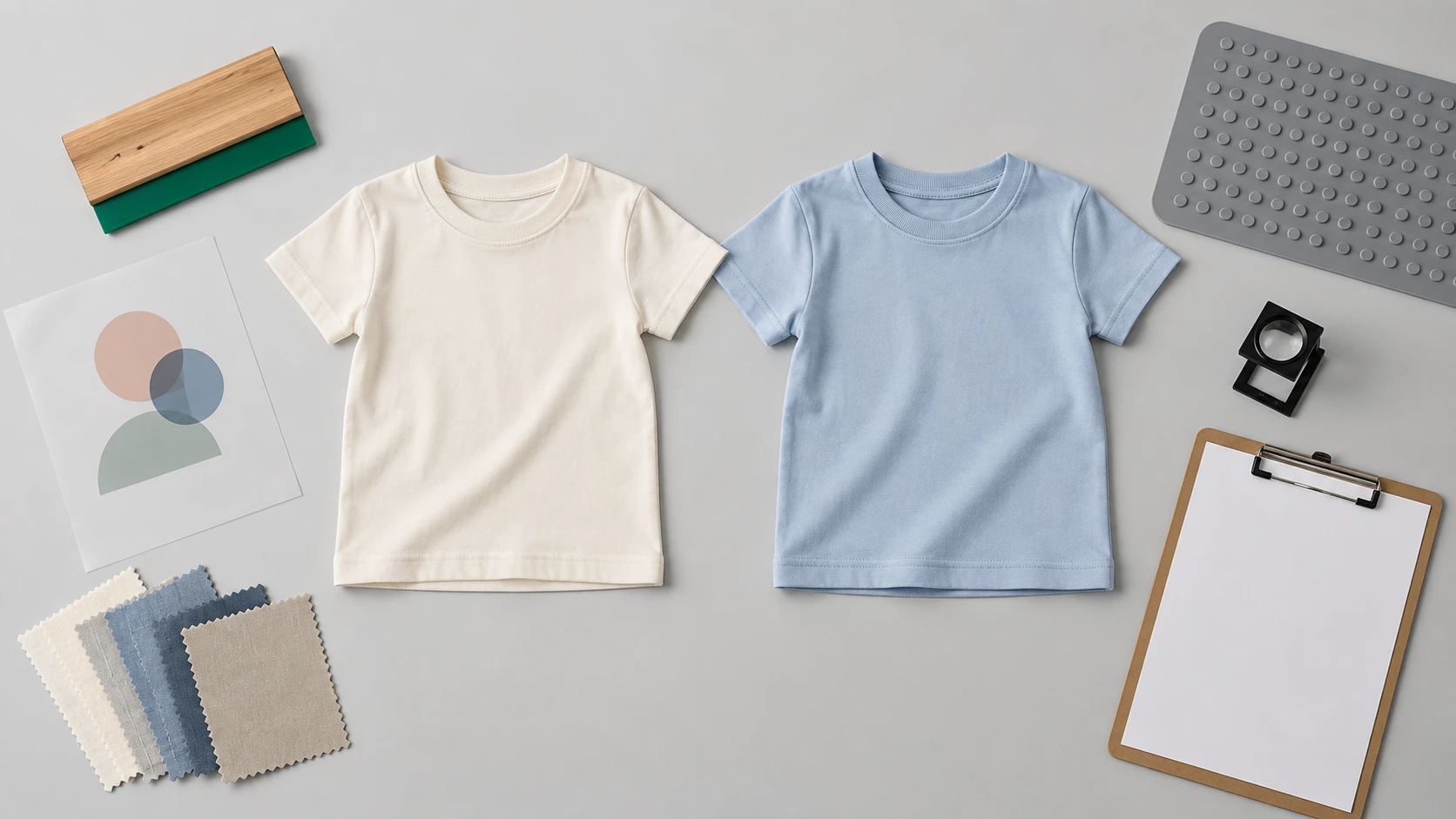
The BELLA + CANVAS 3001B and Rabbit Skins 3401 are both short-sleeve infant jersey tees, but they are not interchangeable blanks. Current manufacturer specifications position the 3001B as a 4.2 oz, 32-singles jersey with color-dependent cotton/polyester blends, while the 3401 is a 5.5 oz cotton jersey with more construction details and several blend exceptions. The better choice depends on the exact color, size system, artwork, decoration process, labeling plan, and finished-garment review.
This BELLA CANVAS 3001B vs Rabbit Skins 3401 comparison separates three kinds of evidence: manufacturer specifications, current Beytees selector data, and operational recommendations for decorators. It does not claim that either style is currently in stock, safer, certified as a finished decorated garment, true to size, or guaranteed for any print method.
Quick Answer: Which Infant Tee Should You Choose?
Choose the 3001B for evaluation when the brief calls for the manufacturer’s published 4.2 oz, 32-singles jersey, side seams, crew neck, tear-away label, and the specific color families offered under that style. Choose the 3401 for evaluation when the brief calls for the manufacturer’s published 5.5 oz jersey, rib collar, shoulder-to-shoulder back neck tape, double-needle sleeve and bottom hems, EasyTear™ label, and source-listed tracking label.
Those are specification-based starting points, not promises about softness, opacity, fit, comfort, durability, safety, or print quality. For either style, approve a production-equivalent sample in the exact color and size before buying for a customer program.
- Best first step for a lighter published jersey: sample the 3001B.
- Best first step for a heavier published jersey and more documented construction details: sample the 3401.
- Best choice for a larger selector range: the current Beytees 3401 page displays more color labels, but selectors do not prove inventory.
- Best choice for decoration: whichever exact color and size passes the decorator’s process, wear, wash, attachment, and compliance review.
Review the current BELLA + CANVAS 3001B product page and Rabbit Skins 3401 product page before ordering. At the research check, both public Store API aggregates reported is_in_stock=false. Treat every color and size selector as catalog data only; confirm current price, quantity, availability, and timing separately.
Manufacturer Facts, Beytees Selectors, and Recommendations
A reliable comparison needs clear source boundaries. Product specifications come from the current manufacturer pages. Color and size selector counts come from Beytees’ public catalog. Decoration and purchasing controls below are operational recommendations, not manufacturer guarantees.
| Evidence type | What it supports | What it does not support |
|---|---|---|
| Manufacturer page or technical sheet | Published weight, fiber family, construction, label type, and listed measurements | Current Beytees stock, finished-decoration results, universal fit, or independent certification |
| Beytees product page and Store API | Current catalog identity plus displayed color and size labels | Purchasability, quantity by variation, price continuity, or replenishment timing |
| Operational recommendation | A sample, test, inspection, and documentation workflow | A substitute for supplier instructions, a compliance review, or a production approval |
BELLA + CANVAS 3001B vs Rabbit Skins 3401 Buyer Matrix
| Buying factor | BELLA + CANVAS 3001B | Rabbit Skins 3401 | Buyer action |
|---|---|---|---|
| Published weight | 4.2 oz/yd²; 32 singles | 5.5 oz/yd² cotton jersey | Handle and decorate actual samples; do not infer opacity or durability from weight alone |
| Solid-color fiber | 100% Airlume combed and ring-spun cotton | 100% cotton jersey | Verify the exact color because exceptions apply to both style families |
| Blend exceptions | Heather CVC 52/48 cotton/polyester; Athletic Heather 90/10 | Ash 99/1; Heather 90/10; Granite Heather and CVC groups 60/40 cotton/polyester | Record fiber content by approved color and reopen heat testing when the color family changes |
| Construction | Side-seamed; crew neck; short sleeves | Side seams; rib collar; shoulder-to-shoulder self-fabric back neck tape; double-needle sleeves and bottom hem | Inspect seam bulk, platen contact, neckline clearance, and artwork field on the exact size |
| Removable label wording | Tear-away label | EasyTear™ label | Plan relabeling only after preserving all required permanent information |
| Infant tracking-label wording | No equivalent statement was found in the reviewed manufacturer feature block | Manufacturer and Beytees copy state “CPSIA compliant tracking label” | Do not convert this wording into a claim that the decorated garment or seller is certified |
| Current Beytees selectors | 13 color labels; sizes 3/6, 6/12, 12/18, 18/24 | 27 color labels; sizes 6M, 12M, 18M, 24M | Map labels to the current measurement chart; never assume equivalent age notation means equivalent dimensions |
| Current catalog signal | Store API aggregate reported is_in_stock=false |
Store API aggregate reported is_in_stock=false |
Make no availability promise; verify the exact variation at order time |
The BELLA+CANVAS 3001B manufacturer page currently labels the style “New Style Coming Soon” and publishes the fabrication and construction above. The LAT Apparel 3401 manufacturer page publishes the 3401 construction, blend exceptions, care language, measurements, and print-area data. Neither source establishes Beytees inventory.
How to Compare Sizes and Colors Without Guessing Fit
The current Beytees 3001B selector displays four size labels: 3/6, 6/12, 12/18, and 18/24. Its 13 displayed color labels span solid and heather families. The current 3401 selector displays 6M, 12M, 18M, and 24M across 27 color labels. These counts describe the catalog interface at the research check, not available units.
The manufacturer size systems are not identical. The current BELLA+CANVAS 3001B measurement sheet lists 0–3 through 18–24, while the current Beytees selector begins at 3/6. The 3401 manufacturer page lists 6M through 24M and publishes body length, width, and sleeve length. Because age labels and dimensions can change, compare garment measurements rather than matching size names across brands.
| Size-planning step | Why it matters |
|---|---|
| Download the current manufacturer chart | Archived or distributor charts can differ from the current source |
| Measure a received blank | Published tolerances and production variation can affect placement |
| Test smallest and largest approved sizes | A design that clears seams on one size may crowd the neckline or hem on another |
| Keep brand-specific size mapping | 3/6 is not automatically the same finished garment as 6M |
If the program needs a bodysuit rather than a tee, compare the wholesale infant bodysuit guide and the Rabbit Skins 4400 versus 4424 comparison. For the next age range, the toddler tee comparison addresses different garments and should not be used as an infant sizing chart.
DTF, Screen Print, and Embroidery Testing
The manufacturer specifications support sampling, not a universal print recipe. BELLA+CANVAS’ printing recommendations say transfer pressure, temperature, and dwell vary by transfer system and should begin with the transfer manufacturer’s instructions. They also describe DTF as broadly comparable across the company’s fabrications and styles while requiring independent testing for production variables.
DTF and other heat-applied transfers
Use the transfer supplier’s instructions, calibrated equipment, and the exact garment variation. Test adhesion, edge lift, press marks, discoloration, fabric distortion, hand, opacity, and laundering. Polyester-containing heathers need color-specific migration review after the observation period recommended by the ink or transfer supplier. Do not apply a setting proven on a solid cotton sample to a heather blend without retesting.
Screen printing
Build the ink, underbase, flash, and cure plan around the actual fiber content and artwork. The small infant print field raises the cost of poor alignment: a few misplaced inches can crowd the collar, sleeve seam, or hem. Approve registration and cure on the smallest production size, then verify that the same art scale still works on larger sizes.
Embroidery
Embroidery should be treated as a separate engineered sample. Infant jersey is a small, flexible substrate; a dense or large design can distort the garment or produce an unacceptably stiff interior. Let the embroidery operator select digitizing, stitch count, needle, thread, backing, and placement. Inspect both sides of the finished sample and reject exposed roughness, loose threads, puckering, insecure components, or excess stiffness.
Infant-Garment Safety and Compliance Controls
Infant apparel is a children’s product category, so decoration can create obligations beyond print quality. The federal children’s-product definition in 16 CFR Part 1200 explains that intended use, marketing, common recognition, and age-determination guidance are considered together. This article is not a legal determination, testing report, or Children’s Product Certificate.
- Do not add loose stones, buttons, patches, charms, or other detachable embellishments without a qualified product-safety review.
- Keep decoration flat and secure; reject peeling edges, sharp surfaces, loose threads, exposed backing, or stiff components that fail the approved finished-garment standard.
- Preserve lot, source, and production records for the exact blank and decoration inputs.
- Do not remove or cover tracking, fiber, origin, business-identity, or care information without confirming the replacement-label requirements.
- Review the finished decorated garment—not only the undecorated blank—against the rules that apply to the business and product.
The 3401 source’s “CPSIA compliant tracking label” wording is useful catalog evidence about that blank’s stated label. It does not prove that every variation is available, that a decorator’s changes preserve compliance, or that the finished item has been independently verified. The FTC’s textile labeling guidance explains that most textile products need fiber content, country of origin, and responsible-business identification, with separate care-label requirements. Consult qualified compliance support for the actual finished product and sales channel.
A Practical Sample-to-Bulk Buyer Workflow
- Write the brief: define garment type, audience, exact artwork, decoration method, size range, color family, label plan, quantity, and deadline.
- Freeze the source facts: save the current manufacturer page, measurement chart, Beytees selector labels, and garment-label photographs for each candidate.
- Order representative samples: include the smallest and largest planned sizes plus every distinct fiber/color family.
- Measure the blanks: record body width, length, sleeve area, collar clearance, seam positions, and usable decoration field.
- Decorate production-equivalent units: use the same equipment, consumables, artwork, operator controls, and planned placement as production.
- Inspect the finished garment: check the front, reverse, interior contact surface, seams, label information, attachment security, distortion, press marks, migration, and print edges.
- Run care tests: follow the garment label and compatible decoration-supplier instructions; document appearance and attachment changes.
- Complete the compliance gate: confirm the business’s testing, certification, tracking, labeling, recordkeeping, and sales-channel duties for the finished product.
- Approve one controlled specification: retain the signed sample, color, size, blank lot, artwork, placement, process settings, consumables, and inspection criteria.
- Recheck the order: confirm current variation availability, price, quantity, shipping, and ETA before promising a customer date.
For timing context, use the Beytees wholesale shipping guide, then treat the live cart or order confirmation as authoritative. Blank transit time is not finished-merch turnaround; sampling, decoration, inspection, and any compliance work need their own schedule.
Frequently Asked Questions
What is the main difference between the BELLA + CANVAS 3001B and Rabbit Skins 3401?
The clearest published difference is the garment specification: the 3001B is listed at 4.2 oz and 32 singles, while the 3401 is listed at 5.5 oz with a rib collar, back neck tape, and double-needle sleeve and bottom hems. Those facts do not establish fit, comfort, durability, or print quality.
Which size labels are shown for the 3001B and 3401 at Beytees?
The current 3001B selector shows 3/6, 6/12, 12/18, and 18/24. The current 3401 selector shows 6M, 12M, 18M, and 24M. Compare current garment measurements; do not assume the different age-label systems are dimensionally equivalent.
Are the 3001B and 3401 always 100% cotton?
No. Each style has color-dependent exceptions. The 3001B manufacturer lists Heather CVC at 52/48 cotton/polyester and Athletic Heather at 90/10. The 3401 manufacturer lists Ash, Heather, Granite Heather, and CVC groups with different cotton/polyester ratios.
Which infant tee is better for DTF?
Neither can be declared universally better from specifications alone. Test the exact color, fiber blend, size, transfer, equipment, and placement for adhesion, migration, press marks, hand, distortion, secure edges, and care performance.
Can both infant tees be screen printed?
Both can be evaluated for screen printing. The decorator should match the ink and cure system to the exact substrate, keep artwork within the small usable field, and approve a production-equivalent sample rather than relying on one generic recipe.
Can the 3001B or 3401 be embroidered?
Embroidery can be sampled, but use a compact design engineered for the exact jersey. Review the front and interior for puckering, stiffness, loose threads, rough backing, insecure elements, and care performance before approving the finished infant garment.
Does the 3401 tracking-label wording certify the finished decorated shirt?
No. The source states that the blank has a “CPSIA compliant tracking label.” That statement is not independent verification of the decorated product and does not replace the responsible business’s finished-product testing, certification, labeling, tracking, and recordkeeping review.
What should buyers test before a bulk infant tee order?
Test current measurements, size mapping, exact color and fiber content, artwork scale, placement, decoration settings, migration, attachment security, surface and interior feel, laundering, required labels, tracking records, and finished-product compliance. Verify availability and order economics separately.
Final Recommendation
There is no responsible universal winner in the BELLA CANVAS 3001B vs Rabbit Skins 3401 decision. Start with the 3001B when its lighter published jersey, 32-singles fabrication, and listed construction fit the brief. Start with the 3401 when its heavier published jersey, documented collar and seam construction, EasyTear label, and source-listed tracking label fit the brief.
Then make the real decision with controlled samples. Match brand-specific measurements, test every production fiber/color family, inspect the finished infant garment inside and out, preserve required label and tracking information, and complete the applicable compliance gate before a bulk commitment. That process—not a selector count or a style-name shortcut—is what turns either blank into a defensible custom-printing choice.
Leave a Reply