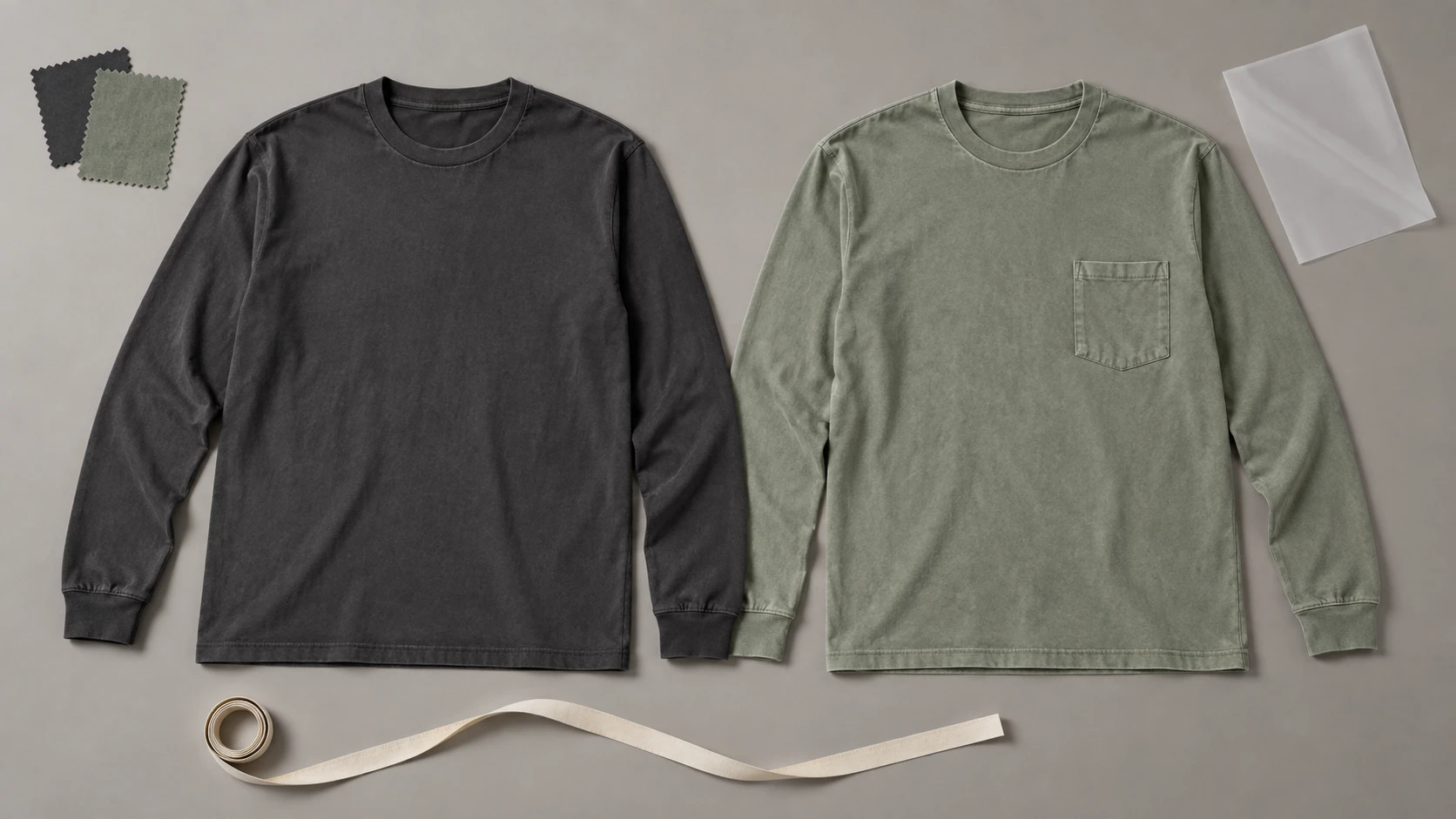
Quick answer: the Gildan 5400 vs Comfort Colors 4410 decision is a no-pocket, 5.3 oz/yd² classic-fit long sleeve versus a pocketed, 6.1 oz/yd² garment-dyed relaxed-fit long sleeve. Sample the Gildan 5400 first when the artwork needs an uninterrupted chest field, the brief calls for the lighter published fabric weight, or a tear-away label is important. Sample the Comfort Colors 4410 first when a functional left-chest pocket, garment-dyed character, a seamless body, or a signature twill label is part of the product concept.
Verdict: for an artwork-led full-front program, the Gildan 5400 is the more direct first sample because its reviewed construction has no listed chest pocket. For a pocket-led merchandise concept, the Comfort Colors 4410 is the purposeful first sample. Test both if fit, shade, print-zone geometry, decoration behavior, labeling, or current commercial terms could change the decision.
Gildan 5400 vs Comfort Colors 4410: Source-Aware Comparison
Start with the current Gildan 5400 Beytees product page and Comfort Colors 4410 Beytees product page. Compare those seller records with the official Gildan G5400 page and official Comfort Colors 4410 page. The received garment, sewn labels, exact color, and production-equivalent sample remain the controlling evidence.
| Buying factor | Gildan 5400 | Comfort Colors 4410 | Buyer action |
|---|---|---|---|
| Chest construction | No chest pocket is listed in the reviewed manufacturer or Beytees feature sets | Left-chest pocket | Choose by intended product and artwork field; confirm the received sample |
| Published area weight | 5.3 oz/yd² | 6.1 oz/yd² | Use the 0.8 oz/yd² difference for sample planning, not to infer finished weight, comfort, warmth, durability, or print quality |
| Primary fiber statement | Solids: 100% U.S. cotton; color-specific blends apply | 100% ring-spun U.S. cotton with cotton threads | Verify the exact color and received label before production |
| Dye or finish | No garment-dyed claim on the reviewed official page | Garment-dyed; current official colors include pigment and direct/reactive groups | Do not call every 4410 color pigment-dyed |
| Fit wording | Classic fit for loose comfort | Relaxed fit | Do not equate size letters, drape, or wearer preference |
| Body and cuffs | Rib collar, taped neck and shoulders, rib cuffs | Seamless body, topstitched rib collar, shoulder-to-shoulder twill tape, rib cuffs | Create model-specific placement references |
| Label | Tear-away label | Signature twill label | Plan compliant replacement labeling before removing required information |
| Current manufacturer size selector | S–3XL | S–3XL | Treat selector entries as mutable assortment signals, not stock promises or equivalent fit |
This page owns only the 5400/4410 decision. The 5400 versus 6014 article and 4410 versus 6014 article answer different comparisons.
Pocket vs No Pocket: Make the Construction Intentional
The 5400 is the no-pocket option: neither reviewed feature list identifies a chest pocket. Its front is uninterrupted by pocket construction, subject to the collar, armholes, hem, garment size, and received sample. Start here when a centered illustration, broad front mark, or flexible chest placement drives the brief.
The 4410 pocket adds function, an opening, extra fabric, seams, and corners. Artwork on or near it needs a measured field and loading method. Do not bridge the opening unless the construction and intended pocket use have been engineered and tested. If the pocket matters, start with the 4410; if it is unnecessary and front art leads, start with the 5400.
5.3 oz Heavy Cotton vs 6.1 oz Garment-Dyed Ring-Spun Cotton
The published area-weight difference is 0.8 oz/yd². Gildan lists the 5400 at 5.3 oz/yd², while Comfort Colors lists the 4410 at 6.1 oz/yd². Area weight does not prove exact finished-garment weight, softness, opacity, warmth, drape, durability, or decoration quality. The blank apparel weight guide provides broader context, but production samples should control this purchase.
Gildan’s official page lists 5400 solids as 100% U.S. cotton, Sport Grey as 90% cotton and 10% polyester, and Safety Colors as 50% cotton and 50% polyester. The current Beytees record adds Ash at 99/1 and identifies Dark Heather and Graphite Heather with the 50/50 group. Treat these as exact-color distinctions and verify the sewn label; a solids process does not automatically approve a polyester-containing color.
Comfort Colors lists the 4410 as 100% ring-spun U.S. cotton with cotton threads. It is garment-dyed, but its current official selector separates 21 pigment-dye colors from four direct/reactive colors. “Every 4410 is pigment-dyed” is therefore inaccurate. Record the selected color, dye group, lot, and received label before qualification.
Comfort Colors’ official care guidance says garment-dyed products should be washed separately before wearing, pigment shades with like colors, and cold water used to reduce staining risk. It also says loose pigment may remain and shade variation is inherent. Its “almost no shrinkage at home” wording is a manufacturer statement, not a shrink-proof guarantee for a decorated finished garment.
Classic vs Relaxed Fit, Current Sizing, and Label Systems
The 5400 is described as classic fit for loose comfort. The 4410 is described as relaxed fit. Shared size letters from S through 3XL do not establish equal body width, length, sleeve geometry, ease, or wearer preference. The 4410 official page publishes style-specific measurements; the reviewed Gildan retail page exposes a generic men’s size-chart image rather than an equivalent exact-style table. Do not manufacture a numerical side-by-side chart from unlike evidence.
Measure received samples with one method, including the smallest and largest planned sizes. Approve fit and artwork by size tier. Use the Gildan 5400 adult and youth guide only if the program later needs a youth branch.
The 5400 has a manufacturer-listed tear-away label. The 4410 has a signature twill label and should not be called tear-away. The FTC’s textile labeling guidance addresses fiber content, country of origin, responsible-business identity, replacement labels, attachment, and records. Its Care Labeling Rule guidance requires a reasonable basis for complete instructions covering the finished garment. A removable label is not permission to sell an unlabeled or incompletely labeled shirt.
Print-Zone Planning for Fronts, Pockets, Backs, and Sleeves
| Zone | Gildan 5400 | Comfort Colors 4410 | Approval requirement |
|---|---|---|---|
| Centered or broad front | No listed pocket interrupts the chest field | Left pocket may intersect the design or loading field | Measure actual art against representative sizes and platen geometry |
| Left chest | Define placement from garment center and collar on the sample | Choose on-pocket, above-pocket, or another intentional relationship | Keep art clear of opening and seam allowances unless specifically tested |
| Back | Pocket does not control the back, but model, size, collar, shoulder, and hem still define the field | Approve the actual back art on smallest and largest planned sizes | |
| Sleeve | Both have rib cuffs; locate sleeve seams and taper on received garments | Use the intended sleeve platen or fixture and a repeatable reference | |
Front and body prints
Build separate templates. Record art dimensions, size tier, collar distance, center reference, platen, and setup. On the 4410, identify any image area over the pocket layer or seam. Never assume a 2XL template fits small.
Pocket-area decoration
Preserve the opening and avoid unstable edges unless testing proves otherwise. Identify every layer under the image and qualify the fixture. For embroidery, test backing, stitch density, distortion, and pocket function.
Back and sleeve decoration
Back and sleeve positions keep the pocket clear but still need measured fields. Sleeve art requires size-specific length, rotation, seam and cuff clearance, equipment access, and a repeatable reference.
Pre-Production Testing: Qualify the Exact Program
Neither reviewed exact-style source provides a universal DTF recipe, wash-life guarantee, migration guarantee, screen-print result, embroidery result, or production-yield promise. Follow current instructions from the transfer, ink, thread, stabilizer, and equipment suppliers. Record model, exact color, fiber or dye group, size, lot, artwork, coverage, batch, equipment, platen or fixture, operator, placement, and date.
DTF and other heat-applied decoration
Do not publish or inherit one time, temperature, pressure, peel, cure, repress, or wash formula. Qualify 5400 cotton and blend groups separately. On the 4410, qualify the selected pigment or direct/reactive color and inspect surface-color response, loose pigment, staining or transfer, press boxes, shine, scorching, adhesion, edge lift, dimensional change, and laundering without predicting the result.
Screen printing and DTG
Gildan lists screen printing for the 5400, which supports testing rather than a guarantee. Qualify ink or pretreatment, underbase, cure, opacity, hand, registration, and laundering. The blank T-shirts for DTF guide is context, not approval.
Embroidery and labels
Test digitizing, backing, stitch density, hooping, distortion, and laundering. On the 4410, preserve pocket function. Complete replacement-label and finished-care plans before removing original information.
Catalog, Stock, Price, Freight, and Lead-Time Caveats
At the research snapshot, the public Beytees 5400 parent exposed 150 variation IDs, 25 color terms, and six size terms. The 4410 parent exposed 174 variation IDs, 29 color terms, and six size terms. Both parent records returned is_in_stock=false. The current Comfort Colors manufacturer selector exposed 25 colors, not the seller’s 29. These are mutable channel signals, not proof of stock, a universal assortment, or a contradiction that can be resolved without exact-variant evidence.
Do not freeze a color count, size-color matrix, price, freight charge, warehouse source, replenishment date, lead time, delivery date, or margin into the order promise. At order time, verify the exact variant, quantity, current availability, landed cost, spoilage allowance, decoration labor, relabeling, packaging, exchanges, and reorder plan. The blank long-sleeve category guide can support discovery, but live checkout and order confirmation remain authoritative.
Strict Two-Model Decision Framework
| Written program brief | First sample | Required gate before bulk |
|---|---|---|
| Uninterrupted front field, 5.3 oz published weight, classic-fit wording, color-specific Heavy Cotton platform, or tear-away label | Gildan 5400 | Approve exact color/fiber label, fit set, print zones, decoration, replacement label, care basis, and live terms |
| Functional left pocket, 6.1 oz ring-spun cotton, garment-dyed character, relaxed seamless body, or signature twill label | Comfort Colors 4410 | Approve exact dye group and lot, fit set, pocket function, print zones, decoration, labels, care basis, and live terms |
| Fit, hand, shade, pocket value, artwork scale, decoration behavior, labeling, reorder matching, or landed economics remains unresolved | Test both | Score production-equivalent samples against one written brief and retain the approved control |
If the pocket is not useful and creates avoidable artwork constraints, the 5400 is the clearer first sample. If the pocket is a functional or visual requirement, the 4410 is the clearer first sample. This is a use-case verdict, not a claim that either shirt is categorically better for print quality, comfort, durability, wash life, or profit.
Sample-to-Production Approval Checklist
- Confirm exact model, color, size, lot, dye or fiber group, and received labels.
- Measure representative smallest and largest sizes with one documented method.
- Approve wearer fit without treating shared size letters as equivalent.
- Map collar, armholes, hem, pocket where present, back field, sleeve seams, cuff, and actual art dimensions.
- Qualify the intended decoration system on every materially different color, fiber, or dye group.
- Inspect immediate appearance, cooled result, pocket function, dimensional response, and supported laundering evidence.
- Complete replacement-label and finished-care controls before production.
- Verify exact-variant availability, cost, freight, lead time, and reorder terms only when ordering.
- Retain the approved garment and process record; reopen testing after a material change.
Frequently Asked Questions
What is the main difference between the Gildan 5400 and Comfort Colors 4410?
The Gildan 5400 is a 5.3 oz/yd² classic-fit long sleeve with no chest pocket listed in the reviewed features and a tear-away label. The Comfort Colors 4410 is a 6.1 oz/yd² garment-dyed relaxed-fit long sleeve with a left-chest pocket, seamless body, and signature twill label.
Which shirt is the no-pocket option?
The Gildan 5400 is the no-pocket option in this comparison because the reviewed official and Beytees feature lists do not identify a chest pocket. Confirm the received sample before freezing artwork or production fixtures.
Which shirt has a left-chest pocket?
The Comfort Colors 4410 has the manufacturer-listed left-chest pocket. Treat the opening, extra fabric, seams, and corners as print-zone constraints, and approve pocket function after decoration.
Which long sleeve has the higher published fabric weight?
The Comfort Colors 4410 has the higher published area weight at 6.1 oz/yd², compared with 5.3 oz/yd² for the Gildan 5400. The 0.8 oz/yd² difference does not prove finished weight, comfort, warmth, durability, or print quality.
How do the fiber and dye programs differ?
The 5400 uses 100% U.S. cotton for solids with color-specific cotton/polyester blends. The 4410 is 100% ring-spun U.S. cotton and garment-dyed, with current pigment and direct/reactive color groups. Verify the exact color, dye or fiber group, lot, and sewn label.
Do classic fit and relaxed fit use equivalent sizing?
No. The 5400’s classic-fit and 4410’s relaxed-fit terms are not equivalent measurement systems. Both current manufacturer selectors show S–3XL, but matching size letters do not prove matching width, length, sleeve geometry, ease, or wearer preference.
Which shirt has a tear-away label?
The Gildan 5400 has the manufacturer-listed tear-away label. The Comfort Colors 4410 has a signature twill label. Any private-label workflow must preserve required textile and care information and applicable records.
Which shirt is better for a full-front print?
The Gildan 5400 is the more direct first sample for a broad full-front print because no chest pocket is listed in its reviewed construction. The 4410 pocket can interrupt the field. Actual art, garment size, platen, placement, and samples must still be approved.
Which shirt is better for DTF or screen printing?
Neither is a universal decoration winner from the reviewed evidence. Follow current transfer, ink, and equipment instructions, then test the exact model, color, fiber or dye group, size, lot, artwork, equipment, and placement before production.
What should decorators test before a bulk long-sleeve order?
Test identity, measurements, wearer fit, front, pocket, back and sleeve fields, exact colors and lots, decoration appearance, shade or migration response where relevant, adhesion or stitch quality, pocket function, laundering, labels, care basis, availability, cost, freight, and reorder controls.
Final Recommendation
Sample the Gildan 5400 first when the design needs an uninterrupted front, the brief calls for the 5.3 oz Heavy Cotton platform, or a tear-away label matters. Sample the Comfort Colors 4410 first when the pocket is part of the product, the brief calls for a 6.1 oz garment-dyed ring-spun cotton shirt, or the relaxed seamless construction and signature twill label are intentional.
Test both whenever fit, shade, pocket value, artwork scale, labels, decoration behavior, reorder matching, or landed economics remains open. Choose the shirt that satisfies the documented program brief and passes the exact pre-production gates; do not name a universal winner from catalog language alone.
Leave a Reply