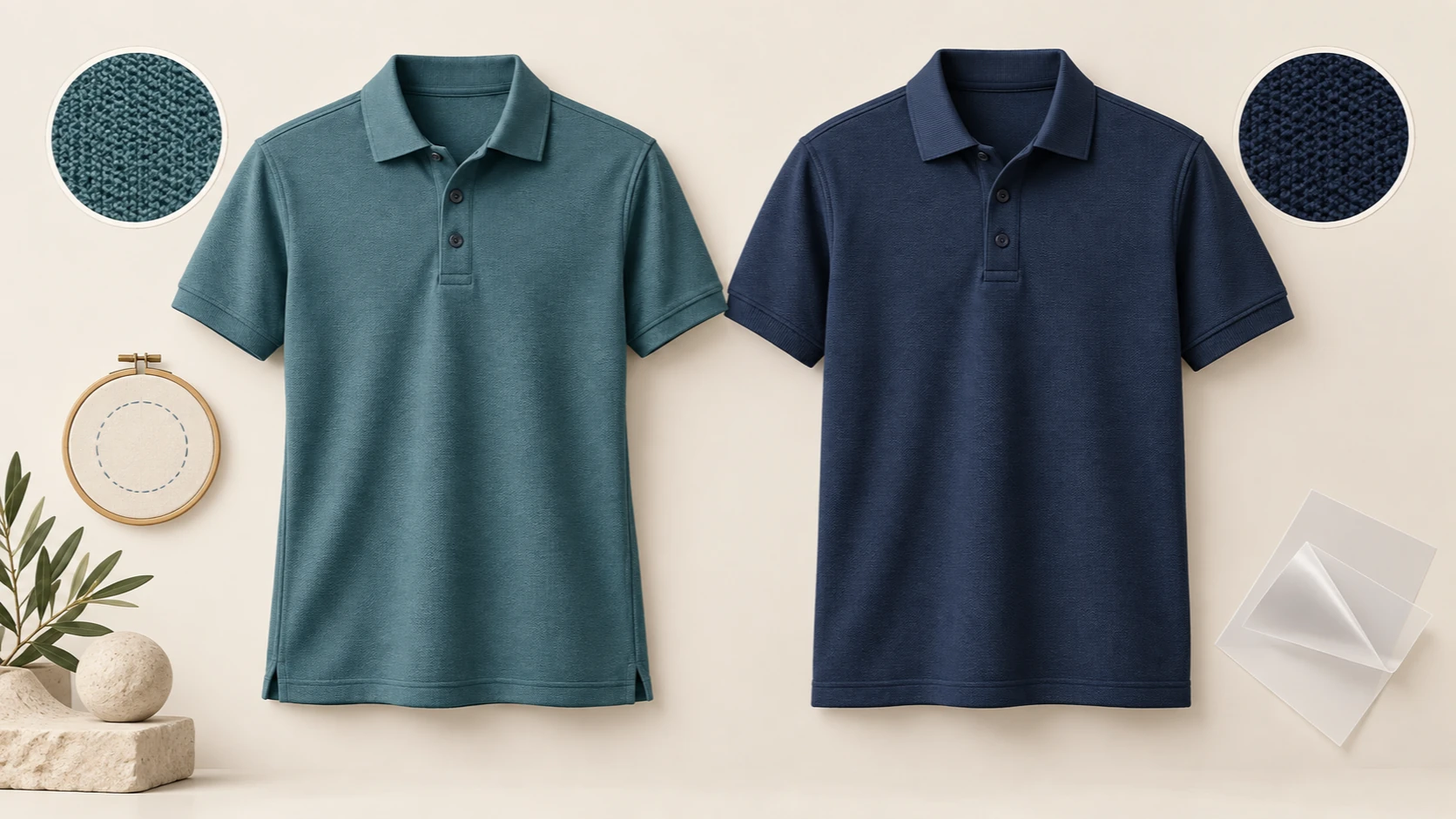
Quick answer: the Gildan 64800 vs Tultex 400 decision is a 5.2 oz/yd² cotton-forward Softstyle double-pique polo versus a 6.7 oz/yd² 50/50 cotton-polyester sport-pique polo. Sample the Gildan 64800 first when the brief favors its lower published area weight, modern classic fit, side-seamed body, or mostly cotton fiber program. Sample the Tultex 400 first when the brief favors its higher published area weight, consistent 50/50 blend, tubular construction, or contoured welt collar and cuffs.
Procurement verdict: neither model is a universal embroidery, printing, uniform, or team winner. The 64800 and 400 differ enough in fiber, weight, construction, collar-and-cuff treatment, and catalog positioning that the correct choice should come from a production-equivalent sample, representative wearer approval, decoration testing, laundering, and live order-time terms.
Gildan 64800 vs Tultex 400 at a Glance
Start with the current Gildan 64800 Beytees product page and Tultex 400 Beytees product page. Cross-check the official Gildan brand page and official Tultex 400 product page. The Gildan corporate page confirms manufacturer identity but not the exact 64800 specifications; those specifications come from the live Beytees product page. The exact received garment, sewn label, color, lot, and production-equivalent sample remain the controlling evidence.
| Buying factor | Gildan 64800 | Tultex 400 | Procurement action |
|---|---|---|---|
| Published area weight | 5.2 oz/yd² | 6.7 oz/yd² | Use the 1.5 oz/yd² difference to select samples; do not infer finished weight, comfort, heat performance, durability, or decoration quality |
| Primary fiber statement | 100% ring-spun cotton; Sport Grey is 90/10 cotton/polyester | 50/50 cotton/polyester | Verify the exact color and sewn label; qualify materially different fiber groups separately |
| Knit | Softstyle double pique | Pique textured knit | Approve logo detail, surface coverage, and finished hand on the actual face |
| Fit or product wording | Unisex; modern classic fit | Men’s 400 Classic Polo; no equivalent fit measurement claim is established here | Run wearer fittings instead of translating size letters between models |
| Body construction | Side seams and rolled-forward shoulders | Tubular construction | Build model-specific placement and loading references |
| Front and trim | Clean-finished placket and dyed-to-match buttons | Three-button placket, contoured welt collar and cuffs, banded sleeves | Inspect placket, collar, cuff, and sleeve presentation on the decorated sample |
| Label | Tear-away label | Tear-away or manufacturer-termed Tear Anywhere label | Approve removal and any replacement-label workflow separately |
The published area-weight difference is useful for narrowing a shortlist, but it is not a wear test. A heavier number does not automatically mean better embroidery, greater durability, more warmth, or better opacity. A cotton-forward statement does not automatically mean softer, cooler, or easier to print. Use the specifications to choose what to sample, then let the complete finished product decide.
This article owns only the two-model decision. For deeper single-style context, use the Gildan 64800 guide and Tultex 400 guide. The pique versus jersey polo guide answers the broader fabric-category question rather than this exact head-to-head.
Gildan 64800 Model Profile
The 64800 is listed at 5.2 oz/yd² in 100% ring-spun cotton at 31 singles, with Sport Grey identified as 90% cotton and 10% polyester. Its double-pique knit gives the expected textured polo face, while Gildan’s Softstyle wording and the current Beytees description position the fabric as breathable and suited to embroidery. Treat that as a manufacturer or seller positioning statement, not a guarantee for every logo, wearer, climate, or wash process.
Construction includes a modern classic fit, clean-finished placket, dyed-to-match buttons, rolled-forward shoulders, side seams, and a tear-away label. These details make it a logical first sample for a cotton-forward business-casual program and for buyers who want side seams as visual and inspection references. Rolled-forward shoulders can change where an upper-chest mark looks balanced, so approve placement on body rather than from a flat mockup alone.
Sport Grey belongs in a separate decoration lane because its fiber content differs from the 100% cotton statement. That does not predict migration, scorching, adhesion, or wash performance. It means the solid-color approval should not be copied to Sport Grey without testing the exact garment and process.
Tultex 400 Model Profile
The Tultex 400 is listed at 6.7 oz/yd² in a 50/50 cotton-polyester pique knit. Its current first-party page identifies tubular construction, a contoured welt collar and cuffs, three buttons, banded sleeves, a double-needle bottom hem, and a Tear Anywhere label. The current Beytees page uses compatible tear-away wording and specifies USA premium cotton in the blend.
This is the more direct first sample when the written brief intentionally calls for a higher published area weight, a uniform 50/50 fiber program, tubular construction, or the traditional presentation created by welt collar-and-cuff treatment and banded sleeves. None of those features proves fit preference, climate suitability, durability, colorfastness, snag resistance, or laundering performance.
The current official Tultex selector presents S through XXL and a focused set of colors, while current seller assortments can differ or render conflicting labels. Treat every selector as mutable catalog data, not stock or delivery evidence. Before standardizing the 400, map the complete roster, confirm every required size and color at order time, and approve an alternative if the program needs a range the live catalog cannot cover.
Embroidery: Choose the Complete System, Not Just the Polo
Both polos are reasonable embroidery sample candidates because both use pique and traditional placket construction. The 64800 seller description expressly calls its double pique ideal for embroidery; the Tultex 400’s textured 6.7 oz face and classic trim create a conventional embroidered-polo direction. Neither statement approves a particular logo or production recipe.
| Embroidery control | Why it matters | Approval gate |
|---|---|---|
| Artwork and digitizing | Tiny text, narrow gaps, gradients, and dense fills can lose clarity or distort knit | Approve the production-size stitch file on each finalist |
| Backing and topping | Pique needs support and may let fine stitches sink into the texture | Test the actual backing, topping, needle, thread, underlay, and density together |
| Hooping or framing | Stretching the knit can create puckering after release | Use a repeatable method that does not distort the body or placket |
| Placement | Side-seamed and tubular bodies provide different visual references | Approve representative small and large sizes on body |
| Interior comfort | Backing and stitch count affect the wearer-facing surface | Inspect the finished inside and test it during intended use |
| Laundering | Thread, backing, knit, collar, placket, and body can change together | Wash the completed sample through a documented care protocol |
For a small left-chest logo, start with the approved final dimensions rather than scaling a cap or jacket file. Keep a retained control sample and production record. For broader polo selection logic, the corporate embroidery polo guide can help frame alternatives without replacing exact-style testing.
DTF and Screen Printing: Test the Pique and Fiber Program
DTF can be evaluated on both models, but a smooth transfer film is being applied to a textured knit. Fine isolated elements need complete contact; large solid fields can change hand and breathability. Keep buttons, plackets, collar layers, seams, and cuffs outside the active pressure zone unless the fixture and artwork have been engineered for them.
Do not publish or inherit one universal time, temperature, pressure, peel, repress, or wash formula. Follow current transfer and equipment instructions on calibrated equipment. Qualify the 64800’s 100% cotton group separately from Sport Grey, and qualify every approved Tultex 400 color under the 50/50 program. Inspect cooled samples for contact, edge lift, gloss, texture flattening, pressure marks, scorching, dimensional change, shade response, migration where relevant, and finished hand; then launder before approval.
Screen printing also needs model-and-color qualification. Pique can break fine detail across high and low points, while extra ink deposit can create a heavy patch. On polyester-containing garments, the ink system, underbase, flash, cure window, and color response deserve specific control. A successful White sample does not approve a dark color, another model, or another ink system.
For both DTF and screen printing, document model, exact color, size, lot when available, artwork revision, dimensions, placement, equipment, platen, material batch, process settings, operator, inspection, and laundering result. Test-first language is not hedging; it is the shortest path to a repeatable reorder.
Uniform and Team Scenarios
| Program scenario | First sample direction | What must decide the order |
|---|---|---|
| Office, sales, or front desk wants cotton-forward Softstyle positioning and a modern classic fit | Gildan 64800 | Wearer fit, collar and placket presentation, embroidery, laundering, roster, and live terms |
| Club, service, or traditional team brief specifies a 50/50 blend and higher published area weight | Tultex 400 | Climate wear test, fit, decoration, collar and cuff behavior, roster coverage, and live terms |
| School or organization needs varied body types and recurring replacements | Test both | Complete size roster, fitting results, exact-color continuity, approved alternative, and reorder controls |
| Mixed embroidery plus sleeve, back, or event print | Test both | Full decoration sequence, fixtures, heat exposure, stitch stability, finished hand, and spoilage allowance |
| Outdoor, industrial, chemical, or specialized laundering environment | Do not assume either wins | Written performance requirements and an environment-specific wear-and-care trial |
A uniform program is also an operating system. Define issue quantities, fitting, personalization, replacements, new-hire ordering, returns, substitutions, and retained controls before purchasing. The school and team bulk-ordering guide provides a wider roster and deadline framework.
Decision Tree: Which Polo Should You Sample First?
- Does the written brief require a mostly cotton, lower published area-weight polo? Start with the Gildan 64800; keep Sport Grey in its own 90/10 test lane.
- Does it require a consistent 50/50 blend or the higher 6.7 oz/yd² published area weight? Start with the Tultex 400.
- Does body construction matter to placement or presentation? Choose the 64800 for its listed side seams or the 400 for its listed tubular construction, then verify the sample.
- Does the complete roster fit only one current size-and-color path? Sample that viable path first, but confirm exact variants and an approved alternative at order time.
- Are fit, hand, decoration, climate, laundering, replenishment, or landed economics still unresolved? Test both under one written scorecard and choose the model that passes the complete program.
Use case wins, not marketing adjectives. “Softstyle,” “Classic Polo,” “sport,” “premium,” and “ideal for embroidery” help describe positioning; they do not replace measurements, fitting, production, wash testing, or commercial verification.
Buyer Checklist Before a Bulk Polo Order
- Confirm the exact style, color, size, fiber statement, lot when available, and sewn labels.
- Map the complete roster and fit representative wearers; do not translate size letters between models.
- Approve garment measurements and logo placement on representative small and large sizes.
- Build production-size embroidery, DTF, or screen-print samples with the real artwork and equipment.
- Inspect collar, placket, buttons, cuffs, sleeves, seams, hem, body shape, and inside comfort.
- Complete documented cooling, laundering, remeasurement, and post-wash appearance checks.
- Freeze the decoration file, materials, settings, fixture, sequence, placement, and inspection standard.
- Verify exact-variant availability, price, freight, lead time, and substitution rules only when ordering.
- Include decoration labor, spoilage, relabeling, personalization, packaging, exchanges, and replacement stock in landed cost.
- Retain the approved sample and reopen testing after a material garment, lot, art, equipment, or process change.
Frequently Asked Questions
What is the main difference between the Gildan 64800 and Tultex 400?
The Gildan 64800 is a 5.2 oz/yd² cotton-forward double-pique polo with a modern classic fit, rolled-forward shoulders, and side seams. The Tultex 400 is a 6.7 oz/yd² 50/50 cotton-polyester pique polo with tubular construction, welt collar and cuffs, and banded sleeves.
Which polo has the lower published fabric weight?
The Gildan 64800 has the lower published area weight at 5.2 oz/yd², compared with 6.7 oz/yd² for the Tultex 400. The 1.5 oz/yd² difference does not prove finished weight, comfort, warmth, durability, or decoration quality.
Which polo uses a 50/50 cotton-polyester blend?
The Tultex 400 uses a published 50/50 cotton-polyester blend. The Gildan 64800 is 100% ring-spun cotton in its primary statement, with Sport Grey listed as 90% cotton and 10% polyester.
Which polo is side-seamed and which is tubular?
The Gildan 64800 lists side seams, while the official Tultex 400 page lists tubular construction. Use model-specific placement references and verify the actual received garment before freezing production templates.
Which polo is better for embroidery?
Neither is a universal embroidery winner. The Gildan 64800 is expressly positioned as embroidery-friendly, while the Tultex 400 offers a substantial textured pique direction. Test the exact logo, digitizing, backing, topping, hooping, placement, wearer comfort, and laundering on each finalist.
Can the Gildan 64800 and Tultex 400 use DTF transfers?
Both can be evaluated for DTF, but pique texture and polyester-containing colors or blends require exact-style and exact-color testing. Follow current supplier instructions and inspect cooled and laundered samples for contact, edge lift, surface change, shade response, migration where relevant, and finished hand.
Can both polos be screen printed?
Both can be sampled for screen printing. Approve the ink system, underbase, detail, deposit, flash, cure, texture, color response, hand, and laundering on the actual model and color rather than copying settings from a smooth jersey shirt.
Do the Gildan 64800 and Tultex 400 fit the same?
No equivalent fit is established by shared size letters. The 64800 is described as a unisex modern classic fit, while the 400 is sold as a men’s Classic Polo. Compare current measurements and conduct wearer fittings with production-representative samples.
Are both polos suitable for uniforms and teams?
Both are reasonable uniform and team candidates when they satisfy the written brief and pass fit, decoration, wear, laundering, roster, replenishment, and landed-cost gates. Specialized outdoor, industrial, or care environments may require a different polo.
What should buyers test before a bulk polo order?
Test identity, exact color and fiber, measurements, wearer fit, decoration, placement, collar, placket, buttons, cuffs, seams, inside comfort, cooling, laundering, dimensional response, live variant availability, landed cost, substitutions, and reorder controls.
Compare, Sample, and Approve
Review the live Gildan 64800 ordering page and Tultex 400 ordering page, then build a small production-equivalent sample set before committing to uniforms or team volume. Quote from exact variants and current terms, not old catalog counts or a blank-only price.
Choose the Gildan 64800 when its cotton-forward 5.2 oz double-pique program, modern classic fit, and side-seamed construction best match the written brief. Choose the Tultex 400 when its 6.7 oz 50/50 pique, tubular body, and traditional welt trim best match the brief. Test both when the remaining decision depends on people, decoration, laundering, availability, or economics.
Leave a Reply