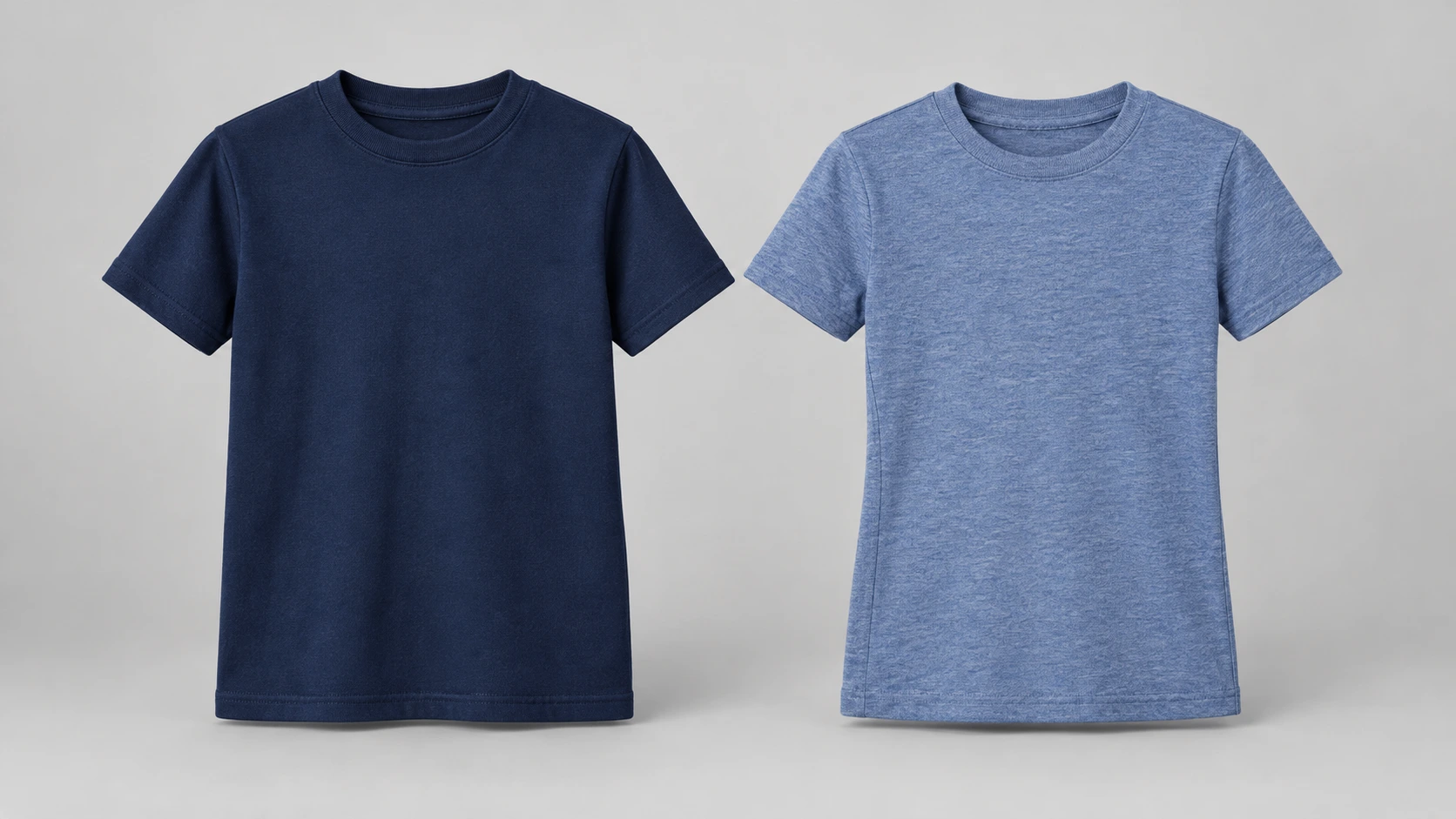
Gildan 5000B vs BELLA + CANVAS 3001Y is a choice between two documented youth-tee specifications, not a contest with one universal winner. Beytees currently describes the Gildan 5000B as a 5.3 oz/yd², 20-singles, classic-fit Heavy Cotton youth shirt. The BELLA + CANVAS 3001Y is listed as a 4.2 oz/yd², 32-singles, side-seamed youth jersey. Those published differences can guide the first sample, but they do not prove fit, softness, comfort, opacity, durability, print quality, stock, or total cost.
Use the written program brief to select a first sample, then qualify the exact style, color, size, artwork, transfer, press, and laundering process. Buyers who still need broad youth-blank discovery should start with the wholesale youth T-shirt guide. This page stays narrow: the exact 5000B-versus-3001Y procurement decision for schools, teams, camps, booster clubs, youth merch, and print programs.
Quick answer: which youth tee should you sample first?
Sample the Gildan 5000B first when the approved brief intentionally calls for the current heavier 5.3 oz classic-fit Heavy Cotton specification, taped neck and shoulders, and the exact 5000B assortment. Sample the 3001Y first when the approved brief intentionally calls for the current lighter 4.2 oz side-seamed youth jersey specification and the exact 3001Y assortment.
Test both when same-letter sizing, exact color and fiber content, artwork scale, decoration method, wearer preference, substitution, or complete landed economics could change the choice. Keep the evaluation fair: use the same production artwork and QC standard while allowing style-specific placement, transfer, and press controls. Do not treat a successful sample on one color or size as approval for every variant.
Gildan 5000B vs BELLA + CANVAS 3001Y at a glance
| Decision factor | Gildan 5000B | BELLA + CANVAS 3001Y | Buyer control |
|---|---|---|---|
| Published fabric weight | 5.3 oz/yd² | 4.2 oz/yd² | Treat the 1.1 oz/yd² gap as a fabric-area specification, not a performance verdict |
| Published yarn figure | 20 singles | 32 singles | Do not infer softness, durability, or print detail from yarn count alone |
| Fit wording | Beytees: classic fit | Manufacturer: classic fit; Beytees: retail fit | Resolve wording with samples and measurements |
| Construction verified | Rib collar; taped neck and shoulders | Side-seamed; crew neck | Do not invent corresponding features for the other shirt |
| Seller size terms | XS–XL | S–XL | Never assume same-letter equivalence or age mapping |
| Label wording | Beytees says tear-away | Beytees says tear-away | Inspect received labels before relabeling |
| Youth compliance wording | Beytees states CPSIA Tracking Label Compliant | No equivalent style-level claim verified in the reviewed exact sources | Do not convert blank-product wording into finished-garment legal assurance |
| Universal DTF recipe | None verified | None verified | Qualify exact variants with the current transfer system |
The 5000B’s published fabric weight is 1.1 oz/yd² higher, about 26.2% relative to the 3001Y figure. That calculation does not establish the weight of a finished shirt or predict opacity, warmth, shrinkage, durability, comfort, or print results. Review the live Gildan 5000B product page and BELLA + CANVAS 3001Y product page before quoting any program.
Gildan 5000B profile
Beytees identifies the style as the Gildan 5000B Youth Heavy Cotton T-Shirt. The current seller record lists a 5.3 oz/yd², 100% cotton, 20-singles base, classic fit, rib collar, taped neck and shoulders, and tear-away label. It also lists color-specific fiber exceptions: Ash Grey at 99/1 cotton/polyester; Sport Grey at 90/10; and Dark Heather, Graphite Heather, Heather, Neon, and Safety colors at 50/50. Verify the exact ordered color and received label rather than applying the base fiber statement to every variant.
The page uses CPSIA Tracking Label Compliant wording and identifies Safety Green with ANSI/ISEA 107 language. Preserve that attribution and scope. Neither statement proves that a decorated, relabeled, packaged, or otherwise modified finished garment satisfies every legal requirement. Buyers remain responsible for current product identity, tracking information, decoration effects, labeling, records, and the intended use. The exact Gildan style page was not readable during research because its public path returned an anti-bot HTTP 403, so these style facts remain seller-attributed.
For a deeper Gildan-family comparison, use the Gildan 5000B vs 64000B youth guide. This article uses only the 5000B details necessary for the exact 3001Y decision.
BELLA + CANVAS 3001Y profile
Beytees identifies the style as the BELLA + CANVAS 3001Y Youth Jersey Tee, while the manufacturer uses 3001Y Youth Jersey Short Sleeve Tee. The current exact sources list a 4.2 oz/yd², 32-singles base made from Airlume combed and ring-spun cotton, plus side seams, unisex sizing, crew neck, and youth sizes YS–YXL on the manufacturer record. Beytees uses S–XL and describes a retail fit; the manufacturer says classic fit. Keep those attributions separate.
The manufacturer page lists Ash as 99% cotton and 1% polyester. The official specification PDF separately contains a 90/10 cotton/polyester fabrication line without mapping it to a color. Beytees says the shirt is pre-shrunk and uses a tear-away label, but those statements were not present in the exact manufacturer body or PDF reviewed for this article. Confirm the exact color, fiber label, and physical garment.
The manufacturer prose, rendered Beytees selector, and public Store API showed different color counts during research. That conflict is a reason to omit a fixed evergreen count, not a reason to choose one source silently. Use the current BELLA + CANVAS 3001Y manufacturer page, exact seller record, and live variant evidence at order time.
Fabric weight, yarn, fit wording, and construction
The comparison is strongest when it stays literal. The 5000B has the higher published fabric-area weight and lower published singles figure. The 3001Y has the lighter published fabric-area weight, higher singles figure, and verified side-seamed construction. These are useful specification differences, but none is a shortcut to a winner.
Fit labels are especially weak as conversion tools. “Classic fit” and “retail fit” are marketing descriptions, not shared measurement standards. Even the 3001Y sources disagree on the label. The safest approval uses finished-garment measurements, physical samples, intended wearer review, and the exact size mix. Do not promise that matching letters fit the same or map either style to a specific age.
Construction should shape sampling and artwork placement. The 5000B seller record verifies a rib collar and taped neck and shoulders. The 3001Y manufacturer record verifies side seams. A source confirming one feature on one shirt does not prove the other shirt lacks or includes a corresponding detail. Inspect the garments rather than filling gaps from assumptions.
Youth sizing and artwork placement
| Approval control | 5000B evidence | 3001Y evidence | Required action |
|---|---|---|---|
| Size terminology | Beytees selector: XS–XL | Beytees: S–XL; manufacturer: YS–YXL | Preserve exact style and source terminology in the order record |
| Finished measurements | No fresh readable first-party chart was obtained | Official PDF supplies YS–YXL body width and length | Do not publish a numeric cross-style fit table |
| Same-letter comparison | No verified equivalence | Measure samples and test representative wearers | |
| Artwork scale | Youth size range can change available print area | Approve production-size art on representative smallest and largest ordered sizes | |
| Placement reference | Check collar and body relationship | Check collar, side seams, and body relationship | Freeze measured placement references by style and size band |
The official 3001Y PDF lists YS at 15.25 × 20.875 inches, YM at 16.25 × 22.125, YL at 17.25 × 23.375, and YXL at 18.25 × 24.375, using body width one inch below the armhole and body length from the high point shoulder. Those are finished-garment chart values, not body circumferences or age guarantees. Without a current readable first-party 5000B chart using reconciled definitions, a numeric style-to-style fit table would imply evidence the research does not have.
Approve artwork at production size. Check the smallest and largest ordered garments for collar clearance, seam clearance, visual balance, and edge proximity. One adult placement template or one transfer size should not be applied automatically across the entire youth roster.
DTF and decoration qualification
No reviewed exact source supplies a universal DTF time, temperature, pressure, peel, post-press, cure, or wash-life guarantee for either style. Follow the current transfer-system supplier instructions and qualify the exact garment, color, size, artwork coverage, transfer batch, press, platen, moisture state, pressure method, peel, post-press, and laundering protocol.
Color-specific fiber content matters because both programs contain exceptions. A successful solid-color cotton sample does not approve every heather, grey, neon, safety, vintage, or special shade. Record the received fiber label and test adhesion, edge lift, press marks, shine, scorching, color change, migration where relevant, hand, collar and seam clearance, distortion, dimensional response, and laundering. These are inspection gates, not predictions that a defect will occur.
Other decoration methods also require their own proof. The sources do not establish a universal winner for screen printing, DTG, HTV, sublimation, or embroidery. Keep the broader 3001Y-family boundaries separate by using the 3001Y vs 3001YCVC comparison and 3001Y vs Gildan 64000B comparison when those are the actual buying questions.
School and team use-case matrix
| Written program brief | First sample | Why | What can reverse the choice |
|---|---|---|---|
| Heavier classic-fit Heavy Cotton specification | Gildan 5000B | Its current seller specification directly matches that brief | Fit, exact color/fiber, artwork, stock, substitution, or landed cost |
| Lighter side-seamed youth jersey specification | BELLA + CANVAS 3001Y | Its current exact records directly match that brief | Fit wording, exact color/fiber, artwork, stock, substitution, or landed cost |
| Mixed roster with unresolved same-letter sizing | Both | No verified size equivalence exists | Measured samples and representative wearer approval |
| Large front graphic across several youth sizes | Both | Available print area and visual balance may change by style and size | Smallest/largest production-size decoration tests |
| Substitution-sensitive school or team program | Both | Brand, style, color, fit, and construction are part of the approved product | Written no-substitution rule or separately approved alternate |
Do not let broad labels such as school, team, camp, booster club, spirit wear, or youth merch substitute for specifications. The first sample should follow the written garment brief. The production choice should follow measured fit, decorated samples, QC results, live exact-variant availability, current commercial terms, and a documented substitution policy. For a source-aware comparison of the 3001Y with a garment-dyed alternative, use the 3001Y vs Comfort Colors 9018 guide.
Sample-to-bulk approval checklist
- Freeze the exact brand, style, color, size terminology, and supplier record.
- Inspect the received brand, fiber, care, and tracking labels; do not rely on the base-fabric line alone.
- Measure representative garments using one documented method and compare them with the intended wearer group.
- Freeze the roster revision, quantity by exact SKU, artwork revision, and size-specific placement plan.
- Decorate production-equivalent samples on representative smallest and largest ordered sizes.
- Record transfer, press, platen, pressure method, peel, post-press, and laundering controls for DTF.
- Define adhesion, alignment, seam and collar clearance, visual balance, hand, distortion, and wash tolerances.
- Recheck exact-variant stock, current price, freight, lead time, delivery context, return terms, and complete landed cost.
- Write the substitution rule before release; requalify any changed brand, style, color, fiber, construction, label, artwork, or process.
- Retain the approved sample and evidence for reorder comparison.
This gate keeps an evergreen comparison from becoming a future inventory or performance promise. A defensible order record shows exactly what was approved, under which conditions, and which changes require another sample.
Frequently asked questions
What is the main difference between the Gildan 5000B and BELLA + CANVAS 3001Y?
The Gildan 5000B has a current 5.3 oz classic-fit Heavy Cotton seller specification, while the BELLA + CANVAS 3001Y has a current 4.2 oz side-seamed youth-jersey specification. Those facts guide sampling but do not establish a universal winner.
Which youth tee has the higher published fabric weight?
The 5000B is published at 5.3 oz/yd² and the 3001Y at 4.2 oz/yd², a difference of 1.1 oz/yd². That fabric-area difference does not by itself prove durability, opacity, warmth, comfort, or finished-shirt weight.
Are the 5000B and 3001Y 100% cotton in every color?
No all-colors claim is safe. The 5000B seller record lists 99/1, 90/10, and 50/50 color exceptions; the 3001Y sources list Ash at 99/1 and an unmapped 90/10 fabrication line. Verify the exact received label.
How do the fit descriptions differ?
Beytees describes the 5000B as classic fit. The 3001Y manufacturer says classic fit while Beytees says retail fit. Use physical samples and reconciled measurements instead of treating those labels as a shared standard.
Do the 5000B and 3001Y use the same youth sizes?
No verified equivalence was established. Beytees shows XS–XL for the 5000B and S–XL for the 3001Y, while the manufacturer uses YS–YXL for the 3001Y. Do not infer age ranges or same-letter substitution.
Which youth shirt is better for DTF printing?
There is no universal DTF winner. Qualify the exact style, color, fiber label, size, artwork, transfer, press, placement, peel, post-press, and laundering process before bulk production.
Can one artwork size be used across the whole youth roster?
Do not assume it can. Approve production-size artwork on representative smallest and largest ordered garments, then check collar and seam clearance, edge proximity, and visual balance.
Do both shirts have tear-away labels and youth compliance claims?
Beytees says both styles use tear-away labels. Only the reviewed 5000B seller page supplied a CPSIA tracking-label statement. Neither fact proves that every finished decorated or relabeled garment meets every legal requirement.
Which shirt should schools, teams, or camps sample first?
Sample the 5000B first for a written heavier classic-fit Heavy Cotton brief and the 3001Y first for a written lighter side-seamed jersey brief. Do not choose from popularity, budget, softness, or generic market labels alone.
What should buyers verify before a bulk youth-shirt order?
Verify exact SKU, color, size terminology, received labels, roster, measurements, artwork, decorated samples, QC, live stock, substitution rules, current commercial terms, and complete landed cost.
Leave a Reply