Independent Trading Co. IND20SRT vs Comfort Colors 1468 is a choice between two genuinely different wholesale shorts: the IND20SRT is a substantial 8.5 oz blended fleece short with a 9-inch inseam, while the 1468 is a lighter 6.4 oz garment-dyed cotton jersey short with a 7.5-inch inseam. Choose the IND20SRT for heavier streetwear, fleece sets, longer coverage, compact embroidery, and a tear-away label. Choose the 1468 for warm-weather merchandise, vintage color, lightweight comfort, and boutique, resort, or campus collections.
The most important correction is that the Comfort Colors 1468 is not conventional brushed fleece. Its current Beytees record specifies 100% ring-spun U.S. cotton jersey. That difference affects hand, warmth, decoration, pricing, and the type of program each short can support. Both styles have relaxed fits and usable hand pockets, but the similarities mostly end there.
This comparison uses the current Beytees IND20SRT product record, the Beytees Comfort Colors 1468 product record, and live manufacturer data checked September 6, 2026. Both Beytees product pages displayed an out-of-stock status during the check. Inventory, colors, sizes, and sourcing can change, so confirm every required combination before accepting a deadline or a decorated-order deposit.
IND20SRT vs Comfort Colors 1468: Quick Verdict
- Best heavier short: Independent Trading Co. IND20SRT.
- Best lightweight short: Comfort Colors 1468.
- Best for vintage garment-dyed merch: Comfort Colors 1468.
- Best for a fleece streetwear or team program: IND20SRT.
- Best published starting point for compact embroidery: IND20SRT, subject to digitizing and wash tests.
- Best for a shorter warm-weather silhouette: Comfort Colors 1468.
- Best for private-label neck-label removal: IND20SRT, because it publishes a tear-away label; the 1468 publishes a signature twill label.
- Best first DTF sample: A solid-color IND20SRT or a physically approved 1468 color, depending on the desired weight and finish. Do not start with IND20SRT camo unless the transfer and low-temperature process are qualified.
- Best exact-color choice: Neither by default. Garment dye can vary, fleece-set colors are described only as close matches, and later production lots require approval.
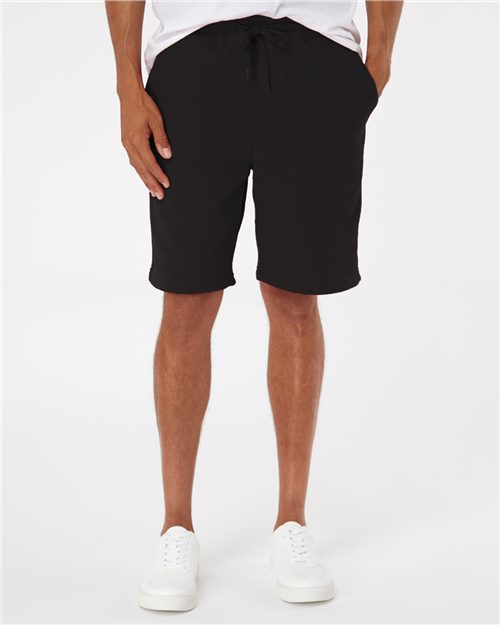
Table of Contents
- Side-by-side comparison
- IND20SRT specifications
- Comfort Colors 1468 specifications
- Fabric, weight, and feel
- Fit, inseam, and sizing
- Pockets, waistband, and construction
- Colors and current availability
- DTF printing comparison
- Screen-printing comparison
- Embroidery comparison
- Matching sets and merchandising
- Best use cases
- Private-label considerations
- Costing and quoting
- Sample and production test
- Wholesale ordering plan
- Frequently asked questions
IND20SRT vs Comfort Colors 1468 Comparison Table
| Feature | Independent Trading Co. IND20SRT | Comfort Colors 1468 | Buying impact |
|---|---|---|---|
| Product category | Midweight fleece short | Garment-dyed lightweight jersey sweat short | Different hand, warmth, drape, and retail position |
| Published weight | 8.5 oz / 280 gsm | 6.4 oz / 217 gsm | IND20SRT feels more substantial; 1468 is lighter |
| Primary fiber | Solid and camo: 80/20 cotton/polyester; Grey Heather: 52/48 | 100% ring-spun U.S. cotton jersey | Changes heat response, hand, shrink behavior, and print planning |
| Decoration face | 100% cotton face yarn published for solid and camo; exact color still matters | Ring-spun cotton jersey with cotton threads | Both are logical print candidates after color-specific testing |
| Finish | Conventional fleece colors plus camo options | Garment-dyed lived-in finish | 1468 emphasizes vintage shade and lot character |
| Fit | Men’s relaxed fit with tapered knee opening | Unisex relaxed fit with differential rise | Use samples; the category labels are not interchangeable sizing evidence |
| Published sizes | XS–2XL | S–2XL | IND20SRT adds XS; both end at 2XL in current records |
| Inseam | 9 inches | 7.5 inches | IND20SRT offers 1.5 inches more published coverage |
| Hand pockets | Jersey-lined | Jersey-lined side pockets | Pocket bags affect decoration placement on both |
| Back pocket | Published | Not published | IND20SRT offers additional storage and another construction obstacle |
| Waist details | Elastic waistband, shoestring drawcord, sewn eyelets, sewn fly detail | Natural flat drawcord and 1.5-inch waistband in current supplier data | Keep cords, elastic, and seams away from heat and pressure |
| Label | Tear-away label | Signature twill label | IND20SRT is the easier starting point for relabeling |
| Current colors | Five manufacturer colors | Six published colors | 1468 has one more color direction; actual stock matters more than count |
| Current Beytees status | Out of stock during September 6 check | Out of stock during September 6 check | Contact Beytees before quoting fulfillment |
The numbers point to a simple conclusion: these are not substitutes selected only by color or price. They are different blanks for different customer promises. If a collection brief says “substantial fleece short,” the 1468 will not become that product through decoration. If the brief says “lightweight washed summer short,” the IND20SRT may feel heavier and longer than intended.
Independent Trading Co. IND20SRT Specifications
The IND20SRT uses 8.5 oz / 280 gsm 3-end fleece with 32-singles face yarn. Independent Trading Company currently specifies an 80% cotton / 20% polyester blend with 100% cotton face yarn for solid and camo colors. Grey Heather is a separate 52% cotton / 48% polyester blend. That color-specific fiber difference matters: a decoration recipe approved on Black should not be assumed to behave identically on Grey Heather or Black Camo.
Construction includes an elastic waistband with shoestring drawcord, sewn eyelets, sewn fly detail, a back pocket, jersey-lined hand pockets, relaxed fit, tapered knee opening, and tear-away label. The published size range is XS through 2XL. The technical measurements show a 9-inch inseam across that range, with the outseam increasing from 19.5 inches in XS to 22 inches in 2XL.
Review the official IND20SRT product page for the current first-party record. The manufacturer describes its fabric colors as a close match to the IND4000 10 oz fleece hoodie and specifically recommends ordering samples when building a set. “Close match” is the useful phrase: it does not promise an exact shade or fabric-weight match.
IND20SRT strengths
- Substantial midweight fleece hand for premium casualwear and streetwear.
- Longer 9-inch inseam for buyers who want more coverage.
- Back pocket plus jersey-lined hand pockets.
- Tear-away label for a more practical relabeling workflow.
- Cotton-facing solid colors that are logical candidates for screen printing and DTF testing.
- Enough body for compact embroidery when stabilizing and digitizing are correct.
- XS through 2XL range for six published sizes.
IND20SRT cautions
- Grey Heather has a different fiber blend from the solid and camo specification.
- Camo is an all-over surface print with a specific manufacturer heat and migration warning.
- Pocket bags, the back pocket, waistband, fly detail, and side structure reduce the flat decoration area.
- The manufacturer calls the fit relaxed and the Beytees title calls it men’s; neither replaces a try-on test.
- The current Beytees page displayed out of stock at publication check.
Comfort Colors 1468 Specifications
The Comfort Colors 1468 uses 6.4 oz / 217 gsm 100% ring-spun U.S. cotton jersey at 31 singles, with cotton threads. Some distributor sheets round the weight to 6.5 oz, but the live Beytees record uses 6.4 oz and the current manufacturer page expresses the fabric as 217 gsm. More important than the rounding difference is the construction: this is lightweight jersey, not a conventional lofted fleece short.
The style is garment-dyed for a lived-in feel and minimal shrinkage, with a relaxed fit, natural flat drawcord, jersey-lined side pockets, differential rise, side seams, and signature twill label. The published range is S through 2XL. Finished measurements show a 7.5-inch inseam across all five sizes, with a published plus-or-minus 1-inch inseam tolerance. The relaxed waist progresses from 15 inches in S to 19.5 inches in 2XL, with a plus-or-minus 0.75-inch tolerance.
The current Gildan Brands 1468 page provides the manufacturer’s fabric, fit, sizing, and sustainability statements. For a detailed production-focused overview, use the existing Comfort Colors 1468 wholesale merch and decoration guide.
Comfort Colors 1468 strengths
- Lightweight all-cotton jersey for warm-weather and indoor casual use.
- Garment-dyed color and lived-in character for vintage merchandise.
- Shorter 7.5-inch inseam for a more seasonal, retail-oriented silhouette.
- Relaxed fit, differential rise, and side seams.
- Jersey-lined side pockets without a published back pocket.
- Six focused colors for resort, campus, wellness, and lifestyle concepts.
Comfort Colors 1468 cautions
- Garment-dyed shade can vary; a color name or screen swatch is not a physical color standard.
- Light jersey needs careful pressing and embroidery control to avoid marks, stiffness, or puckering.
- The signature twill label is not published as tear-away.
- The current range begins at S and ends at 2XL.
- The current Beytees page displayed out of stock at publication check.
Fabric, Weight, Drape, and Seasonal Feel
The 1.9 oz difference between the published weights is meaningful, but construction matters as much as the number. IND20SRT is 3-end fleece, giving it a more substantial sweat-short character. The 1468 is cotton jersey, creating a lighter, more T-shirt-like drape. A buyer should expect the IND20SRT to present as a premium fleece bottom and the 1468 to present as an easy warm-weather lifestyle short.
Use IND20SRT when structure, coverage, and a heavier hand support the retail position. It can work for streetwear capsules, gym arrival wear, team travel, loungewear, creators, clubs, and fleece-set programs. Use the 1468 when garment color and relaxed seasonal character are the story. It can work for lake and beach shops, campuses, camps, wellness brands, sororities and fraternities, resorts, festivals, and summer merchandise.
Do not convert weight into unsupported warmth or durability claims. A heavier garment is not automatically warmer in every condition, and a cotton-polyester blend is not automatically more durable for every use. Seam construction, laundering, wearer activity, fit, and decoration all affect service life. Approve both the blank and the decorated sample for the real use case.
The broader wholesale fleece shorts guide helps position the IND20SRT among other substantial bottoms. For the 1468, the garment-dyed finish should be treated as a design feature and a controlled production variable, not merely another color option.
Fit, Inseam, and Finished Measurements
Both styles publish relaxed fits, but the silhouette and size language differ. Independent Trading Company describes the IND20SRT as a relaxed men’s short with a tapered knee opening. Beytees and current supplier records describe the Comfort Colors 1468 as unisex with a relaxed fit and differential rise. Those labels do not tell a wearer how the garment will sit on their body.
| Size | IND20SRT relaxed waist | IND20SRT inseam | 1468 relaxed waist | 1468 inseam |
|---|---|---|---|---|
| XS | 14 in | 9 in | Not published | Not published |
| S | 15 in | 9 in | 15 in | 7.5 in |
| M | 16 in | 9 in | 16 in | 7.5 in |
| L | 17 in | 9 in | 17 in | 7.5 in |
| XL | 18 in | 9 in | 18 in | 7.5 in |
| 2XL | 19.5 in | 9 in | 19.5 in | 7.5 in |
The aligned relaxed-waist numbers from S through 2XL may look like proof of identical fit. They are not. Fabric, rise, leg shape, elastic recovery, measurement method, and garment tolerances change how a short wears. The IND20SRT also has a tapered knee opening and a longer outseam; the 1468 has differential rise and a shorter inseam. Order the actual styles and try them on.
Finished-garment measurements are not body measurements. When selling to a roster, publish the exact chart version, explain how the garment was measured, and let wearers compare it with a short they already own. When selling online, include both the garment measurements and a clear exchange policy before personalization.
Pockets, Waistband, and Decoration Area
Shorts are harder to decorate than a flat tee because construction occupies more of the available surface. Both styles have elastic waists, drawcords, and lined hand pockets. The IND20SRT adds sewn eyelets, a sewn fly detail, a back pocket, and tapered knee opening. The 1468 adds side seams and differential rise. Every one of those details can influence platen contact, hoop access, pressure, and visible alignment.
A compact left-leg or right-leg mark is the safest first placement for many programs. Before printing, turn the short inside out and map the pocket bag, seam allowance, and any stacked layers behind the artwork. Keep the waistband and drawcord off the heat plane. A print that crosses a pocket edge may receive uneven pressure; an embroidery design too close to a pocket can restrict access or sew through layers that were meant to remain separate.
The IND20SRT back pocket can support a small mark only after the decorator confirms access, thickness, pocket function, and production repeatability. The pocket is also a reason to avoid treating the rear panel as uninterrupted. On the 1468, the absence of a published back pocket simplifies the rear structure, but actual side-pocket bags still need inspection.
Colors, Shade Control, and Live Availability
The current Independent manufacturer record lists Black, Grey Heather, Army, Forest Camo, and Black Camo. Its live product data contained 30 color-size combinations. During the September 6 check, all six sizes in Black, Grey Heather, and Black Camo were marked available, while the Army and Forest Camo combinations were unavailable. That is 18 available combinations out of 30 in the manufacturer’s own store data.
That availability does not prove Beytees inventory. The Beytees IND20SRT page displayed an out-of-stock class during the same check. A manufacturer may have units while a specific distributor route, warehouse, or storefront has none. Do not quote an arrival date until Beytees confirms the style, color, size quantities, sourcing path, and timeline.
The 1468 currently publishes Blue Jean, Hydrangea, Ivory, Neon Violet, Peachy, and Pepper. The range supports dark washed neutrals, warm and cool pastels, a light neutral, and a bright statement color. The Beytees page also displayed out of stock during the check, and the manufacturer page did not provide a reliable U.S. color-size inventory count for this article. Treat all six as catalog colors, not a fulfillment promise.
For the 1468, approve actual garment shade. Garment dye creates character and can produce variation between lots. Wash finished samples according to the attached care label, keep light items away from potential loose pigment during testing, and evaluate later reorders beside the retained approval sample. The blank apparel color guide can help build a commercial palette, but a trend list never replaces physical shade approval.
DTF Printing: Which Short Is Better?
Both are reasonable DTF candidates after qualification. The safer choice depends on the desired garment, color, and transfer system. Solid IND20SRT colors publish a cotton face over blended fleece, providing a logical surface for testing. The 1468 provides an all-cotton jersey surface, but its lighter body and garment-dyed finish make pressure marks, shade response, and hand especially important.
Start with the exact production color. On IND20SRT, do not use a Black recipe as automatic approval for Grey Heather or camo. Grey Heather has a different 52/48 fiber specification. Black Camo and Forest Camo are all-over printed surfaces. Independent Trading Company’s official printing guidance warns that camo garments should not approach 320°F because the surface print can migrate into the new decoration. It recommends a compatible low-temperature process and blocker strategy, supplier consultation, and testing.
A DTF transfer supplier’s required application temperature may or may not fit that camo limit. If the transfer cannot be applied and cured within a validated safe process, select a solid garment color or another blank. Do not lower temperature informally and assume adhesion will remain acceptable. Time, pressure, peel, post-press, ink, powder, film, heat accuracy, and fabric must work as one documented system.
On the 1468, isolate the decoration area from pocket bags and seams. A smaller print with negative space may preserve the light jersey hand better than a large solid transfer. Inspect for shine, press boxes, dye change, seam impressions, incomplete adhesion, edge lift, and stiffness. Let the sample cool, then launder and recheck it. The DTF printing on Comfort Colors guide adds garment-dye-specific controls.
DTF starting recommendation
- Solid-color IND20SRT: Good first candidate for a heavier streetwear or team short.
- Grey Heather IND20SRT: Separate fiber and color test required.
- Camo IND20SRT: Advanced qualification required because of heat and migration risk.
- Comfort Colors 1468: Good first candidate for lightweight vintage merchandise after shade, pressure, and wash testing.
Screen Printing: Fleece Face vs Garment-Dyed Jersey
IND20SRT is the more natural screen-print candidate when the program wants a substantial fleece short and repeated leg graphics. Its ring-spun cotton-facing construction can provide a stable surface, particularly in solid colors. Printers still need to control mesh, underbase, flash, cure, fibrillation, opacity, and pocket-layer interference. The exact fabric color remains part of the print recipe.
The 1468 can work well for collegiate marks, resort graphics, club merchandise, and vintage-inspired retail designs. Its 100% cotton jersey is familiar, but garment dye and the light body call for care. A large heavy ink deposit may overpower the garment’s casual hand. A distressed one-color mark, smaller logo, or design with open space may better support the product concept, provided the artwork and process pass testing.
For either style, cure should be measured rather than assumed from dryer settings. Keep the drawcord and elasticized waistband away from flash and heat. Compare the printed garment with an unprinted control after cooling and laundering. Inspect shade, cure, cracking, opacity, hand, stretch at the leg, pocket function, and dimensional change.
If the shop needs a broader process refresher, adapt the controls in the wholesale screen-printing blanks guide to the smaller, layered geometry of shorts.
Embroidery: IND20SRT Has the Stronger Starting Structure
The IND20SRT is the stronger first embroidery candidate because its 8.5 oz fleece provides more body than the 1468’s lightweight jersey. A compact club mark, monogram, resort logo, or team emblem can work well when it is digitized for fleece, stabilized correctly, and positioned away from the pocket opening and seam stack.
That does not make the IND20SRT risk-free. Dense fills can stiffen the leg and change drape. Incorrect hooping can stretch the panel, and pocket bags can be caught by the needle. Map every layer, use a placement fixture, avoid pulling the fabric out of shape, and inspect the inside finish for wearer comfort.
Embroidery on the 1468 should be smaller and more restrained. Lightweight jersey is more vulnerable to puckering, tunneling, visible backing, and an overly rigid stitch field. Use appropriate underlay, backing, density, needle, thread, and hoop tension. Test the actual garment color, then launder it and inspect shape, comfort, pocket access, thread appearance, and label presentation.
A patch may be a useful alternative when direct embroidery would require too much density. The patch attachment method still needs qualification; a large heat-applied or sewn patch can create the same stiffness problem in another form.
Matching Sets, Color Coordination, and Merchandising
IND20SRT can anchor a coordinated fleece program. The manufacturer describes its fabric color as a close match to the IND4000 10 oz hoodie. The word “close” protects an important distinction: the garments do not share the same published weight, and the page does not promise an exact lot-to-lot shade match. Order the exact top and bottom, view them together in the intended lighting, decorate samples, and approve the set as one product.
The 1468 can coordinate with garment-dyed tees, tanks, crewnecks, and hoodies. Matching color names are not enough. Different fabric weights, constructions, dye lots, and production dates can create visible differences. A tonal set may look excellent even when the shades are not mathematically identical, but that should be an intentional approved result.
For lightweight and heavyweight garment-dyed tops, the Comfort Colors 1467 vs 1567 hoodie comparison explains the top-side tradeoff. Build the set around the customer, season, and retail price rather than assuming every bottom needs a matching sweatshirt.
A commercially clear collection often needs only one neutral, one expressive color, and one approved decoration system. Every added color multiplies sizes, samples, stock exposure, photography, product pages, and reorder complexity.
Which Short Fits Each Wholesale Program?
| Program | Better starting choice | Why | Required validation |
|---|---|---|---|
| Heavy streetwear capsule | IND20SRT | Heavier fleece, longer inseam, back pocket, tear-away label | Fit, solid/camo process, label removal, set match |
| Vintage summer merch | 1468 | Light jersey and garment-dyed character | Shade, lot, print hand, wash behavior |
| Team travel fleece | IND20SRT | Substantial hand and longer coverage | Roster sizing, pockets, logo, sourcing |
| Resort or beach retail | 1468 | Lighter weight and seasonal colors | Try-on, shade, decoration, care messaging |
| Compact embroidered club mark | IND20SRT | More structural body | Digitizing, backing, pocket clearance, wash test |
| Soft garment-dyed campus drop | 1468 | Washed color and cotton jersey direction | Physical color and size approval |
| Camo print-on-print design | IND20SRT only after advanced testing | Camo options exist | Low-temperature compatibility, blocker, migration hold |
| Extended-size program beyond 2XL | Neither current range | Both published records stop at 2XL | Choose a companion or different primary style |
| Exact Pantone garment requirement | Neither by default | Garment-dye and fleece-lot matching are not exact-color systems | Physical standard and written tolerance |
| Technical moisture-performance uniform | Neither from current published claims | No qualifying performance standard is published here | Select documented technical apparel |
Labels and Private-Brand Programs
The IND20SRT publishes a tear-away label, making it the more convenient starting point for rebranding. Tear-away does not mean “legally blank.” Inspect the actual received garment, test label removal, and preserve all fiber-content, country-of-origin, care, responsible-party, and other required information for the market where the short will be sold.
The 1468 publishes a signature twill label rather than a tear-away label. Removing or covering it may require more labor and can change the inside finish. Before quoting, inspect how the label is attached, whether removal affects a seam, where replacement information will go, and whether a new label remains comfortable.
For both, define who owns compliance review and approve a physical sample. The tear-away label and private-brand guide explains why decoration convenience is separate from labeling compliance.
How to Quote the Decorated Shorts Profitably
Do not compare these styles by blank price alone. Build the quote from live color-size cost, size upcharges, inbound freight, receiving, samples, spoilage, artwork, screens or digitizing, transfers or ink, per-location production, special loading, personalization, label work, finishing, packaging, outbound freight, replacement reserve, and payment fees.
IND20SRT can add process cost when camo needs a low-temperature ink or transfer system, blocker, extended migration hold, or more testing. Back-pocket and pocket-adjacent decoration can slow loading. The 1468 can add cost when light jersey requires smaller artwork, pressure isolation, garment-dye shade sorting, or more careful embroidery.
Measure real production time. A shop that prices every leg print as if it were a flat tee front may lose margin through pocket isolation, smaller platens, alignment, and slower loading. If the order is a set, quote the top, bottom, combined decoration, sorting, and packaging explicitly.
For repeat programs, record style, color, size chart, lot expectations, artwork revision, placement measurements, production recipe, approved sample, care language, packaging, and reorder policy. The custom apparel inventory management guide provides a practical control framework.
Twelve-Step Sample and Production Test
- Define the brief: Record audience, climate, use, weight, inseam, fit, artwork, retail position, deadline, and budget.
- Select the actual style: Choose IND20SRT for the fleece direction or 1468 for the lightweight garment-dyed direction.
- Verify live sourcing: Ask Beytees to confirm every required color-size quantity and expected timing.
- Order exact samples: Include the real production color and representative sizes.
- Approve fit: Compare the short with the published measurements and evaluate standing, sitting, walking, and pocket use.
- Map construction: Mark waistband, cord, pocket bag, back pocket, fly detail, side seams, and multi-layer zones.
- Decorate production artwork: Use the intended machine, operator, materials, placement, and finished dimensions.
- Control special risks: Separate Grey Heather, camo, and every garment-dyed color into their own approved tests.
- Inspect immediately: Check alignment, cure or adhesion, opacity, stitch quality, hand, shade, shine, marks, and pocket function.
- Hold when needed: Give migration-prone samples enough time to reveal delayed color contamination before approval.
- Launder and wear test: Follow the sewn care label and inspect decoration, garment shape, shade, comfort, and dimensional change.
- Lock the standard: Save the physical sample, chart, recipe, artwork, placement, roster, packaging, and approval date.
Wholesale Ordering and Reorder Plan
Start with the complete color-size roster, not an aggregate unit count. Twenty available shorts do not help if the missing units are essential sizes. Verify each combination, reserve blanks, and leave time for inbound shipping, receiving, quality control, decoration, curing or finishing, sorting, packaging, and outbound delivery.
Because both Beytees pages displayed out of stock during the publication check, contact Beytees before promising the style. The manufacturer’s IND20SRT availability can support a sourcing conversation, but it cannot establish Beytees cost, route, arrival time, or allocation. For the 1468, the six catalog colors likewise do not prove current units.
Limit first-run complexity. One or two garment colors, one decoration location, a controlled size curve, and a retained sample are easier to reproduce than a broad launch with untested substitutions. Define what happens if a color-size combination becomes unavailable: wait, refund, substitute, split ship, or move the entire program to an approved alternate.
Use the wholesale blank apparel shipping guide to build a realistic deadline. “In stock” at one source is not the same as received, inspected, decorated, packed, and delivered.
Copy-and-paste sourcing brief
Program name:
End user and season:
Selected style: IND20SRT / Comfort Colors 1468
Approved color:
Sizes and quantities:
Published chart version:
Fit sample approved by:
Garment/source availability checked at:
Decoration method:
Artwork revision:
Placement and finished dimensions:
Production recipe:
Special risk: Grey Heather / camo / garment dye / none
Wash and wear test result:
Label or relabeling requirement:
Packaging and delivery requirement:
Required in-hand date:
Substitution and reorder policy:
Final Verdict
Choose the Independent Trading Co. IND20SRT when the product promise is a substantial fleece short. Its 8.5 oz weight, 9-inch inseam, tapered knee, back pocket, hand pockets, and tear-away label make it the stronger starting point for streetwear, team fleece, compact embroidery, and private-brand programs. Solid colors are the simpler decoration path; Grey Heather and camo require separate qualification.
Choose the Comfort Colors 1468 when the product promise is a lightweight garment-dyed lifestyle short. Its 6.4 oz all-cotton jersey, 7.5-inch inseam, lived-in color, relaxed fit, and side pockets suit warm-weather, campus, resort, wellness, and boutique merchandise. Its strongest feature is not fleece performance but washed visual character.
Neither style eliminates the need for a sample. Check live stock, approve the exact color and size, map the pockets, run the real decoration process, launder the sample, and preserve the approved standard. Visit the IND20SRT wholesale product page and the Comfort Colors 1468 wholesale product page to begin the current sourcing check.
Frequently Asked Questions
What is the main difference between IND20SRT and Comfort Colors 1468?
IND20SRT is an 8.5 oz blended 3-end fleece short with a 9-inch inseam. Comfort Colors 1468 is a lighter 6.4 oz garment-dyed 100% cotton jersey short with a 7.5-inch inseam. The first is more substantial; the second is lighter and more vintage-oriented.
Are Comfort Colors 1468 shorts fleece?
The current Beytees and manufacturer records specify ring-spun cotton jersey, not conventional brushed fleece. The product uses sweat-short styling, but buyers should evaluate it as a lightweight jersey short.
Which short is heavier?
The IND20SRT is heavier at 8.5 oz / 280 gsm. The Comfort Colors 1468 is published by Beytees at 6.4 oz and by the current manufacturer page at 217 gsm.
Which short has the longer inseam?
The IND20SRT publishes a 9-inch inseam across XS through 2XL. The 1468 publishes a 7.5-inch inseam across S through 2XL, with a plus-or-minus 1-inch tolerance.
What sizes are available?
The current IND20SRT record covers XS through 2XL. The current 1468 record covers S through 2XL. Live availability may be narrower than the published size range.
Which short is better for DTF printing?
Both can be tested successfully. Solid IND20SRT colors provide a cotton-facing fleece surface for a heavier program. The 1468 provides all-cotton jersey for a lighter garment-dyed program. Test the exact color, pocket structure, transfer, settings, hand, shade, and wash result.
Can you DTF print IND20SRT camo shorts?
Only after an advanced compatibility test. Independent Trading Company warns that its all-over camo surface print can migrate when the garment approaches 320°F. The transfer supplier, blocker, time, temperature, pressure, peel, cure, and delayed migration result must all be approved.
Which short is better for screen printing?
IND20SRT is the stronger starting point for substantial fleece and repeated team or streetwear graphics. The 1468 is compelling for lighter vintage merchandise. Neither is approved by fiber content alone; every color and ink/cure system needs testing.
Which short is better for embroidery?
IND20SRT is generally the stronger starting candidate because its 8.5 oz fleece has more body. The 1468 can support compact embroidery, but lightweight jersey needs especially careful digitizing, backing, hooping, and density.
Do both shorts have pockets?
Yes, both publish jersey-lined hand or side pockets. IND20SRT also publishes a back pocket. Decorators must map every pocket bag before printing or sewing.
Which short is easier to relabel?
IND20SRT publishes a tear-away label, so it is the easier starting point. The 1468 publishes a signature twill label. Legal labeling duties still apply to both.
Can IND20SRT match an Independent Trading hoodie?
The manufacturer says the fleece color is a close match to the IND4000 10 oz hoodie and recommends samples. That is not a guarantee of identical fabric weight, shade, or lot.
Can Comfort Colors 1468 match a garment-dyed top?
It can create a coordinated set, but identical color names do not guarantee identical finished shades across fabrics, lots, and production dates. Approve the physical top and bottom together.
What colors are currently published?
Independent Trading Company currently lists Black, Grey Heather, Army, Forest Camo, and Black Camo for IND20SRT. Current 1468 records list Blue Jean, Hydrangea, Ivory, Neon Violet, Peachy, and Pepper.
Are IND20SRT and Comfort Colors 1468 in stock at Beytees?
Both live Beytees product records displayed out of stock during the September 6, 2026 check. Contact Beytees for current sourcing, quantity, cost, and timing before promising an order.
Which style should a warm-weather merch brand choose?
The Comfort Colors 1468 is the more direct starting point because of its lighter jersey construction, shorter inseam, and garment-dyed color direction. Fit, stock, artwork, and the exact decoration process still require approval.
Which style should a streetwear brand choose?
IND20SRT is the more direct starting point when the collection wants a heavier fleece short, longer inseam, back pocket, and tear-away label. The 1468 may be better when the streetwear concept prioritizes a light vintage summer short.
Source note: Specifications and availability were checked September 6, 2026 against the live Beytees product records, Independent Trading Company’s product and printing pages, the current Gildan Brands 1468 page, and current supplier measurement records. Product data can change. The sewn garment label, current Beytees quote, decoration-supplier instructions, and approved physical sample control the actual order.
Leave a Reply