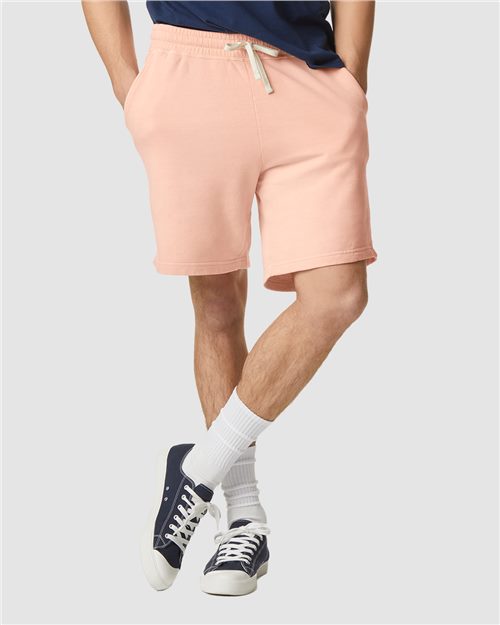
Comfort Colors 1468 wholesale sweat shorts give merch brands a lightweight, garment-dyed bottom that can coordinate with vintage-inspired tees and fleece without feeling like a heavy cold-weather garment. The live Beytees catalog lists a 6.4 oz./yd², 100% ring-spun U.S. cotton jersey construction, a relaxed fit, a natural flat drawcord, jersey-lined side pockets, differential rise, side seams, and a signature twill label.
Those details make the 1468 useful for campus shops, resort merch, fitness and wellness brands, summer collections, creator drops, spirit wear, and matching sets. They also create production questions that do not exist on a flat T-shirt. The waistband, pockets, seams, drawcord, curved body shape, and garment-dyed surface all affect decoration placement and press setup.
This guide explains how to evaluate the live Comfort Colors 1468 Unisex Garment-Dyed Lightweight Sweat Shorts, plan sizes and colors, test DTF and screen printing, assess embroidery, build coordinated merch sets, and quote a wholesale order without overlooking production costs.
Comfort Colors 1468 wholesale specifications at a glance
| Feature | Published Comfort Colors 1468 specification | Why it matters for buyers |
|---|---|---|
| Fabric weight | 6.4 oz./yd² | Creates a lightweight jersey short rather than a conventional heavy fleece bottom |
| Fiber content | 100% ring-spun U.S. cotton, 31 singles | Provides a cotton print surface and requires exact-color heat testing |
| Construction | 100% ring-spun U.S. cotton jersey with cotton threads | Supports a casual hand and a coordinated garment-dyed appearance |
| Dye process | Garment-dyed for a lived-in feel and minimal shrinkage | Creates vintage character, while making shade and lot approval important |
| Fit | Relaxed fit with differential rise | Supports casual styling, but should be confirmed with a try-on sample |
| Waist detail | Natural colored flat drawcord | Adds a visible design element and affects waistband decoration planning |
| Pockets | Jersey-lined side pockets | Adds utility, but creates extra layers and pressure changes near the decoration area |
| Body construction | Side seams | Provides stable reference points for placement and size checks |
| Label | Signature twill label | Must be considered in any private-brand presentation or relabeling plan |
| Current Beytees range | Six listed colors; sizes S through 2XL | Supports a focused adult assortment that must be matched to the real roster |
The specifications, colors, sizes, and measurements in this guide reflect the live Beytees and supplier-connected product records checked on August 27, 2026. A catalog option is not a guarantee that every size and color is available at the same moment. Confirm live inventory before promising a drop date, team deadline, or reorder.
What makes the Comfort Colors 1468 different from fleece sweat shorts?
The word “sweat shorts” can suggest a thick fleece bottom, but the 1468 is published as 6.4 oz cotton jersey. That distinction matters. Jersey generally creates a lighter, more T-shirt-like hand, while fleece has a lofted interior and usually feels more substantial. The 1468 is therefore better understood as a relaxed garment-dyed jersey short with sweat-short styling.
That direction can work well for warm weather, indoor events, casual uniforms, travel sets, and transitional collections. It can also coordinate with lightweight garment-dyed tops without making the outfit feel too heavy. Buyers who want plush fleece, winter warmth, or a highly structured athletic bottom should sample alternatives before assuming the 1468 will meet that brief.
The 100% cotton jersey surface is familiar to many decorators, but the garment shape is not the same as a tee. Pocket bags, seams, the elasticized waist area, the drawcord, and the differential rise create changing layers and contours. A successful shirt print recipe does not automatically become a successful shorts recipe.
How the garment-dyed finish affects a merch program
Comfort Colors uses garment dyeing to create a lived-in character. The garment is assembled before the dye process, which helps the fabric, cotton threads, and finished components share a washed visual language. That character is a major selling point for vintage, collegiate, coastal, resort, and lifestyle merchandise.
It also means buyers should treat shade as a controlled variable. Garment-dyed products can show natural variation between production lots. A digital swatch, color name, or prior purchase is not a physical color standard. For a color-critical launch, approve a current sample under the lighting in which the product will be sold or worn.
Keep the approved sample and identify whether split shipments or later reorders may come from different lots. If the same drop includes a top and bottom, do not assume that two products with the same color name will be a perfect set. Approve the actual garments together. The 2026 blank apparel color guide provides a broader framework for building a commercial palette without relying only on a screen preview.
The live product record also states that the style contains U.S.-grown BCI cotton and is made in a facility certified by OEKO-TEX and the Fair Labor Association. Buyers evaluating those claims can review the role of Better Cotton and request current documentation appropriate to their own compliance, marketplace, or customer requirements. A product-page statement should not be expanded into a claim the supporting documentation does not make.
Current colors and how to merchandise them
The live Beytees record currently lists Blue Jean, Hydrangea, Ivory, Neon Violet, Peachy, and Pepper. It is a compact assortment with several clear merchandising directions:
- Blue Jean supports washed collegiate, lake, coastal, and everyday lifestyle concepts.
- Hydrangea can anchor spring, resort, floral, wellness, or soft-color collections.
- Ivory offers a warm neutral base, but decoration contrast and opacity must be sampled.
- Neon Violet creates a high-energy direction for camps, events, creator drops, and statement merch.
- Peachy fits warm seasonal palettes, vacation themes, and coordinated pastel sets.
- Pepper supports washed black and vintage-band styling without looking like a flat jet-black blank.
Choose colors from the finished collection brief, not from popularity alone. The garment color, print colors, top style, packaging, photography, and sales environment should work as one system. For a three-color launch, a practical assortment might include one dark neutral, one light neutral, and one expressive color. The exact choice should follow physical approval and real inventory.
Test decoration on every approved garment color. An Ivory sample does not prove opacity on Pepper, and a transfer that looks clean on Blue Jean may respond differently on Neon Violet. Record the blank color, decoration batch, equipment settings, and wash result so the approved combination can be repeated.
Comfort Colors 1468 sizing and finished measurements
The live catalog lists S, M, L, XL, and 2XL. Supplier-connected finished measurements list a 7.5-inch inseam for all five sizes, with an inseam tolerance of plus or minus 1 inch. The relaxed waist measurement progresses by size.
| Size | Relaxed waist | Inseam | Published tolerance |
|---|---|---|---|
| S | 15 inches | 7.5 inches | Waist plus or minus 0.75 inch; inseam plus or minus 1 inch |
| M | 16 inches | 7.5 inches | Waist plus or minus 0.75 inch; inseam plus or minus 1 inch |
| L | 17 inches | 7.5 inches | Waist plus or minus 0.75 inch; inseam plus or minus 1 inch |
| XL | 18 inches | 7.5 inches | Waist plus or minus 0.75 inch; inseam plus or minus 1 inch |
| 2XL | 19.5 inches | 7.5 inches | Waist plus or minus 0.75 inch; inseam plus or minus 1 inch |
Finished-garment measurements are not body measurements. Confirm how the waist was measured, compare the table with a pair the wearer already owns, and use an actual try-on sample whenever fit drives returns or team satisfaction. The drawcord offers adjustment, but it does not make one size suitable for every body or styling preference.
For group orders, collect wearer name, approved size, color, quantity, personalization, and delivery location in one controlled roster. Freeze the roster at a stated deadline. If the program needs sizes beyond 2XL, approve a companion bottom or select another primary style before sales open.
Is the Comfort Colors 1468 good for DTF printing?
The 100% cotton jersey surface makes the 1468 a logical DTF test candidate. The main challenge is not fiber content alone. It is creating level, consistent pressure on a garment with pockets, seams, a curved body, and an elasticized waist area.
Common decoration zones include the lower left leg, lower right leg, a small mark near the pocket, or a larger front-leg graphic. Avoid assuming a pocket edge or side seam can sit under the platen without changing pressure. A tested pressing pillow, alternate platen, or garment-loading method may help isolate the print zone, but the complete setup must be validated.
DTF approval sequence for Comfort Colors shorts
- Choose the exact production color and a representative size.
- Mark the proposed print location while the shorts are worn or positioned on a fit form.
- Check the back of the decoration zone for pocket bags, seam allowances, or multiple fabric layers.
- Load the garment so the print area is level and the drawcord stays clear of the heat zone.
- Follow the transfer supplier’s current time, temperature, pressure, and peel instructions.
- Inspect immediately for shine, press boxes, seam impressions, incomplete adhesion, and color change.
- Let the sample cool fully, then inspect the garment-dyed shade and transfer again.
- Launder the sample according to the intended customer care plan.
- Check adhesion, cracking, edge lift, hand, pocket function, shape, and shade after washing.
- Retain the approved sample and production record for the order and future reorders.
Large solid transfers can change the hand of a lightweight jersey short. Artwork with negative space or a smaller mark may preserve more of the casual feel. Evaluate the finished sample as merchandise, not only as an adhesion test. For additional garment-dyed controls, use the DTF printing on Comfort Colors guide.
Screen printing the Comfort Colors 1468
Screen printing can be effective for larger runs, one-color collegiate marks, camp merchandise, club graphics, and coordinated retail collections. The 100% cotton jersey is a familiar ink surface, but the shorts still need a garment-specific setup.
Choose a location that can sit flat on the platen without placing pocket bags or thick seams under the image. Confirm that the waistband, drawcord, and elastic area remain clear of flash and cure equipment. The print needs complete cure, but excessive heat can change the garment surface, leave marks, or affect the washed appearance.
Artwork should be built for the real decoration zone. A logo designed for a full tee front may become unreadable when reduced to the leg. Test line weights, type size, ink coverage, underbase needs, and placement on every approved color. A dark Pepper short and light Ivory short may require different print engineering even when the graphic appears identical.
Run a production-size sample through the planned wash test and compare it with the unprinted control. The broader wholesale screen-printing blank guide explains ink, artwork, sampling, and production controls that also apply when adapted to shorts.
Can you embroider the Comfort Colors 1468?
Embroidery can work for a compact monogram, club mark, resort logo, or small lifestyle emblem, but lightweight cotton jersey is not a rigid woven fabric. Excessive stitch density, aggressive hooping, unsuitable backing, or a large filled design can cause puckering, distortion, stiffness, and discomfort.
Digitize the artwork for the final size and actual jersey. Keep fine text realistic, reduce unnecessary density, select backing for the design and fabric, and avoid stretching the shorts in the hoop. The inside finish matters because the garment sits against the leg and may be worn in warm weather.
Test pocket access and drape after embroidery. A mark placed too close to a pocket opening can interfere with use, while a dense design can make the leg hang differently. Launder the decorated sample and inspect puckering, thread appearance, shape, backing, and wearer comfort before approving a bulk run.
Building matching wholesale merch sets
The 1468 becomes more commercially interesting when it is treated as part of a collection rather than a standalone bottom. A merch set can pair the shorts with a garment-dyed tee, tank, long sleeve, lightweight crewneck, or hoodie. The goal is not simply to choose two products with the same brand name. The colors, weights, fits, decoration scale, and selling season must work together.
For warm-weather sets, compare the shorts with lightweight and heavyweight garment-dyed tee directions in the Comfort Colors 1717 versus 4017 guide. For cooler transitional collections, the Comfort Colors 1466 versus 1566 crewneck comparison explains lightweight and heavyweight fleece tradeoffs.
Approve the complete set on a person or fit form. Compare color harmony, not just color names. Check whether the top covers the shorts decoration, whether both graphics compete for attention, and whether the combined blank cost supports the intended retail price.
A disciplined set can use one hero graphic on the top and a small coordinating mark on the shorts. Another approach uses tonal decoration on both pieces for a premium, restrained look. The right choice depends on the audience, artwork, price point, and sales channel.
Best use cases for Comfort Colors 1468 bulk orders
The style is a strong candidate when the buyer wants garment-dyed character, lightweight cotton jersey, usable pockets, a relaxed unisex direction, and a focused S through 2XL assortment. Potential programs include:
- College organizations, sororities, fraternities, alumni groups, and campus stores
- Resorts, camps, lake houses, beach shops, and vacation merchandise
- Yoga, pilates, wellness, dance, and lifestyle brands
- Creator drops, music merchandise, and vintage-inspired streetwear capsules
- School spirit stores, clubs, summer teams, and fundraising collections
- Cafes, boutiques, salons, and local businesses selling casual branded goods
- Family reunions, retreats, destination events, and group travel
The style is less suitable when the program requires extended sizes beyond the current range, a formal uniform appearance, heavy fleece warmth, technical moisture management, or exact shade matching across repeated lots. Those are selection constraints, not defects. Define the program before choosing the blank.
How to quote Comfort Colors 1468 wholesale orders profitably
A profitable quote includes much more than the blank price. Account for artwork cleanup, transfer or ink cost, screen setup, embroidery digitizing, stitch count, sample garments, spoilage, size-related price differences, personalization, folding, bagging, relabeling, freight, rush labor, and replacement units.
Shorts can add handling time because they may need a smaller platen, special loading, pocket isolation, or more careful placement. Measure the real production cycle instead of borrowing a shirt labor rate. If the order includes a matching top, quote both pieces and the set pack-out explicitly.
Lock these fields before purchasing:
- Exact blank: Comfort Colors 1468 Unisex Garment-Dyed Lightweight Sweat Shorts
- Approved garment color, lot expectations, and authorized substitute
- Size quantities within the verified S through 2XL range
- Decoration method, artwork revision, dimensions, and exact placement
- Approved press, ink, thread, backing, and wash-test record
- Top style and color if the order is sold as a matching set
- Folding, bagging, labeling, barcode, and delivery requirements
- Purchase deadline, production schedule, and customer approval owner
- Reorder, shortage, shade variation, substitution, and replacement policy
For recurring programs, use the controls in the custom apparel inventory management guide. Retained samples, documented reorder points, approved alternatives, and complete specifications reduce emergency decisions.
Bulk ordering and production checklist
- Define the audience, selling season, use case, target retail price, and required delivery date.
- Confirm that the 6.4 oz cotton jersey direction matches the desired hand and climate.
- Order the exact colors and representative sizes needed for approval.
- Compare finished measurements with the target customer or roster.
- Approve garment shade, fit, pocket function, drawcord, rise, and inseam.
- Choose a decoration zone that can be loaded flat and used comfortably.
- Create production-size artwork for the selected leg or pocket-adjacent area.
- Test the exact DTF, screen-print, or embroidery system on each approved color.
- Inspect the immediate result for marks, distortion, adhesion, coverage, and hand.
- Complete the planned wash and wear test.
- Approve the full top-and-bottom combination if the product is a merch set.
- Recheck live inventory before taking payment or promising a firm deadline.
- Freeze the roster, artwork revision, placement, and pack-out instructions.
- Purchase the blanks and retain a controlled buffer for testing and spoilage.
- Compare production units with the approved sample throughout the run.
- Perform final quality control for size, color, placement, decoration, pockets, drawcord, labels, and packaging.
Final verdict
The Comfort Colors 1468 is a compelling wholesale blank for brands that want a relaxed, garment-dyed short with lightweight 100% cotton jersey, practical side pockets, a flat natural drawcord, and a focused vintage-inspired color assortment. It can support summer drops, campus merchandise, resort programs, wellness brands, group events, and matching lifestyle sets.
Its most important production controls are equally clear. Buyers should approve actual shade and fit, treat finished measurements as garment measurements rather than body measurements, isolate pocket and seam layers during heat application, test every garment color, and price the extra handling required by a shorts silhouette.
Visit the live Comfort Colors 1468 wholesale product page to review current colors, sizes, pricing, and inventory. Then approve a decorated sample, retain the production record, and build the bulk order around verified availability.
Frequently asked questions
What are Comfort Colors 1468 sweat shorts made of?
The published specification lists 6.4 oz./yd², 100% ring-spun U.S. cotton jersey at 31 singles, with cotton threads. The style is garment-dyed for a lived-in feel.
Are Comfort Colors 1468 shorts fleece?
The live product record describes the fabric as cotton jersey, not conventional brushed fleece. Buyers wanting a plush or cold-weather short should compare a physical sample with heavier fleece alternatives.
What sizes does Beytees list for the Comfort Colors 1468?
The current live catalog lists S, M, L, XL, and 2XL. Confirm inventory for the exact color and size combination before approving a deadline.
What is the inseam on Comfort Colors 1468 shorts?
The supplier-connected finished measurements list a 7.5-inch inseam for S through 2XL, with a published tolerance of plus or minus 1 inch.
What colors are currently available in the Beytees catalog?
The live catalog currently lists Blue Jean, Hydrangea, Ivory, Neon Violet, Peachy, and Pepper. Catalog listing does not guarantee that every size-color combination is in stock.
Can you use DTF transfers on Comfort Colors 1468 shorts?
DTF is a logical method to test on the cotton jersey surface. The exact garment color, transfer, print location, pocket layers, equipment settings, and wash result must be approved before production.
Can you screen print Comfort Colors 1468 shorts?
Yes, screen printing can be evaluated for leg graphics and compact marks. Use a flat decoration zone, keep the drawcord and waistband clear of heat, and test the ink and cure system on every approved color.
Can Comfort Colors 1468 shorts be embroidered?
Compact embroidery can be tested, but lightweight jersey needs suitable digitizing, backing, hooping, needle, and density. Approve the design after laundering and confirm that it does not interfere with pocket use or comfort.
Do Comfort Colors 1468 shorts have pockets?
Yes. The published specification lists jersey-lined side pockets. Decorators should check the pocket bag behind the proposed print or embroidery location because the extra layer can change pressure and stability.
Are Comfort Colors 1468 shorts good for matching merch sets?
They can be an effective lightweight bottom for garment-dyed tees, tanks, crewnecks, and hoodies. Approve the actual colors together because matching color names do not guarantee an exact shade match across different products or lots.
What should be approved before a bulk Comfort Colors 1468 order?
Approve the exact color, size range, finished measurements, fit, artwork, decoration method, placement, physical sample, wash result, matching top, packaging, deadline, and substitution policy. Recheck live inventory immediately before purchasing.
Leave a Reply