Quick Answer: Which Cap Should You Sample First?
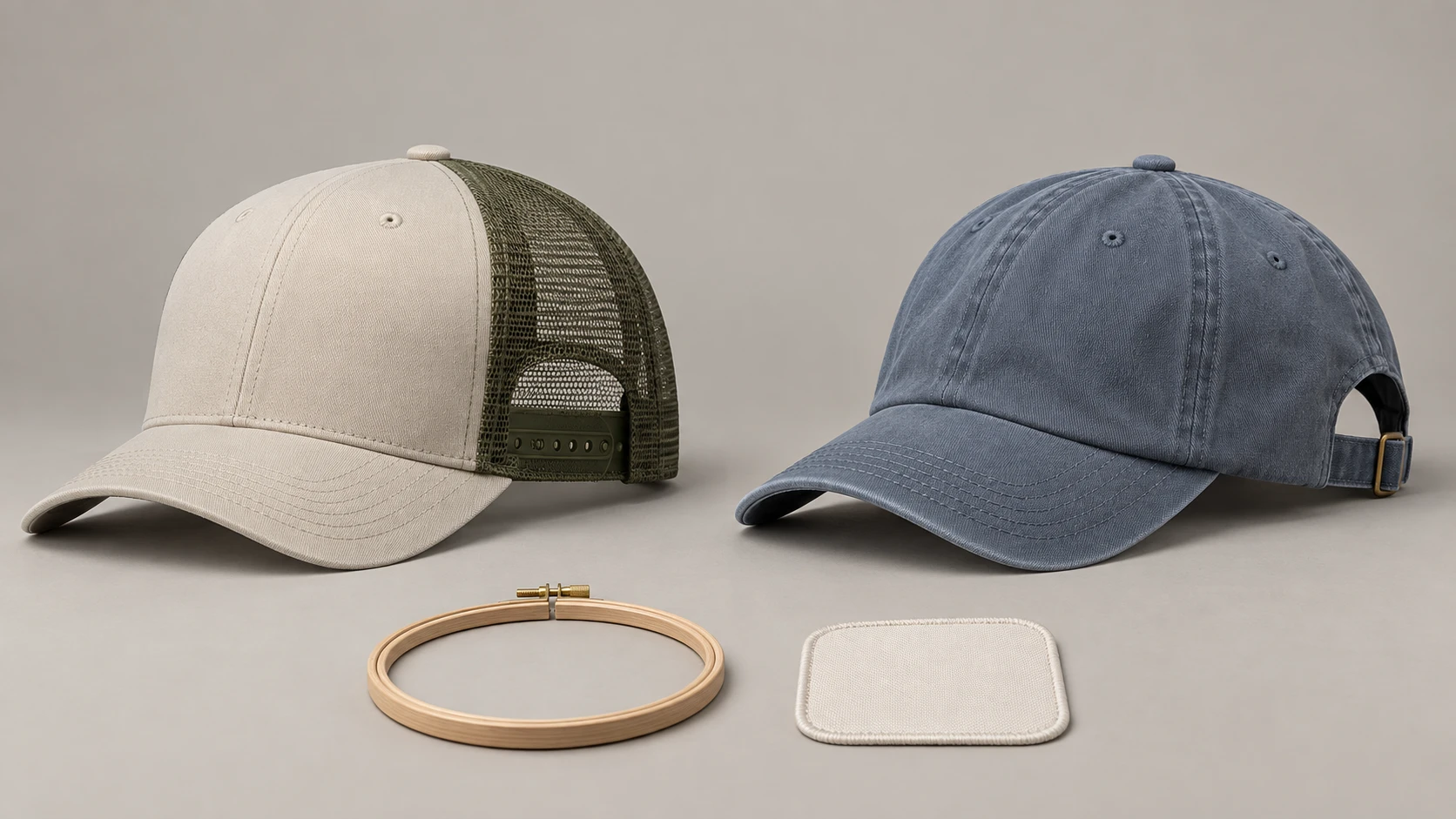
Choose by silhouette before decoration method. Sample the Richardson 112 first when the written brief calls for a structured, six-panel Mid Pro trucker with a twill front, polyester mesh back, pre-curved bill, and plastic snapback. Sample the Valucap VC300A first when the brief calls for an unstructured, six-panel, low-profile dad hat made from bio-washed cotton chino twill with a fabric strap and antique-brass buckle.
The Richardson 112 vs Valucap VC300A decision is not a contest between a universally better and worse cap. These styles create visibly different merchandise. Structure, crown profile, rear construction, closure, fabric, artwork proportions, wearer fit, and the completed decoration system should decide the order. A logo that looks balanced on one cap may need a different size or placement on the other.
Test both when the buyer has not approved the silhouette, when fit depends on representative wearers, or when embroidery, patches, transfers, care, exact-variant availability, substitution rules, and landed cost remain unresolved. A production-equivalent sample is more reliable than applying one model’s results to the other.
Richardson 112 vs Valucap VC300A at a Glance
Start with the exact Richardson 112 Beytees product record and Valucap VC300A Beytees product record. Cross-check the Richardson 112 manufacturer page and the Sportsman VC300 family page. The Sportsman page uses VC300 rather than VC300A, so it supports the family construction without independently proving the A suffix. Beytees remains the exact source for the buyer-facing VC300A identity.
| Decision factor | Richardson 112 | Valucap VC300A | Buyer action |
|---|---|---|---|
| Silhouette | Structured mesh-back trucker | Unstructured all-fabric dad hat | Approve the merchandise direction before comparing decoration |
| Crown | Six-panel, Mid Pro profile | Six-panel, low-profile | Fit representative wearers and approve artwork proportions on-cap |
| Main material | 60/40 cotton-polyester front with 100% polyester mesh back | 100% cotton bio-washed chino twill | Verify the exact received style, color, labels, and sample |
| Bill or visor | Pre-curved bill | Pre-curved visor | Do not assume identical curve, depth, or decoration field |
| Closure | Adjustable plastic snapback | Self-fabric tri-glide buckle with antique-brass finish | Inspect the rear presentation and test wearer adjustment |
| Rear construction | Polyester mesh | Cotton chino twill panels | Choose the visible back treatment required by the brief |
| Label evidence | No tear-away claim established in reviewed exact sources | Tear-away label | Review relabeling requirements separately from decoration |
This table is a sourcing screen, not a substitute for receiving inspection. Product selectors, colors, and size terms can change. Before committing to a bulk run, confirm the exact style number, color, size, closure, label, material, and current availability on the received blank. Record the approved sample so a later reorder is compared with the right reference.
Richardson 112: Structured Mid Pro Trucker Profile
The Richardson 112 is a structured, six-panel Mid Pro trucker. Its front is a 60/40 cotton-polyester blend, while the rear is 100% polyester mesh. The style uses a pre-curved bill and an adjustable plastic snapback. Together, those details create the familiar trucker-cap presentation: a supported front, visible mesh at the back, and a closure that reads as casual and utility-oriented.
That construction can suit teams, crews, outdoor programs, events, promotional merchandise, and retail concepts that intentionally want a trucker silhouette. It does not prove universal fit, comfort, airflow in use, durability, or decoration quality. The supported front can be a useful first sample for some embroidery briefs, but the center seam, crown curve, lower-front clearance, frame setup, backing, density, speed, and artwork still require an exact production test.
Use the existing Richardson 112 buying guide for broader style navigation, then keep this comparison focused on the choice against VC300A. If the buyer is deciding among structured trucker proportions, the Richardson 115 vs 112 comparison provides additional profile context. Neither supporting article replaces the exact blank, artwork, and sample approval for the present order.
Valucap VC300A: Unstructured Bio-Washed Dad-Hat Profile
The Beytees VC300A record describes a 100% cotton bio-washed chino-twill cap with an unstructured, six-panel, low-profile crown, pre-curved visor, self-fabric tri-glide buckle, antique-brass finish, and tear-away label. It is an all-fabric dad-hat direction rather than a mesh-back trucker direction. That distinction should lead the buying decision before anyone compares thread colors or patch types.
An unstructured crown can support understated retail, hospitality, campus, nonprofit, lifestyle, or service-business merchandise when the approved brief calls for a relaxed low-profile shape and fabric strap. It does not automatically mean softer, more comfortable, easier to embroider, more sustainable, or better for every wearer. Bio-washed describes the product treatment in the source; it should not be expanded into an environmental claim.
The first-party Sportsman page uses the model name VC300. Its construction aligns with the family details, but it does not independently establish that VC300 and VC300A are interchangeable identifiers. Keep VC300A in buyer-facing copy because that is the exact Beytees product identity. Confirm the received label and do not use family sizing, case-pack, youth, or fit claims as if they were exact VC300A inventory facts.
The tear-away label may help a buyer evaluate a relabeling workflow, but it does not complete one. Brand removal, replacement labels, fiber-content and origin disclosures, care instructions, legal requirements, and customer approvals remain separate tasks. The broad washed-cap sourcing guide can help with category context without replacing this exact structured-versus-unstructured decision.
Structure, Profile, Fit, and Closure Decide the Merchandise Direction
Structure changes how a cap presents before decoration. The Richardson 112’s supported Mid Pro front holds a defined trucker shape. The VC300A’s unstructured low-profile crown is intended to present more softly. Those are visual and construction differences, not quality rankings. A program that needs a matching uniform silhouette should approve the exact profile before bulk ordering.
Closure also changes the back view and adjustment experience. The 112 uses a plastic snapback. The VC300A uses a fabric strap with a tri-glide buckle and antique-brass finish. Photograph both front and back during sample approval when rear presentation matters. Test adjustment with representative wearers rather than describing either option as universally fitting.
Do not freeze mutable product-selector terms into a long-term promise. Confirm the current size terms, color, and exact variant at order time. If a program needs multiple fit ranges, record which style and size each wearer group approved. A later restock should be checked against that record, not against a generic statement that a cap is adjustable.
Finally, compare actual artwork proportions. The same logo width can feel different on a Mid Pro structured crown and a low-profile unstructured crown. Approve the design at production size on each intended cap. Keep center seams, lower-front clearance, visor proximity, crown curvature, and the visible field in the approval record.
Embroidery and Patch Qualification for Each Cap
Neither cap is a universal embroidery winner. Begin with artwork cleanup and digitizing for the exact cap, then test the complete system: hoop or frame, backing, topping when appropriate, underlay, stitch direction, density, needle, thread, tension, speed, center-seam pathing, lower-front clearance, trimming, inside finish, and laundering. Approve the result from the exact production-equivalent blank.
| Control | Richardson 112 test focus | VC300A test focus | Approval evidence |
|---|---|---|---|
| Crown support | Structured front and center seam | Soft crown support and distortion control | Front, side, and inside sample photos |
| Artwork field | Approve size around seam and lower-front clearance | Approve size against low-profile curvature | Production-size sew-out on exact cap |
| Stitch system | Digitizing, underlay, backing, density, speed, tension | Digitizing, support, backing, density, speed, tension | Recorded approved settings and artwork revision |
| Patch | Conformity to structured crown and mesh proximity | Conformity without excessive stiffness on soft crown | Material, edge, attachment, comfort, and care review |
| QC | Registration, puckering, skipped stitches, trimming | Distortion, puckering, support, trimming | Written acceptance standard and inspected sample |
Patches require their own sample. Verify material identity, size, shape, edge treatment, attachment method, crown conformity, hardware and closure clearance, interior comfort, and care. Do not label leather-look material as genuine leather without documentation. For another structured-cap patch example, use the Richardson 258 embroidery and patch guide only as planning context.
DTF, HTV, Transfers, and Specialized Printing Considerations
Both caps can be evaluated for heat-applied decoration only with cap-specific equipment, the current blank and transfer-system instructions, and a production-equivalent test. Curvature, seams, platen contact, pressure distribution, hardware, and crown support make a finished cap different from a flat apparel panel. A time, temperature, pressure, peel, or repress recipe that works on another cap is not evidence for either exact style.
Inspect adhesion, edge lift, glossing, scorching, shade change, migration where relevant, crown distortion, mesh proximity, and care behavior. Record the exact blank, color, transfer, artwork size, equipment, settings, and result. If the decoration field crosses a seam or approaches the visor, use the test to establish whether the design must be resized or repositioned.
Screen printing on a finished cap is specialized. Do not imply that an apparel screen-print setup transfers automatically to curved headwear. Sublimation is also not a default recommendation for the cotton or cotton-blend front decoration zones. Polyester mesh at the rear of the 112 does not make the front panel a sublimation surface.
When comparing methods, keep the decision practical: Which process can the chosen shop control consistently on the exact style, color, artwork, and quantity? Which sample has been approved? What defects trigger rejection? What care statement is supported? Those questions protect the order better than declaring one cap universally best for DTF, HTV, embroidery, patches, or print.
Use-Case Decision Matrix
Use cases are starting points, not guarantees. A structured trucker can be a logical first sample for a crew or outdoor program, while a dad hat can be a logical first sample for relaxed retail or hospitality merchandise. The final choice still depends on brand direction, representative fit testing, artwork, decoration, current exact-variant availability, and approved economics.
| Written brief | First sample | Why it enters first | What remains to prove |
|---|---|---|---|
| Classic team or crew trucker presentation | Richardson 112 | Structured Mid Pro front, mesh back, snapback | Fit, artwork field, decoration, availability, landed cost |
| Outdoor or event trucker merchandise | Richardson 112 | Brief explicitly requests a mesh-back trucker silhouette | Wearer approval, exact variant, sample performance |
| Relaxed retail or campus dad hat | Valucap VC300A | Unstructured low-profile all-cotton construction | Fit, artwork support, exact color, decoration, care |
| Hospitality or service-business merchandise | VC300A when a fabric buckle dad hat is specified | Back presentation and low-profile direction match the brief | Uniform consistency, fit, decoration, replenishment |
| Patch-led program | Test both | Crown structure changes patch conformity and feel | Material, attachment, stiffness, comfort, care |
| Buyer has not approved silhouette | Test both | The products represent different merchandise directions | Front, side, back, fit, decoration, and cost approval |
Avoid using static price, discount, minimum, stock, warehouse, freight, shipping-speed, lead-time, color-depth, bestseller, or margin claims in the selection brief. Those facts can change. Capture current official evidence during quoting and define what happens if the approved exact style, color, or size is unavailable.
Sample-to-Bulk Buyer Checklist
Use a written sample-to-bulk record so the purchase, decoration, and reorder are tied to the same approved evidence.
- Freeze the brief: customer, use case, silhouette, profile, rear construction, closure, color direction, quantity, in-hand date, and decoration method.
- Confirm the exact blanks: style number, product title, color, size, material, closure, label, and current official availability.
- Inspect received units: shade, shape, stitching, bill or visor, mesh or fabric panels, closure, labels, damage, and consistency.
- Fit-test representative wearers: record who tested which exact style and size without turning the result into a universal fit claim.
- Prepare artwork separately for each cap: approve physical dimensions, placement, center-seam treatment, lower-front clearance, and color.
- Produce exact samples: use the intended decoration system and record machine, material, settings, artwork revision, and operator notes.
- Define QC: registration, puckering, distortion, adhesion, edge lift, stitch defects, trimming, shade variance, interior finish, and care checks.
- Approve front, side, back, and inside: include closure and hardware presentation, not only a close-up of the logo.
- Set substitution rules: no style, color, size, material, or closure substitution without documented review.
- Calculate landed economics: use current blank, decoration, setup, freight, labor, spoilage, and rework evidence rather than evergreen article pricing.
- Archive the decision: retain the approved blank identity, sample photos, artwork and digitizing revision, settings, QC standard, approver, and date.
- Revalidate reorders: inspect current product identity, availability, received units, and any output-changing change before production.
This process keeps the comparison useful even when catalog details change. The article helps identify the first sample; the retained approval record controls the order.
Frequently Asked Questions
What is the main difference between the Richardson 112 and Valucap VC300A?
The Richardson 112 is a structured Mid Pro mesh-back trucker with a plastic snapback. The VC300A is an unstructured low-profile all-cotton chino-twill dad hat with a fabric strap and tri-glide buckle. Approve the silhouette before comparing decoration.
Which cap is structured and which is unstructured?
The Richardson 112 is structured; the Valucap VC300A is unstructured. Structure describes crown construction and presentation. It does not prove that one is more comfortable, durable, or easier to decorate.
What fabrics do the Richardson 112 and VC300A use?
The 112 has a 60/40 cotton-polyester front and 100% polyester mesh back. The VC300A is 100% cotton bio-washed chino twill. Verify the exact received style and color before production.
What closures do the two caps use?
The Richardson 112 uses an adjustable plastic snapback. The VC300A uses a self-fabric tri-glide buckle with an antique-brass finish. Test adjustment with representative wearers and approve the back presentation.
Which cap is better for embroidery?
There is no universal winner. The 112 is a logical first sample for a structured-front brief, while the VC300A requires a soft-crown support plan. Approve digitizing and a production-equivalent sew-out on the exact cap.
Can both caps use patches?
Both can enter a patch test. Verify patch material, size, shape, edge, attachment, crown conformity, stiffness, closure clearance, interior comfort, and care on the exact style.
Can Richardson 112 and VC300A use DTF or HTV?
They can be evaluated with cap-specific equipment and current blank and transfer-system instructions. Test curvature, seams, contact, adhesion, edge lift, scorching, shade change, distortion, and care. Do not reuse an unverified universal recipe.
Can both caps be screen printed or sublimated?
Screen printing on finished caps is specialized and requires an exact process test. Neither cotton or cotton-blend front is a default sublimation surface; the 112’s polyester rear mesh does not change its front-panel composition.
Which cap fits teams, outdoor merch, retail, or hospitality programs?
The 112 is a logical first sample for a specified team, crew, event, or outdoor trucker look. The VC300A is a logical first sample for a specified relaxed retail, campus, nonprofit, service, or hospitality dad-hat look. Fit and production approval remain required.
What should buyers verify before a bulk cap order?
Verify exact style, color, size, received labels, current availability, representative fit, artwork size and placement, decoration sample, QC standard, care, substitution rule, and landed cost. Archive the approved evidence for reorders.
Leave a Reply