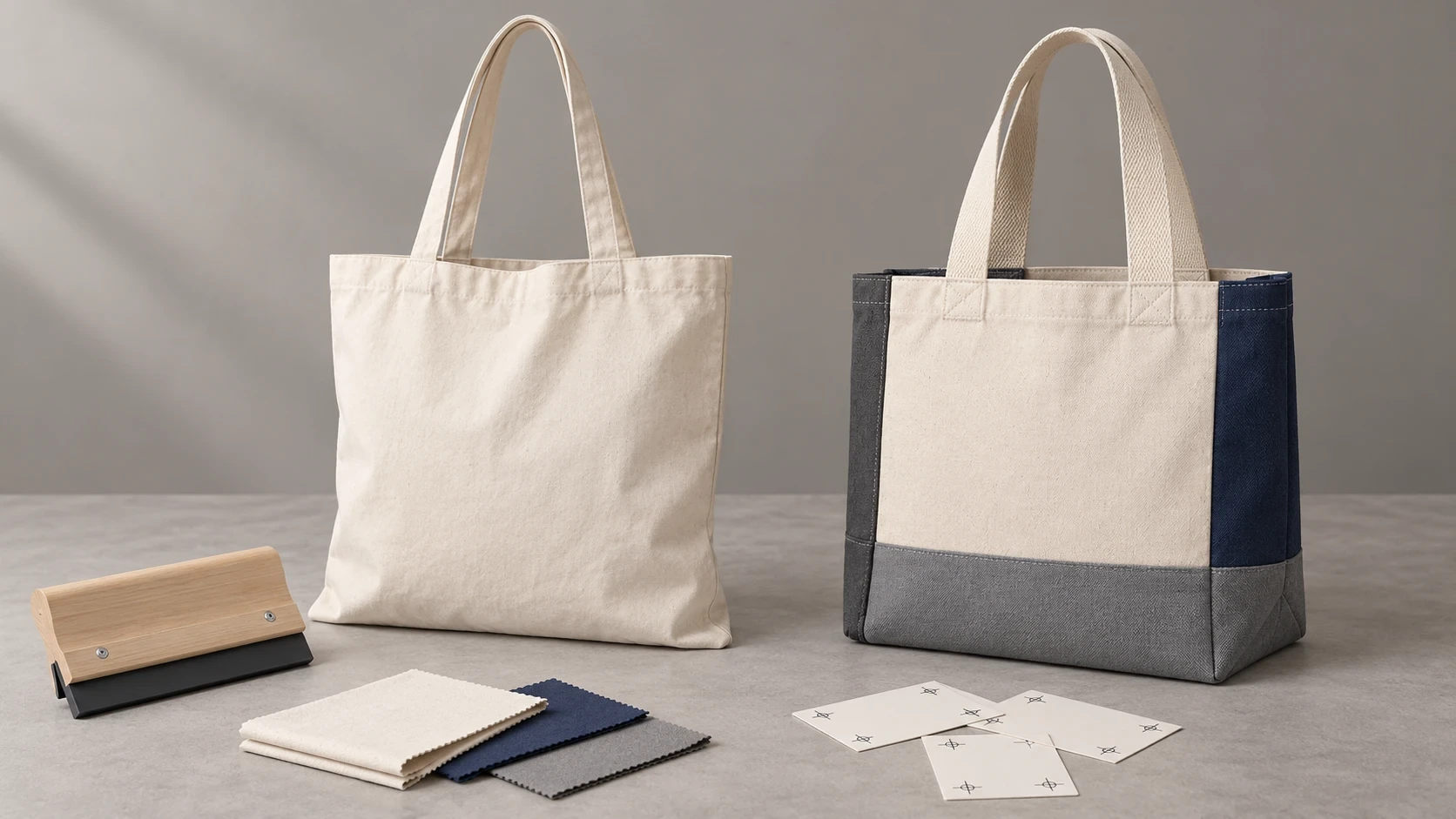
Quick Answer: Which Q-Tees Tote Should You Sample First?
Sample the Q-Tees QTB first when the brief prioritizes a simple, lightweight cotton tote with a large decoration field for giveaways, events, or broad promotional distribution. Sample the Q125900 first when the brief prioritizes heavier cotton canvas, a bottom gusset, webbed handles, and a tri-color retail presentation. This is a sourcing direction, not a universal winner. The exact artwork, carry load, decoration process, packaging plan, quality standard, and landed cost still require approval.
The models solve different jobs. Current sources describe the QTB as a 6 oz 100% cotton economical tote, while the Beytees Q125900 page describes 12 oz 100% heavy cotton canvas. Q-Tees publishes a 15 by 16 inch body and 10 by 12 inch imprint area for QTB. Its current Q125900 page publishes a 15 by 15 by 3 inch body and 8 by 5 inch imprint area. Those published dimensions suggest different artwork and merchandising priorities; they do not prove capacity, load rating, durability, comfort, or print quality.
Handle wording is not fully aligned across current sources. Q-Tees lists a 22-inch natural web handle for Q125900 in its specification bullets, while Beytees lists 20-inch nylon natural webbed handles; the Q-Tees narrative also uses inconsistent “self-handle” wording. Treat the exact received sample and current supplier confirmation as controlling before approving packaging, carry fit, or production.
Verified Q-Tees QTB vs Q125900 Comparison
Begin with the live Q-Tees QTB product page and Q125900 product page. They identify the current Beytees records and core material direction. The matching Q-Tees pages supply body, imprint, handle, case, and color details. None of these pages freezes price, stock, minimums, warehouse availability, freight, delivery, or a decoration result.
| Decision factor | Q-Tees QTB | Q125900 | Buyer treatment |
|---|---|---|---|
| Material direction | 6 oz 100% cotton on Beytees; cotton sheeting on Q-Tees | 12 oz 100% heavy cotton canvas on Beytees | Approve received hand, structure, and decoration behavior |
| Published body | 15″ W × 16″ H | 15″ W × 15″ H × 3″ D | Use physical samples for packing and carry tests |
| Published imprint | 10″ W × 12″ H | 8″ W × 5″ H | Resize and proof the exact artwork for each style |
| Base construction | No gusset stated on reviewed exact pages | 3-inch bottom gusset on Q-Tees page | Do not convert dimensions into a load or volume guarantee |
| Visual direction | Simple economical tote; many solid colors shown | Tri-color tote; seven combinations shown on Beytees | Approve the exact combination and logo contrast |
| Handle evidence | 20½-inch self-fabric handles; 9½-inch drop | Current sources disagree on length and material wording; 8-inch drop is aligned | Confirm current lot and measure samples |
Use the table to select the first sample, never to bypass qualification. Fabric weight, material name, gusset, and published imprint area do not establish finished capacity, seam strength, shrinkage, colorfastness, wash behavior, wearer comfort, print opacity, adhesion, or profitability.
Q-Tees QTB: Economical Cotton Promotion Direction
The current QTB first-party page identifies style QTB as a 100% cotton sheeting tote. Its specifications list a 15-inch-wide by 16-inch-high body, 20½-inch self-fabric handles, a 9½-inch drop, and a 10-inch-wide by 12-inch-high imprint area. Beytees currently adds a 6 oz per square yard US fabric-weight statement.
That combination makes QTB the logical first sample when the written brief calls for an uncomplicated giveaway, conference handout, fundraiser bag, lightweight merch insert, or broad promotional run with a comparatively large published art field. “Economical” is the model’s positioning, not a promise that it will always produce the lowest complete program cost. Printing, spoilage, setup, packing, freight, and replacement exposure remain part of the decision.
Q-Tees currently displays many color names, while Beytees shows 24 options. Color counts and availability can change. Approve the exact product color, decoration ink or transfer color, substrate show-through, and acceptable shade range from current production-equivalent samples rather than relying on a screen swatch.
Q125900: Heavy Canvas Tri-Color Retail Direction
The current Q125900 first-party page identifies a 100% cotton canvas tri-color tote with a 15-inch-wide by 15-inch-high body, 3-inch bottom gusset, 8-inch handle drop, and 8-inch-wide by 5-inch-high imprint area. Beytees currently describes the fabric as 12 oz per square yard US heavy cotton canvas and presents seven color combinations.
Sample Q125900 first for boutique merchandise, donor gifts, employee kits, campus stores, hospitality programs, or branded retail projects where the heavier canvas direction, gusset, webbed-handle presentation, and tri-color styling belong in the brief. Those features do not prove a universal premium impression or better durability. Buyers still need physical review and use-case testing.
The published imprint field is smaller than QTB’s. That can require simplified art, reduced wording, a different lockup, or a revised placement. Tri-color panels also create contrast decisions that a flat logo file cannot settle. Approve each ordered color combination with the intended decoration rather than assuming one proof applies to every variation.
Dimensions, Handles, Gusset, and Carry Testing
Nominal dimensions are planning inputs, not engineering ratings. QTB is published at 15 by 16 inches without a gusset claim on the reviewed exact pages. Q125900 is published at 15 by 15 by 3 inches with a bottom gusset. A gusset changes shape and packing behavior, but no reviewed source establishes a liter capacity, safe load, seam-strength threshold, or suitability for a specific object.
Handle data requires special caution. QTB evidence is aligned around 20½-inch self-fabric handles and a 9½-inch drop. For Q125900, Q-Tees’ top specification says a 22-inch natural web handle and 8-inch drop; Beytees says 20-inch nylon natural webbed handles and 8-inch drop; Q-Tees’ narrative includes conflicting self-handle language. Do not silently choose one. Ask the current supplier, measure received samples, and archive the result by lot.
Run a realistic pack test with the actual contents, protective materials, inserts, and decoration. Record packed dimensions, closure behavior if packaging adds one, handle clearance, hand and shoulder carry, seam appearance, panel distortion, and post-carry presentation. Do not publish or communicate a load rating unless the supplier provides one for the exact current product.
Screen Printing, Transfer, and Embroidery Qualification
Both products are marketed for customization, but that does not make one universal process suitable. For screen printing, qualify artwork dimensions, mesh, stencil, ink system, flash and cure controls, platen setup, off-contact, pressure, number of passes, opacity, hand, blocking, registration, scorching, dye or color interaction, and wash or rub testing appropriate to the program.
The QTB’s larger published imprint area may favor larger campaign art, but lightweight cotton sheeting can behave differently under pressure and ink deposit than heavy canvas. The Q125900’s heavier canvas and smaller published field can change surface texture, contact, and art simplification needs. These are reasons to test, not claims that either fabric will print better.
For heat-applied graphics, follow current instructions for the exact transfer and blank. Record time, temperature, pressure, platen or insert, protective sheet, peel method, visible marks, bond, edge lift, and aftercare. For embroidery, verify hooping, stabilizer, needle, thread, density, pull compensation, panel distortion, interior finish, and carried-item contact. Never reuse a generic recipe without validation.
Promotional vs Retail Tote Use-Case Matrix
Program position should select the first sample. The broader wholesale blank tote guide can help with category discovery, while the Q-Tees Q600 vs Q611 comparison covers a different jumbo open-versus-zippered decision.
| Written brief | First sample | Why it fits the brief | Still to prove |
|---|---|---|---|
| High-volume event giveaway with large front art | QTB | Economical positioning and larger published imprint field | Print result, packing, current cost, stock, and delivery |
| Tri-color boutique or donor presentation | Q125900 | Heavy canvas direction, color blocking, webbed handles, and gusset | Color approval, decoration contrast, carry test, and landed cost |
| Large or detailed screen print | QTB first; test both | QTB publishes 10″ × 12″ versus 8″ × 5″ | Actual printable clearance, texture, opacity, cure, and registration |
| Structured gift kit or retail bundle | Q125900 first | Gusset and heavier-canvas positioning | Pack-out, distortion, presentation, seam behavior, and freight |
| Embroidery or patch program | Test both | Material and panel behavior differ | Stabilization, distortion, attachment, comfort, and repeatability |
| Cost-sensitive reorder program | Quote both | Blank positioning alone does not equal lowest landed cost | All current commercial and production inputs |
Complete Landed Cost and Reorder Controls
Compare the entire approved program, not just a displayed blank price. Include blank quantity, color and case constraints, setup, screens or digitizing, test pieces, labor, ink or transfer, backing, spoilage, rework, packaging, inserts, freight, rush charges, storage, pick-and-pack, replacement allowance, and applicable compliance work. Requote whenever the quantity, color, supplier, destination, method, or required date changes.
A lightweight blank may reduce one cost while increasing another; a heavier canvas tote may support a higher retail position while adding freight or handling. Neither outcome is established by current public sources. Use the same artwork revision, quality standard, delivery assumptions, and accounting boundary when comparing bids.
For reorders, retain an approved decorated sample and a written specification. Recheck product identity, color combination, dimensions, handle construction, imprint placement, decoration inputs, packaging, and current terms. The handle-source discrepancy on Q125900 is a concrete reason to require receiving verification rather than relying on an old record.
Sample-to-Bulk Checklist for Tote Programs
Use one controlled record from sourcing through reorder. Name the approver and define which changes trigger resampling.
| Gate | Required check | Evidence to retain |
|---|---|---|
| Brief | Audience, use, quantity, color, art, pack-out, quality standard, budget, and required date | Approved written specification |
| Blank | Exact style, material statement, weight claim, body dimensions, gusset, handles, labels, and condition | Current source record, sample measurements, and receiving photos |
| Artwork | Revision, physical size, placement, colors, contrast, clearances, and orientation | Approved proof and production file |
| Process | Method, equipment, consumables, settings, operator, lot, curing or attachment controls | Production-equivalent sample record |
| Use | Actual contents, pack-out, carry, panel distortion, handle behavior, and presentation | Dated use-case approval; no unsupported load claim |
| Quality | Shade, dimensions, seams, placement, registration, adhesion, marks, defects, and sampling rate | Written tolerances and retained sample |
| Commerce | Current price, stock, minimums, freight, lead time, packaging, spoilage, rework, and terms | Current quote and landed-cost worksheet |
| Change control | Substitution rule and resampling triggers for lot, source, art, method, settings, or pack-out | Named approver and archived decision |
Frequently Asked Questions
What is the main difference between Q-Tees QTB and Q125900?
QTB is positioned as an economical 100% cotton sheeting tote, with Beytees listing a 6 oz US fabric weight. Q125900 is a tri-color tote that Beytees lists as 12 oz 100% heavy cotton canvas, and Q-Tees lists a 3-inch bottom gusset. They also have different published imprint fields and handle construction.
Which tote has the larger published imprint area?
Q-Tees currently publishes a 10-inch-wide by 12-inch-high imprint area for QTB and an 8-inch-wide by 5-inch-high area for Q125900. Treat those as planning limits from the manufacturer, then confirm actual printable clearance, seams, texture, equipment, and artwork on physical samples.
Is Q125900 larger than QTB?
Not in every nominal direction. QTB is published at 15 inches wide by 16 inches high. Q125900 is published at 15 inches wide by 15 inches high by 3 inches deep. The gusset changes pack-out, but these dimensions do not establish a verified capacity or load rating.
What are the QTB handle specifications?
Current Q-Tees and Beytees information aligns on 20½-inch self-fabric handles and a 9½-inch handle drop for QTB. Buyers should still confirm the received sample, because public product information and current lots can change.
Why do Q125900 handle descriptions need verification?
Current sources do not fully agree. Q-Tees lists a 22-inch natural web handle in its specification bullets, Beytees lists 20-inch nylon natural webbed handles, and Q-Tees narrative wording is internally inconsistent. Both list an 8-inch drop. Confirm with the supplier and measure the received sample.
Which tote is better for screen printing?
There is no universal winner. QTB offers a larger published imprint field, while Q125900 has heavier canvas and a smaller field. Test the exact art, ink system, mesh, platen, pressure, passes, cure, opacity, registration, surface texture, hand, and wash or rub result before production.
Can QTB and Q125900 use heat transfers?
Both are presented as customizable totes, but no reviewed source provides a universal transfer recipe or guaranteed result. Follow the current transfer-system instructions and test time, temperature, pressure, support, peel, marks, bond, edge lift, and aftercare on the exact product and color.
Which tote should a promotional campaign sample first?
Sample QTB first when the brief prioritizes simple economical distribution and a large decoration field. Sample Q125900 first when the brief prioritizes heavier canvas, a gusset, webbed-handle styling, and tri-color presentation. Test both if pack-out, decoration, or complete landed cost decides.
Does 12 oz canvas prove Q125900 is more durable?
No. The heavier published fabric weight describes a material direction, not a verified durability, seam-strength, load, wash-life, or service-life result. Those outcomes depend on construction, lot, use, decoration, care, and quality controls and require appropriate testing.
What should buyers verify before a bulk tote order?
Verify the exact style, color combination, material and weight statement, dimensions, gusset, handles, artwork revision, placement, decoration process, approved sample, pack-out, quality tolerances, substitution rule, current price, stock, freight, lead time, and complete landed cost. Reapprove material changes before reorder.
Leave a Reply