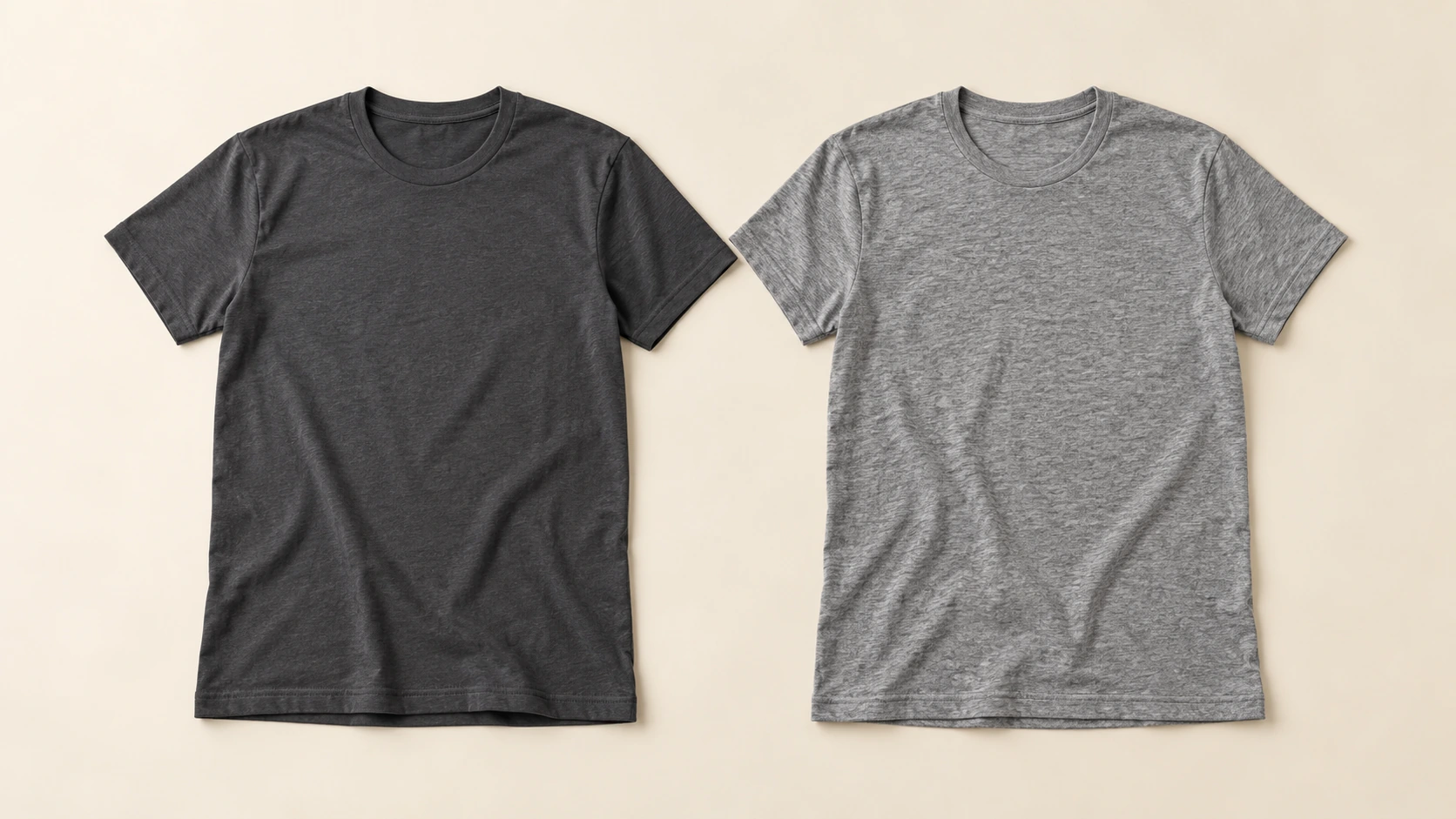
BELLA CANVAS 3001 vs 3001CVC is a base-fiber and color-program decision, not a contest with one universal winner. Both current style records publish the same 4.2 oz./yd² weight and 32-singles figure. The base 3001 is 100% Airlume combed and ring-spun cotton, while Heather CVC colors in the 3001CVC are 52/48 cotton/polyester; named color exceptions change that simple split.
Choose a first sample from the written brief, then qualify the exact style, color, size, fiber label, artwork, decoration process, equipment, and laundering basis. Weight and yarn count do not prove DTF adhesion, screen-print detail, softness, durability, fit, opacity, or a finished merch result.
Quick Answer: 3001 or 3001CVC?
Sample the 3001 first when the approved brief calls for the base 100% Airlume cotton construction or the Ash 99/1 exception. Sample the 3001CVC first when the approved color belongs to its Heather CVC 52/48 assortment or another named blend. The two styles share published 4.2 oz./yd² and 32-singles specifications, so this comparison turns primarily on exact fiber content, exact color, and production qualification rather than a weight difference.
Sample both when hand, wearer preference, shade, print response, fit interpretation, reorder controls, or laundering could change the choice. A passed sample approves only the tested combination. It does not transfer automatically across styles, colors, size constructions, lots, artwork revisions, transfers, inks, presses, operators, or care conditions.
BELLA CANVAS 3001 vs 3001CVC at a Glance
| Decision factor | BELLA + CANVAS 3001 | BELLA + CANVAS 3001CVC | Buyer control |
|---|---|---|---|
| Published US fabric weight | 4.2 oz./yd² | 4.2 oz./yd² | Do not use weight to declare a winner |
| Published yarn figure | 32 singles | 32 singles | Do not convert yarn count into an outcome guarantee |
| Base fiber wording | 100% Airlume combed and ring-spun cotton | Heather CVC colors: 52/48 Airlume cotton/polyester | Freeze the exact style and color |
| Named exceptions | Ash: 99/1 cotton/polyester | 90/10 and 99/1 groups, including a distinct Heather Prism Blue rule | Read the current listing and received label |
| Listed fit wording | Retail fit and unisex sizing on Beytees; mixed tailored/classic wording on the official page | Retail fit and unisex sizing on Beytees; tailored/classic wording on the official page | Measure and wear-test; do not infer same-letter equivalence |
| Listed construction | Pre-shrunk, coverstitched collar and sleeves, shoulder-to-shoulder taping, side seams, tear-away label | The same listed controls | Inspect the received units before production |
Review the current BELLA + CANVAS 3001 product page and BELLA + CANVAS 3001CVC product page before ordering. Their shared weight, yarn figure, and listed construction reduce some variables, but they do not establish identical hand, stretch, shade response, decoration behavior, wash behavior, fit, or reorder consistency.
Nearby content should answer adjacent questions rather than replace this exact comparison. The Gildan 5000 versus 3001 guide compares heavyweight and lightweight specifications, while the 3001 versus Tultex 202 guide evaluates another jersey-tee pair.
BELLA + CANVAS 3001 Cotton Jersey Profile
The current Beytees record lists the 3001 at 4.2 oz./yd² in the US, 7 oz./L yd in Canada, 32 singles, and a base 100% Airlume combed and ring-spun cotton construction. Ash is listed at 99/1 cotton/polyester. It also lists pre-shrunk wording, retail fit, unisex sizing, coverstitched collar and sleeves, shoulder-to-shoulder taping, side seams, and a tear-away label.
The official 3001 page supports the 4.2 oz., 32-singles, base Airlume cotton, Ash 99/1, side-seamed, shoulder-taping, and unisex facts. Its marketing text uses tailored fit while its feature line says classic fit; the seller uses retail fit. Preserve those as source descriptions instead of turning them into one measurement promise.
The 3001 is the logical first sample when the brief requires the base cotton style and an approved 3001 color. That is not proof that it will feel softer, print sharper, last longer, shrink more, fit better, or outperform a CVC option. Those outcomes remain sample questions under a defined process.
BELLA + CANVAS 3001CVC Heather CVC Profile
The current Beytees record lists the 3001CVC at 4.2 oz./yd², 32 singles, and Heather CVC colors at 52/48 Airlume combed and ring-spun cotton/polyester. Athletic Heather and Black Heather are 90/10. Heather Prism colors are 99/1, while the official source separately lists Heather Prism Blue at 90/10. The current color name therefore matters as much as the style number.
The official 3001CVC page supports those four fiber groups, the shared 4.2 oz. and 32-singles figures, side seams, shoulder taping, and unisex sizing. The official and seller pages also use fit marketing language that should not be treated as a size chart or promise of identical measurements across every garment.
The 3001CVC is the logical first sample when the chosen color and brief intentionally call for its verified blend. The 3001CVC versus Gildan 64000CVC guide covers a different exact CVC comparison. Do not import that article’s preference language or process assumptions into this cotton-versus-CVC decision.
Fiber Content, Color, Fit, and Construction Controls
The style suffix is not enough to approve production. Freeze the exact catalog color, retain a screenshot or source record, and read the received garment label. The wholesale CVC T-shirt guide provides broader category context, but the two exact current product records control the facts used here.
| Style and color group | Published fiber content | What remains unproved | Approval evidence |
|---|---|---|---|
| 3001 base colors | 100% Airlume combed and ring-spun cotton | Hand, opacity, shrinkage, durability, decoration result | Exact-color label and production-equivalent sample |
| 3001 Ash | 99/1 Airlume cotton/polyester | Whether Ash behaves like another 3001 color | Separate Ash qualification |
| 3001CVC Heather CVC colors | 52/48 Airlume cotton/polyester | Universal DTF or screen-print advantage | Exact-color print and wash test |
| 3001CVC Athletic Heather and Black Heather | 90/10 Airlume cotton/polyester | Equivalence to the 52/48 group | Separate color-group approval |
| 3001CVC Heather Prism colors | 99/1 Airlume cotton/polyester | Equivalence to cotton 3001 or other Prism shades | Color-specific label and sample |
| 3001CVC Heather Prism Blue | 90/10 Airlume cotton/polyester on the official page | Equivalence to the general Prism rule | Blue-specific verification and test |
Measure representative garments using one documented method. Include the sizes that matter to the order, record chest and body length consistently, and add wearer checks when movement or silhouette matters. Retail, tailored, classic, and unisex are source wording, not evidence that the two styles fit identically or that one same-letter size can replace another without review.
The shared listed construction controls are useful for planning, yet a current listing is not a receiving inspection. Confirm style, color, size, seams, collar, taping, label, shade, and visible defects on delivered units. Reopen approval when a supplier record, color code, size construction, or received label changes.
DTF Testing for Cotton and CVC Jersey
No reviewed exact source supplies a universal DTF temperature, time, pressure, peel, post-press, or wash recipe for either style. Start from the current transfer-system instructions and calibrated equipment. Qualify the exact garment, color, fiber label, artwork dimensions, coverage, placement, transfer batch, press, platen, pressure method, peel, post-press, and care basis.
Inspect immediate adhesion, edges, opacity, surface feel, press gloss, distortion, shade response, seam interference, and artwork readability. Compare the decorated sample with an undecorated control. Launder to the written test basis, then record adhesion, cracking, edge behavior, dimensional change, shade, and garment response.
Polyester percentage alone does not guarantee a better or worse DTF result, and the 100% cotton base does not settle the choice. The exact color groups differ, so a 52/48 approval cannot be extended automatically to 90/10, 99/1, or base cotton. Requalify any change to the controlled combination.
Screen Printing and Other Decoration Tests
Both styles can be evaluated for screen printing, but no current source establishes one universal winner, mesh, underbase, ink deposit, flash, cure, or wash result. Build trials around the actual artwork, garment color, fiber label, and equipment. Review detail, opacity, registration, hand, cure evidence, distortion, and laundering against the buyer’s written standard.
The shared 4.2 oz. and 32-singles specifications keep this from being a simple heavy-versus-light comparison. The broader blank T-shirt weight guide can help frame test planning, but it does not predict which of these two exact styles will pass a specific shop’s art and process.
Qualify embroidery, discharge, bleaching, or other methods separately if the program considers them. Use the intended needle, thread, backing, chemistry, screen, ink, artwork, placement, and care basis. Inspect distortion, puckering, shade response, comfort, and washed results rather than relying on a technique name or fiber percentage.
Merch, Private-Label, and Reorder Controls
Both seller records list tear-away labels, which can help plan a relabeling workflow. That feature does not make either style automatically ready or compliant for private-label sale. Test removal on the received lot, preserve substantiated fiber and source records, inspect the finished result, and obtain qualified guidance for the actual selling context.
Create one approved configuration per style, color, size range, artwork revision, placement, decoration method, label treatment, and QC standard. Retain accepted undecorated and decorated samples. A substitution to another style, blend group, shade, size construction, label, lot, transfer, ink, equipment path, or artwork coverage requires review and may require a new decorated approval.
Keep mutable commerce outside the evergreen decision. Recheck current variants, availability, pricing, freight, production capacity, and landed economics when quoting. A color with one fiber composition is not an approved substitute for a visually similar color with another composition merely because both carry the 3001 family name.
Decision Matrix and Bulk Approval Checklist
| Written brief or open question | First sample | Source-aware reason | Release evidence |
|---|---|---|---|
| Base Airlume cotton required | 3001 in an eligible base color | Current base specification is 100% Airlume cotton | Received label, measurements, decorated and washed sample |
| 52/48 Heather CVC required | 3001CVC in a verified Heather CVC color | Current Heather CVC group is listed at 52/48 | Exact color record, label, decorated and washed sample |
| Ash, Athletic Heather, Black Heather, or Prism considered | The exact named color only | Published exceptions are 99/1 or 90/10 depending on style and color | Color-specific record and label |
| Fit or hand unresolved | Both | Marketing wording and shared specs do not prove equivalence | One measurement method and representative wearer checks |
| DTF or screen result is decisive | Both exact colors | No universal process outcome is established | Production-equivalent decoration and laundering test |
| Private-label or repeat-order release | Every viable configuration | Tear-away labels and prior orders are incomplete controls | Label file, retained samples, receiving check, substitution rule |
Before bulk release, freeze brand, style, color, size terminology, current supplier record, received fiber label, measurement method, artwork revision, placement, process inputs, equipment identity, decorated and laundered sample, QC limits, label plan, receiving checks, and substitution rule. Keep an accepted sample available for production comparison.
The practical decision is narrow: choose the 3001 first for an approved base cotton color, choose the 3001CVC first for an approved blend color, and test both when fiber mix, hand, fit, shade, decoration, laundering, relabeling, or reorder controls could change the answer.
Frequently Asked Questions
Are the BELLA + CANVAS 3001 and 3001CVC the same weight?
Yes. Both current product records list 4.2 oz./yd² in the US and 32 singles. Those shared specifications do not prove identical hand, opacity, stretch, fit, shrinkage, durability, decoration behavior, or finished garment weight.
What is the main difference between the 3001 and 3001CVC?
The base 3001 is listed as 100% Airlume combed and ring-spun cotton, while 3001CVC Heather CVC colors are listed at 52/48 cotton/polyester. Both styles have named color exceptions, so verify the exact color and received label.
Is every 3001 shirt 100% cotton?
No. The base 3001 specification is 100% Airlume cotton, but Ash is listed at 99/1 cotton/polyester. Confirm the current color record and received fiber label rather than extending the base specification to every variant.
Is every 3001CVC color a 52/48 blend?
No. Heather CVC colors are 52/48, Athletic Heather and Black Heather are 90/10, Heather Prism colors are 99/1, and the official page lists Heather Prism Blue at 90/10. Freeze and verify the exact color.
Which style should I sample first for DTF?
Sample the 3001 first when the brief requires an approved base cotton color and the 3001CVC first when it requires a verified blend color. Neither style has a universal DTF recipe or guaranteed result, so qualify the exact production combination.
Which style should I sample first for screen printing?
Start with the style and exact color whose fiber content matches the brief, or test both when the result is decisive. Approve the actual artwork, screen, ink system, cure method, hand, opacity, detail, garment response, and washed sample.
Is the 3001CVC automatically softer or more durable?
No. Fiber percentage, weight, and yarn count do not by themselves prove softness, smoothness, stretch, durability, pilling, shrinkage, or wearer preference. Compare production-equivalent samples under one written evaluation and laundering standard.
Do the 3001 and 3001CVC fit the same?
No exact same-letter equivalence is established here. Current pages use retail, tailored, classic, and unisex wording, but those descriptions are not a shared measurement standard. Measure and wear-test representative units in the needed sizes.
Can both styles support a private-label merch program?
Both seller records list tear-away labels, which can support workflow planning. Label removal does not settle fiber, origin, responsible-business identity, care, recordkeeping, or other finished-garment duties. Test removal and preserve substantiated source information.
What should buyers approve before a bulk reorder?
Approve exact style, color, size terminology, fiber label, measurements, artwork revision, placement, production-equivalent decorated and laundered sample, QC limits, label plan, receiving checks, substitution rule, and current commercial terms. Requalify any material change.
Leave a Reply