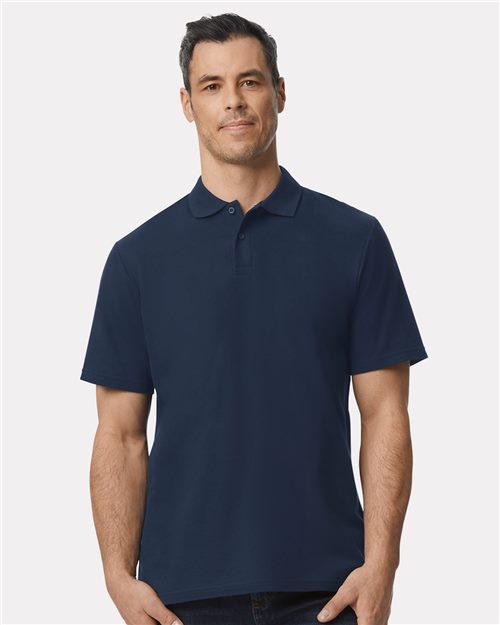
Choosing between pique and jersey polo shirts is not just a style decision. The knit structure affects how a uniform looks, how a logo decorates, how the garment feels during a long shift, and how consistently a reorder performs. For wholesale buyers, the right answer depends on the job the shirt needs to do.
This guide compares pique vs jersey polo shirts wholesale for uniforms, embroidery, DTF transfers, team programs, and branded merchandise. It also uses current Beytees catalog examples, including the Gildan 64800 pique polo, Gildan 8800 jersey polo, and Tultex 400 pique polo, so you can turn fabric theory into a practical buying decision.
Pique vs Jersey Polo Shirts: The Quick Answer
Choose pique when you want a traditional polo appearance, visible knit texture, a more structured body, and a dependable base for classic left-chest embroidery. Choose jersey when you want a smoother surface, softer T-shirt-like hand, easy drape, and a more decoration-friendly face for DTF or other heat-applied graphics.
That is the short answer, but it is not a universal rule. Fiber content, fabric weight, fit, stabilizer, artwork, heat settings, and the wear environment can matter as much as knit structure. A substantial cotton-poly jersey can outperform a very light pique in one program, while a soft ring-spun cotton pique may feel more premium than a basic jersey in another.
- Best classic uniform look: Pique
- Best smooth face for detailed DTF graphics: Jersey
- Best default for small embroidered chest logos: Pique
- Best casual, T-shirt-like comfort: Jersey
- Best moisture-management option in this comparison: A purpose-built blend such as the Gildan 8800 DryBlend jersey polo
- Best premium cotton-forward example in the current Beytees catalog: The Gildan 64800 Softstyle pique polo
What Is Pique Fabric?
Pique is a knit construction with a raised, textured face. Depending on the exact knit, the surface may look like small cords, waffles, diamonds, or honeycomb shapes. That texture is closely associated with the traditional polo shirt, which is why pique often reads as more structured and uniform-ready than a smooth knit.
The small pockets of texture can help the garment feel airy, but breathability also depends on fiber content, fabric weight, finishing, and fit. A dense, heavy pique is not automatically cooler than a lighter jersey. Buyers should compare the whole specification instead of treating the fabric name as a performance guarantee.
Pique usually holds its shape well around the placket, collar, and body. That makes it useful for restaurant uniforms, front-desk teams, sales staff, trade-show crews, school staff, and corporate apparel programs that need a recognizable polo silhouette.
Typical strengths of pique polos
- Traditional, professional polo appearance
- Visible texture that adds depth to solid colors
- More structure through the body than many jersey polos
- Reliable foundation for modest left-chest embroidery when correctly stabilized
- Good fit for uniforms, hospitality, corporate programs, and premium merch
Typical limitations of pique polos
- The textured face can show through thin or very detailed heat transfers
- Small printed text may be less crisp than it is on smooth jersey
- Some pique fabrics feel firmer than buyers expect
- Dense embroidery can still pucker or distort the knit without correct backing and hooping
What Is Jersey Fabric?
Jersey is the smooth knit most people associate with T-shirts. It generally has a flatter face, softer drape, and more casual hand than classic pique. When used in a polo, jersey combines a collar and placket with the comfort and visual familiarity of a tee.
The smoother surface is useful for DTF transfers, screen printing, and other applications where the graphic needs to sit evenly across the fabric. Fine edges and small details usually have a more predictable base than they do on a pronounced pique texture. Jersey can also feel less formal, which may be a benefit for service teams, event crews, schools, and brands that want approachable uniforms.
Jersey is not automatically lightweight or fragile. The current Gildan 8800 product record, for example, specifies a 6 oz./yd² 52/48 cotton-poly knit. That is a substantial polo fabric with a classic fit, contoured welt collar and cuffs, and moisture-wicking positioning.
Typical strengths of jersey polos
- Smooth face for DTF transfers and printed artwork
- Soft, familiar, T-shirt-like hand
- Easy drape and a less rigid uniform look
- Good option for mixed decoration programs
- Often comfortable for long shifts and casual environments
Typical limitations of jersey polos
- May look more casual than a textured pique polo
- Can stretch or shift during embroidery if hooping and stabilization are weak
- Heavy stitch counts can overwhelm the knit
- Very smooth fabric may show pressing marks or transfer outlines more clearly, so testing still matters
Pique vs Jersey Polo Comparison
| Buying factor | Pique polo | Jersey polo |
|---|---|---|
| Surface | Raised and textured | Smooth and T-shirt-like |
| Visual style | Traditional and structured | Casual and approachable |
| Embroidery | Strong default for modest logos with proper backing | Works well, but usually needs careful stabilization and controlled density |
| DTF transfers | Possible, but texture may affect fine detail | Generally the easier surface for crisp heat-applied graphics |
| Drape | Usually holds shape more firmly | Usually softer and more fluid |
| Uniform formality | Higher | Lower to medium |
| Artwork flexibility | Best with compact embroidery and simpler transfers | Better for mixed print sizes and detailed DTF art |
| Best use cases | Corporate, hospitality, retail, premium team apparel | Events, schools, service teams, casual staff, printed merch |
This table describes common tendencies, not guarantees. Always test the exact blank, color, size, and decoration combination before approving production.
Current Wholesale Polo Examples at Beytees
Gildan 64800 Softstyle Pique Polo
The Gildan 64800 Unisex Softstyle Pique Polo is a cotton-forward option for buyers who want a refined pique surface without moving to a stiff, old-school uniform feel. The current catalog record lists 5.2 oz./yd² fabric, 100% ring-spun cotton at 31 singles, with Sport Grey listed as a 90/10 cotton-polyester blend.
Its double-pique construction, modern classic fit, clean-finished placket, dyed-to-match buttons, rolled-forward shoulders, side seams, and tear-away label make it a useful starting point for corporate programs and premium branded merchandise. The live catalog currently lists sizes S through 4XL and 13 color terms. Because availability can change by color and size, buyers should confirm the product page before finalizing a roster.
Best fit: Polished uniforms, premium merch, cotton-forward programs, and modest embroidery.
Gildan 8800 DryBlend Jersey Polo
The Gildan 8800 Unisex DryBlend Jersey Polo gives buyers a smooth jersey face with a 52/48 cotton-polyester knit. The current product data lists 6 oz./yd² fabric, 20 singles, moisture-wicking positioning, a classic fit, contoured welt collar and cuffs, a clean-finished placket with dyed-to-match buttons, and a tear-away label.
The live catalog currently shows sizes S through 5XL and 19 color terms, giving larger uniform programs useful range. Its smooth face makes it the natural comparison choice for DTF and other printed decoration, while the substantial blend can still support embroidery when the design and backing are appropriate.
Best fit: Value-conscious team orders, broad size runs, moisture-aware work settings, DTF decoration, and mixed embroidery-plus-print programs.
Tultex 400 Sport Pique Polo
The Tultex 400 Men’s 50/50 Sport Pique Polo offers a heavier blended alternative. Its current catalog record lists a 6.7 oz./yd² 50/50 USA premium cotton-polyester pique, contoured welt collar and cuffs, a three-button placket, banded sleeves, a double-needle bottom hem, and a tear-away label.
The live catalog currently lists sizes S through 2XL and seven color terms. That narrower range may suit a controlled team assortment more than a large national program with extensive extended-size needs, but the heavier pique construction can appeal to buyers who prioritize substance and a traditional uniform hand.
Best fit: Smaller uniform programs, buyers who prefer heavier pique, and straightforward embroidered branding.
Which Polo Is Better for Employee Uniforms?
Pique is usually the safer visual choice when management wants a clearly professional uniform. The texture and structure make even a simple solid color feel intentional. It works especially well for customer-facing teams, restaurant hosts, retail associates, account managers, office staff, and trade-show representatives.
Jersey is often better when comfort, movement, and approachability matter more than traditional formality. Delivery teams, event staff, school volunteers, warehouse coordinators, field crews, and casual service businesses may prefer a jersey polo because it wears more like a T-shirt while still looking more finished than a crewneck.
For a multi-role company, one fabric does not have to serve everyone. A practical program might use pique for customer-facing staff and jersey for active teams, while keeping the same garment color and logo placement. The program remains visually consistent without forcing every employee into the same construction.
If you are planning a school or team rollout, use the roster and reorder controls in our wholesale blank apparel guide for schools and teams.
Which Polo Is Better for Embroidery?
Pique is the traditional embroidery choice because its structure supports a compact logo and the textured surface already feels consistent with stitched decoration. A well-digitized left-chest mark can look premium on a pique polo, especially when the artwork uses bold shapes, readable text, and moderate stitch density.
That does not mean pique is foolproof. The raised knit can allow small stitches to sink between texture points. Fine text, thin outlines, and tiny negative spaces may close up. A qualified decorator may use underlay, adjust density, select an appropriate needle, and add topping or backing depending on the specific fabric and design.
Jersey can also embroider well, but the operator must manage stretch and distortion. The smoother face helps details remain visible, yet the knit may move more easily under the needle. Cut-away backing is often the safer starting point for stretchy or soft jersey, while design density should be kept under control. Do not assume that a thicker logo is a better logo.
Embroidery approval checklist
- Digitize for the actual finished size, not just the screen preview.
- Keep small lettering large enough to remain open after stitching.
- Confirm the stabilizer and hooping method on the exact garment.
- Approve a sew-out on the actual polo color.
- Wash and dry the sample according to the care instructions.
- Check the logo again after laundering for puckering, edge lift, and distortion.
For a broader blank selection, see the wholesale polo guide for corporate embroidery.
Which Polo Is Better for DTF Printing?
Jersey usually wins for DTF because its smooth face gives the transfer an even surface. Fine lines, compact text, gradients, and clean borders generally reproduce more predictably when the knit is flat. The Gildan 8800 is especially relevant when a buyer wants a polo silhouette but needs graphics that feel closer to decorated T-shirt artwork.
Pique can accept DTF, but the texture may telegraph through the film. Large solid areas may look uneven, and very fine detail can lose visual sharpness as the garment bends. Pique works better when the artwork is bold, not overly large, and positioned on a stable section of the garment.
Heat testing is essential for both constructions. Cotton-poly blends can react differently by color, and polyester content can create dye-migration or gloss risks under some time, temperature, and pressure combinations. A press setting that works on a white cotton-forward polo may not be appropriate for a dark blended polo. Follow the transfer supplier’s instructions, then test the specific blank and color before production.
DTF approval checklist
- Use a production transfer, not a different film or powder sample.
- Test the exact color because dyes can respond differently to heat.
- Keep the placket, buttons, seams, and collar outside the pressure zone.
- Use a pressing pillow or platen setup that produces even pressure.
- Inspect after the recommended peel and finishing press.
- Run a wash test before decorating the full order.
How Fabric Weight Changes the Decision
Knit type should never be evaluated without fabric weight. A light pique and a heavy pique do not behave the same way, just as a lightweight jersey and a 6 oz jersey do not offer the same hand or support.
The three current examples make that clear. The Gildan 64800 is listed at 5.2 oz./yd², the Gildan 8800 at 6 oz./yd², and the Tultex 400 at 6.7 oz./yd². Those numbers help explain why the 8800 jersey can still feel substantial and why the Tultex 400 may be useful when a buyer wants a heavier traditional polo.
Weight is only one specification. Fiber blend, yarn size, knit density, finishing, fit, and color can alter the result. Use the number as a screening tool, then approve a physical sample. Our blank apparel weight guide explains how weight interacts with print method and end use.
Comfort, Breathability, and Hot-Weather Wear
Texas businesses and warm-weather teams often ask which construction is cooler. There is no reliable answer from the words pique and jersey alone. Airflow, moisture movement, fabric mass, fiber content, color, and garment fit all matter.
A cotton-forward pique may feel breathable and premium, but it can retain moisture longer than a performance-oriented blend. A cotton-poly jersey with moisture-wicking positioning may be more practical for active workers, even if it has a higher listed weight. Dark colors also absorb more heat in direct sun than light colors, regardless of knit.
For indoor uniforms, comfort testing should include sitting, reaching, bending, and wearing the shirt for several hours. For outdoor teams, include heat, perspiration, and drying time in the trial. A ten-minute fitting is not enough to approve a year-round uniform.
Durability, Care, and Reorder Consistency
Pique texture can disguise minor wear and give a uniform visual depth over time. Jersey offers a smooth surface, but repeated friction may be more visible on some colors and blends. Neither construction is inherently indestructible. Collar recovery, placket construction, seam quality, laundering, stain treatment, and dryer temperature all influence useful life.
Before a large order, run a simple wear test:
- Decorate at least one sample in a light color and one in a dark color.
- Record the original garment measurements.
- Wash and dry the samples several times according to the label.
- Measure again and inspect the collar, cuffs, placket, seams, and decoration.
- Have a real employee wear each option through a normal shift.
- Document the approved style number, color name, size range, decoration file, thread or transfer specification, and placement.
That record becomes the control sheet for reorders. It prevents a later buyer from replacing one polo with a similar-looking style that performs differently.
Color and Size Planning for Wholesale Orders
A shirt can win every fabric test and still fail the program if it does not cover the team roster. Based on the current Beytees catalog records, the Gildan 8800 offers the broadest listed range among these three examples, with S through 5XL and 19 color terms. The Gildan 64800 currently lists S through 4XL and 13 color terms. The Tultex 400 currently lists S through 2XL and seven color terms.
Those listings can change. Do not promise an employee color or size until current availability is checked. Build the roster first, identify every required size, then choose a style that covers the full team. If one style does not cover the range, approve a companion garment in advance and document how the colors coordinate.
For large launches, order a small fitting set before collecting employee selections. Size labels are not universal across brands or fits. A modern classic fit and a classic fit may distribute room differently even when both are labeled Large.
Tear-Away Labels and Branded Programs
All three current examples list tear-away labels, which can help merch brands and uniform programs create a cleaner presentation. A tear-away label does not automatically make a garment ready for any relabeling method. Buyers should confirm local labeling requirements, fiber-content disclosure, country-of-origin information, care instructions, and the physical construction before replacing or supplementing identification.
For internal uniforms, a simple size and employee-name system may matter more than a custom neck label. For retail merchandise, packaging, hangtags, fold consistency, and reorder documentation are part of the customer experience. Plan those elements before decoration so the handling sequence does not damage the finished logo.
How to Build a Low-Risk Sample Order
The best wholesale polo decision usually comes from a controlled comparison, not a guess. Build a sample order that mirrors the real program:
- Select two finalists. Use one pique and one jersey when the construction decision is open.
- Choose representative colors. Include the actual brand color and the darkest production color.
- Include critical sizes. Test the center of the roster and at least one extended size.
- Decorate with real artwork. Use the actual stitch file or DTF transfer.
- Test real placement. A logo that clears a small placket may conflict with a larger one.
- Wear and wash. Evaluate comfort, movement, shrinkage, collar behavior, and decoration durability.
- Approve in writing. Record the exact SKU, color, size, art file, placement, and production settings.
Once the sample is approved, use the wholesale blank apparel shipping guide to plan order timing and reduce last-minute substitutions.
Common Wholesale Polo Buying Mistakes
Choosing by price before choosing by use
The lowest blank cost is irrelevant if employees dislike the shirt, the logo requires rework, or the style cannot cover the size roster. Compare total program cost, including sampling, decoration, replacements, and future reorders.
Assuming all pique or all jersey is the same
Knit name is only one field. Weight, blend, yarn, fit, collar construction, and finishing can change the experience. Compare actual style numbers and samples.
Skipping a dark-color heat test
A successful white sample does not prove that a dark polyester-containing polo will behave the same way under DTF heat. Test the production color.
Approving embroidery from a digital mockup
A screen image cannot show how small text fills, how the knit compresses, or how the logo behaves after washing. Approve a real sew-out on the exact garment.
Ignoring extended sizes until checkout
A style that stops before the largest roster size forces a late substitution. Build the size list first.
Mixing style numbers without a control standard
Two navy polos can look different under store lighting. If a companion style is required, approve the color relationship before production.
Pique vs Jersey Polo Decision Matrix
- Choose the Gildan 64800 pique polo when you want a cotton-forward, ring-spun option with a modern classic fit and a traditional textured face.
- Choose the Gildan 8800 jersey polo when you want a broad listed size and color range, a smooth face for DTF, a substantial cotton-poly blend, and moisture-wicking positioning.
- Choose the Tultex 400 pique polo when you want a heavier 50/50 textured polo for a controlled size and color assortment.
- Choose pique generally when uniform formality and compact embroidery are the main goals.
- Choose jersey generally when smooth print detail, casual comfort, and mixed decoration are the main goals.
- Order both samples when the team has competing comfort and appearance priorities.
Frequently Asked Questions
What is the main difference between pique and jersey polo shirts?
Pique has a raised, textured knit and usually creates a more traditional, structured polo appearance. Jersey has a smoother, T-shirt-like surface with softer drape. That surface difference affects visual style, comfort, embroidery behavior, and DTF detail.
Is pique or jersey better for embroidered uniforms?
Pique is the common default for embroidered uniforms because the garment looks structured and the knit supports modest left-chest logos well. Jersey can also be embroidered, but it usually benefits from careful hooping, stable backing, and controlled stitch density. Always approve a sew-out on the actual blank.
Is pique or jersey better for DTF transfers?
Jersey is generally better for DTF because the flat surface helps fine details and solid areas sit evenly. Pique can be decorated with DTF, but its texture may show through the transfer. Test the exact garment, color, time, temperature, and pressure before production.
Are jersey polo shirts too casual for work uniforms?
Not necessarily. A jersey polo still has a collar and placket, and a substantial blend can look clean and professional. It is often a strong choice for service teams, events, schools, and active work settings where comfort and approachable branding matter more than traditional corporate formality.
Which current Beytees polo has the broadest listed size range?
Among the three products compared here, the current Gildan 8800 catalog record lists the broadest range, S through 5XL. The Gildan 64800 lists S through 4XL, and the Tultex 400 lists S through 2XL. Check the live product pages because availability and listed options can change.
Does heavier fabric always embroider better?
No. More weight can provide support, but knit stability, stretch, texture, backing, hooping, digitizing, and logo density also matter. A properly prepared midweight polo can outperform a heavier garment with unsuitable artwork or weak stabilization.
Can a company use pique and jersey polos in the same uniform program?
Yes. Many programs use pique for customer-facing roles and jersey for active roles. Keep color, logo size, placement, and supporting garments consistent, and approve the styles together under the same lighting before production.
How many samples should a wholesale buyer order?
Order enough to test both construction finalists, the main production color, a dark color if heat decoration is planned, a core roster size, and at least one extended size. For a small program, that may be four to eight garments. The goal is to test real risks, not collect every variation.
Should I choose a polo before finalizing the logo method?
No. Garment and decoration should be selected together. Pique may favor compact embroidery, while jersey may favor detailed DTF. The artwork, placement, production volume, wear environment, and care routine all influence the best blank.
Final Buying Recommendation
For a classic corporate or hospitality uniform, start with pique. For a casual team polo or a program built around detailed DTF graphics, start with jersey. If you need a current cotton-forward pique example, compare the Gildan 64800. If you need a smooth cotton-poly jersey with broad listed options, compare the Gildan 8800. If you prefer a heavier blended pique, include the Tultex 400 in the sample set.
The winning style is the one that passes four tests at the same time: it fits the roster, supports the artwork, works in the real wear environment, and can be reordered consistently. Check current catalog options, buy a small sample set, decorate with production artwork, and approve the garment only after a wear-and-wash test.
Leave a Reply