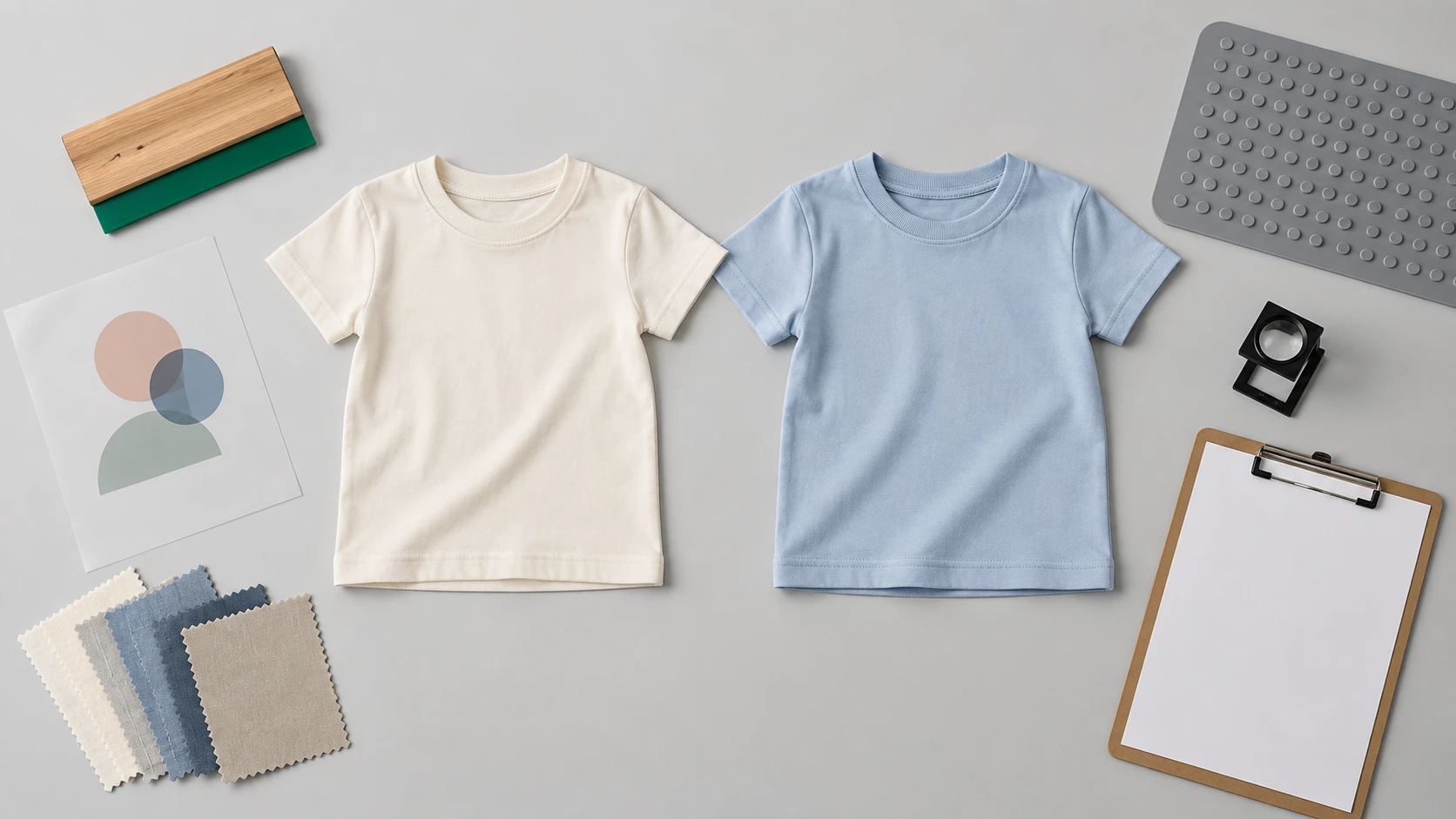
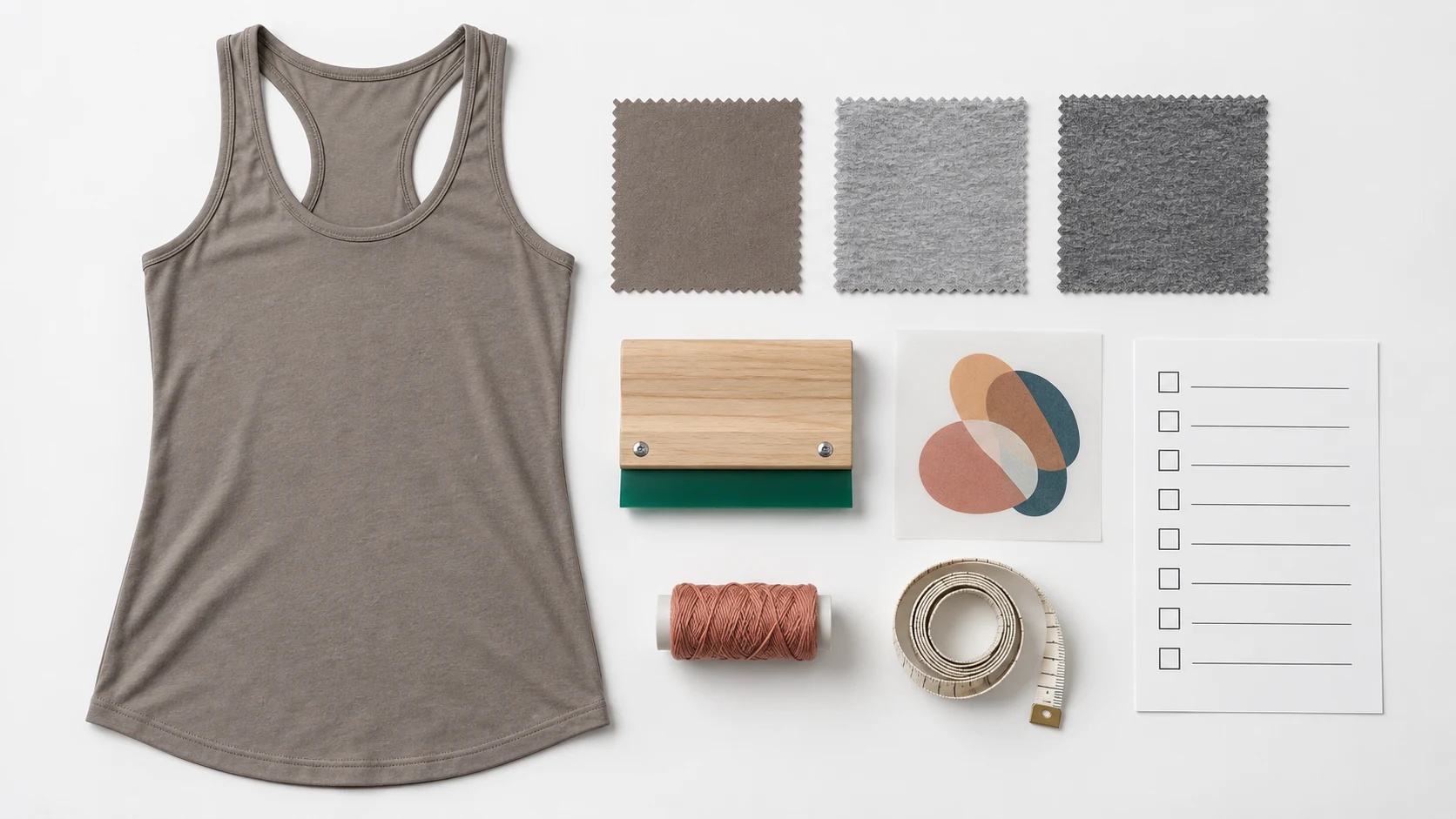
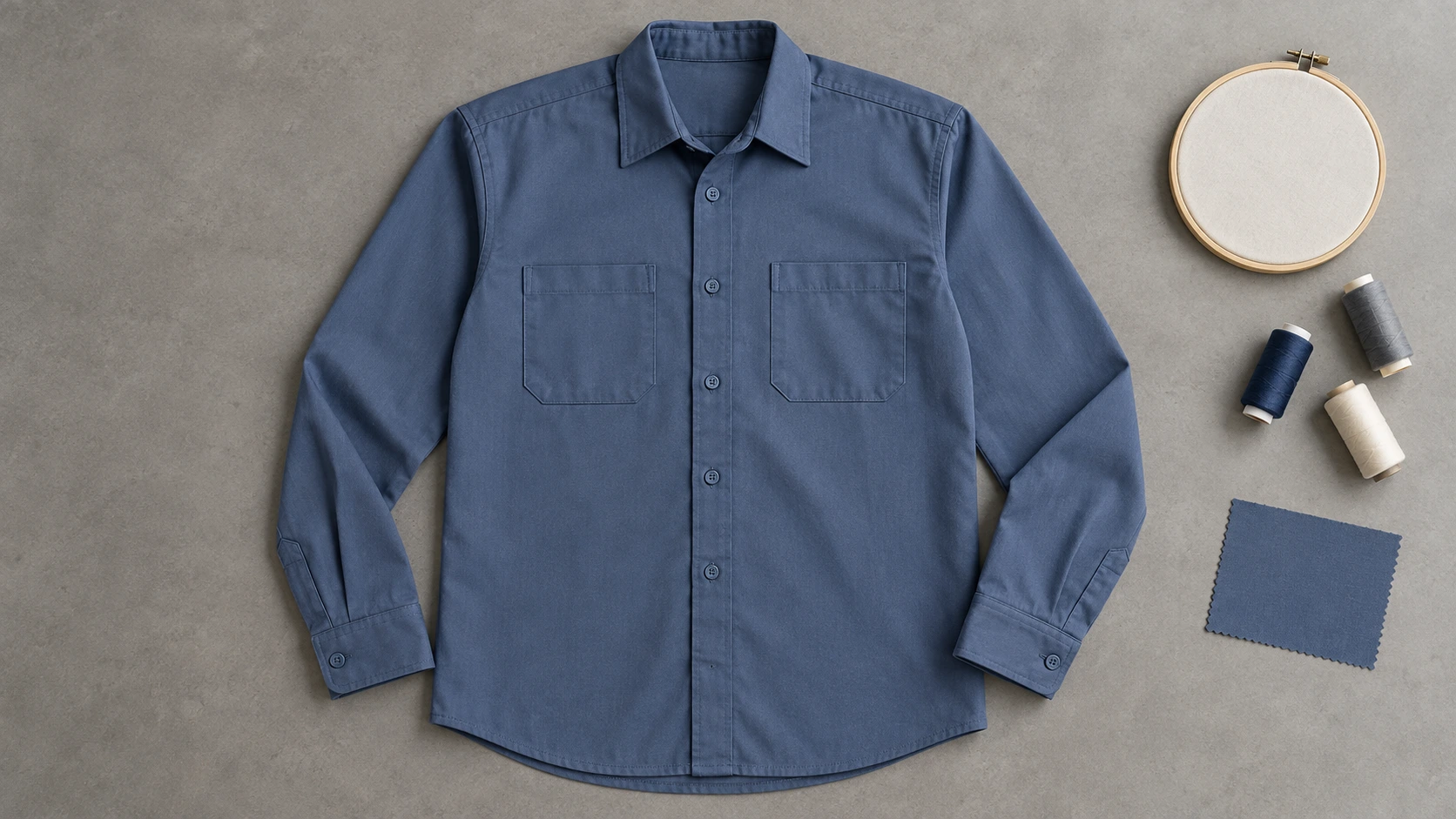
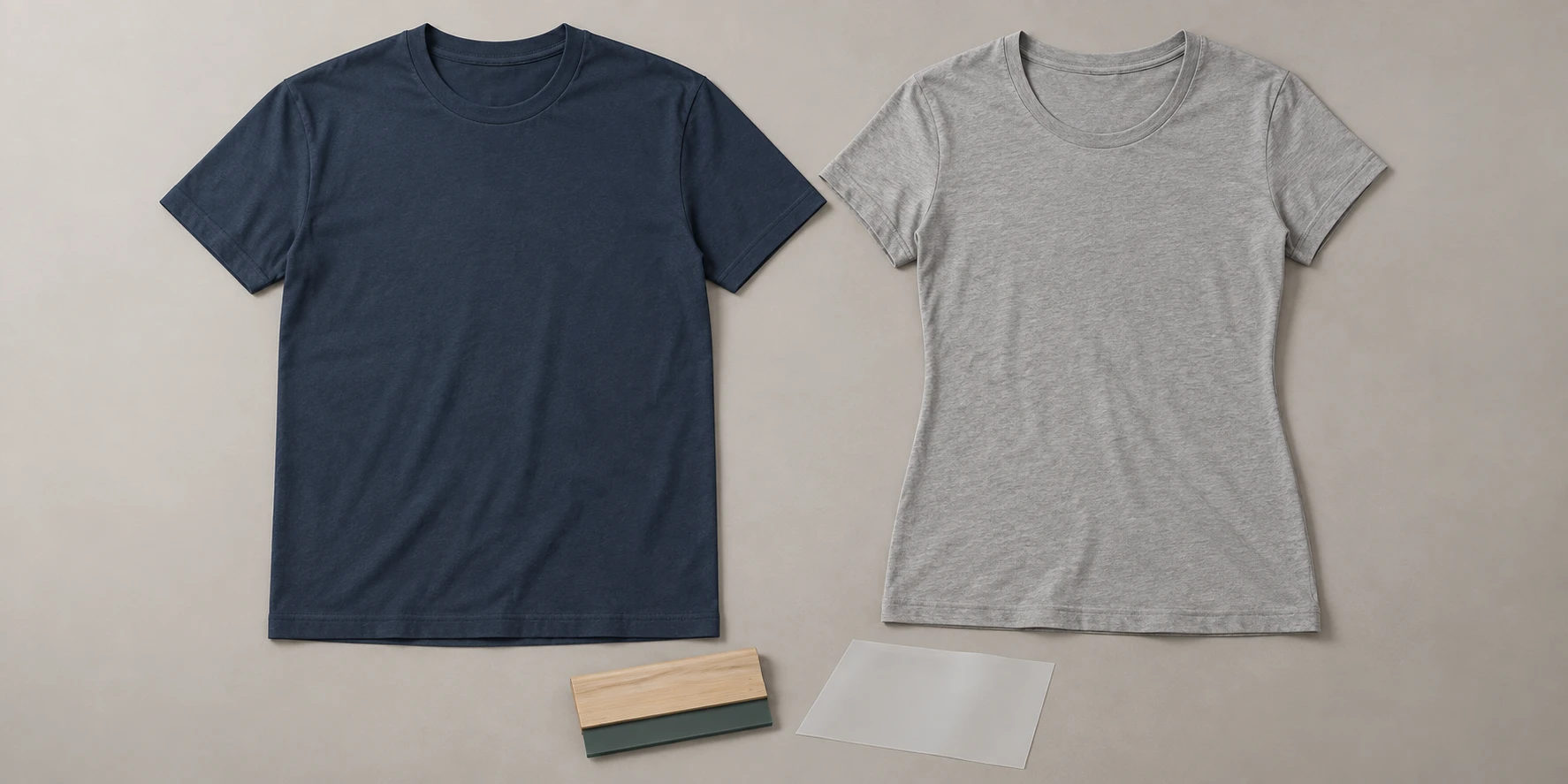
The BELLA + CANVAS 3001B and Rabbit Skins 3401 are both short-sleeve infant jersey tees, but they are not interchangeable blanks. Current manufacturer specifications position the 3001B as a 4.2 oz, 32-singles jersey with color-dependent cotton/polyester blends, while the 3401 is a 5.5 oz cotton jersey with more construction details and several blend exceptions. The better choice depends on the exact color, size system, artwork, decoration process, labeling plan, and finished-garment review.
This BELLA CANVAS 3001B vs Rabbit Skins 3401 comparison separates three kinds of evidence: manufacturer specifications, current Beytees selector data, and operational recommendations for decorators. It does not claim that either style is currently in stock, safer, certified as a finished decorated garment, true to size, or guaranteed for any print method.
Quick Answer: Which Infant Tee Should You Choose?
Choose the 3001B for evaluation when the brief calls for the manufacturer’s published 4.2 oz, 32-singles jersey, side seams, crew neck, tear-away label, and the specific color families offered under that style. Choose the 3401 for evaluation when the brief calls for the manufacturer’s published 5.5 oz jersey, rib collar, shoulder-to-shoulder back neck tape, double-needle sleeve and bottom hems, EasyTear™ label, and source-listed tracking label.
Those are specification-based starting points, not promises about softness, opacity, fit, comfort, durability, safety, or print quality. For either style, approve a production-equivalent sample in the exact color and size before buying for a customer program.
Best first step for a lighter published jersey: sample the 3001B.
Best first step for a heavier published jersey and more documented construction details: sample the 3401.
Best choice for a larger selector range: the current Beytees 3401 page displays more color labels, but selectors do not prove inventory.
Best choice for decoration: whichever exact color and size passes the decorator’s process, wear, wash, attachment, and compliance review.
Review the current BELLA + CANVAS 3001B product page and Rabbit Skins 3401 product page before ordering. At the research check, both public Store API aggregates reported is_in_stock=false. Treat every color and size selector as catalog data only; confirm current price, quantity, availability, and timing separately.
Manufacturer Facts, Beytees Selectors, and Recommendations
A reliable comparison needs clear source boundaries. Product specifications come from the current manufacturer pages. Color and size selector counts come from Beytees’ public catalog. Decoration and purchasing controls below are operational recommendations, not manufacturer guarantees.
Evidence type
What it supports
What it does not support
Manufacturer page or technical sheet
Published weight, fiber family, construction, label type, and listed measurements
Current Beytees stock, finished-decoration results, universal fit, or independent certification
Beytees product page and Store API
Current catalog identity plus displayed color and size labels
Purchasability, quantity by variation, price continuity, or replenishment timing
Operational recommendation
A sample, test, inspection, and documentation workflow
A substitute for supplier instructions, a compliance review, or a production approval
BELLA + CANVAS 3001B vs Rabbit Skins 3401 Buyer Matrix
Buying factor
BELLA + CANVAS 3001B
Rabbit Skins 3401
Buyer action
Published weight
4.2 oz/yd²; 32 singles
5.5 oz/yd² cotton jersey
Handle and decorate actual samples; do not infer opacity or durability from weight alone
Solid-color fiber
100% Airlume combed and ring-spun cotton
100% cotton jersey
Verify the exact color because exceptions apply to both style families
Ash 99/1; Heather 90/10; Granite Heather and CVC groups 60/40 cotton/polyester
Record fiber content by approved color and reopen heat testing when the color family changes
Construction
Side-seamed; crew neck; short sleeves
Side seams; rib collar; shoulder-to-shoulder self-fabric back neck tape; double-needle sleeves and bottom hem
Inspect seam bulk, platen contact, neckline clearance, and artwork field on the exact size
Removable label wording
Tear-away label
EasyTear™ label
Plan relabeling only after preserving all required permanent information
Infant tracking-label wording
No equivalent statement was found in the reviewed manufacturer feature block
Manufacturer and Beytees copy state “CPSIA compliant tracking label”
Do not convert this wording into a claim that the decorated garment or seller is certified
Current Beytees selectors
13 color labels; sizes 3/6, 6/12, 12/18, 18/24
27 color labels; sizes 6M, 12M, 18M, 24M
Map labels to the current measurement chart; never assume equivalent age notation means equivalent dimensions
Current catalog signal
Store API aggregate reported is_in_stock=false
Store API aggregate reported is_in_stock=false
Make no availability promise; verify the exact variation at order time
The BELLA+CANVAS 3001B manufacturer page currently labels the style “New Style Coming Soon” and publishes the fabrication and construction above. The LAT Apparel 3401 manufacturer page publishes the 3401 construction, blend exceptions, care language, measurements, and print-area data. Neither source establishes Beytees inventory.
How to Compare Sizes and Colors Without Guessing Fit
The current Beytees 3001B selector displays four size labels: 3/6, 6/12, 12/18, and 18/24. Its 13 displayed color labels span solid and heather families. The current 3401 selector displays 6M, 12M, 18M, and 24M across 27 color labels. These counts describe the catalog interface at the research check, not available units.
The manufacturer size systems are not identical. The current BELLA+CANVAS 3001B measurement sheet lists 0–3 through 18–24, while the current Beytees selector begins at 3/6. The 3401 manufacturer page lists 6M through 24M and publishes body length, width, and sleeve length. Because age labels and dimensions can change, compare garment measurements rather than matching size names across brands.
Size-planning step
Why it matters
Download the current manufacturer chart
Archived or distributor charts can differ from the current source
Measure a received blank
Published tolerances and production variation can affect placement
Test smallest and largest approved sizes
A design that clears seams on one size may crowd the neckline or hem on another
Keep brand-specific size mapping
3/6 is not automatically the same finished garment as 6M
The manufacturer specifications support sampling, not a universal print recipe. BELLA+CANVAS’ printing recommendations say transfer pressure, temperature, and dwell vary by transfer system and should begin with the transfer manufacturer’s instructions. They also describe DTF as broadly comparable across the company’s fabrications and styles while requiring independent testing for production variables.
DTF and other heat-applied transfers
Use the transfer supplier’s instructions, calibrated equipment, and the exact garment variation. Test adhesion, edge lift, press marks, discoloration, fabric distortion, hand, opacity, and laundering. Polyester-containing heathers need color-specific migration review after the observation period recommended by the ink or transfer supplier. Do not apply a setting proven on a solid cotton sample to a heather blend without retesting.
Screen printing
Build the ink, underbase, flash, and cure plan around the actual fiber content and artwork. The small infant print field raises the cost of poor alignment: a few misplaced inches can crowd the collar, sleeve seam, or hem. Approve registration and cure on the smallest production size, then verify that the same art scale still works on larger sizes.
Embroidery
Embroidery should be treated as a separate engineered sample. Infant jersey is a small, flexible substrate; a dense or large design can distort the garment or produce an unacceptably stiff interior. Let the embroidery operator select digitizing, stitch count, needle, thread, backing, and placement. Inspect both sides of the finished sample and reject exposed roughness, loose threads, puckering, insecure components, or excess stiffness.
Infant-Garment Safety and Compliance Controls
Infant apparel is a children’s product category, so decoration can create obligations beyond print quality. The federal children’s-product definition in 16 CFR Part 1200 explains that intended use, marketing, common recognition, and age-determination guidance are considered together. This article is not a legal determination, testing report, or Children’s Product Certificate.
Do not add loose stones, buttons, patches, charms, or other detachable embellishments without a qualified product-safety review.
Keep decoration flat and secure; reject peeling edges, sharp surfaces, loose threads, exposed backing, or stiff components that fail the approved finished-garment standard.
Preserve lot, source, and production records for the exact blank and decoration inputs.
Do not remove or cover tracking, fiber, origin, business-identity, or care information without confirming the replacement-label requirements.
Review the finished decorated garment—not only the undecorated blank—against the rules that apply to the business and product.
The 3401 source’s “CPSIA compliant tracking label” wording is useful catalog evidence about that blank’s stated label. It does not prove that every variation is available, that a decorator’s changes preserve compliance, or that the finished item has been independently verified. The FTC’s textile labeling guidance explains that most textile products need fiber content, country of origin, and responsible-business identification, with separate care-label requirements. Consult qualified compliance support for the actual finished product and sales channel.
A Practical Sample-to-Bulk Buyer Workflow
Write the brief: define garment type, audience, exact artwork, decoration method, size range, color family, label plan, quantity, and deadline.
Freeze the source facts: save the current manufacturer page, measurement chart, Beytees selector labels, and garment-label photographs for each candidate.
Order representative samples: include the smallest and largest planned sizes plus every distinct fiber/color family.
Measure the blanks: record body width, length, sleeve area, collar clearance, seam positions, and usable decoration field.
Decorate production-equivalent units: use the same equipment, consumables, artwork, operator controls, and planned placement as production.
Inspect the finished garment: check the front, reverse, interior contact surface, seams, label information, attachment security, distortion, press marks, migration, and print edges.
Run care tests: follow the garment label and compatible decoration-supplier instructions; document appearance and attachment changes.
Complete the compliance gate: confirm the business’s testing, certification, tracking, labeling, recordkeeping, and sales-channel duties for the finished product.
Approve one controlled specification: retain the signed sample, color, size, blank lot, artwork, placement, process settings, consumables, and inspection criteria.
Recheck the order: confirm current variation availability, price, quantity, shipping, and ETA before promising a customer date.
For timing context, use the Beytees wholesale shipping guide, then treat the live cart or order confirmation as authoritative. Blank transit time is not finished-merch turnaround; sampling, decoration, inspection, and any compliance work need their own schedule.
Frequently Asked Questions
What is the main difference between the BELLA + CANVAS 3001B and Rabbit Skins 3401?
The clearest published difference is the garment specification: the 3001B is listed at 4.2 oz and 32 singles, while the 3401 is listed at 5.5 oz with a rib collar, back neck tape, and double-needle sleeve and bottom hems. Those facts do not establish fit, comfort, durability, or print quality.
Which size labels are shown for the 3001B and 3401 at Beytees?
The current 3001B selector shows 3/6, 6/12, 12/18, and 18/24. The current 3401 selector shows 6M, 12M, 18M, and 24M. Compare current garment measurements; do not assume the different age-label systems are dimensionally equivalent.
Are the 3001B and 3401 always 100% cotton?
No. Each style has color-dependent exceptions. The 3001B manufacturer lists Heather CVC at 52/48 cotton/polyester and Athletic Heather at 90/10. The 3401 manufacturer lists Ash, Heather, Granite Heather, and CVC groups with different cotton/polyester ratios.
Which infant tee is better for DTF?
Neither can be declared universally better from specifications alone. Test the exact color, fiber blend, size, transfer, equipment, and placement for adhesion, migration, press marks, hand, distortion, secure edges, and care performance.
Can both infant tees be screen printed?
Both can be evaluated for screen printing. The decorator should match the ink and cure system to the exact substrate, keep artwork within the small usable field, and approve a production-equivalent sample rather than relying on one generic recipe.
Can the 3001B or 3401 be embroidered?
Embroidery can be sampled, but use a compact design engineered for the exact jersey. Review the front and interior for puckering, stiffness, loose threads, rough backing, insecure elements, and care performance before approving the finished infant garment.
Does the 3401 tracking-label wording certify the finished decorated shirt?
No. The source states that the blank has a “CPSIA compliant tracking label.” That statement is not independent verification of the decorated product and does not replace the responsible business’s finished-product testing, certification, labeling, tracking, and recordkeeping review.
What should buyers test before a bulk infant tee order?
Test current measurements, size mapping, exact color and fiber content, artwork scale, placement, decoration settings, migration, attachment security, surface and interior feel, laundering, required labels, tracking records, and finished-product compliance. Verify availability and order economics separately.
Final Recommendation
There is no responsible universal winner in the BELLA CANVAS 3001B vs Rabbit Skins 3401 decision. Start with the 3001B when its lighter published jersey, 32-singles fabrication, and listed construction fit the brief. Start with the 3401 when its heavier published jersey, documented collar and seam construction, EasyTear label, and source-listed tracking label fit the brief.
Then make the real decision with controlled samples. Match brand-specific measurements, test every production fiber/color family, inspect the finished infant garment inside and out, preserve required label and tracking information, and complete the applicable compliance gate before a bulk commitment. That process—not a selector count or a style-name shortcut—is what turns either blank into a defensible custom-printing choice.
The BELLA + CANVAS 6008 is a women’s racerback tank built around a 4.2 oz jersey, a relaxed fit, side seams, and a tear-away label. Its solid, CVC heather, and Athletic Heather versions do not share the same fiber blend, so a decorator should approve the exact color and fabric—not just the style number—before producing a wholesale run.
This BELLA CANVAS 6008 wholesale guide is for print shops, merch teams, event sellers, fitness and lifestyle brands, and buyers comparing women’s tank blanks. It turns current manufacturer specifications into a practical sample-to-production workflow. It does not promise stock, price, minimum quantity, delivery speed, fit on every wearer, or identical decoration results across colors.
Quick Answer: Who Should Consider the 6008?
Consider the 6008 when the brief calls for a women’s racerback silhouette, a 4.2 oz jersey, side-seamed construction, and a removable label. It gives brands a more specific silhouette than a unisex tank, but that specificity makes fit, artwork scale, and color-level testing more important.
Choose the exact fabric first: current manufacturer specifications separate solid cotton, 52/48 CVC heathers, and 90/10 Athletic Heather.
Use the actual print field: the racerback shape, armholes, neckline, and side seams create a narrower front and back canvas than a standard tee.
Treat size labels as a starting point: use current garment measurements and representative samples instead of assuming a universal women’s fit.
Build a color-specific process: polyester-containing heathers need migration and heat testing; solids still need adhesion, cure, wash, and press-mark checks.
Keep ordering claims separate from specs: a live product page or selector does not prove current stock, price, or fulfillment timing.
The BELLA + CANVAS 6008 product page at Beytees and the current BELLA+CANVAS 6008 manufacturer page are both live. At the research check, however, the manufacturer page displayed “New Style Coming Soon,” and the public Beytees Store API did not establish available inventory. Use the pages to evaluate the garment, then confirm the selected color, size, quantity, price, and timing at order time.
Verified BELLA + CANVAS 6008 Specifications
The current manufacturer page is the primary source for construction and fabrication. Beytees also lists the exact style and adds catalog details, but where catalog wording differs, buyers should confirm the current production garment rather than blend two versions into one promise.
Buying factor
Current verified detail
Why it matters
Fabric weight
4.2 oz, 32 singles
Approve artwork, opacity, hand, and show-through on the actual color
Solid colors
100% Airlume combed and ring-spun cotton
Do not transfer this fiber claim to every heather option
Heather CVC/blend colors
52% Airlume combed and ring-spun cotton / 48% polyester
Heat and dye-migration testing become part of approval
Athletic Heather
90% Airlume combed and ring-spun cotton / 10% polyester
Keep it separate from both solids and 52/48 heathers
Construction
Side seamed; racerback
Measure the usable decoration field between neckline, armholes, and seams
Manufacturer fit term
Relaxed fit
This is a style description, not a promise for every body or size
Label
Tear-away label
Useful for relabeling plans, subject to legal and care-label requirements
Beytees lists the garment as pre-shrunk with a merrowed bottom hem. Those lines are not displayed in the current manufacturer feature block reviewed for this guide. If either detail is critical to a private-label or production specification, verify it on a current sample and the received garment label rather than treating older catalog copy as a guarantee.
Solid, CVC Heather, or Athletic Heather?
The color decision is also a substrate decision. A solid 100% cotton 6008 and a 52/48 CVC heather may share the same nominal weight and singles count, but their fiber content can change ink behavior, heat response, opacity needs, and dye-migration risk. Athletic Heather is a third case at 90/10 cotton/polyester.
Solid colors
Use the solid version when the brief specifically favors the published 100% cotton fabrication. That does not eliminate process control. Light and dark colors can need different underbase, opacity, pretreatment, or transfer decisions. A successful black sample does not automatically approve white, Natural, or a bright color.
Record the exact color label and fiber blend on the approval sheet. If a later reorder substitutes another color family, reopen the decoration test instead of relying on the shared 6008 style code.
Fit, Measurements, and the Real Print Canvas
BELLA+CANVAS calls the 6008 a relaxed fit. Use that as manufacturer language, not as a body-fit guarantee. A racerback tank has less shoulder coverage and different armhole exposure than a conventional tee, so representative wearers should test comfort, coverage, movement, layering, and the intended sales context.
The manufacturer’s live 6008 measurement specification lists S through 2XL and warns that the chart is subject to change. These are garment measurements in inches, not body measurements.
Size
Body width, 1 inch below armhole
Center-front length
S
16
19
M
16 3/4
19 3/8
L
17 3/4
19 7/8
XL
18 3/4
20 3/8
2XL
19 3/4
20 7/8
Measure the usable front and back decoration area on the smallest and largest approved sizes. Keep designs clear of the neckline, armhole curves, side seams, and bottom hem. A tee-sized transfer can feel oversized or drift into curved edges on a tank. Do not publish one universal logo width without artwork and garment testing.
DTF, Screen Print, and Heat-Transfer Planning
BELLA+CANVAS’ official printing recommendations say heat-transfer pressure, temperature, and dwell vary by transfer type and should begin with the transfer manufacturer’s instructions. The company also says DTF is broadly comparable across its fabrications and styles. That general statement is useful, but it is not a 6008 color-by-color guarantee.
DTF and other heat transfers
Test the final transfer on the exact garment color. Inspect alignment, adhesion, edge lift, opacity, texture, press marks, discoloration, show-through to the back, and migration after the supplier’s recommended observation period. Use a platen, insert, or dressing method that isolates the intended layer and keeps seams and curved edges from creating uneven pressure.
Screen printing
Match ink, underbase, cure window, and mesh decisions to the actual substrate. The manufacturer’s print-testing page treats its ratings as reference information and explicitly says production environments still require independent testing. For polyester-containing heathers, include a migration-control plan validated by the ink supplier and decorator.
No universal recipe
This guide intentionally does not publish a fixed press temperature, dwell time, pressure, ink system, mesh count, underbase, transfer width, or cure schedule. Equipment calibration, artwork, garment color, substrate, consumables, and production environment all matter. Supplier instructions and a production-equivalent sample outrank a generic blog setting.
Can the 6008 Be Embroidered?
Small embroidery can be evaluated, but a 4.2 oz jersey racerback is not the same canvas as a woven work shirt or heavy sweatshirt. Dense artwork, large fills, or stiff stabilization may distort the fabric or create an uncomfortable result. The practical question is not simply “Can it be embroidered?” but “Does this exact design, placement, backing, and stitch plan produce an acceptable wearable sample?”
Madeira’s backing guidance says stabilization depends on fabric stability, stitch density, design size, thread and material color, stitch length and speed, and expected laundering. Let the embroidery operator choose backing, hooping, needle, thread, and digitizing after handling the exact 6008 variation.
For merch programs centered on larger graphics, DTF or screen print may offer a more natural starting point. If a heavier, unisex tank is a better match, compare the Comfort Colors 9360 heavyweight tank. The two styles solve different silhouette and fabric-weight needs; neither is automatically better.
6008 Buyer Decision Table
Program need
6008 may fit when…
Reconsider when…
Women’s-specific silhouette
A racerback and manufacturer-described relaxed fit match the brief after wearer testing
A unisex, high-coverage, or heavier tank is required
Private-label merch
The tear-away label supports the planned relabeling workflow
Required fiber, origin, tracking, or care information would be removed or obscured
Large graphic
The art has been resized for the actual narrow print field
A standard tee-size graphic is non-negotiable
Heat-applied decoration
The exact color and substrate pass migration, adhesion, press-mark, and wash checks
The buyer will not approve a production-equivalent sample
Size roster
Current measurements and representative try-ons cover the intended audience
The order depends on an unsupported “true to size” assumption
Confirm that style 6008 and a women’s racerback silhouette match the brief.
Record the exact color, published fiber blend, size, and current catalog source.
Compare current garment measurements with representative wearer samples.
Map the neckline, armholes, racerback, side seams, and bottom hem.
Scale the artwork on the smallest and largest production sizes.
Choose the decoration process with the ink, transfer, or embroidery supplier.
Decorate the exact color and fabrication—not a substitute tank.
Inspect opacity, registration, hand, distortion, press marks, migration, and comfort.
Launder the finished sample using the garment label and decoration supplier’s compatible instructions.
Retain the approved sample and production notes for reorder comparison.
Ordering and U.S. Shipping Planning
Confirm availability, current price, quantity rules, shipping service, and delivery estimate in the live cart or with Beytees before promising a customer deadline. For domestic planning context, review the Beytees Texas wholesale shipping guide, but treat checkout and carrier information for the specific order as authoritative. Build sample approval and decoration time into the schedule; a shipping estimate is not a finished-merch turnaround guarantee.
Frequently Asked Questions
What fabric is the BELLA + CANVAS 6008 made from?
The current manufacturer page lists solids as 100% Airlume combed and ring-spun cotton, Heather CVC/blend colors as 52% cotton and 48% polyester, and Athletic Heather as 90% cotton and 10% polyester. All are listed at 4.2 oz and 32 singles.
Are all BELLA + CANVAS 6008 colors the same fiber blend?
No. Solids, CVC heathers, and Athletic Heather have different published compositions. Confirm the exact color family before choosing ink, transfer, heat, or migration controls.
What sizes are listed for the BELLA + CANVAS 6008?
The current manufacturer specification and Beytees selector list S through 2XL. A listed size is not proof of stock, and the manufacturer says its measurement chart can change. Recheck measurements and availability before ordering.
Is the BELLA + CANVAS 6008 good for DTF?
It can be evaluated for DTF, and BELLA+CANVAS describes DTF as broadly comparable across its collection. Still test the exact 6008 color for adhesion, opacity, press marks, migration, feel, and laundering before production.
Can the BELLA + CANVAS 6008 be screen printed?
It can be evaluated for screen printing. Match the ink and cure plan to the exact solid or polyester-containing heather, then approve a production-equivalent print rather than relying on a universal recipe.
Can the BELLA + CANVAS 6008 be embroidered?
Small embroidery can be sampled, but the operator must engineer digitizing, stabilization, hooping, and placement for the 4.2 oz jersey. Reject a result that distorts the fabric, feels too stiff, or does not survive the intended care test.
How should artwork be placed on a racerback tank?
Measure the usable field between the neckline, armholes, side seams, and hem on the actual size. Scale the design for both the smallest and largest production garments instead of reusing a standard tee placement.
What should buyers test before a bulk 6008 order?
Test representative fit, exact color and composition, artwork scale, placement, decoration process, migration risk, opacity, press marks, hand, wearer comfort, wash response, and reorder documentation. Confirm current order and shipping details separately.
Final Recommendation
Choose the BELLA + CANVAS 6008 when a women’s racerback silhouette, 4.2 oz jersey, side seams, relaxed-fit manufacturer profile, and tear-away label match the program. The best buying path is color-specific: identify the fiber blend, verify current measurements and availability, fit-test representative wearers, and approve a decorated sample made from the exact production variation.
Start with the 6008 product details, then browse BELLA + CANVAS blanks at Beytees if the racerback, coverage, weight, or print field does not fit the brief. A disciplined sample decision will protect the finished merch program better than any unsupported claim about fit, stock, or one-setting decoration.
The Red Kap SP14 is a practical starting point when a uniform program needs a long-sleeve, collared work shirt with two chest pockets and a 65/35 polyester/cotton poplin base. Buyers still need to approve the exact pattern, color, size, logo placement, decoration process, and care result before a bulk rollout. The two biggest planning issues are that the published fabric weight changes for microcheck options and that the pockets, pencil stall, buttons, bartacks, placket, and collar limit uninterrupted decoration space.
This Red Kap SP14 wholesale guide is for uniform buyers, embroidery shops, service businesses, facilities teams, maintenance programs, and branded-apparel planners. It uses current seller and manufacturer facts, then turns them into a test-first buying workflow. It does not promise price, stock, delivery timing, fit, safety performance, or a universal decoration result.
Key Takeaways for Red Kap SP14 Wholesale Buyers
Know the variation: Beytees lists solids and striped options at 4.25 oz/yd² and microcheck options at 3.75 oz/yd². All are listed as 65% polyester and 35% cotton.
Plan around the chest: Two button-through pockets, angled bartacks, and a pencil stall on the left pocket reduce clean logo space.
Lead with embroidery, not assumptions: A compact company mark or name can fit the uniform brief, but the decorator must choose backing, hooping, digitizing, and placement after testing the exact garment.
Test heat-based methods: Polyester blends can show dye migration during screen or heat printing. No reviewed source supplies a universal SP14 screen-print, heat-transfer, or DTF recipe.
Separate catalog labels from inventory: A listed size or color is not proof that a particular variation is currently orderable.
Keep safety requirements separate: The evidence reviewed for the standard SP14 does not establish flame resistance, an ANSI high-visibility rating, an arc rating, or PPE suitability.
Use the exact selected option for fit and decoration approval
Microcheck fabric
3.75 oz/yd², 65/35 polyester/cotton
Do not assume every SP14 option has the same weight or hand
Reviewed solid collar
Two-piece lined collar with sewn-in stays
Keep hooping and press fixtures clear of the collar structure
Reviewed solid closure
Six buttons plus a gripper at the neck
Avoid pressing or stitching over the placket and hardware
Chest storage
Two button-through hex-style pockets with angled bartacks; left pocket has a bartacked pencil stall
Confirm logo field and pocket function on a physical sample
Finish language
Red Kap lists wrinkle resistance and Touchtex Technology; Beytees lists soil-release and wicking finish
Treat these as attributed product descriptions, not performance guarantees
Care for reviewed solid
Machine wash warm; do not bleach; tumble dry medium; iron medium; do not dry clean
Follow the sewn-in label first and add decorator-specific care instructions
Related styles
Beytees points to SP14T for tall sizes and SP14E for enhanced visibility
Do not treat those separate styles as features of the standard SP14
Red Kap describes the reviewed solid as industrial-laundry friendly and imported. It also attributes breathable comfort, lasting colors, and stain resistance to Touchtex Technology. Those phrases should stay attributed to the manufacturer. They do not support calling the shirt stain-proof, fade-proof, cooling, no-iron, or guaranteed for a fixed number of washes.
Solid, Stripe, or Microcheck: Verify the Exact Fabric
The SP14 name covers more than one visual option. Beytees publishes the solid and striped group at 4.25 oz/yd², while microcheck colors are listed at 3.75 oz/yd². The fiber ratio remains 65/35 polyester/cotton, but weight can affect hand, drape, perceived structure, hooping, and the way a finished logo feels on the garment.
For a uniform program, approve the exact production variation rather than a substitute that merely shares the style number. A solid sample does not prove how a microcheck will look after embroidery. A light pattern does not prove how a darker color will respond to heat. Record the pattern name, color label, size, decoration method, and approval sample together so a reorder is based on the same specification.
The live Beytees selector displayed size labels from S through 6XL and multiple color labels at the research check. Those labels show catalog taxonomy, not body measurements, current stock, or guaranteed purchasing eligibility. Recheck the selected combination and obtain current measurements before promising a roster match.
Collar, Placket, Pockets, and Logo Placement
The SP14’s work-shirt identity comes from its structured collar, button front, and two chest pockets. Those same details create placement constraints. A decorator cannot treat the front like an uninterrupted T-shirt panel.
Left-chest embroidery
The left pocket includes a pencil stall and bartacking. A logo placed above, beside, or on the pocket must preserve the intended pocket function and avoid thick intersections. The correct field depends on the actual logo shape, wearer size, pocket position, and machine access. Do not publish or reuse one universal placement dimension across every size.
Right-chest names and marks
The right pocket can support a name or compact mark in some programs, but its button, bartacks, pocket edge, and placket still need clearance. Check visual balance against the opposite pocket and confirm that hooping does not sew through an unintended layer.
Sleeves and back
Sleeve decoration must account for cuff construction and sleeve seams. A back design has more area, but a buyer should still test how the woven fabric, yoke area, garment size, and artwork density interact. If a large front graphic is central to the brief, a two-pocket work shirt may be the wrong canvas.
Fit and Size Planning Without Guesswork
No sufficiently reliable body-measurement chart or fit instruction for the exact seller assortment was verified for this article. That means buyers should not label the SP14 true to size, relaxed, tailored, roomy, or equivalent across every pattern and size.
Build the roster with current garment measurements or physical samples. Fit-test representative wearers across the size range that matters to the program, including people who work seated, reach overhead, layer underneath, or need full sleeve movement. Record the approved labeled size for each wearer rather than prescribing a generic size-up or size-down rule.
If the program requires measured tall coverage, evaluate the separate tall reference rather than assuming the standard SP14 includes the same body and sleeve proportions. Beytees points to SP14T, while SanMar catalogs a separate SP14LONG companion style. Neither is the standard SP14 reviewed here, and SanMar’s IL50 statement belongs to SP14LONG; it must not be transferred to the standard SP14. SP14E is also a separate enhanced-visibility reference, not a feature of SP14.
Embroidery is the strongest editorial starting point for compact company logos, technician names, departments, or service identifiers. It is not a one-setting process. The operator needs the exact shirt, exact color or pattern, final artwork, intended location, and expected care process.
Let the operator choose backing and hooping
Madeira’s backing guidance says selection depends on fabric stability, stitch density, material color, stitch length and speed, design size, and expected laundering. It identifies tear-away as a general option for stable woven fabrics and adhesive tear-away as useful for pockets and other hard-to-hoop items. That is process guidance, not an SP14-specific prescription. The embroidery operator should choose the backing after handling the selected variation.
Protect pocket function
Decide whether a pocket must remain fully usable before digitizing. If the design sits on a pocket, isolate the intended fabric layer and confirm that the machine does not close the pocket or cross the pencil stall. If the design sits above a pocket, check clearance at the smallest approved garment size, where the available field may be tighter.
Approve the sewn result
Inspect registration, edge definition, puckering, stiffness, backing visibility, thread show-through, pocket access, and wearer comfort. Then launder the sample through the intended real-world care process. Retain the approved garment and production notes for reorder control. Do not assume a logo that works on one pattern will behave identically on another.
Screen Print, Heat Transfer, and Guarded DTF Planning
The 65% polyester content makes heat and color testing important. Transfer Express explains that polyester and polyester blends can experience dye migration during screen printing and heat printing, and that outcomes vary by garment brand and color. Migration may not be visible immediately, so production approval should include an appropriate observation window.
The reviewed Red Kap and Beytees pages do not provide a universal SP14 screen-print, transfer, or DTF recipe. Follow the ink or transfer supplier’s validated settings for the exact system, then test the exact garment and color. Check adhesion, opacity, edge lift, press marks, discoloration, migration, hand, seam interaction, and laundering.
Use a platen or fixture that keeps pressure away from buttons, the neck gripper, seams, bartacks, and layered pocket construction. Never press directly over hardware. A large front design may be impractical because the placket and pockets divide the surface. For DTF specifically, treat the method as a test-led option, not guaranteed compatibility.
When the SP14 Fits a Uniform Program
Program need
Start with SP14 when…
Reconsider when…
Industrial or service look
A long-sleeve collared shirt with two chest pockets matches the role
The brief calls for a polo, tee, short sleeve, or women’s-specific silhouette
Compact embroidery
The decorator can engineer placement around pockets and hardware
A large uninterrupted front graphic is essential
Care workflow
The selected variation and decorated sample pass the intended wash process
The buyer cannot run a representative sample and wash approval
Safety requirement
No protective standard is being inferred from the standard SP14
Flame resistance, enhanced visibility, arc rating, or another PPE property is mandatory
Layered uniform
The shirt has been fit-tested with the actual base layer and movement needs
The program requires unverified fit claims or assumes a tall style is included
For cooler or outdoor programs, use Beytees’ wholesale workwear jacket guide to plan the outer layer separately. The jacket and shirt should be tested together so collar, sleeve, embroidery, and movement decisions work as one uniform system.
Sample, Wash, and Reorder Checklist
Confirm standard SP14 versus a separate tall or enhanced-visibility style.
Record the exact pattern, color label, size label, and published fabric weight.
Obtain current measurements or physical samples for representative wearers.
Map the collar, placket, neck gripper, buttons, pockets, bartacks, pencil stall, cuffs, and seams.
Approve artwork scale and placement on the smallest and largest relevant sizes.
Decorate the exact production variation with the intended machine, backing, ink, or transfer system.
Follow the sewn-in care label and the decorator’s post-decoration care instructions.
Launder the finished sample using the intended process and document the result.
Retain an approved sample and complete production notes before a reorder.
Frequently Asked Questions
What fabric is the Red Kap SP14 made from?
Beytees lists the SP14 as 65% polyester and 35% cotton. Solids and striped options are published at 4.25 oz/yd², while microcheck options are published at 3.75 oz/yd². Confirm the exact selected variation before approval.
Are every SP14 color and pattern the same fabric weight?
No. Beytees lists solids and stripes at 4.25 oz/yd² and microchecks at 3.75 oz/yd². The shared style number does not make every option identical in weight or decoration behavior.
Is the Red Kap SP14 suitable for embroidery?
It can be evaluated for compact uniform embroidery, but no reviewed source guarantees one result for every logo, pattern, or location. A qualified operator should select digitizing, backing, hooping, and placement after testing the exact garment.
Where can a logo be placed around the SP14 chest pockets?
Possible areas include above, beside, or on a pocket, depending on logo shape, garment size, hardware, and machine access. Preserve pocket and pencil-stall function, avoid bartacks and buttons, and approve placement on a physical sample rather than relying on a universal measurement.
Can the Red Kap SP14 be screen printed or decorated with DTF?
Only as a test-led production decision. The reviewed sources do not provide an SP14-specific screen-print or DTF recipe, and the polyester blend can present dye-migration risk. Use supplier-validated settings and test the exact color and garment.
What sizes does Beytees list for the Red Kap SP14?
The seller selector displayed size labels S through 6XL at the research check. Selector labels are not body measurements or a stock promise. Recheck the exact variation and use current measurements or samples for roster planning.
How should the Red Kap SP14 be washed after decoration?
For the reviewed solid, Red Kap publishes machine wash warm, do not bleach, tumble dry medium, iron medium heat, and do not dry clean. Follow the sewn-in garment label first, then add any narrower care instruction required by the decoration supplier.
What should uniform buyers test before ordering SP14 shirts in bulk?
Test representative fit, movement, exact fabric variation, logo scale, placement, pocket function, the complete decoration process, finished hand, wash response, and reorder documentation. Approve a production-equivalent sample rather than a different pattern or color.
Final Recommendation
Choose the Red Kap SP14 when the brief specifically needs a long-sleeve industrial work-shirt silhouette, two functional chest pockets, and a 65/35 poly/cotton poplin platform. Reconsider when the program needs a safety-rated garment, a large uninterrupted print field, a different silhouette, or a rollout without representative fit and decoration testing.
Choose the Tultex 202 when you need a straight, unisex blank with the broader seller-listed size and color selector. Choose the Tultex 216 when a women’s contoured, semi-fitted, side-seamed silhouette is the specific merchandising or uniform requirement. Both styles use the same published 4.5 oz fine-jersey base and the same solid/heather fiber rules, so this decision is mainly about silhouette, construction, and assortment—not fabric weight.
This Tultex 202 vs 216 comparison is for apparel brands, print shops, team buyers, event planners, uniform programs, and private-label sellers. It covers verified product facts and test-first decoration planning. It does not promise price, stock, delivery timing, shrink-proof performance, true-to-size fit, or one universal print recipe. Confirm the exact variation and approve a production-equivalent sample before a bulk order.
Key Takeaways
Same published base: Both are 4.5 oz fine-jersey tees. Solid colors are listed as 100% ring-spun cotton and 30 singles; Heather Grey is 90/10 cotton/polyester, while other heathers are 50/50.
202 role: Beytees presents it as unisex, and its selector spans XS through 5XL. The straight/basic silhouette supports broad merch, event, team, and retail assortments.
216 role: Tultex describes a more generous feminine cut with a semi-fitted, contoured silhouette. Beytees lists S through 2XL.
Construction difference: Tultex calls the 202 tubular, while Beytees specifically lists side seams for 4XL and 5XL. The 216 is side-seamed.
Decoration rule: Screen print, DTG, discharge, heat transfer, DTF, and embroidery plans still need an exact-style, exact-color sample. Do not assume one placement or process setting fits both silhouettes.
Straight/unisex assortment versus contoured women’s assortment
Published weight
4.5 oz/yd²
4.5 oz/yd²
Weight does not separate the two
Solid-color base
100% ring-spun cotton; 30 singles
Same
Confirm the exact color because heathers differ
Heather Grey
90/10 cotton/polyester
Same
Polyester content can affect decoration behavior
Other heathers
50/50 cotton/polyester
Same
Do not apply cotton-only assumptions
Body construction
Tultex says tubular; Beytees lists side seams for 4XL/5XL
Side-seamed, semi-fitted, contoured
Verify platen support and placement on the exact size
Beytees size-selector labels observed September 17, 2026
XS–5XL
S–2XL
Labels are not measurements or inventory promises
Beytees color-selector labels observed September 17, 2026
71 labels; five include “(disc)”
11 labels
202 has broader listed taxonomy, not guaranteed availability
Label system
Tear-away/Tultex “Tear Anywhere”
Same
Useful for relabeling only after a physical removal test
Both listings also state reactive dye, pre-washed or pre-shrunk treatment as published, double-needle sleeve and bottom hems, and USMCA certification. Tultex says its cotton products use U.S.-grown ring-spun cotton. None of that supports calling either shirt shrink-proof or “Made in USA,” and double-needle construction is not a wear-life guarantee.
Unisex 202 vs Women’s Contoured 216 Fit and Construction
The 202 is the broad-program choice when the buyer wants a straight, unisex presentation. Tultex calls it a classic basic tee; Beytees calls it unisex. No reviewed source provided verified body measurements for this comparison, so terms such as relaxed, slim, oversized, or true to size would go beyond the evidence. Use current garment measurements or samples rather than translating a label into a fit promise.
The 216 has a more explicit shape. Tultex describes a more generous feminine cut and a side-seamed, semi-fitted contoured silhouette; Beytees calls it a classic fit with a contoured silhouette. That makes it the better starting point when a women’s cut is an intentional part of the assortment. It does not mean every wearer will prefer the same labeled size.
Construction also affects decoration layout. Tultex’s 202 page says tubular construction, while the Beytees listing adds a specific caveat: sizes 4XL and 5XL have side seams. Do not generalize one construction across every 202 size. The 216 is side-seamed throughout its published description, and artwork may need different horizontal scale or vertical placement to look balanced on its contoured body.
The neck details are not measured as identical, either. Both are crewnecks, but Tultex describes the 216 as a feminine ribbed crew neck. Without verified opening measurements, a buyer should not assume the neckline depth or width matches the 202.
Size and Color Selector Breadth
At the publication check, Beytees displayed nine size labels for the 202—XS, S, M, L, XL, 2XL, 3XL, 4XL, and 5XL—and five for the 216—S through 2XL. The 202 also displayed 71 color labels versus 11 for the 216. Five 202 color labels included “(disc),” reinforcing why selector taxonomy should not be presented as active inventory.
A selector label means the catalog recognizes an option. It does not prove that a particular color/size combination can be purchased now, and size labels are not garment or body measurements. Recheck the exact variation when planning, then obtain a current size chart or measure samples across representative sizes.
The wider 202 selector can simplify a program that needs extended seller-listed sizes or more color concepts. The narrower 216 selector can still be right when the contoured women’s silhouette is the actual requirement. Mixed programs can carry both, but should treat them as two fit blocks under a shared artwork system—not interchangeable bodies.
Screen Print, DTG, Discharge, Heat Transfer, DTF, and Embroidery
Tultex’s decoration guidance presents fine jersey as a platform for screen print, DTG, heat transfer, discharge, embroidery, and other methods, while its FAQ specifically lists both 202 and 216 among discharge-capable styles. That is useful process context, not a guarantee for every garment color, artwork, machine, or shop environment.
Screen printing
Fine jersey can be a practical screen-print surface, and screen printing can suit larger runs. Test registration, opacity, hand, flash behavior, cure, and laundering on the exact style and color. Tultex publishes approximate maximum post-print drying guidance of 170°C/340°F for five seconds on 100% cotton and 160°C/320°F for 3.5 seconds on 50/50 or 65/35 blends, with an explicit instruction to test. Those numbers are not a universal ink-cure recipe. The wholesale screen-printing blank guide adds broader selection context.
DTG and discharge
Tultex identifies fine jersey as suitable for DTG and discharge, and specifically names both styles for discharge. Results can change with fiber content, color, pretreatment or chemicals, equipment, environment, and temperature. Polyester does not discharge like cotton, so do not promise the same color or hand across solids and heathers. Follow the ink or chemical manufacturer’s procedure and document the approved sample.
Heat transfer and guarded DTF planning
Tultex supports heat transfer as a general category, but the reviewed product pages do not provide a style-specific DTF recipe or certify every variation for DTF. Follow the film, powder, and transfer supplier’s instructions. Test adhesion, edge lift, press marks, discoloration, dye migration, stretch, and laundering on the exact garment. The Beytees DTF blank guide can help with process selection, but it cannot replace a 202 or 216 production sample.
Use a platen or insert that supports the intended print area. Reconfirm artwork width and placement on the 216’s contoured body instead of copying the 202 setup automatically. One transfer size may look balanced on one silhouette and crowded on the other.
Embroidery and sublimation
Embroidery is a general Tultex decoration category, but neither style page supplies a backing, needle, density, or maximum-logo specification. A lightweight 4.5 oz tee needs qualified digitizing, stabilization, and a sewn sample to manage stiffness and distortion. Conventional direct-dye sublimation is intended for polyester-rich fabrics; do not position the solid 100% cotton versions as ordinary sublimation blanks.
Merch, Team, Uniform, and Private-Label Scenarios
If your priority is…
Start with
Validate before bulk production
One straight/unisex merch silhouette
202
Representative fit, exact size range, and artwork grading
Extended seller-listed size labels through 5XL
202
Exact variation and the 4XL/5XL side-seam caveat
A women’s contoured program
216
Roster coverage, representative fit, and print balance
A mixed-gender team or retail assortment
Both
Two fit blocks, two placements, and a shared color plan
Private-label presentation
Either
Label removal, replacement-label compliance, and seam finish
A polo-based uniform
Neither
Review a purpose-built polo such as the Tultex 400
The removable label system can support relabeling, but “tear away” does not mean every production operator should remove it without testing. Check the removal point, remaining fibers, neck finish, replacement-label method, and applicable labeling rules. The tear-away-label blank T-shirt guide covers broader private-label planning; use the narrower verified origin wording in this comparison.
Sample and Bulk-Order Checklist
Confirm the exact style, color label, size label, and fiber composition.
Recheck the live seller variation without treating a selector as stock proof.
Obtain current measurements or measure physical samples in representative sizes.
Fit-test representative wearers; do not assume the same labeled size fits the same way in both silhouettes.
Map seams, collar, sleeve, hem, platen support, artwork width, and vertical placement.
Decorate the exact production color with the intended ink, pretreatment, transfer, or embroidery setup.
Launder the decorated sample using the intended care instructions and document the result.
Retain an approved sample and process notes for reorder control.
Frequently Asked Questions
What is the difference between the Tultex 202 and Tultex 216?
The 202 is positioned by Beytees as a unisex fine-jersey tee with a straight/basic assortment role and a broader seller-listed selector. The 216 is a women’s classic-fit tee with a side-seamed, semi-fitted contoured silhouette. Their published base weight and core fiber rules match.
Do the Tultex 202 and 216 use the same fabric weight?
Yes. Both publish a 4.5 oz/yd² base. Solid colors are listed as 100% ring-spun cotton and 30 singles; Heather Grey is 90/10 cotton/polyester, and other heathers are 50/50. Confirm the exact variation before decoration.
Is the Tultex 202 a unisex T-shirt?
Beytees names it the Tultex 202 Unisex Fine Jersey T-Shirt, while Tultex calls it the 202 Basic Tee. “Unisex” is a merchandising label, not a measurement or true-to-size promise, so review current measurements and physical samples.
How does the women’s Tultex 216 fit compared with the 202?
Tultex describes the 216 as a more generous feminine cut with a semi-fitted, contoured, side-seamed silhouette. The 202 is the straighter unisex/basic option. No verified measurement chart was used here, so fit-test representative wearers rather than prescribing a size change.
Which style has the broader published size and color selection at Beytees?
At the September 17, 2026 check, the 202 displayed XS through 5XL and 71 color labels; the 216 displayed S through 2XL and 11 color labels. These are selector labels, not body measurements, guaranteed stock, or a promise that every combination can be ordered.
Can Tultex 202 and 216 shirts be screen printed or printed with DTG?
Tultex presents fine jersey as suitable for screen print and DTG, and both styles share the published fine-jersey base. Test the exact style and color for registration, opacity, pretreatment, cure, hand, and laundering. Heather blends may behave differently from solid cotton.
Can DTF transfers be applied to Tultex 202 and 216 shirts?
Tultex supports heat transfer generally, but the reviewed sources do not publish a style-specific DTF recipe for every 202 or 216 variation. Follow the transfer supplier’s instructions and test adhesion, edge lift, press marks, dye migration, discoloration, stretch, placement, and laundering.
What should buyers test before ordering Tultex 202 or 216 shirts in bulk?
Test representative fit, measurements, exact fiber/color, artwork scale, placement, platen support, the full decoration process, finished hand, seam interaction, and laundering. For mixed programs, approve separate 202 and 216 samples rather than assuming one setup transfers unchanged.
Final Recommendation
For the Tultex 202 vs 216 decision, start with the Tultex 202 when a straight unisex blank, extended seller-listed size labels, or broad color taxonomy leads the brief. Start with the Tultex 216 when a women’s contoured, semi-fitted, side-seamed silhouette is the requirement.
Do not choose by fabric weight alone: the published base is the same. Choose by fit architecture and assortment role, then confirm the exact variation and approve a decorated physical sample before production.
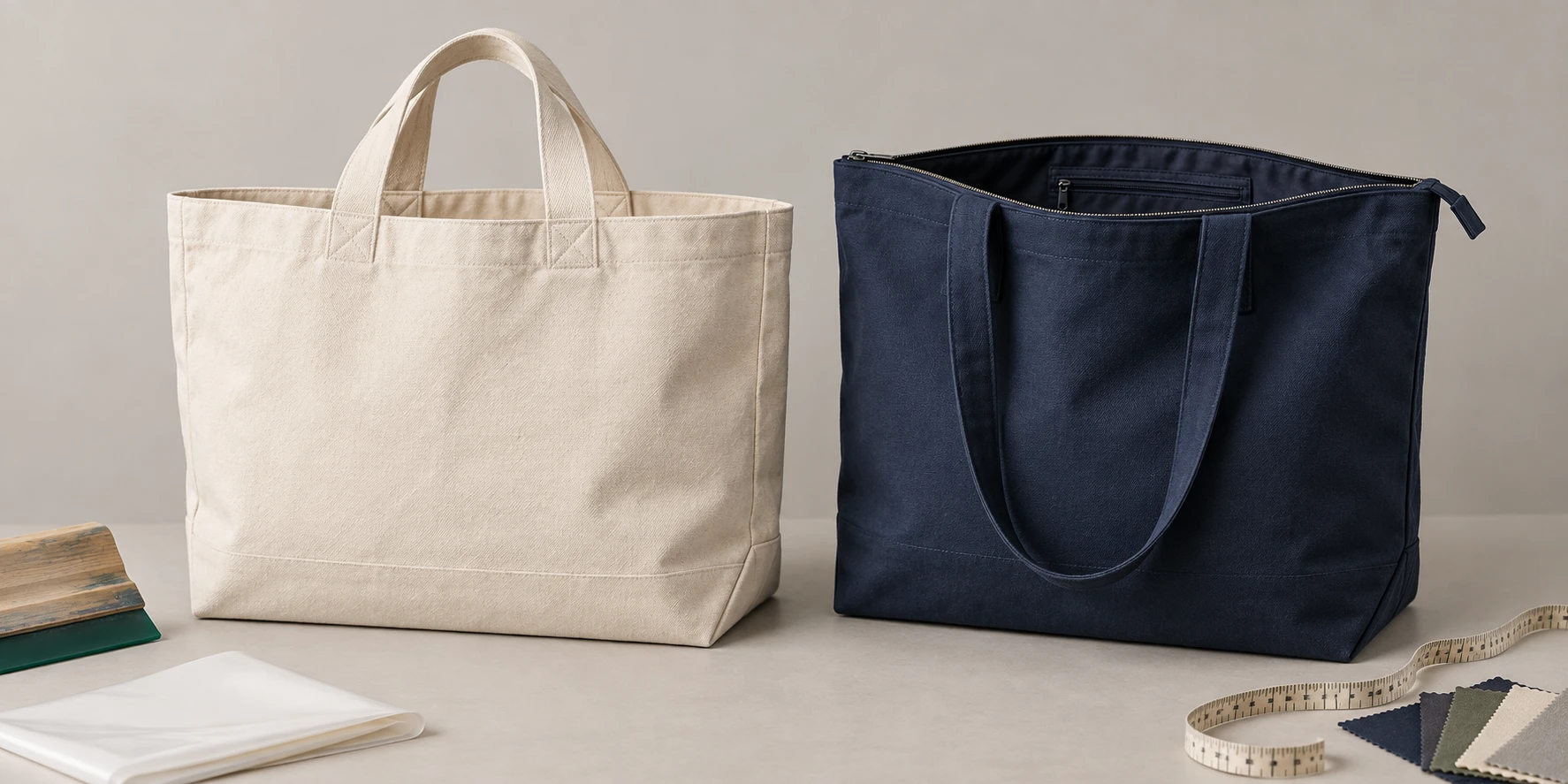
Choose the Q-Tees Q600 when open-top access, fast loading, and a mechanically simpler decoration surface matter most. Choose the Q-Tees Q611 when a zippered main compartment and an inside zippered flap pocket justify extra production planning. Both are 25 L heavy-cotton-canvas totes with the same published 20 W × 15 H × 5 D-inch dimensions and 14 W × 10 H-inch suggested imprint area. The real decision is access versus closure, not capacity.
This wholesale tote bags comparison is for event buyers, retailers, promotional-product teams, screen printers, DTF decorators, and embroidery operators. It covers verified construction and practical sample checks; it does not promise a price, stock level, warehouse, delivery date, minimum quantity, or universal decoration recipe. Confirm live purchasing details on the exact product page before ordering.
Key Takeaways
Shared platform: Both styles are one size, 25 L, 100% heavy cotton canvas, and 20 W × 15 H × 5 D inches, with a published ±1-inch tolerance.
Q600 advantage: The open top and lack of pockets make access fast and reduce hardware and layered areas around the decoration zone.
Q611 advantage: A zippered main compartment and inside zippered flap pocket help retain and organize contents.
Handle difference: Q600 has 23-inch canvas-webbed handles with a 10-inch drop; Q611 has 25-inch self-fabric handles with an 11-inch drop.
Decoration rule: Treat 14 × 10 inches as a suggested imprint field, not blanket approval. Sample the exact color, artwork, process, placement, and finished feel.
100% heavy cotton canvas; 12 oz/yd² US / 20 oz/L yd CA
Same
Use cotton-canvas-specific production tests
Finished size
20 W × 15 H × 5 D in
20 W × 15 H × 5 D in
Same nominal envelope; ±1 in tolerance applies
Top
Open; no closure
Zippered main compartment
Fast access versus contents retention
Interior pocket
None listed
Inside zippered flap pocket
Q611 adds organization and a layer to isolate during decoration
Handles
23-in canvas-webbed; 10-in drop
25-in self-fabric; 11-in drop
Sample carry comfort with intended load
Bottom
Gusseted
Gusseted
Both gain depth when loaded
Suggested imprint area
14 W × 10 H in
14 W × 10 H in
Keep artwork inside the field, then sample
Beytees additionally describes the Q611 zipper as approximately 18 inches. Treat that as a seller-published detail, not a substitute for measuring the received sample. Finished-bag tolerance, seam position, pocket position, and how the tote sits on a platen can all affect usable clearance.
Which Tote Should You Choose?
For events, the Q600 is the practical default when staff will load bags quickly, guests need frequent access, or the tote functions as a handout carrier. Its open top removes the zipper step and its simpler front-panel construction gives decorators fewer hardware conflicts to manage. That does not make it automatically easier for every design: seams, gusset folds, handle attachments, and canvas texture still require testing.
The Q611 is the stronger candidate when contents should remain enclosed or separated. Retail purchases, employee kits, registration materials, travel-oriented packs, and organized client gifts can benefit from a zippered main compartment and inside pocket. Buyers should decide whether those functions are worth the added sample work and potential fixture complexity.
If your priority is…
Start with
Reason to validate
Fast event loading and open access
Q600
Confirm the open-top experience suits the contents and venue
Fewer zipper/pocket conflicts during decoration
Q600
Still map seams, handles, gusset, and insert position
Closing the main compartment
Q611
Test zipper operation before and after decoration
Separating small items inside the bag
Q611
Confirm pocket size and placement on the physical sample
Building a color assortment
Either
Selector options can change and do not prove stock
Choosing strictly by capacity or nominal size
Either
Both publish the same 25 L and 20 × 15 × 5-in specifications
For other bag silhouettes, browse Q-Tees products at Beytees or use the wholesale blank tote bag guide. A color name or online selector entry is an option, not an inventory commitment; recheck the chosen variation and purchasing details at order time.
Decoration Planning for Screen Printing, DTF, and Embroidery
The published 14 W × 10 H-inch imprint area is a starting boundary. It does not approve every screen-print setup, DTF transfer, embroidery design, ink system, press setting, or platen. Keep artwork inside that field, identify the centerline on an actual tote, and approve a production-equivalent sample in the exact production color.
Screen printing
Test ink opacity and cure on the exact canvas and color. Dark bags may require an underbase, but the correct ink, mesh, off-contact, cure method, and sequence depend on the shop’s system and artwork. The screen-printing blank guide provides broader blank-selection context; the operator must still establish the tote-specific process.
DTF transfers
Follow the transfer supplier’s cotton-canvas parameters instead of borrowing a generic garment recipe. Test adhesion, edge lift, canvas texture showing through the graphic, discoloration or scorching, and the post-cure handle. Use a suitable insert or platen, and never press over the Q611 zipper. The DTF blank buying guide explains broader selection factors without replacing a bag sample.
Embroidery
Let the embroidery operator choose backing, needle, thread, hooping, and fixture strategy after inspecting the bag. Verify seam and handle clearance, stiffness, registration, interior finish, and whether the Q611 pocket has been isolated so it is not accidentally sewn closed. No universal embroidery recipe is safe for every logo or machine.
Q611 Zipper and Pocket Controls
Before decorating Q611, open the bag and locate the main zipper tape, pull, inside flap pocket, pocket zipper, seams, and folded layers. Build the setup so heat and pressure do not land on the zipper or create an uneven stack beneath the artwork. A suitable insert, platen, or fixture should support the print area while keeping hardware outside the pressure zone.
After decoration, operate both zippers repeatedly and inspect teeth alignment, pull travel, pocket access, nearby stitching, print edges, and any pressure marks. Load the sample with representative contents and check whether the decoration, pocket, and closure behave normally together. Q600 avoids these exact hardware checks, but it still needs panel, handle, seam, and gusset inspection.
Printable Sample-Approval Checklist
Confirm the exact style, seller variation, and production color.
Measure the received tote and account for the published ±1-inch tolerance.
Keep artwork within 14 W × 10 H inches and map handles, seams, gusset folds, and hardware.
Use the intended screen-print, DTF, or embroidery setup on a physical sample.
Inspect registration, opacity or adhesion, cure, texture, edge quality, stiffness, and discoloration.
For Q611, isolate the zipper and pocket; never press over the zipper or sew through the pocket.
Test handle comfort, open/close behavior, pocket access, and the intended representative load.
Retain one approved decorated sample and process notes for reorder control.
Freight and timing can affect a program decision, but they are dynamic. Use the wholesale blank apparel shipping guide for planning questions, then confirm the current order-specific details before committing to an event or retail launch.
Frequently Asked Questions
What is the difference between the Q-Tees Q600 and Q611?
Q600 is an open tote with no listed interior pocket, 23-inch canvas-webbed handles, and a 10-inch drop. Q611 has a zippered main compartment, inside zippered flap pocket, 25-inch self-fabric handles, and an 11-inch drop. Their published capacity, fabric, dimensions, gusset, and suggested imprint area otherwise match.
Are the Q600 and Q611 the same size?
Yes at the published nominal level: both are one size, 25 L, and 20 W × 15 H × 5 D inches. The specification sheets state a ±1-inch tolerance, so measure the received sample when exact placement or packaging fit matters.
Which tote is better for events and giveaways?
Q600 is usually the more direct event choice when staff need fast loading and recipients need open access. Choose Q611 when retaining contents or separating small items is more important. Test the intended contents and handling flow rather than deciding by style name alone.
Which tote is better for retail purchases or staff kits?
Q611 can add value when a zippered main compartment and inside zippered pocket support the kit. Q600 works when simplicity, open access, and straightforward loading matter more. Both need a representative-load sample before bulk approval.
Can Q-Tees Q600 and Q611 totes be screen printed?
The 14 × 10-inch field is a suggested imprint area, not blanket process approval. A qualified printer should test the exact canvas and color for placement, opacity, cure, texture, and finished feel. Dark colors may require an underbase; no universal mesh, ink, or cure recipe applies.
Can DTF transfers be applied to Q600 and Q611 canvas totes?
Any DTF plan should follow the transfer supplier’s cotton-canvas parameters and pass a physical sample. Test adhesion, edge lift, texture, discoloration or scorching, and handle. On Q611, use an appropriate support and never press over the zipper, pull, pocket, seams, or folded layers.
What is the suggested imprint area?
Both Q600 and Q611 publish a suggested imprint area of 14 W × 10 H inches. Keep artwork within that boundary, then verify the actual centerline, seam clearance, hardware clearance, and finished appearance on the received tote.
What should decorators test around the Q611 zipper and pocket?
Map and isolate the main zipper, pull, interior flap pocket, pocket zipper, seams, and folded layers. Verify even support, safe heat and pressure clearance, zipper travel, pocket access, nearby stitching, print edges, and pressure marks before approving production.
Final Recommendation
For this wholesale tote bags comparison, start with Q600 when event speed, open access, and a simpler panel are the priorities. Start with Q611 when closure and interior organization improve the buyer’s real use case. Because capacity and nominal size are the same, choose by function and production clearance—not by an assumed size advantage.
Confirm the live variation and purchasing details, order the exact color, and approve a decorated physical sample. That process is more reliable than treating either tote—or the shared 14 × 10-inch suggested imprint area—as universally compatible with every job.
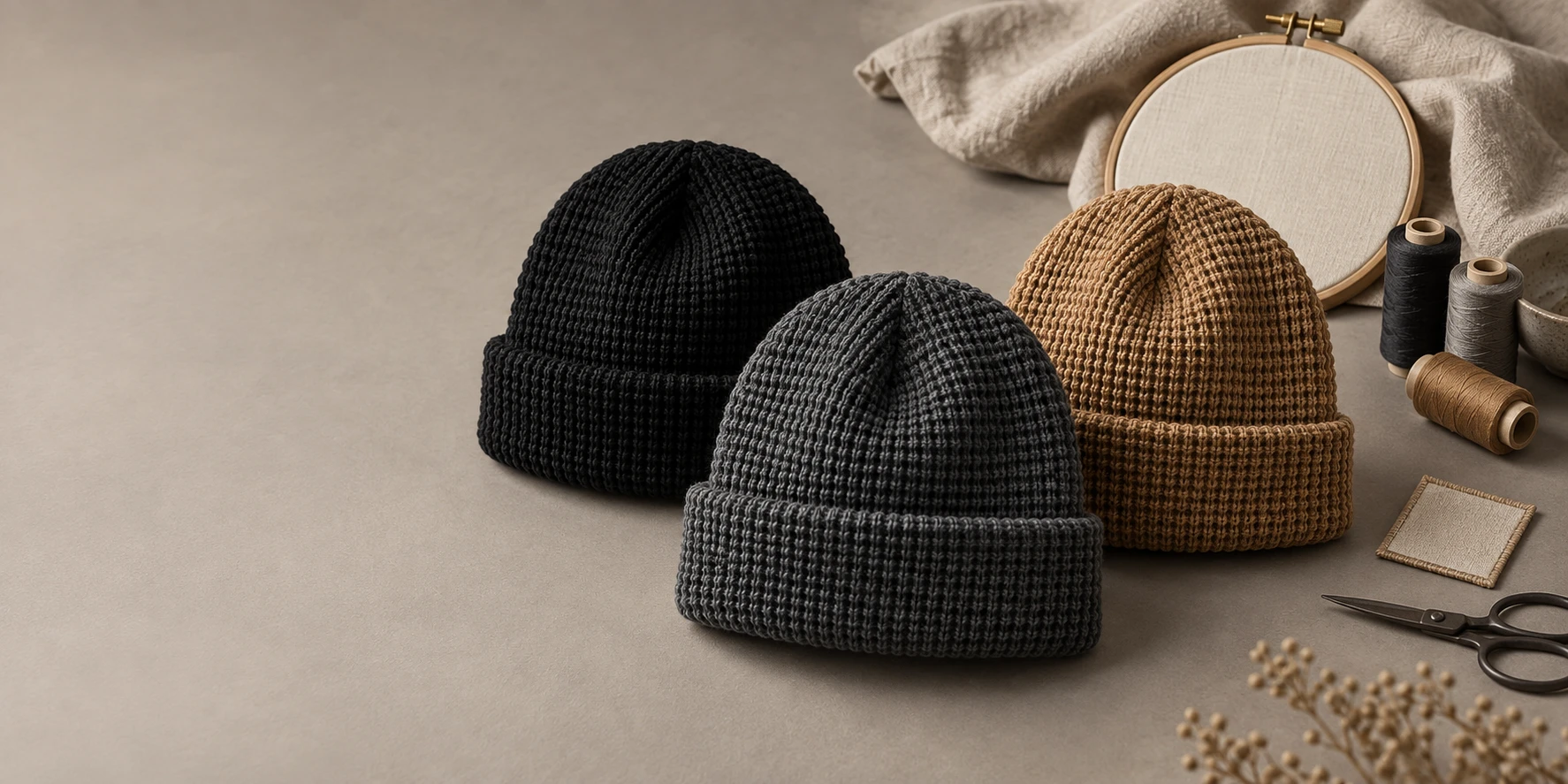
Richardson 146R wholesale buyers are usually looking for a textured winter blank that can carry a clean logo without feeling like generic promotional headwear. The waffle-knit surface and roll-up cuff make this beanie visually distinctive, while the cuff creates the main decoration zone for embroidery or an appropriately attached patch.
The most important limitation belongs at the top of the buying decision: Richardson lists direct embroidery, several patch and leather options, and woven-label applique for this style, but it expressly lists no transfers and excludes heat-pressed felt, twill, and distressed-twill applique. Buy the Richardson 146R Waffle Cuffed Beanie for an embroidery- or patch-led program—not as a blank for DTF, heat-transfer vinyl, or an untested heat-applied emblem.
This guide separates verified specifications from practical production recommendations. Price, stock, selectable colors, warehouse source, and delivery timing are live variables. Confirm all of them on the Beytees product page when ordering rather than treating this article as an inventory promise.
Quick Answer: Who Is the Richardson 146R For?
The Richardson 146R is a strong candidate for embroidery shops, streetwear labels, employee programs, schools, clubs, outdoor organizations, and hospitality brands building cold-weather merchandise. It combines a mid-profile, mid-cuffed shape with stretchy, mid-weight acrylic waffle knit. The published size is adult OSFM/one size, which is an assortment designation rather than a guarantee that every wearer will prefer the fit.
Choose it when texture, a snug beanie silhouette, and a defined cuff branding area support the brief.
Prioritize direct embroidery when the artwork can be engineered for stretchy knit and approved on a production-equivalent sample.
Consider a patch or leather treatment only with an attachment method that respects Richardson’s no-transfer and no-heat limitations.
Choose another blank when the decoration plan depends on a transfer, an unsupported heat-applied applique, or a measured size range.
Why Beytees Says 146R While Richardson Says 146
Beytees lists the product as the Richardson 146R Waffle Cuffed Beanie. Richardson’s current manufacturer page calls it the 146 Waffle Knit Beanie with Cuff. The matched product name, 100% acrylic composition, cuffed waffle-knit construction, adult OSFM sizing, and overlapping colors indicate that buyers should use the Beytees 146R listing while recognizing Richardson’s 146 manufacturer nomenclature.
Do not assume that 146R and 146 are two separate beanies, but do not silently rewrite an order record either. Keep “Richardson 146R” and the exact Beytees product URL on the purchase order, then note “Richardson style 146” as the manufacturer reference. That small documentation step reduces confusion when a decorator, buyer, and supplier use different catalogs.
Verified Richardson 146R Specifications
Buyer question
Verified information
What it means for the program
What is it made from?
100% acrylic yarn
It is not wool. Richardson describes a soft, wool-like feel, but that is a hand description rather than fiber content.
What is the knit?
Mid-weight waffle knit with a roll-up cuff
The texture creates visual depth and requires knit-specific decoration testing.
What is the shape?
Adult, mid-profile, mid-cuffed beanie
Expect a snug presentation rather than a structured cap or a documented slouch fit.
What is the size?
OSFM on Richardson; one size on Beytees
Fit-test intended wearers because no verified circumference range was published.
What construction details does Beytees list?
Four top seams and an 11 1/2-inch knit
Use these as seller-published details; do not convert them into an unsupported cuff depth or on-head height.
Where should the logo go?
Richardson identifies the cuff as decoration space
Approve the logo with the cuff folded into its intended worn position.
Which methods are supported?
Direct embroidery, listed patch and leather options, and woven-label applique
Each design and attachment method still needs a physical sample.
Which methods are excluded?
No transfers; no heat-pressed felt, twill, or distressed-twill applique
Do not build the program around DTF, HTV, or prohibited heat application.
The manufacturer describes the acrylic as warm, durable, and wool-like, and says the doubled cuff adds insulation around the lower beanie. Those descriptions do not establish a temperature rating, windproofing, waterproofing, or technical cold-weather protection. Position the 146R as a casual winter-merch blank, not protective equipment.
Waffle Knit, Cuff Construction, and Fit
Waffle knit is the defining visual feature. Its raised grid gives a solid color more character than a smooth knit and can help a small merchandise capsule feel intentional without adding a complex garment graphic. The roll-up cuff creates a doubled lower section and lets the wearer adjust how much cuff is displayed.
That flexibility also creates production variables. Cuff depth, fold position, seam location, head shape, hair volume, and local stiffness from decoration can change how the logo appears. Set the cuff exactly as it will be worn before approving placement. Review the sample flat, from the front and side, and on representative wearers. A centered logo on the worktable can look too high, too low, or slightly rotated when the beanie stretches on-head.
Adult OSFM should never become “fits everyone” in sales copy. For team or employee programs, test people with different head shapes, hair volume, and snugness preferences. For retail, show the texture, cuff, top seams, and on-head profile so customers can evaluate the silhouette rather than relying on a single flat mockup.
Beytees Color Names and Exact-Color Approval
As reviewed on September 15, 2026, the Beytees selector listed eight color names: Birch, Black, Burgundy, Camel, Heather Charcoal, Heather Grey, Navy, and Rust. Richardson’s broader manufacturer record listed additional catalog colors. The larger manufacturer assortment does not mean those extra colors are selectable or available from Beytees.
Color menus are dynamic, and a selector name is not proof of current stock. It is also not a calibrated physical color standard. Before approving thread, leather, patch borders, packaging, or companion garments, confirm the exact selectable variation and inspect a real production-color blank. Heathered yarns and screen displays can make visual matching especially unreliable.
For alternate silhouettes or current assortment discovery, shop Richardson headwear at Beytees. Compare construction and intended decoration—not merely color names—before authorizing a substitution.
Richardson 146R Embroidery: Build for Stretch and Texture
Direct embroidery is the clearest starting method for a Richardson 146R embroidery program. Richardson lists flat, chain, rope-stitch, and 3D embroidery capabilities for the style. That support confirms a decoration category, not automatic approval of every logo, file, thread path, or third-party machine setup.
A file made for a sweatshirt, polo, or structured cap should not be reused unchanged. Waffle knit can stretch during framing and allow small stitches to sink into the texture. Digitize at the final production size and review lettering, negative space, borders, stitch direction, sequence, density, underlay, backing, and topping as one system. Industry guidance for stretchy knits commonly uses continuing support from suitable stabilizer and, when needed, water-soluble topping to keep stitches visible above textured fabric. The exact recipe belongs to the qualified decorator after testing.
What to inspect on the sewn sample
Confirm that small type, counters, and narrow gaps remain readable at actual size.
Check registration and edges without stretching the cuff to hide defects.
Look for puckering, tunneling, distortion, or stitches sinking into the waffle texture.
Evaluate stiffness and whether the decorated section still conforms comfortably on-head.
Inspect the inside for rough backing, thread tails, or attachment points that could irritate the wearer.
Verify placement with the cuff folded exactly as specified and the beanie worn.
Retain one approved decorated unit and one undecorated control for reorder comparisons.
Headwear artwork must be developed for the individual style. The Richardson embroidery and patch planning guide illustrates why seams, construction, and decoration zones change the production decision even within one brand.
Patches, Leather, and Woven Labels
A patch can isolate fine artwork from the textured knit and create a workwear, outdoor, hospitality, or streetwear presentation. Richardson lists embroidered, sublimated, woven, and rubber patches, along with genuine and faux leather treatments. It also identifies etched leather applique as a featured decoration. For applique, Richardson lists woven label only.
The patch category does not override the style’s application limits. Confirm how the exact patch will be attached. A sewn or tackdown-compatible construction is a sensible planning direction, but the decorator must validate the patch edge, backing, attachment path, seam clearance, stretch loss, interior finish, and care durability. Do not assume an adhesive or heat-activated backing is acceptable simply because the face material appears in Richardson’s option list.
Cut an actual-size paper shape before producing the patch. Place it on the worn cuff and check scale from normal viewing distance. No verified maximum logo or patch dimension was found for this beanie, so a universal size limit would be misleading.
Why Transfers and Heat-Pressed Applique Are Not Recommended
Richardson’s product page is unusually clear: the style is listed for no transfers, and felt, twill, and distressed twill are excluded as heat-press applications. Therefore, do not use the 146R as a DTF-transfer or HTV blank and do not borrow a press recipe from a flat acrylic swatch. The finished beanie has stretch, texture, a folded cuff, seams, and three-dimensional shape that a generic material test does not reproduce.
This product-specific restriction takes priority over broad statements that beanies can be “printed.” If transfers are mandatory to the campaign, choose another style whose current manufacturer guidance explicitly supports the exact process, then test that complete system. The broader wholesale blank beanie guide can help buyers compare silhouettes, but decoration approval must always come from the exact style record.
Care Guidance for a Decorated Waffle Beanie
The reviewed Richardson and Beytees pages did not publish a complete product-specific wash procedure. Follow the sewn-in care label on the received blank first, then add the decorator’s instructions for the approved embroidery or patch. Do not replace those sources with a generic blog recipe.
General embroidered-knit guidance favors gentle cleaning in cool water with mild detergent, no wringing, and flat air drying. Treat that as conservative industry guidance rather than the Richardson factory care label. Test the intended routine on a production-equivalent decorated sample and inspect shape, color, stitch appearance, patch edges, and cuff behavior before issuing customer care instructions.
Richardson 146R Wholesale Buying Checklist
Record the exact Beytees 146R product URL and note Richardson style 146 as the manufacturer reference.
Recheck the current selectable color, price, inventory status, source, quantity, and delivery estimate at order time.
Order the exact production color for blank evaluation rather than approving from a screen image.
Fit-test representative adult wearers; do not turn OSFM into a universal-fit promise.
Set the intended cuff fold and map the decoration around seams and stretch.
Digitize embroidery for the actual waffle knit or define a non-heat patch attachment method.
Approve one production-equivalent decorated sample for appearance, comfort, and care.
Calculate landed program cost, including samples, digitizing, setup, decoration, spoilage, labels, packaging, and freight.
Define whether substitutions are prohibited or require new blank, color, fit, and decoration approval.
Retain approved controls and production records for repeat orders.
Winter Merch Uses and Bundle Strategy
The 146R can anchor a compact cold-weather capsule for coffee shops, breweries, school organizations, teams, nonprofits, service crews, outdoor businesses, destination stores, and lifestyle labels. Build around one recognizable logo treatment and a controlled palette instead of trying to make every color and decoration method part of the first run.
A useful assortment might pair a neutral embroidered beanie with a coordinated sweatshirt or jacket, or offer one core color plus a limited seasonal shade. Keep fiber, color, and care claims specific to each item in the bundle. Shared branding does not make companion garments identical in shade, construction, or cleaning requirements.
If the collection also needs a structured warm-season cap, compare the Richardson 258 Five-Panel Classic Rope Cap. It is a different silhouette with different production constraints, so it requires its own decoration sample rather than automatic reuse of the beanie file.
Frequently Asked Questions
Is the Richardson 146R made of wool?
No. Richardson and Beytees list 100% acrylic. Richardson’s “wool-like” wording describes the look and feel, not the fiber content.
Are Richardson 146R and Richardson 146 different products?
Beytees calls the listing 146R, while Richardson’s current manufacturer page uses style 146. Their matched name, construction, material, sizing, and overlapping colors support using 146 as the manufacturer reference without claiming two separate products.
Is the Richardson 146R good for embroidery?
Richardson lists direct embroidery for the style. Success still depends on knit-specific digitizing, stabilization, placement, and a production-equivalent sample in the exact color.
Can DTF or heat-transfer vinyl be used on the Richardson 146R?
They should not be used for this style. Richardson expressly lists no transfers and excludes specified heat-pressed applique materials.
What size is the Richardson 146R?
Richardson lists adult OSFM, and Beytees lists one size. No verified circumference range was found, so test representative wearers instead of promising universal fit.
What colors does Beytees list for the Richardson 146R?
On September 15, 2026, the selector showed Birch, Black, Burgundy, Camel, Heather Charcoal, Heather Grey, Navy, and Rust. The list can change and does not prove live inventory.
Can a patch be added to the waffle cuff?
Richardson supports several patch and leather categories. Confirm an attachment method that respects the no-transfer/no-heat limits, then sample the exact patch for scale, stretch, edge security, comfort, and care.
How should an embroidered Richardson 146R be cared for?
Follow the sewn-in care label and the decorator’s instructions first. Validate the final care routine on a decorated sample before giving it to customers.
What should buyers test before a bulk order?
Approve the exact color, fit, cuff fold, artwork, backing or patch attachment, placement, inside comfort, and care result. Recheck live purchasing details before committing to quantity or timing.
Final Recommendation
The Richardson 146R wholesale opportunity is straightforward: use the waffle texture and roll-up cuff to build focused winter merchandise around direct embroidery or a properly attached patch. The style is not a universal decoration blank, and that clarity is useful. Respect the no-transfer limitation, test adult OSFM fit, approve the exact production color, and keep one decorated standard for reorders.
Ready to evaluate the blank? Review the live Richardson 146R product page at Beytees, confirm the current variation and purchasing details, and order a production-color sample before approving the full decorated run.
Next Level 1580 wholesale buyers are evaluating more than a standard blank cut shorter. The 1580 Women’s Ideal Crop Tee is a lightweight cotton-poly jersey with a regular, modest crop, a finished hem, side seams, and a tear-away label. It can be considered for boutiques, creator merchandise, fitness and dance programs, events, and small private-label launches—but only when fit, color, decoration, and inventory are controlled at the exact SKU level.
This guide explains how to evaluate the Next Level 1580 Women’s Ideal Crop Top at Beytees for DTF, screen printing, DTG, HTV, light embroidery, and retail merchandising. It uses current manufacturer specifications, avoids one-size-fits-all press settings, and gives wholesale buyers a practical sample, ordering, and quality-control process.
Next Level 1580 Wholesale: The Short Answer
Choose the 1580 when the program calls for a women’s crew-neck crop in lightweight 60/40 jersey, with a finished bottom hem and sizes currently listed from XS through 3XL.
The manufacturer describes a regular fit and a modest crop whose finished hem falls just below the belly button; it should not be presented as a tightly fitted baby tee. When the required silhouette is still undecided, compare the alternatives in the broader wholesale blank cropped T-shirt guide.
Specification
Current Next Level 1580 detail
Buying implication
Product
1580 Women’s Ideal Crop Tee
Confirm the exact style and live color-size SKU before ordering
Fabric
60% combed ring-spun cotton / 40% polyester jersey
Test cotton/poly-compatible decoration on every approved color
Weight
4.0 oz./yd² / 135 g
Balance opacity and coverage against hand feel on lightweight fabric
Yarn
30 singles
Confirm decoration performance through exact-garment sample and wash tests
Fit and length
Regular fit; modest crop with finished hem below the belly button
Publish finished measurements and approve placement across the planned size range
Neck and construction
Crew neck, neck binding, side seams, finished hem, tear-away label
The tear-away label simplifies removal but does not eliminate replacement-label obligations
Size range
XS-3XL
Confirm the current live chart and exact color-size availability before quoting
Current color list
12 observed colors; some may have limited inventory
Control orders by exact color-size SKU rather than by style alone
Specifications, measurements, colors, and stock can change. Treat this table as a buying framework, then confirm the live product page and current manufacturer chart before approving a customer order or production run.
Fit, Crop Length, and Artwork Placement
The 1580 is a regular-fit crop, not a standard-length tee and not a close-fitting baby tee. Publish finished garment measurements instead of relying on standard unisex sizing.
Cropped length increases placement and sizing risk. Measure the usable print height on the smallest and largest sizes in the planned order, then approve the artwork on both ends of the range.
DTF Printing the Next Level 1580
The smooth lightweight jersey can support detailed DTF transfers, but its 40% polyester content makes exact-color testing essential. Test the exact color for dye migration, glazing or shade change, press-box marks, adhesive contact, edge lift, stretch recovery, and wash durability. A successful result on one color does not validate every other shade.
Follow the decoration supplier’s instructions rather than publishing one universal time, temperature, or pressure formula. Sample- and wash-test the exact garment and color combination before scaling production. For broader blank-selection principles, see the Beytees wholesale DTF T-shirt guide.
Screen Printing, DTG, HTV, Embroidery, and Sublimation
Screen Printing
Screen printing is suitable for repeat quantities. On a 4.0 oz garment, balance opacity with hand feel, and validate cure and migration control on dark or saturated colors. Sample- and wash-test the exact garment and color before production. The wholesale screen-printing blank guide offers a wider selection framework.
Direct-to-Garment Printing
The 1580 is not a cotton-only blank. Use a pretreatment, ink, and cure process qualified for cotton-poly blends, expect a different visual result than on 100% cotton, and sample- and wash-test the exact garment and color before scaling.
Heat Transfer Vinyl
For HTV, select material qualified for cotton/poly blends, follow the decoration supplier’s instructions, minimize unnecessary heat exposure, and sample- and wash-test the exact garment and color.
Embroidery
Embroidery should be limited to small, light-density designs with appropriate backing. Large or dense stitching can pucker lightweight jersey. Sample the exact garment before production.
Sublimation
Do not market the 1580 as a default sublimation blank. It is a colored 60/40 blend, not a high-polyester white performance blank.
Color and Exact-SKU Controls
The official color list observed during research was Black, White, Heather Gray, Desert Pink, Antique Gold, Red, Royal, Dark Gray, Midnight Navy, Stonewash Denim, Tan, and Military Green. The manufacturer warns that some colors may have limited inventory. Color range, stock, measurements, and specifications can change, so do not promise a complete collection from a static list.
Build the assortment from live color-size availability. If a launch uses several colors, test every selected color; do not assume all colors behave the same under heat.
Before committing to a color story, check the current Beytees product listing rather than treating an earlier snapshot as guaranteed inventory. Confirm every exact live color-size SKU required by the program.
Best Uses for a Retail Crop Blank
Boutiques and lifestyle brands: Consider the modest crop when the collection needs a women’s crop silhouette, and provide accurate finished measurements.
Creator merchandise: Approve the exact garment, color, artwork, and decoration process through sample and wash tests.
Fitness and dance programs: Evaluate the regular fit and modest crop against the program’s intended use and size range.
Events: Confirm the planned color-size SKUs and decoration process before placing the wholesale order.
Private-label pilots: The tear-away label can simplify removal, but it does not eliminate fiber, origin, care, or responsible-business disclosure obligations. Review the Beytees tear-away-label guide and obtain qualified compliance guidance.
Wholesale Ordering Checklist
Confirm that the regular, modest crop matches the intended customer and is not being sold as a fitted baby tee.
Check the live size chart and exact color-size availability before quoting.
Order representative samples in the exact colors being considered.
Review the current measurement chart and disclose finished garment measurements.
Decorate every selected color with the final artwork and production method.
Approve the smallest and largest planned sizes for placement.
Inspect and wash-test the decorated samples.
Confirm the exact required color-size SKUs before placing the bulk order.
Calculate the current landed cost before approving the order.
Reconfirm stock immediately before making a hard delivery promise.
Beytees pricing and availability are live variables, so this guide does not publish a guaranteed price or delivery date. Browse the Beytees wholesale blank apparel catalog and verify the exact required SKUs when the order is ready.
Production Quality-Control Checklist
Confirm the exact garment color and current specifications before decoration.
Confirm the approved artwork and production method.
Confirm artwork placement and usable print height on the planned size range.
For DTF, check for dye migration, glazing or shade change, press-box marks, adhesive contact, edge lift, and stretch recovery.
For embroidery, check lightweight jersey for puckering.
Wash-test an approved sample before a large or repeat run.
Common Buying and Production Mistakes
Calling It a Baby Tee
The manufacturer describes a regular fit with a modest crop. Use that language and finished measurements rather than promising a tighter silhouette.
Using One Heat Recipe for Every Color
Do not assume all colors behave the same under heat. Test each production color instead of treating one result as universal.
Ignoring the Shorter Print Area
A standard tee graphic may be too tall for a crop. Measure usable height and approve artwork on the smallest and largest sizes.
Treating a Tear-Away Label as Automatic Compliance
Easy label removal does not remove replacement-label obligations. Confirm applicable fiber, origin, care, and responsible-business disclosures with qualified guidance.
Quoting From a Static Color List
The observed list is not a stock guarantee. Confirm the exact live color-size matrix before promising a collection or delivery date.
Frequently Asked Questions
What is the Next Level 1580?
It is the Women’s Ideal Crop Tee: a crew-neck, regular-fit crop made from lightweight cotton-poly jersey with a finished hem, side seams, and a tear-away label.
What is the fabric content?
The current manufacturer specification is 60% combed ring-spun cotton and 40% polyester, at 4.0 oz./yd² or 135 g with 30-singles yarn.
Is the Next Level 1580 fitted?
It is described as a regular fit, not a close-fitting baby tee. The manufacturer calls it a modest crop with the hem falling just below the belly button.
What sizes are available?
The current listed range is XS through 3XL. Verify the live measurement chart and exact color-size inventory before quoting or ordering.
Can the Next Level 1580 be printed with DTF?
Yes, with a validated cotton/poly process. Test the exact color for adhesion, migration, glazing, press marks, stretch recovery, edge lift, and wash durability.
What press settings should I use for DTF?
Use the transfer supplier’s qualified instructions and test on the exact garment. There is no universal time, temperature, or pressure formula for every transfer, press, color, and shop environment.
Can it be screen printed?
Yes. Balance opacity with hand feel on the 4.0 oz fabric, and validate cure and migration control on dark or saturated colors.
Is it suitable for DTG?
It can be decorated with a blend-qualified pretreatment, ink, and cure process. Expect a different result than on 100% cotton and approve the exact color after washing.
Can the 1580 be embroidered?
Small, light-density embroidery may work with suitable backing. Large dense designs can pucker lightweight jersey.
Is the tear-away label enough for private labeling?
No. It simplifies removal but does not itself satisfy legal labeling duties. Confirm all applicable replacement-label requirements with qualified compliance guidance.
Can I sublimate the Next Level 1580?
It should not be treated as a default sublimation blank because it is a colored 60/40 fashion jersey rather than a high-polyester white performance substrate.
How should I choose colors for a first wholesale order?
Verify every live color-size SKU, then decorate and wash-test each chosen color before placing the bulk order.
Final Recommendation
The Next Level 1580 wholesale blank is a regular, modest women’s crop in lightweight 60/40 jersey. It can be evaluated for DTF, screen printing, DTG, HTV, and small, light-density embroidery, but every method needs an exact-garment sample and wash test rather than a universal recipe.
Sample first, describe the regular modest crop accurately, control exact color-size SKUs, and approve placement before scaling. Then check current Next Level 1580 availability at Beytees or browse the Beytees shop. Prices, colors, sizes, measurements, specifications, and inventory can change; verify the live SKU before purchase or production.
BELLA + CANVAS 6405 vs 6405CVC is not a choice between two unrelated women’s V-neck T-shirts. It is a choice between two fabric and color strategies built around the same relaxed silhouette. The 6405 is the solid-color, 100% Airlume combed and ring-spun cotton option. The 6405CVC is the heather option, using cotton/polyester CVC blends that add visual texture and change how the garment behaves during decoration.
That distinction matters to wholesale buyers, print shops, merch brands, boutiques, uniform programs, and event producers. A blank can share the same measurements and still require different testing, color planning, inventory decisions, and decoration recipes. This guide compares the current BELLA + CANVAS 6405 women’s relaxed jersey V-neck tee with the BELLA + CANVAS 6405CVC women’s relaxed heather CVC V-neck tee so you can choose the right blank for DTF, screen printing, DTG, heat transfer, and retail merchandise.
6405 vs 6405CVC: The Short Answer
Choose the 6405 when you want solid colors, a 100% cotton print surface, the most straightforward starting point for cotton-focused DTG, or a current size range that includes 3XL. Choose the 6405CVC when you want heather colors, blended-fiber texture, and a softer visual color effect, and your production process is prepared to test for polyester-related heat and dye-migration behavior.
Use both styles when your collection needs solids and heathers in one consistent women’s relaxed V-neck fit. The current manufacturer measurement sheets list the same body width and body length for both styles from S through 2XL. This makes the pair useful for coordinated assortments, but it does not mean the fabrics should share an untested print recipe.
Decision factor
BELLA + CANVAS 6405
BELLA + CANVAS 6405CVC
Color direction
Solid colors
Heather colors
Primary fabrication
100% Airlume combed and ring-spun cotton
Generally 52% Airlume cotton / 48% polyester; Athletic Heather and Black Heather CVC are listed at 90% cotton / 10% polyester
Fabric weight
4.2 oz./yd²
4.2 oz./yd² on the current Beytees listing
Yarn
32 singles
32 singles on the current Beytees listing
Fit
Women’s relaxed fit, side-seamed
Women’s relaxed fit, side-seamed
Current measurement-sheet range
S-3XL
S-2XL
Best starting point for
Solid-color programs and cotton-first printing
Heather color stories and blended-fabric merchandise
Main production control
Validate ink, pretreatment, or transfer on the exact color
Validate adhesion, shade change, press marks, and possible dye migration on the exact color
What the Style Numbers Actually Mean
The shared 6405 number signals a shared design family. Both garments are short-sleeve women’s V-neck tees with a modern relaxed shape. The CVC suffix identifies the heather blended-fabric version. In practical buying terms, the suffix is not a minor catalog detail. It tells the decorator that polyester is present in the body fabric and that color, hand feel, moisture behavior, and heat response may differ from the solid cotton version.
The current official BELLA + CANVAS product page describes the 6405 as a relaxed, side-seamed tee made in solid colors from 100% Airlume combed and ring-spun cotton. The current 6405CVC page identifies the heather CVC/blend colors as 52% Airlume combed and ring-spun cotton and 48% polyester, with Athletic Heather and Black Heather CVC listed at 90% cotton and 10% polyester.
One wording issue is worth clarifying. A current distributor description may label the 6405CVC blend as “fleece,” but this product is a lightweight short-sleeve jersey V-neck tee, not a sweatshirt-fleece garment. Buyers should use the official product identity and current specification sheet when building customer-facing copy.
Fabric Comparison: Solid Cotton vs Heather CVC
BELLA + CANVAS 6405 Solid Jersey
The 6405 uses 4.2 oz./yd², 32-singles, 100% Airlume combed and ring-spun cotton for its solid colors. Combed and ring-spun yarn is designed to create a smoother, more refined surface than a coarse basic cotton blank. For decorators, that can support clean linework, detailed screen printing, smooth DTF transfer contact, and predictable cotton-focused DTG development.
One hundred percent cotton does not make a garment production-proof. The exact color, dye, pretreatment, ink, transfer adhesive, pressure, and cure settings still matter. The advantage is that the fiber content is simpler and does not introduce polyester dye migration as a primary variable.
BELLA + CANVAS 6405CVC Heather Jersey
The standard heather CVC construction is 52% Airlume combed and ring-spun cotton and 48% polyester. The current manufacturer page lists Athletic Heather and Black Heather CVC at 90% cotton and 10% polyester. These composition changes are the reason a buyer should record color-level fabric data instead of treating every 6405CVC SKU as identical.
Polyester helps create the mottled heather appearance and can change drying behavior and dimensional stability. It also changes decoration risk. Heat can activate dye migration in some polyester-containing colors, and cotton-focused DTG ink interacts differently with the polyester portion. Those effects are process- and color-dependent, so the correct response is a sample and wash test rather than a universal assumption.
Fit and Finished Measurement Comparison
Both products use a women’s relaxed fit. This is important because “women’s” does not automatically mean fitted, narrow, or short. The 6405 family has more ease than a close-fitting fashion tee, while the side-seamed construction supports a consistent body shape for retail presentation and decoration placement.
The current BELLA + CANVAS measurement specification reports list the following finished garment measurements. Body width is measured one inch below the armhole, and body length is measured from the high point of shoulder. Measurements are useful for planning, but the manufacturer notes that its chart is subject to change. Always compare a current sample with the live size information before committing a large run.
Size
6405 width
6405 length
6405CVC width
6405CVC length
S
18.5 in
25 in
18.5 in
25 in
M
20 in
25.75 in
20 in
25.75 in
L
22 in
26.5 in
22 in
26.5 in
XL
24 in
27.25 in
24 in
27.25 in
2XL
26 in
28 in
26 in
28 in
3XL
28 in
28.75 in
Not listed
Not listed
The measurement match through 2XL is valuable. A brand can photograph one common silhouette, use one customer fit explanation, and begin with one artwork-placement framework across solid and heather colors. However, a decorated sample of each fabric is still necessary because drape, surface texture, opacity, and heat response can differ even when the dimensions match.
Which Is Better for DTF Printing?
Both styles can support DTF, but the 6405 is the easier starting point when a shop wants a 100% cotton body. Its smooth 32-singles jersey gives the transfer a consistent contact surface, and the absence of polyester reduces one common source of dye migration. That makes it a practical solid-color blank for short runs, full-color art, personalization, and mixed-order programs.
The 6405CVC can also produce strong DTF results. Its heather appearance often works well with vintage branding, gym merchandise, event apparel, and casual retail graphics. The production plan must account for the polyester content. A shop should test the exact color for:
Complete adhesive contact around the V-neck and side-seamed body
Color shift or glazing after the garment cools
Dye migration into light transfer areas
Press-box marks or changes in the heather surface
Stretch, recovery, and edge lift after laundering
Do not publish one generic temperature and time as a promise for every transfer film, adhesive, press, garment color, and shop environment. Follow the transfer supplier’s tested instructions, use the lowest validated heat exposure that creates durable adhesion, and approve the garment after cooling and washing. For broader fabric-selection guidance, see the wholesale CVC T-shirts for DTF guide.
Screen Printing the 6405 and 6405CVC
Screen printing is a strong option for both styles when quantities justify the setup. The smooth surface can support crisp spot-color art, halftones, retail graphics, and soft-hand designs. The decision between the two blanks should follow the desired garment color and final visual effect rather than an assumption that only one can be screen printed.
On the 6405, shops can develop around a cotton body. On the 6405CVC, the ink and cure plan should account for polyester in the blend. Dark or saturated heathers deserve a migration test, especially when the artwork contains bright white or pale colors. If the shop uses a lower-cure or migration-resistant system, validate it as a complete recipe instead of relying on the ink name alone.
For a premium hand, balance opacity with deposit. A heavy underbase can make a lightweight retail tee feel stiff. A test print should be evaluated for color, cure, hand feel, stretch, wash durability, and how the print sits when the V-neck garment is worn. The wholesale blank T-shirts for screen printing guide provides a broader blank-selection framework.
DTG, HTV, Embroidery, and Sublimation
Direct-to-Garment Printing
The 6405 is the more direct cotton-first DTG choice. Its 100% Airlume cotton surface can accept water-based DTG ink when pretreatment, print settings, and curing are correctly developed. The 6405CVC can also be decorated with DTG, but the polyester component may create a more heathered or vintage-looking result because the fibers do not receive pigment in exactly the same way.
For both styles, approve the result after curing and laundering. Check white opacity, color accuracy, pretreatment visibility, hand feel, fine detail, and wash durability. A print that looks acceptable immediately after curing may reveal issues after the first wash.
Heat Transfer Vinyl
HTV can work for names, numbers, simple logos, and small runs. Use a product compatible with the garment’s fiber content, and test the exact heather shade before producing the 6405CVC. Protect the fabric when required, avoid unnecessary heat exposure, and confirm adhesion after the garment has fully cooled.
Embroidery and Patches
These are 4.2 oz jersey T-shirts, not heavy fleece or structured polos. Small left-chest embroidery, a compact center mark, or a lightweight patch can work with appropriate backing and stitch planning. Dense, oversized embroidery can pull or pucker the fabric. Sample the smallest garment size and inspect it both flat and worn.
Sublimation
Neither model should be sold as the default sublimation blank. The 6405 is 100% cotton, while the 6405CVC has color-specific polyester content and is offered as a heather garment rather than a high-polyester white performance tee. Sublimation output depends on sufficient polyester and a suitably light substrate. Choose a purpose-built sublimation blank when bright, predictable sublimated color is the main requirement.
Artwork Placement on a Women’s Relaxed V-Neck
A V-neck changes the available vertical space above a front graphic. Artwork copied from a crewneck template can sit too high, crowd the neckline, or appear too low if an operator overcompensates. Build a placement reference specifically for the 6405 family.
Measure the printable area on the smallest size in the order.
Position the artwork relative to the actual V-neck seam, not a generic collar chart.
Check the graphic on a dress form or person because the neckline changes when worn.
Create more than one artwork size when a single transfer or screen would look unbalanced across the range.
Record the approved distance, graphic dimensions, garment size, and production method.
Left-chest marks also need a visual check. A mathematical center point can look wrong on a V-neck. The approved physical sample should be the final standard for production.
Best Markets for These Women’s V-Neck Blanks
Boutiques and Lifestyle Brands
The relaxed silhouette gives boutiques a wearable women’s-specific option without moving to an extremely fitted shape. Use the 6405 for clean solids and the 6405CVC for heathered capsules. The two styles can carry the same logo while creating different seasonal color stories.
Corporate and Staff Apparel
A relaxed women’s V-neck can complement a unisex crewneck in a staff program. It works especially well for indoor teams, front-desk apparel, trade shows, and casual company merchandise. Keep size choices voluntary and provide finished measurements rather than assuming every employee prefers a gendered cut.
Gyms, Studios, and Wellness Programs
Heather colors often align with fitness and wellness branding, making the 6405CVC an attractive retail piece. It remains a casual jersey tee, not automatically a technical performance shirt. If moisture-management performance is required, compare a purpose-built athletic fabric instead of relying on the CVC name alone.
Events, Schools, and Community Merchandise
The shared fit lets a program offer solids and heathers without introducing two unrelated silhouettes. DTF can support individual names and multicolor art, while screen printing can serve repeat event quantities. Preorders help establish the real size curve before the wholesale purchase.
Online Merch Stores
Show the garment on a person, state the model’s size, and publish finished width and length. Customers searching for women’s blank tees in bulk may have very different expectations about “relaxed.” Accurate fit content reduces returns and gives the V-neck product a clearer reason to exist beside a standard unisex tee.
How to Build a Solid-and-Heather Assortment
The most useful way to combine the styles is by role. Let the 6405 carry core solids and let the 6405CVC carry heather accents. This creates visual variety without forcing the buyer to manage different fits. A disciplined assortment might include a small group of evergreen solids, a smaller group of heathers, and one artwork system tested separately on each fabric.
Avoid buying every available color in every size. That multiplies slow-moving SKUs and makes lot, artwork, and reorder control harder. Start with customer demand, brand palette, or preorder data. Track sell-through by style, color, and size. Reorder the combinations that move and remove the ones that do not.
Begin with representative samples of both styles in the exact colors being considered. Measure them, decorate them, photograph them, and wash them. That approval set creates evidence for the buyer, sales team, and production operator.
At the time this guide was prepared, both Beytees product pages were live but displayed an out-of-stock master state. That is a dated site snapshot, not a statement about manufacturer-wide inventory or future availability. Before promising a launch date, check the current color-size matrix on the 6405 and 6405CVC product pages and confirm the exact required SKUs.
A reliable order workflow is:
Define the final garment color and fabric role.
Confirm current composition for every selected color.
Check live size availability and the current measurement chart.
Order test garments from the intended source.
Decorate with the final artwork and production method.
Inspect after cooling and after laundering.
Record the approved recipe and placement.
Collect size demand through sales history, preorders, or a controlled first drop.
Place the bulk order with a deadline-appropriate replacement allowance.
Reconfirm stock before approving a hard customer delivery promise.
Because the 6405 currently includes a listed 3XL while the 6405CVC measurement sheet stops at 2XL, a mixed solid-and-heather program needs an explicit extended-size plan. Do not quietly substitute a different silhouette at the edge of the range. Tell the customer what changes and provide measurements.
Production Quality-Control Checklist
Verify style number, color, size, fiber content, and quantity on receipt.
Separate the 6405 from the 6405CVC before decoration.
Confirm the exact artwork version and artwork size for each garment size.
Use a V-neck-specific placement reference.
Test every relevant garment color, not only one style.
Record transfer, ink, pretreatment, screen, cure, pressure, and peel details as applicable.
Let heat-applied pieces cool before judging shade and surface.
Inspect light artwork on heather CVC colors for delayed migration.
Wash-test an approved sample before a large run or repeat program.
Check neckline alignment, side-seam twist, print centering, hand feel, opacity, and garment damage.
Photograph the approved standard under consistent lighting.
Pack only after the decoration has cooled, cured, and passed inspection.
These controls become more important when the same graphic is produced on both fabrications. A finished piece can look visually similar on day one while responding differently to heat or laundering. Separate recipes prevent a convenient assumption from becoming a costly reprint.
Common Buying Mistakes
Treating 6405CVC as a Color Name
CVC describes the blended-fabric family. The suffix has production implications. Record the actual color-level composition before printing.
Assuming Matching Measurements Mean Matching Print Behavior
The fit is shared, but the fiber content is not. Approve both fabrics under the final process.
Using a Crewneck Placement Template
The V-neck changes the available upper-front area. Build and document a dedicated placement reference.
Promising 3XL in Both Styles
The current manufacturer sheet lists 3XL for the 6405 but not for the 6405CVC. Verify the live matrix and communicate the extended-size plan clearly.
Calling the 6405CVC Fleece
It is a lightweight heather CVC short-sleeve V-neck tee. Use the official product identity in sales copy and production records.
Skipping a Color-Specific Heat Test
Polyester content, dye, transfer materials, and press conditions can interact. One successful sample does not validate every heather shade.
Frequently Asked Questions
What is the main difference between BELLA + CANVAS 6405 and 6405CVC?
The main difference is fabrication and color direction. The 6405 is the solid-color 100% Airlume combed and ring-spun cotton version. The 6405CVC is the heather blended-fabric version, generally 52% cotton and 48% polyester, with listed 90/10 exceptions for Athletic Heather and Black Heather CVC.
Do the 6405 and 6405CVC fit the same?
The current manufacturer measurement sheets list identical body width and body length values from S through 2XL. Both are described as women’s relaxed V-neck tees. Samples are still recommended because fabric composition can affect drape and perceived feel.
Is the BELLA + CANVAS 6405 fitted?
It is marketed as a women’s relaxed fit rather than a close-fitting fashion cut. Use finished measurements and a physical sample to set accurate customer expectations.
Are both styles 4.2 ounces?
The current 6405 manufacturer page and current Beytees listings specify 4.2 oz./yd². The Beytees 6405CVC listing also specifies 4.2 oz./yd². Verify the live specification for the exact SKU before a large order.
Which style is better for DTF?
Both can work. The 6405 is the simpler starting point for a solid 100% cotton body. The 6405CVC is useful when heather color and blended-fabric character matter, but the exact color needs testing for heat response, press marks, adhesion, and possible dye migration.
Which style is better for DTG?
The 6405 is generally the more predictable cotton-first DTG choice. The 6405CVC can be printed with a validated process, but polyester in the blend may produce a more heathered result. Pretreat, print, cure, and wash-test the exact garment.
Can the 6405CVC be screen printed?
Yes. Use an ink and cure system validated for the exact blend and color. Test light ink areas for migration and balance opacity against the hand feel of a lightweight retail tee.
Can these shirts be embroidered?
Small, controlled embroidery can work with suitable backing and stitch density. Large dense embroidery is not the natural first choice for 4.2 oz jersey and may cause puckering.
Can I sublimate the 6405CVC?
It should not be treated as a general-purpose sublimation blank. Sublimation depends on polyester percentage and a light substrate, while 6405CVC composition and color vary. Choose a purpose-built high-polyester light garment for bright, predictable sublimation.
Does the 6405 come in 3XL?
The current 6405 measurement specification includes 3XL at 28 inches body width and 28.75 inches body length. The current 6405CVC sheet stops at 2XL. Live availability can differ, so confirm the exact SKU before quoting.
Should one print recipe be used for both styles?
No recipe should be assumed without testing. The shared silhouette helps placement, but the cotton solid and cotton/polyester heather fabrics can react differently to heat, ink, pretreatment, and laundering.
Can a merch program carry both styles?
Yes. That is one of the strongest uses for the pair. Use the 6405 for core solid colors and the 6405CVC for heathers, then keep separate approved production recipes for each fabric.
Final Recommendation
For most buyers, the BELLA + CANVAS 6405 vs 6405CVC decision is simple: select the fabric and color story that serves the program, then test that exact garment. The 6405 is the stronger choice for solid colors, maximum cotton content, cotton-first DTG, and a currently documented 3XL option. The 6405CVC is the stronger choice for heather texture and blended-fabric merchandise, with additional attention to color-specific heat behavior.
If the collection needs both solids and heathers, the two styles work well together because their current S-2XL measurements match. Build one fit story, but maintain two production approvals. That combination gives the customer visual consistency without hiding the fabric differences that matter on press.
Independent Trading Co. IND20SRT vs Comfort Colors 1468 is a choice between two genuinely different wholesale shorts: the IND20SRT is a substantial 8.5 oz blended fleece short with a 9-inch inseam, while the 1468 is a lighter 6.4 oz garment-dyed cotton jersey short with a 7.5-inch inseam. Choose the IND20SRT for heavier streetwear, fleece sets, longer coverage, compact embroidery, and a tear-away label. Choose the 1468 for warm-weather merchandise, vintage color, lightweight comfort, and boutique, resort, or campus collections.
The most important correction is that the Comfort Colors 1468 is not conventional brushed fleece. Its current Beytees record specifies 100% ring-spun U.S. cotton jersey. That difference affects hand, warmth, decoration, pricing, and the type of program each short can support. Both styles have relaxed fits and usable hand pockets, but the similarities mostly end there.
This comparison uses the current Beytees IND20SRT product record, the Beytees Comfort Colors 1468 product record, and live manufacturer data checked September 6, 2026. Both Beytees product pages displayed an out-of-stock status during the check. Inventory, colors, sizes, and sourcing can change, so confirm every required combination before accepting a deadline or a decorated-order deposit.
IND20SRT vs Comfort Colors 1468: Quick Verdict
Best heavier short: Independent Trading Co. IND20SRT.
Best lightweight short: Comfort Colors 1468.
Best for vintage garment-dyed merch: Comfort Colors 1468.
Best for a fleece streetwear or team program: IND20SRT.
Best published starting point for compact embroidery: IND20SRT, subject to digitizing and wash tests.
Best for a shorter warm-weather silhouette: Comfort Colors 1468.
Best for private-label neck-label removal: IND20SRT, because it publishes a tear-away label; the 1468 publishes a signature twill label.
Best first DTF sample: A solid-color IND20SRT or a physically approved 1468 color, depending on the desired weight and finish. Do not start with IND20SRT camo unless the transfer and low-temperature process are qualified.
Best exact-color choice: Neither by default. Garment dye can vary, fleece-set colors are described only as close matches, and later production lots require approval.
The IND20SRT represents the heavier side of this comparison: 8.5 oz blended fleece, relaxed fit, tapered knee opening, and a 9-inch inseam.
Natural flat drawcord and 1.5-inch waistband in current supplier data
Keep cords, elastic, and seams away from heat and pressure
Label
Tear-away label
Signature twill label
IND20SRT is the easier starting point for relabeling
Current colors
Five manufacturer colors
Six published colors
1468 has one more color direction; actual stock matters more than count
Current Beytees status
Out of stock during September 6 check
Out of stock during September 6 check
Contact Beytees before quoting fulfillment
The numbers point to a simple conclusion: these are not substitutes selected only by color or price. They are different blanks for different customer promises. If a collection brief says “substantial fleece short,” the 1468 will not become that product through decoration. If the brief says “lightweight washed summer short,” the IND20SRT may feel heavier and longer than intended.
Independent Trading Co. IND20SRT Specifications
The IND20SRT uses 8.5 oz / 280 gsm 3-end fleece with 32-singles face yarn. Independent Trading Company currently specifies an 80% cotton / 20% polyester blend with 100% cotton face yarn for solid and camo colors. Grey Heather is a separate 52% cotton / 48% polyester blend. That color-specific fiber difference matters: a decoration recipe approved on Black should not be assumed to behave identically on Grey Heather or Black Camo.
Construction includes an elastic waistband with shoestring drawcord, sewn eyelets, sewn fly detail, a back pocket, jersey-lined hand pockets, relaxed fit, tapered knee opening, and tear-away label. The published size range is XS through 2XL. The technical measurements show a 9-inch inseam across that range, with the outseam increasing from 19.5 inches in XS to 22 inches in 2XL.
Review the official IND20SRT product page for the current first-party record. The manufacturer describes its fabric colors as a close match to the IND4000 10 oz fleece hoodie and specifically recommends ordering samples when building a set. “Close match” is the useful phrase: it does not promise an exact shade or fabric-weight match.
IND20SRT strengths
Substantial midweight fleece hand for premium casualwear and streetwear.
Longer 9-inch inseam for buyers who want more coverage.
Back pocket plus jersey-lined hand pockets.
Tear-away label for a more practical relabeling workflow.
Cotton-facing solid colors that are logical candidates for screen printing and DTF testing.
Enough body for compact embroidery when stabilizing and digitizing are correct.
XS through 2XL range for six published sizes.
IND20SRT cautions
Grey Heather has a different fiber blend from the solid and camo specification.
Camo is an all-over surface print with a specific manufacturer heat and migration warning.
Pocket bags, the back pocket, waistband, fly detail, and side structure reduce the flat decoration area.
The manufacturer calls the fit relaxed and the Beytees title calls it men’s; neither replaces a try-on test.
The current Beytees page displayed out of stock at publication check.
Comfort Colors 1468 Specifications
The Comfort Colors 1468 uses 6.4 oz / 217 gsm 100% ring-spun U.S. cotton jersey at 31 singles, with cotton threads. Some distributor sheets round the weight to 6.5 oz, but the live Beytees record uses 6.4 oz and the current manufacturer page expresses the fabric as 217 gsm. More important than the rounding difference is the construction: this is lightweight jersey, not a conventional lofted fleece short.
The style is garment-dyed for a lived-in feel and minimal shrinkage, with a relaxed fit, natural flat drawcord, jersey-lined side pockets, differential rise, side seams, and signature twill label. The published range is S through 2XL. Finished measurements show a 7.5-inch inseam across all five sizes, with a published plus-or-minus 1-inch inseam tolerance. The relaxed waist progresses from 15 inches in S to 19.5 inches in 2XL, with a plus-or-minus 0.75-inch tolerance.
Lightweight all-cotton jersey for warm-weather and indoor casual use.
Garment-dyed color and lived-in character for vintage merchandise.
Shorter 7.5-inch inseam for a more seasonal, retail-oriented silhouette.
Relaxed fit, differential rise, and side seams.
Jersey-lined side pockets without a published back pocket.
Six focused colors for resort, campus, wellness, and lifestyle concepts.
Comfort Colors 1468 cautions
Garment-dyed shade can vary; a color name or screen swatch is not a physical color standard.
Light jersey needs careful pressing and embroidery control to avoid marks, stiffness, or puckering.
The signature twill label is not published as tear-away.
The current range begins at S and ends at 2XL.
The current Beytees page displayed out of stock at publication check.
Fabric, Weight, Drape, and Seasonal Feel
The 1.9 oz difference between the published weights is meaningful, but construction matters as much as the number. IND20SRT is 3-end fleece, giving it a more substantial sweat-short character. The 1468 is cotton jersey, creating a lighter, more T-shirt-like drape. A buyer should expect the IND20SRT to present as a premium fleece bottom and the 1468 to present as an easy warm-weather lifestyle short.
Use IND20SRT when structure, coverage, and a heavier hand support the retail position. It can work for streetwear capsules, gym arrival wear, team travel, loungewear, creators, clubs, and fleece-set programs. Use the 1468 when garment color and relaxed seasonal character are the story. It can work for lake and beach shops, campuses, camps, wellness brands, sororities and fraternities, resorts, festivals, and summer merchandise.
Do not convert weight into unsupported warmth or durability claims. A heavier garment is not automatically warmer in every condition, and a cotton-polyester blend is not automatically more durable for every use. Seam construction, laundering, wearer activity, fit, and decoration all affect service life. Approve both the blank and the decorated sample for the real use case.
The broader wholesale fleece shorts guide helps position the IND20SRT among other substantial bottoms. For the 1468, the garment-dyed finish should be treated as a design feature and a controlled production variable, not merely another color option.
Fit, Inseam, and Finished Measurements
Both styles publish relaxed fits, but the silhouette and size language differ. Independent Trading Company describes the IND20SRT as a relaxed men’s short with a tapered knee opening. Beytees and current supplier records describe the Comfort Colors 1468 as unisex with a relaxed fit and differential rise. Those labels do not tell a wearer how the garment will sit on their body.
Size
IND20SRT relaxed waist
IND20SRT inseam
1468 relaxed waist
1468 inseam
XS
14 in
9 in
Not published
Not published
S
15 in
9 in
15 in
7.5 in
M
16 in
9 in
16 in
7.5 in
L
17 in
9 in
17 in
7.5 in
XL
18 in
9 in
18 in
7.5 in
2XL
19.5 in
9 in
19.5 in
7.5 in
The aligned relaxed-waist numbers from S through 2XL may look like proof of identical fit. They are not. Fabric, rise, leg shape, elastic recovery, measurement method, and garment tolerances change how a short wears. The IND20SRT also has a tapered knee opening and a longer outseam; the 1468 has differential rise and a shorter inseam. Order the actual styles and try them on.
Finished-garment measurements are not body measurements. When selling to a roster, publish the exact chart version, explain how the garment was measured, and let wearers compare it with a short they already own. When selling online, include both the garment measurements and a clear exchange policy before personalization.
Pockets, Waistband, and Decoration Area
Shorts are harder to decorate than a flat tee because construction occupies more of the available surface. Both styles have elastic waists, drawcords, and lined hand pockets. The IND20SRT adds sewn eyelets, a sewn fly detail, a back pocket, and tapered knee opening. The 1468 adds side seams and differential rise. Every one of those details can influence platen contact, hoop access, pressure, and visible alignment.
A compact left-leg or right-leg mark is the safest first placement for many programs. Before printing, turn the short inside out and map the pocket bag, seam allowance, and any stacked layers behind the artwork. Keep the waistband and drawcord off the heat plane. A print that crosses a pocket edge may receive uneven pressure; an embroidery design too close to a pocket can restrict access or sew through layers that were meant to remain separate.
The IND20SRT back pocket can support a small mark only after the decorator confirms access, thickness, pocket function, and production repeatability. The pocket is also a reason to avoid treating the rear panel as uninterrupted. On the 1468, the absence of a published back pocket simplifies the rear structure, but actual side-pocket bags still need inspection.
Colors, Shade Control, and Live Availability
The current Independent manufacturer record lists Black, Grey Heather, Army, Forest Camo, and Black Camo. Its live product data contained 30 color-size combinations. During the September 6 check, all six sizes in Black, Grey Heather, and Black Camo were marked available, while the Army and Forest Camo combinations were unavailable. That is 18 available combinations out of 30 in the manufacturer’s own store data.
That availability does not prove Beytees inventory. The Beytees IND20SRT page displayed an out-of-stock class during the same check. A manufacturer may have units while a specific distributor route, warehouse, or storefront has none. Do not quote an arrival date until Beytees confirms the style, color, size quantities, sourcing path, and timeline.
The 1468 currently publishes Blue Jean, Hydrangea, Ivory, Neon Violet, Peachy, and Pepper. The range supports dark washed neutrals, warm and cool pastels, a light neutral, and a bright statement color. The Beytees page also displayed out of stock during the check, and the manufacturer page did not provide a reliable U.S. color-size inventory count for this article. Treat all six as catalog colors, not a fulfillment promise.
For the 1468, approve actual garment shade. Garment dye creates character and can produce variation between lots. Wash finished samples according to the attached care label, keep light items away from potential loose pigment during testing, and evaluate later reorders beside the retained approval sample. The blank apparel color guide can help build a commercial palette, but a trend list never replaces physical shade approval.
DTF Printing: Which Short Is Better?
Both are reasonable DTF candidates after qualification. The safer choice depends on the desired garment, color, and transfer system. Solid IND20SRT colors publish a cotton face over blended fleece, providing a logical surface for testing. The 1468 provides an all-cotton jersey surface, but its lighter body and garment-dyed finish make pressure marks, shade response, and hand especially important.
Start with the exact production color. On IND20SRT, do not use a Black recipe as automatic approval for Grey Heather or camo. Grey Heather has a different 52/48 fiber specification. Black Camo and Forest Camo are all-over printed surfaces. Independent Trading Company’s official printing guidance warns that camo garments should not approach 320°F because the surface print can migrate into the new decoration. It recommends a compatible low-temperature process and blocker strategy, supplier consultation, and testing.
A DTF transfer supplier’s required application temperature may or may not fit that camo limit. If the transfer cannot be applied and cured within a validated safe process, select a solid garment color or another blank. Do not lower temperature informally and assume adhesion will remain acceptable. Time, pressure, peel, post-press, ink, powder, film, heat accuracy, and fabric must work as one documented system.
On the 1468, isolate the decoration area from pocket bags and seams. A smaller print with negative space may preserve the light jersey hand better than a large solid transfer. Inspect for shine, press boxes, dye change, seam impressions, incomplete adhesion, edge lift, and stiffness. Let the sample cool, then launder and recheck it. The DTF printing on Comfort Colors guide adds garment-dye-specific controls.
DTF starting recommendation
Solid-color IND20SRT: Good first candidate for a heavier streetwear or team short.
Grey Heather IND20SRT: Separate fiber and color test required.
Camo IND20SRT: Advanced qualification required because of heat and migration risk.
Comfort Colors 1468: Good first candidate for lightweight vintage merchandise after shade, pressure, and wash testing.
Screen Printing: Fleece Face vs Garment-Dyed Jersey
IND20SRT is the more natural screen-print candidate when the program wants a substantial fleece short and repeated leg graphics. Its ring-spun cotton-facing construction can provide a stable surface, particularly in solid colors. Printers still need to control mesh, underbase, flash, cure, fibrillation, opacity, and pocket-layer interference. The exact fabric color remains part of the print recipe.
The 1468 can work well for collegiate marks, resort graphics, club merchandise, and vintage-inspired retail designs. Its 100% cotton jersey is familiar, but garment dye and the light body call for care. A large heavy ink deposit may overpower the garment’s casual hand. A distressed one-color mark, smaller logo, or design with open space may better support the product concept, provided the artwork and process pass testing.
For either style, cure should be measured rather than assumed from dryer settings. Keep the drawcord and elasticized waistband away from flash and heat. Compare the printed garment with an unprinted control after cooling and laundering. Inspect shade, cure, cracking, opacity, hand, stretch at the leg, pocket function, and dimensional change.
If the shop needs a broader process refresher, adapt the controls in the wholesale screen-printing blanks guide to the smaller, layered geometry of shorts.
Embroidery: IND20SRT Has the Stronger Starting Structure
The IND20SRT is the stronger first embroidery candidate because its 8.5 oz fleece provides more body than the 1468’s lightweight jersey. A compact club mark, monogram, resort logo, or team emblem can work well when it is digitized for fleece, stabilized correctly, and positioned away from the pocket opening and seam stack.
That does not make the IND20SRT risk-free. Dense fills can stiffen the leg and change drape. Incorrect hooping can stretch the panel, and pocket bags can be caught by the needle. Map every layer, use a placement fixture, avoid pulling the fabric out of shape, and inspect the inside finish for wearer comfort.
Embroidery on the 1468 should be smaller and more restrained. Lightweight jersey is more vulnerable to puckering, tunneling, visible backing, and an overly rigid stitch field. Use appropriate underlay, backing, density, needle, thread, and hoop tension. Test the actual garment color, then launder it and inspect shape, comfort, pocket access, thread appearance, and label presentation.
A patch may be a useful alternative when direct embroidery would require too much density. The patch attachment method still needs qualification; a large heat-applied or sewn patch can create the same stiffness problem in another form.
Matching Sets, Color Coordination, and Merchandising
IND20SRT can anchor a coordinated fleece program. The manufacturer describes its fabric color as a close match to the IND4000 10 oz hoodie. The word “close” protects an important distinction: the garments do not share the same published weight, and the page does not promise an exact lot-to-lot shade match. Order the exact top and bottom, view them together in the intended lighting, decorate samples, and approve the set as one product.
The 1468 can coordinate with garment-dyed tees, tanks, crewnecks, and hoodies. Matching color names are not enough. Different fabric weights, constructions, dye lots, and production dates can create visible differences. A tonal set may look excellent even when the shades are not mathematically identical, but that should be an intentional approved result.
For lightweight and heavyweight garment-dyed tops, the Comfort Colors 1467 vs 1567 hoodie comparison explains the top-side tradeoff. Build the set around the customer, season, and retail price rather than assuming every bottom needs a matching sweatshirt.
A commercially clear collection often needs only one neutral, one expressive color, and one approved decoration system. Every added color multiplies sizes, samples, stock exposure, photography, product pages, and reorder complexity.
Which Short Fits Each Wholesale Program?
Program
Better starting choice
Why
Required validation
Heavy streetwear capsule
IND20SRT
Heavier fleece, longer inseam, back pocket, tear-away label
Fit, solid/camo process, label removal, set match
Vintage summer merch
1468
Light jersey and garment-dyed character
Shade, lot, print hand, wash behavior
Team travel fleece
IND20SRT
Substantial hand and longer coverage
Roster sizing, pockets, logo, sourcing
Resort or beach retail
1468
Lighter weight and seasonal colors
Try-on, shade, decoration, care messaging
Compact embroidered club mark
IND20SRT
More structural body
Digitizing, backing, pocket clearance, wash test
Soft garment-dyed campus drop
1468
Washed color and cotton jersey direction
Physical color and size approval
Camo print-on-print design
IND20SRT only after advanced testing
Camo options exist
Low-temperature compatibility, blocker, migration hold
Extended-size program beyond 2XL
Neither current range
Both published records stop at 2XL
Choose a companion or different primary style
Exact Pantone garment requirement
Neither by default
Garment-dye and fleece-lot matching are not exact-color systems
Physical standard and written tolerance
Technical moisture-performance uniform
Neither from current published claims
No qualifying performance standard is published here
Select documented technical apparel
Labels and Private-Brand Programs
The IND20SRT publishes a tear-away label, making it the more convenient starting point for rebranding. Tear-away does not mean “legally blank.” Inspect the actual received garment, test label removal, and preserve all fiber-content, country-of-origin, care, responsible-party, and other required information for the market where the short will be sold.
The 1468 publishes a signature twill label rather than a tear-away label. Removing or covering it may require more labor and can change the inside finish. Before quoting, inspect how the label is attached, whether removal affects a seam, where replacement information will go, and whether a new label remains comfortable.
For both, define who owns compliance review and approve a physical sample. The tear-away label and private-brand guide explains why decoration convenience is separate from labeling compliance.
How to Quote the Decorated Shorts Profitably
Do not compare these styles by blank price alone. Build the quote from live color-size cost, size upcharges, inbound freight, receiving, samples, spoilage, artwork, screens or digitizing, transfers or ink, per-location production, special loading, personalization, label work, finishing, packaging, outbound freight, replacement reserve, and payment fees.
IND20SRT can add process cost when camo needs a low-temperature ink or transfer system, blocker, extended migration hold, or more testing. Back-pocket and pocket-adjacent decoration can slow loading. The 1468 can add cost when light jersey requires smaller artwork, pressure isolation, garment-dye shade sorting, or more careful embroidery.
Measure real production time. A shop that prices every leg print as if it were a flat tee front may lose margin through pocket isolation, smaller platens, alignment, and slower loading. If the order is a set, quote the top, bottom, combined decoration, sorting, and packaging explicitly.
For repeat programs, record style, color, size chart, lot expectations, artwork revision, placement measurements, production recipe, approved sample, care language, packaging, and reorder policy. The custom apparel inventory management guide provides a practical control framework.
Twelve-Step Sample and Production Test
Define the brief: Record audience, climate, use, weight, inseam, fit, artwork, retail position, deadline, and budget.
Select the actual style: Choose IND20SRT for the fleece direction or 1468 for the lightweight garment-dyed direction.
Verify live sourcing: Ask Beytees to confirm every required color-size quantity and expected timing.
Order exact samples: Include the real production color and representative sizes.
Approve fit: Compare the short with the published measurements and evaluate standing, sitting, walking, and pocket use.
Map construction: Mark waistband, cord, pocket bag, back pocket, fly detail, side seams, and multi-layer zones.
Decorate production artwork: Use the intended machine, operator, materials, placement, and finished dimensions.
Control special risks: Separate Grey Heather, camo, and every garment-dyed color into their own approved tests.
Inspect immediately: Check alignment, cure or adhesion, opacity, stitch quality, hand, shade, shine, marks, and pocket function.
Hold when needed: Give migration-prone samples enough time to reveal delayed color contamination before approval.
Launder and wear test: Follow the sewn care label and inspect decoration, garment shape, shade, comfort, and dimensional change.
Lock the standard: Save the physical sample, chart, recipe, artwork, placement, roster, packaging, and approval date.
Wholesale Ordering and Reorder Plan
Start with the complete color-size roster, not an aggregate unit count. Twenty available shorts do not help if the missing units are essential sizes. Verify each combination, reserve blanks, and leave time for inbound shipping, receiving, quality control, decoration, curing or finishing, sorting, packaging, and outbound delivery.
Because both Beytees pages displayed out of stock during the publication check, contact Beytees before promising the style. The manufacturer’s IND20SRT availability can support a sourcing conversation, but it cannot establish Beytees cost, route, arrival time, or allocation. For the 1468, the six catalog colors likewise do not prove current units.
Limit first-run complexity. One or two garment colors, one decoration location, a controlled size curve, and a retained sample are easier to reproduce than a broad launch with untested substitutions. Define what happens if a color-size combination becomes unavailable: wait, refund, substitute, split ship, or move the entire program to an approved alternate.
Use the wholesale blank apparel shipping guide to build a realistic deadline. “In stock” at one source is not the same as received, inspected, decorated, packed, and delivered.
Copy-and-paste sourcing brief
Program name:
End user and season:
Selected style: IND20SRT / Comfort Colors 1468
Approved color:
Sizes and quantities:
Published chart version:
Fit sample approved by:
Garment/source availability checked at:
Decoration method:
Artwork revision:
Placement and finished dimensions:
Production recipe:
Special risk: Grey Heather / camo / garment dye / none
Wash and wear test result:
Label or relabeling requirement:
Packaging and delivery requirement:
Required in-hand date:
Substitution and reorder policy:
Final Verdict
Choose the Independent Trading Co. IND20SRT when the product promise is a substantial fleece short. Its 8.5 oz weight, 9-inch inseam, tapered knee, back pocket, hand pockets, and tear-away label make it the stronger starting point for streetwear, team fleece, compact embroidery, and private-brand programs. Solid colors are the simpler decoration path; Grey Heather and camo require separate qualification.
Choose the Comfort Colors 1468 when the product promise is a lightweight garment-dyed lifestyle short. Its 6.4 oz all-cotton jersey, 7.5-inch inseam, lived-in color, relaxed fit, and side pockets suit warm-weather, campus, resort, wellness, and boutique merchandise. Its strongest feature is not fleece performance but washed visual character.
Neither style eliminates the need for a sample. Check live stock, approve the exact color and size, map the pockets, run the real decoration process, launder the sample, and preserve the approved standard. Visit the IND20SRT wholesale product page and the Comfort Colors 1468 wholesale product page to begin the current sourcing check.
Frequently Asked Questions
What is the main difference between IND20SRT and Comfort Colors 1468?
IND20SRT is an 8.5 oz blended 3-end fleece short with a 9-inch inseam. Comfort Colors 1468 is a lighter 6.4 oz garment-dyed 100% cotton jersey short with a 7.5-inch inseam. The first is more substantial; the second is lighter and more vintage-oriented.
Are Comfort Colors 1468 shorts fleece?
The current Beytees and manufacturer records specify ring-spun cotton jersey, not conventional brushed fleece. The product uses sweat-short styling, but buyers should evaluate it as a lightweight jersey short.
Which short is heavier?
The IND20SRT is heavier at 8.5 oz / 280 gsm. The Comfort Colors 1468 is published by Beytees at 6.4 oz and by the current manufacturer page at 217 gsm.
Which short has the longer inseam?
The IND20SRT publishes a 9-inch inseam across XS through 2XL. The 1468 publishes a 7.5-inch inseam across S through 2XL, with a plus-or-minus 1-inch tolerance.
What sizes are available?
The current IND20SRT record covers XS through 2XL. The current 1468 record covers S through 2XL. Live availability may be narrower than the published size range.
Which short is better for DTF printing?
Both can be tested successfully. Solid IND20SRT colors provide a cotton-facing fleece surface for a heavier program. The 1468 provides all-cotton jersey for a lighter garment-dyed program. Test the exact color, pocket structure, transfer, settings, hand, shade, and wash result.
Can you DTF print IND20SRT camo shorts?
Only after an advanced compatibility test. Independent Trading Company warns that its all-over camo surface print can migrate when the garment approaches 320°F. The transfer supplier, blocker, time, temperature, pressure, peel, cure, and delayed migration result must all be approved.
Which short is better for screen printing?
IND20SRT is the stronger starting point for substantial fleece and repeated team or streetwear graphics. The 1468 is compelling for lighter vintage merchandise. Neither is approved by fiber content alone; every color and ink/cure system needs testing.
Which short is better for embroidery?
IND20SRT is generally the stronger starting candidate because its 8.5 oz fleece has more body. The 1468 can support compact embroidery, but lightweight jersey needs especially careful digitizing, backing, hooping, and density.
Do both shorts have pockets?
Yes, both publish jersey-lined hand or side pockets. IND20SRT also publishes a back pocket. Decorators must map every pocket bag before printing or sewing.
Which short is easier to relabel?
IND20SRT publishes a tear-away label, so it is the easier starting point. The 1468 publishes a signature twill label. Legal labeling duties still apply to both.
Can IND20SRT match an Independent Trading hoodie?
The manufacturer says the fleece color is a close match to the IND4000 10 oz hoodie and recommends samples. That is not a guarantee of identical fabric weight, shade, or lot.
Can Comfort Colors 1468 match a garment-dyed top?
It can create a coordinated set, but identical color names do not guarantee identical finished shades across fabrics, lots, and production dates. Approve the physical top and bottom together.
What colors are currently published?
Independent Trading Company currently lists Black, Grey Heather, Army, Forest Camo, and Black Camo for IND20SRT. Current 1468 records list Blue Jean, Hydrangea, Ivory, Neon Violet, Peachy, and Pepper.
Are IND20SRT and Comfort Colors 1468 in stock at Beytees?
Both live Beytees product records displayed out of stock during the September 6, 2026 check. Contact Beytees for current sourcing, quantity, cost, and timing before promising an order.
Which style should a warm-weather merch brand choose?
The Comfort Colors 1468 is the more direct starting point because of its lighter jersey construction, shorter inseam, and garment-dyed color direction. Fit, stock, artwork, and the exact decoration process still require approval.
Which style should a streetwear brand choose?
IND20SRT is the more direct starting point when the collection wants a heavier fleece short, longer inseam, back pocket, and tear-away label. The 1468 may be better when the streetwear concept prioritizes a light vintage summer short.
Source note: Specifications and availability were checked September 6, 2026 against the live Beytees product records, Independent Trading Company’s product and printing pages, the current Gildan Brands 1468 page, and current supplier measurement records. Product data can change. The sewn garment label, current Beytees quote, decoration-supplier instructions, and approved physical sample control the actual order.
The Independent Trading Co. EXP30PZ is a midweight performance full-zip hoodie built for buyers who want sweatshirt comfort with four-way stretch, a clean face for decoration, and a more polished profile than a conventional fleece zip hoodie. It uses 8.5 oz, or 280 gsm, French terry made from 60% cotton, 35% polyester, and 5% spandex. The manufacturer also specifies 100% ring-spun cotton face yarns, a reverse-coil zipper, a double-layer three-panel hood, hidden welt pockets, pre-laundered fabric, and a tear-away neck label.
This Independent Trading Co. EXP30PZ wholesale guide is written for embroidery shops, DTF printers, screen printers, team dealers, corporate-apparel programs, schools, gyms, travel groups, and premium merchandise brands. It separates published specifications from production recommendations so buyers can qualify the garment without treating marketing language as a guarantee. Specifications and availability were checked against the current Beytees product record and the manufacturer’s live product data on September 5, 2026; color-size inventory can change after publication.
Start with the Beytees EXP30PZ wholesale product page. Then use this guide to decide whether its stretch, weight, pockets, hood, sizing, decoration surface, and understated four-color assortment fit the program.
EXP30PZ Wholesale: Quick Answer
Best for: Corporate teams, coaches, travel crews, golf and resort staff, active officewear, premium uniforms, gyms, and understated branded merchandise.
Fabric: 8.5 oz / 280 gsm four-way-stretch French terry made from 60% cotton, 35% polyester, and 5% spandex.
Decoration face: 100% ring-spun cotton face yarns, which provide a useful foundation for printing but do not remove the need for a test.
Fit: The current manufacturer page says men’s standard fit. Beytees uses “Unisex” in its catalog title, so publish measurements and approve samples instead of silently treating those descriptions as identical.
Sizes: XS through 3XL in the current manufacturer record.
Colors: Black, Classic Navy, Pine, and Smoke in the current manufacturer record.
Construction: Reverse-coil full zipper, double-layer three-panel hood, hidden welt pockets, pre-laundered fabric, and tear-away label.
Strongest first decoration: A compact left-chest embroidery or DTF mark positioned away from the zipper and pocket openings.
Main production caution: The 5% spandex and four-way stretch require decoration settings, digitizing, and artwork that preserve recovery and drape.
The EXP30PZ combines four-way-stretch French terry with a reverse-coil zipper, three-panel hood, and hidden welt pockets.
Full-zip performance hoodie for layering and easy on/off use
Weight
8.5 oz / 280 gsm
Midweight foundation; test real warmth and drape in context
Fabric
60% cotton / 35% polyester / 5% spandex French terry
Balances cotton hand, synthetic contribution, and four-way stretch
Face yarn
100% ring-spun cotton face yarns
Creates a cotton-facing decoration surface, subject to process testing
Fit
Manufacturer: men’s standard fit; Beytees title: unisex
Use actual measurements and samples for inclusive roster planning
Sizes
XS, S, M, L, XL, 2XL, 3XL
Seven-size range for many corporate, team, and merchandise programs
Current colors
Black, Classic Navy, Pine, Smoke
Focused, commercially practical palette that simplifies inventory
Zipper
Reverse-coil zipper
Clean appearance; creates a center-front decoration interruption
Hood
Double-layer three-panel hood
Structured hood shape with added layers near the neckline
Pockets
Hidden welt pockets
Streamlined front, but pocket openings still constrain placement
Preparation
Pre-laundered to reduce shrinking
Helps consistency but does not justify a zero-shrink promise
Label
Tear-away neck label
Useful for rebranding after legal and physical label checks
The specification table should be the start of the buying decision, not the end. Equal garment weight does not prove equal warmth, and a cotton face does not automatically approve every ink or transfer. A full zipper, pockets, hood seams, stretch, and the intended underlayer all affect decoration and fit. Sample the exact color and size, decorate it with the intended process, then launder and inspect it before committing to a large run.
For the first-party source, review the manufacturer’s current EXP30PZ product page. Its published product data listed all 28 combinations—four colors by seven sizes—as available during the September 5 check. That manufacturer availability is separate from the Beytees storefront status and should never be presented as a promise of immediate Beytees fulfillment.
Fabric, Stretch, Weight, and Everyday Feel
The EXP30PZ’s defining feature is its 60/35/5 cotton-polyester-spandex French terry. French terry typically presents a smooth outer surface and looped interior rather than the brushed interior associated with conventional fleece. The 5% spandex supports four-way movement, making this style a more natural candidate for travel, active office settings, coaching, light training-adjacent use, and jobs that involve reaching or bending.
Do not translate “performance” into unsupported technical claims. The current product description promotes mobility and versatility, but it does not publish a moisture-wicking standard, waterproof rating, wind-resistance test, UPF value, antimicrobial treatment, or comparative thermal rating. If a contract or customer brief requires one of those properties, obtain specific documentation or select a product that publishes the required performance data.
The 8.5 oz / 280 gsm weight sits in a useful middle zone. It can feel substantial enough for premium merchandise and uniforms without automatically becoming a bulky winter layer. Still, weight alone cannot tell a buyer how warm or compressible the finished hoodie will be. Fabric construction, airflow, fit, the layer underneath, and environmental conditions all matter. Use an actual wearing trial when climate or jobsite comfort is material.
The ring-spun cotton face yarns are favorable for many decoration workflows because they create a cotton-facing surface. The body remains a blended stretch structure, however. Heat, pressure, curing, stitch density, and design size can change hand feel or restrict recovery. Independent Trading Company’s official printing-tips page is a useful reference, but the exact artwork, machine, consumables, and color must still be qualified in the decorator’s own process.
Fit and Sizing: Resolve the Men’s vs Unisex Label
Independent Trading Company currently describes the EXP30PZ as a men’s standard fit. The Beytees product title calls it unisex. Those labels can coexist in distribution catalogs, but they should not be treated as interchangeable sizing evidence. For a mixed group, publish the actual garment measurements supplied for the current production lot, state how they were measured, offer samples, and let wearers select a size based on the intended underlayer.
The current manufacturer assortment covers XS, S, M, L, XL, 2XL, and 3XL. A seven-size range is useful, yet it does not guarantee that every employee, athlete, or customer will prefer the silhouette. Full-zip hoodies also behave differently when worn open, partially zipped, and fully zipped. Test each intended mode with the real polo, tee, or base layer underneath.
For rostered programs, do not infer size from another hoodie model. Collect an approved size for each wearer, keep a deadline for changes, and preserve the chart version used during approval. Personalization makes exchanges more difficult, so names, numbers, departments, and sizes should be locked in a single reviewed roster before production.
Practical fit approval
Order representative sizes across the expected range.
Measure chest, body length, and sleeve using one documented method.
Try each sample over the program’s real underlayer.
Zip the garment fully and test sitting, reaching, bending, and arm movement.
Launder the approved sample according to its attached care label and measure again.
Reverse-Coil Zipper, Hood, and Hidden Welt Pockets
The reverse-coil zipper supports a streamlined appearance and easy layering, but it divides the front into two decoration zones. A conventional full-front print cannot cross that zipper on a uniformly flat plane. For most programs, left chest, right chest, sleeve, or upper back is safer than a large center-front treatment.
The double-layer three-panel hood adds structure and creates a premium profile. It also adds bulk near the upper back and neckline. When hooping embroidery or loading a platen, keep those extra layers out of the decoration plane. A back design should sit low enough to avoid hood coverage when visibility matters, yet high enough to remain balanced. Test the hoodie worn both up and down because the hood can cover artwork differently.
Hidden welt pockets keep the front cleaner than a large kangaroo pocket. “Hidden” does not mean absent: pocket openings, bags, and internal layers still affect pressure and stitch behavior. Map them before approving a lower-front print or oversized embroidery. If a platen, seam, pocket bag, or zipper creates uneven thickness, change the placement instead of trying to force a large design through the obstruction.
For buyers comparing silhouettes, the wholesale blank zip-hoodie guide explains where full-zips fit among classic fleece, retail, team, and custom-printing options.
Colors and Live Availability
The manufacturer currently lists four EXP30PZ colors: Black, Classic Navy, Pine, and Smoke. Black and Classic Navy are straightforward foundations for corporate uniforms, schools, teams, and long-running programs. Smoke creates a softer neutral presentation, while Pine gives outdoor, lifestyle, resort, and premium-merch collections a restrained color option.
A four-color palette can be an operational advantage. It reduces the risk of uncontrolled assortment growth, makes approval easier, and helps a buyer concentrate quantities into fewer color-size combinations. The tradeoff is less room for exact brand-color matching. When the garment color cannot reproduce a brand standard, a neutral garment with accurate thread or print color is often cleaner than a near-miss blank.
During this article’s check, the manufacturer product JSON showed 28 available combinations. The Beytees product page displayed an out-of-stock class at the same time. These are different inventory views. Manufacturer availability may indicate a sourcing possibility, but it does not prove that Beytees has the unit ready to ship, nor does it establish arrival time. Confirm the complete size curve, quantities, sourcing route, and deadline before quoting decorated delivery.
How to Embroider the EXP30PZ
The EXP30PZ can be a strong embroidery blank for left-chest corporate marks, coach logos, resort identities, golf programs, department names, and restrained premium merchandise. The smooth face and clean styling support a polished result. The challenge is preserving the drape and stretch of French terry rather than turning a flexible panel into a rigid badge.
Embroidery starting strategy
Begin compact: A small left-chest logo is easier to stabilize and position than a broad, dense design.
Digitize for the fabric: Control underlay, density, pull compensation, stitch direction, and unnecessary overlaps.
Stabilize deliberately: Select backing based on the design, garment weight, stretch, and desired inside feel.
Hoop without distortion: Avoid stretching the panel during hooping and avoid trapping the zipper or pocket layers.
Use a placement fixture: Full-zip fronts can make small inconsistencies obvious from garment to garment.
Test movement: After sewing, zip the hoodie, move the arms, and confirm that the design does not pull or buckle.
Launder before approval: Inspect puckering, edge definition, thread tension, backing behavior, and dimensional stability.
For large back embroidery, test how the hood rests over the art and how the finished stitch field changes drape. For sleeve embroidery, confirm that the machine can access the intended area without catching seams or narrowing the usable field. The wholesale hoodie embroidery guide adds practical blank-selection and production considerations.
How to DTF Print the EXP30PZ
DTF gives decorators flexible color and quantity options, especially for detailed logos, short runs, personalized teams, and artwork that would require many screen-print colors. The EXP30PZ’s cotton face is attractive for testing, but the underlying spandex and four-way stretch mean the transfer must flex and recover with the garment.
Use the transfer supplier’s validated time, temperature, pressure, peel, and post-press instructions as the starting point. Then qualify the exact hoodie. Avoid assuming that a recipe approved on a 100% cotton tee will behave the same on 60/35/5 stretch French terry. Excess heat or pressure can create shine, flatten texture, produce marks, or affect recovery; insufficient application can compromise adhesion.
DTF qualification checklist
Map zipper, pocket, seam, and hood-layer boundaries before choosing placement.
Use the exact production transfer and representative fine details, fills, and edges.
Preflight artwork for readable type and an appropriate overall print area.
Load one flat garment panel and keep the zipper and pocket structure off the pressure plane.
Record press, platen, temperature, dwell, pressure, peel, and post-press settings.
Inspect for adhesion, edge lift, shine, texture change, dye response, hand feel, and marks.
Stretch the decorated area through realistic movement without overstressing it.
Complete repeated laundering tests before approving a customer-facing durability claim.
A modest left-chest, sleeve, or upper-back transfer is the sensible first sample. Broad solid graphics create more potential to restrict stretch and alter hand. For related fleece qualification, read the wholesale sweatshirt DTF guide.
Screen Printing the EXP30PZ
Screen printing can work well for repeated team, corporate, event, or merchandise graphics after the exact combination is tested. Cotton face yarns give printers a useful surface, but the blend and spandex still matter. Choose an ink system, additive strategy, mesh, squeegee setup, flash sequence, and cure method that are compatible with stretch and the garment’s heat limits.
Avoid a zipper-spanning front design. The upper back is often the cleanest larger print area, provided the hood does not cover essential information. Sleeve prints and compact chest marks can also work. If the brief requires a very large front statement, a pullover or crewneck may provide a simpler platen surface and fewer interruptions.
Measure cure with appropriate process controls rather than relying only on dryer settings. Inspect stretch, recovery, cracking, opacity, fibrillation, migration, hand, and wash performance. The goal is not merely to make the first sample look acceptable; it is to create a documented recipe that the shop can repeat across the complete run.
DTG, HTV, Patches, and Mixed Decoration
DTG suitability depends on the printer, pretreatment, ink system, cure method, art, and exact fabric behavior. The cotton face makes the EXP30PZ worth sampling, but it does not guarantee color, wash durability, or hand. Test the exact color before quoting. Dark garments and large filled designs deserve special attention to pretreatment appearance and cure.
HTV can be useful for names, numbers, departments, and low-quantity personalization. Use material and application settings compatible with stretch, and keep the application plane clear of the zipper and pockets. A flexible film may better preserve movement than a rigid, oversized block. Confirm adhesion and recovery through washing.
Woven, embroidered, or printed patches can create a premium identity and reduce the need for dense direct embroidery on the stretch panel. The patch attachment method still needs testing. A patch that is too large or rigid can change drape, and heat-applied adhesive must be qualified for the fabric. Mixed decoration—such as left-chest embroidery with a small sleeve transfer—can work when each process and placement is separately approved.
Best Programs for the EXP30PZ
Corporate teams: A clean full-zip silhouette for office, travel, conference, and client-facing use.
Coaches and athletics staff: Four-way movement and easy layering without promising technical properties that are not published.
Golf and resort programs: Classic Navy, Smoke, and Pine support restrained lifestyle branding.
Gyms and wellness brands: Useful for arrival, warm-up, coaching, and casual wear around activity.
Field and service teams: Hidden welt pockets and full-zip access can suit mobile work, subject to jobsite requirements.
Premium merchandise: French terry, stretch, clean trims, and a focused palette differentiate it from basic promotional fleece.
Travel groups: Easy on/off layering for airports, buses, meetings, and changing indoor conditions.
Schools and clubs: A polished option for staff, leadership, coaches, and higher-tier spirit wear.
Approve fit, color, logo scale, and pocket function
Traditional brushed-fleece feel
Not the most direct match
Compare a conventional fleece full-zip
Large uninterrupted front graphic
Weak candidate
Choose back placement or another silhouette
Compact embroidery
Strong candidate
Digitizing, backing, hooping, and wash test
Stretch DTF application
Promising candidate
Transfer compatibility, press test, recovery, wash test
Many garment colors
Limited
Four current colors; verify live assortment
Mixed-gender roster
Requires careful approval
Resolve manufacturer men’s-fit language with samples
Waterproof or safety requirement
Not established by current page
Select documented technical apparel
How to Quote an EXP30PZ Decorated Program
Do not quote from the blank price alone. Build the estimate from the complete current color-size roster, size upcharges, inbound freight, receiving, spoilage allowance, decoration setup, per-location production, personalization, finishing, packaging, outbound shipping, and replacement reserve. The manufacturer’s public retail-facing price is not the Beytees wholesale price and should not be substituted for a current Beytees quote.
Full-zip construction can affect labor. Operators may need more careful loading, pocket and zipper clearance, smaller platens, or additional placement control. Personalized names and departments add data handling and sorting. Samples and wash tests also have real cost, but they are cheaper than reworking a decorated bulk order.
For repeat programs, define which facts can change and which must remain locked. Style, garment color, logo version, thread or print colors, size-chart version, placement measurements, decoration recipe, packaging, and approval date should live in one reorder record. The custom-apparel inventory guide helps prevent uncontrolled SKU growth and inconsistent reorders.
Ten-Step Sample and Production Test
Define the end use: Record wearer, climate, activity, underlayer, appearance standard, decoration, deadline, and budget.
Verify live sourcing: Confirm each required EXP30PZ color-size quantity through Beytees.
Order physical samples: Include representative sizes and at least the exact production color.
Approve fit: Test the hoodie open, partially zipped, and fully zipped over the real underlayer.
Map construction: Mark zipper, pocket bag, pocket opening, hood, seam, and double-layer boundaries.
Decorate production artwork: Use the actual machine, operator, consumables, dimensions, and intended placement.
Test movement: Zip, reach, bend, sit, and move through realistic work or team activity.
Launder and recheck: Follow the garment’s attached care label and inspect adhesion, cure, recovery, shape, and color.
Lock the standard: Save the approved sample, artwork, placement, recipe, chart, roster, packaging, and signoff date.
Wholesale Ordering, Inventory, and Reorders
Build the order from the size curve outward. A style with broad aggregate availability can still fail a program if one essential size or color is unavailable. Confirm every required combination, then reserve time for blank transit, receiving, quality control, decoration, curing or finishing, sorting, packaging, and outbound delivery.
For a first program, limit the garment colors. Black and Classic Navy can support many long-running uniform and team systems. Pine or Smoke can be a controlled secondary choice for lifestyle merchandise. Every added color multiplies the size-level inventory burden and increases the chance of a mismatched reorder.
Do not promise a completion date solely because the manufacturer’s product JSON shows availability. Verify Beytees’ current status and expected sourcing path. The wholesale apparel shipping guide provides a more complete deadline framework.
Copy-and-paste EXP30PZ sourcing brief
Program name:
End user and use case:
EXP30PZ color:
Sizes and quantities:
Intended underlayer:
Manufacturer/Beytees availability checked at:
Decoration method:
Artwork version:
Placement and finished dimensions:
Personalization roster version:
Production recipe:
Fit approval date:
Wash-test result:
Required delivery date:
Replacement and reorder plan:
Tear-Away Label and Private-Label Considerations
The EXP30PZ has a tear-away neck label, which can simplify a private-label workflow. Tear-away does not mean the garment can be relabeled without review. Inspect the received label construction and preserve all legally required fiber-content, country-of-origin, care, and responsible-business information. Requirements can vary by product and destination, so obtain appropriate compliance advice for the actual market.
Test removal on a sample before defining labor. Confirm that removing the label does not open a seam, leave an unacceptable remnant, or damage the neck area. If a replacement label will be sewn or heat applied, qualify that process on the double-layer hood and neck construction. The tear-away label and private-brand guide explains the distinction between decoration convenience and compliance.
Responsible Manufacturing and Marketing Claims
The current Beytees product description states that the EXP30PZ is made in a WRAP-certified facility. Use that claim narrowly and retain current supporting documentation when it matters to a bid. Facility certification is not proof that the garment is organic, recycled, carbon neutral, fair trade, biodegradable, or universally “sustainable.” Do not expand one specific statement into a broad environmental claim.
Likewise, “pre-laundered to reduce shrinking” does not mean shrink-proof, and “performance” does not establish moisture management or weather protection. Accurate merchandising is stronger than inflated language: describe the published fiber blend, four-way-stretch French terry, construction, fit label, and tested decoration result.
Common EXP30PZ Buying and Decoration Mistakes
Calling the fit universally unisex: The manufacturer currently says men’s standard fit; provide measurements and samples.
Printing across the zipper: A full zip interrupts the front decoration surface.
Ignoring hidden pocket structure: Welt openings and pocket bags still affect pressure and hooping.
Using a basic cotton-tee DTF recipe: The EXP30PZ is stretch French terry with 5% spandex.
Over-densifying embroidery: A rigid stitch field can distort drape and movement.
Choosing by weight alone: 8.5 oz does not define warmth or make the hoodie equivalent to brushed fleece.
Confusing manufacturer and Beytees stock: They are separate availability facts.
Promising zero shrink: Pre-laundered fabric is described as reducing, not eliminating, shrinkage.
Inventing technical performance: Current product data does not publish waterproof, UPF, wicking, or safety ratings.
Skipping a wash test: Initial appearance does not prove adhesion, cure, recovery, or durability.
Final Verdict: Who Should Buy the EXP30PZ?
Buy the Independent Trading Co. EXP30PZ wholesale when the program needs a clean midweight full-zip hoodie with four-way mobility, a cotton-facing decoration surface, discreet pockets, and an understated corporate or premium-merch appearance. It is especially compelling for teams that want something more flexible and polished than standard promotional fleece.
Choose another blank when the priority is a large uninterrupted front print, a broad fashion color assortment, traditional brushed-fleece warmth, or a documented technical property that the EXP30PZ page does not claim. For buyers comparing a related performance pullover with classic fleece, the EXP20PQ versus SS4600QZ guide shows how similar weight can conceal major differences in structure and use.
The safest next step is physical evidence. Check the live Beytees EXP30PZ listing, confirm every color-size quantity, order representative samples, approve fit over the real underlayer, decorate the exact style and color, complete a wash test, and document the final recipe before bulk production.
Frequently Asked Questions About the EXP30PZ
What is the Independent Trading Co. EXP30PZ?
The EXP30PZ, called the Perform Zip Hood by the manufacturer, is an 8.5 oz / 280 gsm full-zip French terry hoodie with four-way stretch. It uses a 60/35/5 cotton-polyester-spandex blend, ring-spun cotton face yarns, a reverse-coil zipper, hidden welt pockets, and a double-layer three-panel hood.
Is the EXP30PZ fleece?
The manufacturer specifies four-way-stretch French terry. French terry normally has a looped interior rather than the brushed interior buyers often associate with conventional fleece. Buyers seeking a traditional cozy fleece feel should compare physical samples instead of relying only on garment weight.
How heavy is the EXP30PZ?
It is published at 8.5 oz per square yard, or 280 gsm. That places it in a versatile midweight range, but weight does not establish a comparative warmth rating. Fit, fabric construction, underlayer, activity, and environment also affect comfort.
Does the EXP30PZ stretch?
Yes. Independent Trading Company describes its French terry as four-way stretch, and the fabric contains 5% spandex. Decoration must be qualified so a transfer, ink film, or stitch field does not unnecessarily restrict that movement.
Is the EXP30PZ unisex?
Beytees uses “Unisex” in the catalog title, while the current manufacturer page describes a men’s standard fit. For a mixed group, use actual garment measurements and physical samples. Do not rely on either label alone to choose personalized sizes.
What sizes does the EXP30PZ come in?
The current manufacturer record lists XS, S, M, L, XL, 2XL, and 3XL. Availability can differ by color, supplier, and date, so confirm the complete required size curve before approving a decorated-order deadline.
What colors are available?
The manufacturer currently lists Black, Classic Navy, Pine, and Smoke. That focused palette is practical for corporate, school, team, resort, and lifestyle programs, but every color-size combination should be checked through Beytees before ordering.
Is the EXP30PZ good for embroidery?
It is a strong candidate for compact embroidery such as a left-chest corporate or team logo. Digitize and stabilize for stretch French terry, avoid zipper and pocket layers, and test for puckering, drape, movement, and wash performance before bulk production.
Can I DTF print the EXP30PZ?
Yes, after testing the exact garment, color, transfer, artwork, and press setup. The cotton face is helpful, but the 5% spandex and four-way stretch require a compatible transfer and controlled application. Inspect adhesion, marks, hand, recovery, and laundering.
Can I screen print the EXP30PZ?
Yes, with a qualified ink and cure system. Use artwork and ink behavior compatible with stretch, keep the zipper and pocket structure off the print plane, and verify cure, opacity, recovery, cracking, hand, and wash durability.
Where should a logo go on the EXP30PZ?
A compact left chest is the most practical starting point. Sleeve and upper-back placements can also work. Avoid crossing the zipper, pocket openings, bulky seams, or hood layers. Test back artwork with the hood in its normal resting position.
Does the EXP30PZ shrink?
The manufacturer says the fabric is pre-laundered to reduce shrinking. That wording does not guarantee zero change. Follow the attached care label, wash the decorated sample, and measure it before and after laundering when dimensional consistency matters.
Does the EXP30PZ have a tear-away label?
Yes, the current product specifications list a tear-away neck label. Inspect the actual garment before planning removal and preserve all required fiber, origin, care, and responsible-business information in any private-label program.
Is the EXP30PZ moisture wicking or waterproof?
The current manufacturer page does not publish a moisture-wicking test, waterproof rating, or water-resistance specification. Do not infer those properties from the word “performance.” Choose documented technical apparel when a contract requires a measurable protective or moisture-management feature.
Does the EXP30PZ have pockets?
Yes. It has hidden welt pockets for a streamlined front. The pocket openings and internal pocket bags still constrain DTF, screen-print, HTV, and embroidery placement, so map their boundaries on a sample.
Where can I buy the EXP30PZ wholesale?
Use the Beytees EXP30PZ product page to check current wholesale sourcing. Confirm exact colors, sizes, quantities, blank transit time, decoration lead time, and final delivery requirements before approving the order.
What should I test before a bulk EXP30PZ order?
Verify live inventory, approve fit over the intended underlayer, map zipper and pocket boundaries, decorate the exact production color, test movement, wash and dry according to the care label, inspect adhesion or stitch quality, and save the approved recipe and sample for repeat orders.